Political Science Mentor, Jesus and Mary College | Updated on - Jul 14, 2026
The NCERT Solutions for Political Science Class 12 Chapter 6 The Crisis of Democratic Order answer every textbook question on the Emergency of 1975 to 1977, set to the latest 2026-27 CBSE syllabus. Each answer explains why the Emergency was declared, what happened during it, and how the 1977 election ended Congress dominance. These solutions help students prepare for the Class 12 Political Science board paper and the UPSC foundation in 2026-27.
Covers all 10 exercise questions from Politics in India Since Independence Chapter 6, with full point-wise answers.
This Class 12 Political Science chapter usually carries 5 to 6 marks per board paper.
Pairs with the Notes, Handwritten Notes and NCERT Book PDF linked lower on this page.
Every solution for Class 12 Political Science Chapter 6 in this Collegedunia compilation is written by subject experts from the official NCERT Politics in India Since Independence textbook, and checked against the last five years of CBSE board papers.
Student Feedback: In a Collegedunia poll of 9,040 Class 12 Political Science students taken before the 2026 boards, 71% of students rated the "effects of the Emergency" question as the hardest part of The Crisis of Democratic Order. Most students said a clear, point-wise list of the four affected areas made the long answer easy to recall.
Source: 2026-27 Class 12 Political Science student poll. Sample of 9,040 students from CBSE schools across 13 states.
What the Crisis of Democratic Order Class 12 Chapter Is About
The Crisis of Democratic Order is the sixth chapter of Politics in India Since Independence. It tells the story of the Emergency of 1975 to 1977, the most controversial phase of Indian democracy. During this period normal rights were suspended, the press was censored, and many leaders were jailed. The chapter asks whether the Emergency was needed at all.
The chapter answers three big questions that students must keep in mind:
What led to the Emergency? An economic crisis, mass protests and a clash with the judiciary.
What happened during it? Arrests, press censorship, the 42nd Amendment and the forced-sterilisation drive.
What followed? The 1977 election, the Janata Party government, and the lessons democracy learnt.
So the chapter is really about how a democracy was tested and how it bounced back. A student who keeps these three threads in mind can connect almost any question in The Crisis of Democratic Order class 12 back to one of them. Sort each fact under "before", "during" or "after" the Emergency first, and revision becomes much easier.
Background: Economic Crisis and Unrest
The Emergency did not come out of nowhere. By the early 1970s, the country was under deep strain, and protest movements were spreading fast. To understand why the Emergency was declared, students must first know what was happening before June 1975.
Economic crisis: rising prices, food shortages and unemployment hit ordinary people hard.
Gujarat and Bihar movements: students led protests against corruption and price rise in 1974.
Total Revolution:Jayaprakash Narayan (JP) called for a full change in society and politics.
Railway Strike: the 1974 strike led by George Fernandes paralysed the country for weeks.
The honest point for the exam is that the unrest of 1973 to 1975 was the build-up to the Emergency. The protests were peaceful in aim but huge in scale. The government saw them as a threat to order, while the opposition saw them as a fight against misrule. Both views matter when you answer the background question.
Why the Emergency Was Declared
The trigger for the Emergency was a court verdict, not the protests alone. The reasons for its declaration are a long-answer favourite, so students should learn them as a clear list rather than a story. The table below sorts the main causes for fast revision.
Cause
What it meant
Allahabad HC verdict
On 12 June 1975 the court found Indira Gandhi guilty of an electoral malpractice and set aside her election.
Call to step down
The opposition and JP demanded that she resign and called for nationwide protests.
Threat to order
The government said the unrest was a threat to internal stability and the economy.
Article 352 invoked
On 25 June 1975 the Emergency was declared on the ground of "internal disturbance".
A key insight for the exam is that the government gave the threat of disorder as its reason, but critics saw it as a way to stay in power. The chapter is careful to separate the reasons the government gave from the reasons critics suspected. A balanced answer mentions both sides before reaching a view.
What Happened During the Emergency
Once the Emergency was in force, the way the country was governed changed sharply. Students should know its effects because the "effects of Emergency" question is one of the most-asked long answers. Learn the impact under four clear heads.
Civil liberties: fundamental rights were suspended and people could be jailed without trial.
Executive and Judiciary: the executive grew very powerful, and the courts' role was cut back.
Mass media: press censorship meant newspapers had to clear content before printing.
Police and bureaucracy: officials followed orders without question, and excesses like forced sterilisation took place.
The point examiners reward is that the Emergency showed how easily power could be misused when checks are removed. The 42nd Amendment was passed to widen the government's powers, and slum demolitions and the sterilisation drive caused real suffering. Always link each effect to a named example to score full marks.
The 1977 Election and the Janata Party
The Emergency was lifted in early 1977, and an election was called. The result was historic, so this topic feeds both short and long answers. Students should know why the Congress lost and what the win meant.
A referendum on the Emergency: the chapter calls 1977 a vote for or against the Emergency itself.
The Janata Party: opposition groups merged into one party to take on the Congress together.
The result: the Congress was defeated for the first time since 1947, winning only 154 seats.
The North-South split: the Congress lost heavily in the north but held on in the south.
The sharp point for the exam is that 1977 was the first time the opposition came to power at the Centre. Voters in the north, who had felt the Emergency's excesses most, turned against the Congress. This single fact answers the "reasons for the 1977 result" question, so keep it ready.
Lessons of the Emergency and the Shah Commission
The chapter ends with what India learnt from the Emergency. This part links the period to the health of democracy, so it is a regular long answer. The table keeps the main lessons side by side for fast revision.
Lesson
Why it matters
Hard to remove democracy
The 1977 vote showed that Indians value their democratic rights and will defend them.
Need for clear rules
"Internal disturbance" was too vague; later, the ground was changed to "armed rebellion".
The Shah Commission
Set up in 1977, it documented the excesses of the Emergency so they could not be denied.
One sharp point for the lessons question: the Emergency made future governments far more careful about using such powers. The Shah Commission's findings became the official record of the abuses, and the law was tightened so an Emergency could not be declared so easily again. This is the heart of the "lessons" answer.
The Crisis of Democratic Order Class 12 Exercise-wise Coverage
The chapter exercise has 10 questions. The table maps each one to its topic so students can plan revision and find the right NCERT answer fast. The full point-wise solution for each sits in the question set lower on this page.
Question
Topic it tests
Q 1
Correct or incorrect statements about the Emergency
Q 2
Odd one out in the context of the proclamation of Emergency
Q 3
Match the following (Total Revolution, Garibi hatao, students' protest, Railway Strike)
Q 4
Reasons that led to the mid-term elections in 1980
Q 5
Why the Shah Commission was appointed and what it found
Q 6
Reasons the government gave for declaring the Emergency in 1975
Q 7
Why the opposition came to power for the first time in 1977
Q 8
Effects of the Emergency on four aspects of the polity
Q 9
How the Emergency affected the party system in India
Q 10
Passage-based question on the near two-party system of 1977
Questions 6, 7, 8 and 9 are the most-asked long answers, so students preparing The Crisis of Democratic Order class 12 important questions should learn those four first. The objective items (Q1 to Q3) are quick marks, so revise the dates and the lead-up events well to secure them.
Students who want the offline copy can save the class 12 political science chapter 6 pdf from the download card above and tick off each question as they finish it.
The Crisis of Democratic Order Important Questions and Previous Year Trends
CBSE sets a steady mix of objective, short and long answers from this chapter. Knowing the pattern helps students decide how much to write. The chapter is a regular source of one 4-mark or 6-mark question, which is why a focused list of The Crisis of Democratic Order important questions saves a lot of revision time.
Long answer (5 to 6 marks): the effects of the Emergency, or why the opposition won in 1977.
Short answer (4 marks): the reasons the government gave, or the Shah Commission's findings.
Source-based: a passage on the 1977 election or the near two-party system, with sub-parts.
Objective and match: dates, Article 352, the Railway Strike and the "Total Revolution" call.
For quick recall before the exam, students often practise the class 12 political science chapter 6 mcq set and a list of The Crisis of Democratic Order class 12 important questions. The most repeated items are the effects of the Emergency and the reasons for the 1977 result, so keep those answer points ready in your own words.
Working through the ncert solutions class 12 political science chapter 6 set twice, once open-book and once from memory, fixes the dates and names well before the board exam.
Common Mistakes Students Make in This Chapter
A few errors cost marks every year in this chapter. Most come from mixing up dates or giving only one side of the Emergency debate. Avoiding them is the fastest way to lift a score.
Writing that the Emergency suspended "all" fundamental rights - it suspended most, not every single one.
Saying it was declared because of poor economic conditions - the stated ground was internal disturbance, not the economy.
Confusing the Allahabad verdict date (12 June 1975) with the Emergency date (25 June 1975).
Forgetting that George Fernandes led the 1974 Railway Strike, not the Total Revolution.
Giving only the government's side - a good answer also gives the critics' view before judging.
Students who fix these five points usually move from average to high marks on the long answers. The exam rewards a balanced view, so always give both the stated reason and the criticism before you reach your conclusion.
The Crisis of Democratic Order PDF Download Formats and Languages
The solutions are free to download in more than one format, so students can pick what suits their device and revision style. The download card at the top of the page carries each option for this chapter.
Normal and HD PDF: the class 12 political science chapter 6 pdf comes in a normal size for quick downloads and an HD version for clear printing.
English medium: all 10 answers are written in simple English for the CBSE board paper.
Question-only set: a print-and-practise sheet of The Crisis of Democratic Order extra questions for self-testing.
Whole-book pack: the solutions sit in one set that runs through every Politics in India Since Independence chapter, so you can revise the book in one place.
Many students search for class 12 political science chapter 6 answers on their phone the night before a test, so a saved PDF means you can revise even without internet. Keep both the question set and the solved version handy for a full self-check.
How the Crisis of Democratic Order Solutions Pair with Notes and the Book PDF
These NCERT Solutions answer the back-exercise questions. To revise the full chapter, students should use them alongside the other resources for the same chapter, all linked in the table below.
Reading the original NCERT chapter text and figures
Tip: read the Notes first, then attempt these solutions on your own, and only then check the model answers here. That order builds memory faster than copying answers straight away.
All NCERT Solutions for Class 12 Political Science
The table links the NCERT Solutions for every chapter in both Class 12 Political Science books, so students can move across the course in one click. The Crisis of Democratic Order is highlighted.
All NCERT Solutions for The Crisis of Democratic Order with Step-by-Step Solutions
Below are all 10 NCERT exercise questions for this chapter, exactly as they appear in the textbook. Tap Check Solution for the model answer or Expert Solution for the topper-style approach.
Q 6.1
State whether the following statements regarding the Emergency are
correct or incorrect. [3pt]
(a) It was declared in 1975 by Indira Gandhi.
(b) It led to the suspension of all fundamental rights.
(c) It was proclaimed due to the deteriorating economic conditions.
(d) Many Opposition leaders were arrested during the emergency.
(e) CPI supported the proclamation of the Emergency.
Concept used. A correct or incorrect question asks you to test each
statement against what the chapter actually says. The Emergency was the
state declared on 25 June 1975 under Article 352 of the Constitution on
the ground of a threat of internal disturbance. Check each line against the
chapter's account of why it was imposed and what it did.
(a) Correct. The Emergency was indeed declared in 1975. On the
night of 25 June 1975, Prime Minister Indira Gandhi recommended it to
President Fakhruddin Ali Ahmed, who issued the proclamation. So it was
declared in 1975 on her advice.
(b) Correct. During the Emergency the various Fundamental Rights
of citizens stood suspended, including the right to move the Court to
restore those rights. The April 1976 Supreme Court ruling even allowed the
government to take away the citizen's right to life and liberty. So
fundamental rights were suspended.
(c) Incorrect. The Emergency was not proclaimed because of
economic conditions. The official ground was a ``threat of internal
disturbance''. The economic crisis only formed the background to the
unrest; it was not the stated reason for the proclamation. This is the
false statement.
(d) Correct. In the early morning of 26 June 1975, a large number
of opposition leaders and workers were arrested. Many opposition leaders
were jailed during the Emergency. So this is correct.
(e) Correct. The Communist Party of India (CPI), which was
supporting the Congress at the time, backed the proclamation of the
Emergency. So this statement is correct.
The trap is statement (c)
The economic crisis (inflation, unemployment, the failed monsoon) is the
background to the Emergency, not its ground. The legal ground stated
by the government was a threat of internal disturbance under Article 352. Mixing
up background and ground is the slip the question is testing.
(a) Correct, (b) Correct, (c) Incorrect (the ground was a threat of
internal disturbance, not economic conditions), (d) Correct, (e) Correct.
AI
Ananya Iyer
MA Political Science, JNU
Verified Expert
Strategic angle. Read the five lines as a checklist and separate fact
from the one distractor. Four lines repeat what the chapter says; one swaps the
real legal ground (internal disturbance) for a tempting wrong one (the economy).
Confirm the true four fast: the Emergency was declared in 1975 on Indira
Gandhi's advice and the President's proclamation (a); fundamental rights,
including the right to move the Court, stood suspended, and the April 1976
Supreme Court ruling even let the government take away the right to life and
liberty (b); opposition leaders and workers were arrested from the dawn of
26 June, the morning after the proclamation (d); and the CPI, then allied to
the Congress, supported the proclamation (e). All four match the chapter.
Test (c) against the text: the government invoked Article 352 citing a
``threat of internal disturbance'', not economic distress. The price rise
(prices rose 23 per cent in 1973 and 30 per cent in 1974), the high
unemployment and the 1972 to 1973 monsoon failure set the scene for the
protests, but the proclamation itself rested on the internal-disturbance
ground. So (c), which names the economy as the reason, is the one incorrect
statement.
Why this matters. Examiners love this distinction because students
routinely confuse why the unrest happened (the economy) with why the Emergency
was legally declared (internal disturbance). Holding the two apart shows you
understand that the Emergency was a constitutional act with a stated ground, not
simply a reaction to inflation.
Only (c) is incorrect: the proclamation rested on a threat of internal
disturbance, not deteriorating economic conditions. (a), (b), (d) and (e) are all
correct.
Q 6.2
Find the odd one out in the context of proclamation of Emergency. [3pt]
(a) The call for ``Total Revolution''.
(b) The Railway Strike of 1974.
(c) The Naxalite Movement.
(d) The Allahabad High Court verdict.
(e) The findings of the Shah Commission Report.
Concept used. An ``odd one out'' question asks you to find the item that
does not belong with the others. Here the theme is the lead-up to the
proclamation of Emergency in June 1975. The odd one out will be the event that
did not come before the Emergency. The odd one out is (e) The
findings of the Shah Commission Report.
Why the other four belong together. The call for ``Total
Revolution'' (a), the Railway Strike of 1974 (b), the Naxalite Movement
(c) and the Allahabad High Court verdict of June 1975 (d) all came
before the Emergency. They were part of the rising unrest and the
political crisis that built up to the proclamation on 25 June 1975.
Why (e) is the odd one out. The Shah Commission was appointed in
1977 by the Janata Party government after the Emergency was over,
to inquire into the abuses committed during it. Its findings were a
consequence of the Emergency, not a cause of its proclamation. So
it is the one item that does not fit the ``lead-up'' theme.
Sort by ``before'' versus ``after''
The simple test is timing. Four of these events happened before 25 June 1975 and
fed the crisis. The Shah Commission came in 1977, after the Emergency, to judge
it. Anything that came afterwards cannot be among the reasons that led to it.
The odd one out is (e) The findings of the Shah Commission Report. The
Commission was set up in 1977, after the Emergency, to inquire into its excesses,
so it was a consequence; the other four preceded and contributed to the
proclamation.
RB
Rohan Banerjee
MA Political Science, University of Delhi
Verified Expert
Structural observation. Line the five up on a time arrow. Four sit to the
left of 25 June 1975 (causes and pressures); one sits to the right
(an inquiry into what followed). The one on the right is the odd one out.
Place the four ``before'' items: Total Revolution (the JP-led 1974 Bihar
call), the 1974 Railway Strike, the Naxalite unrest of the late 1960s and
early 1970s, and the Allahabad High Court verdict of 12 June 1975. All four
belong to the build-up that ended in the Emergency.
Place the fifth: the Shah Commission was appointed in 1977 by the Janata
government to investigate the excesses of the Emergency. It is an
after-the-fact inquiry, not a trigger, so it breaks the pattern and is the
answer.
Why this matters. Some keys wrongly pick the Naxalite Movement because it
began earlier than 1974. But the chapter lists Naxalite activity inside its
``Background to Emergency'' as part of the unrest, so it still belongs to the
lead-up. The Shah Commission is the only item that comes after the
Emergency, which makes it the cleaner, defensible odd one out.
(e) The Shah Commission Report is the odd one out: it was a 1977
post-Emergency inquiry, while the other four were part of the unrest that led to
the proclamation.
Q 6.3
Match the following: [3pt]
tabular@p0.42p0.42@
(a) Total Revolution & i. Indira Gandhi [3pt]
(b) Garibi hatao & ii. Jayaprakash Narayan [3pt]
(c) Students' Protest & iii. Bihar Movement [3pt]
(d) Railway Strike & iv. George Fernandes
tabular
Concept used. A matching question asks you to pair each item on the left
with the right person or movement. Decide each pair by recalling who gave the
slogan or led the event. The correct matches are (a)–ii, (b)–i, (c)–iii,
(d)–iv.
(a) Total Revolution → (ii) Jayaprakash Narayan. It
was Jayaprakash Narayan (JP), leading the Bihar movement, who gave the
call for ``total revolution'' in the social, economic and political
spheres. So Total Revolution matches JP.
(b) Garibi hatao → (i) Indira Gandhi. ``Garibi
hatao'' (remove poverty) was the famous slogan given by Indira Gandhi's
Congress in the 1971 elections. So Garibi hatao matches Indira Gandhi.
(c) Students' Protest → (iii) Bihar Movement. The
students' protest of 1974 in Bihar grew into the Bihar movement that JP
later led. So the students' protest matches the Bihar Movement.
(d) Railway Strike → (iv) George Fernandes. The
nationwide railway strike of 1974 was led by George Fernandes through the
National Coordination Committee for Railwaymen's Struggle. So the Railway
Strike matches George Fernandes.
Pair by who led what
JP gave the ``total revolution'' call; Indira Gandhi gave ``garibi hatao''; the
students' protest in Bihar became the Bihar movement; George Fernandes led the
railway strike. Match by the leader or movement, not by which words sound alike.
Strategic angle. Anchor the two unmistakable pairs first, then the rest
falls out. ``Garibi hatao'' is unmistakably Indira Gandhi's 1971 slogan, and the
railway strike is unmistakably George Fernandes. That leaves JP for Total
Revolution and the Bihar movement for the students' protest.
Lock the certainties: (b) ``Garibi hatao'' is Indira Gandhi's 1971
Congress slogan, so (b)–i; (d) the 1974 railway strike was led by George
Fernandes, so (d)–iv.
Finish the rest: (a) the ``total revolution'' call came from Jayaprakash
Narayan in the Bihar movement, so (a)–ii; that leaves (c) the students'
protest, which grew into the Bihar movement, so (c)–iii.
Why this matters. Matching questions are easy marks if you pin the
unambiguous pairs first and let the others fall into place. Here every pair traces
to a single named leader or movement in the chapter, so a clear memory of who did
what guarantees the full mark. There is also a useful link to remember: the
students' protest, the Bihar movement and the call for total revolution are three
stages of one story, the Bihar students went on protest, the protest grew into the
Bihar movement, and Jayaprakash Narayan, invited to lead it, gave that movement its
``total revolution'' slogan. Seeing them as one chain, with George Fernandes's
railway strike and Indira Gandhi's garibi hatao standing apart, makes the whole key
fall into place at once.
(a)–ii, (b)–i, (c)–iii, (d)–iv.
Q 6.4
What were the reasons which led to the mid-term elections in 1980?
Concept used. A mid-term election is one held before a
government completes its full five-year term, because the ruling government has
fallen or lost its majority. The 1980 election was a mid-term poll caused by the
collapse of the Janata Party government that had come to power in 1977. Explain
why that government fell.
The Janata Party lacked unity and direction. The party had been
formed quickly in 1977 by merging several opposition groups. Its critics
felt it lacked direction, leadership and a common programme. Its only real
glue had been opposition to the Emergency, and that could hold it together
only for a while.
A bitter power struggle at the top. There was stiff competition
for the post of Prime Minister among Morarji Desai, Charan Singh and
Jagjivan Ram. Morarji Desai became Prime Minister, but this did not end the
infighting within the party.
The Morarji Desai government lost its majority. The Janata Party
split, and the government led by Morarji Desai lost its majority in less
than 28 months.
The Charan Singh government also collapsed. A new government under
Charan Singh was then formed with the outside support of the Congress. But
the Congress soon withdrew its support, so the Charan Singh government
survived for only about four months and could not face Parliament.
Fresh elections became unavoidable. With no stable government left
in place, fresh Lok Sabha elections had to be held in January 1980. The
Janata Party suffered a comprehensive defeat and the Congress, led by
Indira Gandhi, returned to power winning 353 seats.
Name the two failed governments
For full marks, do not stop at ``the Janata Party split''. Show the chain: Morarji
Desai's government lost its majority in under 28 months, then Charan Singh's
government fell in about four months when the Congress withdrew support. That
chain is what forced the 1980 mid-term poll.
The 1980 mid-term elections were caused by the collapse of the Janata
Party government. The party lacked unity, direction and a common programme, and
was torn by a power struggle among Morarji Desai, Charan Singh and Jagjivan Ram.
The Janata Party split, Morarji Desai's government lost its majority in under 28
months, and the Charan Singh government that followed fell in about four months
when the Congress withdrew support. With no stable government left, fresh
elections were held in January 1980.
PN
Priya Nair
MA Political Science, University of Hyderabad
Verified Expert
Strategic angle. Tell the story as a collapse in two stages. Stage one:
the Janata Party, held together only by anti-Emergency feeling, splits and Morarji
Desai falls. Stage two: Charan Singh's stop-gap government dies when the Congress
pulls its support. No government left equals a mid-term poll.
The weak foundation: the Janata Party was a hurried 1977 merger with no
common programme and a three-way fight for the top job among Desai, Charan
Singh and Jagjivan Ram. Opposition to the Emergency, its one bond, faded
once the Emergency was history.
Stage one of the fall: the party split and Morarji Desai's government lost
its majority in less than 28 months.
Stage two of the fall: Charan Singh formed a government on Congress
support, but the Congress withdrew that support, so it lasted only about
four months. With no workable majority anywhere, the President had to call
fresh elections in January 1980, which the Congress under Indira Gandhi
swept with 353 seats.
Why this matters. The chapter draws a clear lesson from 1977 to 1979:
governments seen as unstable and quarrelsome are punished by voters, just as
governments seen as anti-democratic were punished in 1977. The 1980 mid-term poll
is the proof, the Janata experiment collapsed under its own divisions and the
electorate turned back to Indira Gandhi.
The Janata Party, united only by opposition to the Emergency, split
amid a power struggle; Morarji Desai's government lost its majority in under 28
months and Charan Singh's replacement fell in about four months when the Congress
withdrew support. The resulting vacuum forced the January 1980 mid-term
elections, which the Congress won.
Q 6.5
The Shah Commission was appointed in 1977 by the Janata Party
Government. Why was it appointed and what were its findings?
Concept used. A commission of inquiry is a body set up by the
government to investigate a specific matter and report its findings. The
Shah Commission was appointed in 1977 by the Janata Party government to
look into the excesses committed during the Emergency of 1975 to 1977. The
question has two parts: why it was appointed, and what it found.
Why the Shah Commission was appointed.
After the Emergency ended and the Janata Party came to power in 1977, it
wanted to investigate the various abuses and excesses that had
taken place during the Emergency.
The Commission was therefore set up to inquire into the controversies and
the malpractices of the Emergency period, so that the truth about them
could be officially recorded.
What the Shah Commission found.
It found that there had been many excesses during the Emergency,
including large-scale, often illegal, arrests and the use of preventive
detention against people who had committed no offence.
It recorded the misuse of authority: the freedom of the press was
suspended and newspapers were censored, fundamental rights were taken away,
and people were detained without being told the grounds of their arrest.
It noted the human costs of the Emergency programmes, such as the
forced sterilisations and the forced relocation and
demolition of slums, which were concentrated mainly in the northern
States.
Most importantly for the chapter's argument, it found that the
administration and the police had become vulnerable to political
pressures: instead of working independently, they had been turned into
political instruments of the ruling party.
Link the finding to the chapter's lesson
The single line the chapter quotes from the Shah Commission is that ``the
administration and the police became vulnerable to political pressures''. Quoting
this shows the examiner you have read the actual finding, not just guessed at it.
The Shah Commission was appointed in 1977 by the Janata Party government
to investigate the excesses and abuses committed during the Emergency. It found
large-scale and often illegal arrests and preventive detentions, press censorship
and the suspension of rights, the forced sterilisations and slum demolitions, and,
above all, that the administration and the police had become vulnerable to
political pressures and were turned into instruments of the ruling party.
AV
Aditya Verma
MA International Relations, Jadavpur University
Verified Expert
Strategic angle. Split the answer cleanly into ``purpose'' and
``findings'', and make the findings concrete with named excesses. Vague phrases
like ``it found misuse of power'' score less than naming the detentions,
censorship, sterilisations and the politicised police.
Purpose: once the Emergency ended and it took office in 1977, the Janata
Party government wanted an official account of what had gone wrong, so it
appointed the Shah Commission to inquire into the excesses of 1975 to 1977.
Findings on individuals: mass and often illegal arrests, preventive
detention of people who had committed no offence, detainees not told the
grounds of their arrest, and press censorship that gagged the newspapers.
Findings on the system: the forced sterilisations and slum demolitions
that hit the northern States hardest, and the central conclusion that the
police and administration had been turned into political instruments of
the ruling party rather than acting independently.
Why this matters. The Shah Commission matters because it gave India an
official, documented memory of the Emergency's abuses. The chapter uses its key
finding, that the police and administration became vulnerable to political
pressures, to make a lasting point: this problem did not vanish when the Emergency
ended, and guarding the neutrality of institutions remains a live concern.
It was appointed in 1977 by the Janata government to investigate the
Emergency's excesses. It found mass illegal arrests and preventive detentions,
press censorship and suspended rights, forced sterilisations and slum demolitions,
and concluded that the police and administration had become political instruments
of the ruling party.
Q 6.6
What reasons did the Government give for declaring a National Emergency
in 1975?
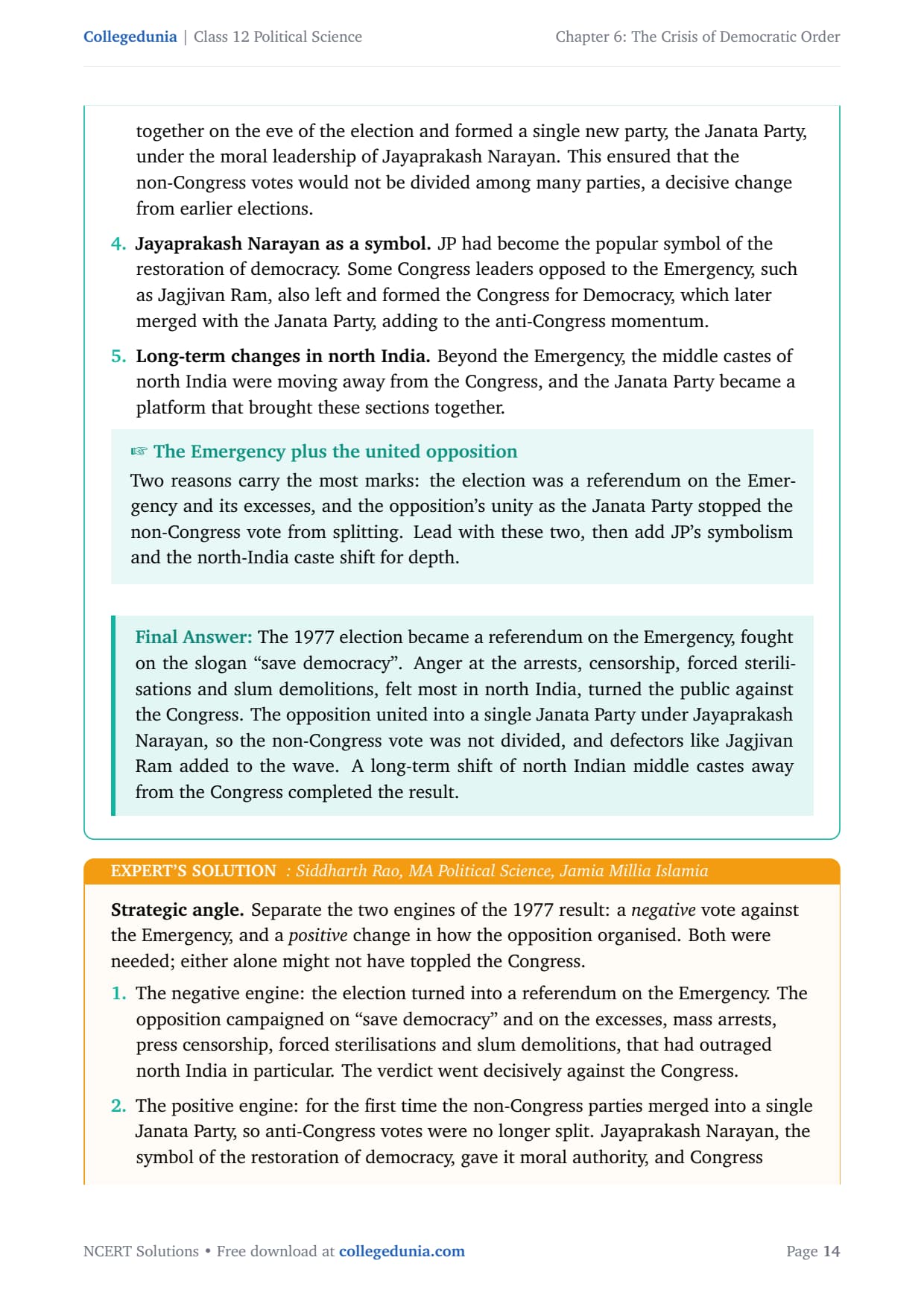
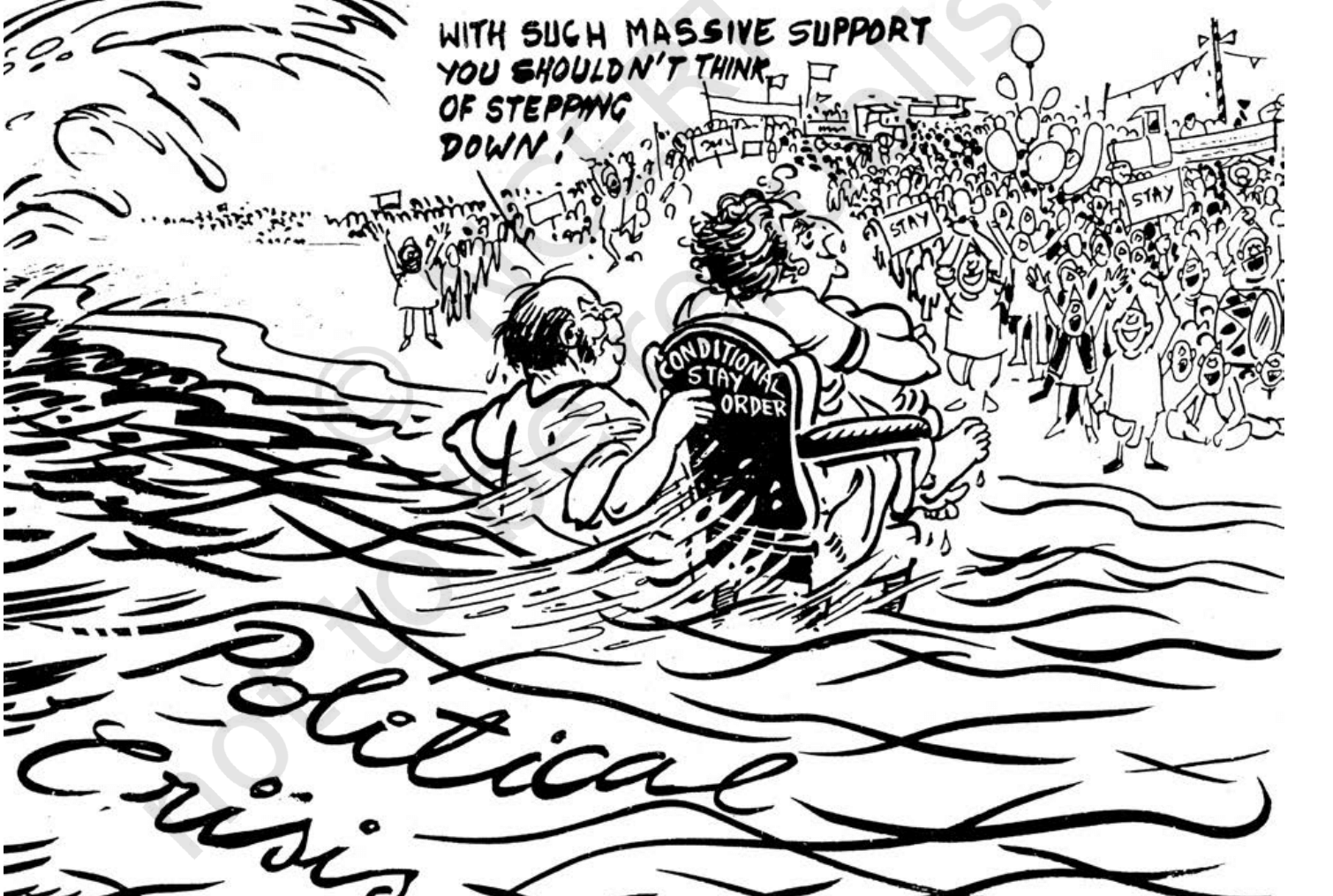
R. K. Laxman's cartoon (The Times
of India, 26 June 1975). NCERT, Politics in India Since Independence, Class 12,
Chapter 6. It appeared a few days before the declaration of Emergency; Congress
President D. K. Barooah carries Indira Gandhi on a ``conditional stay order''
through the ``political crisis'', capturing the confrontation the government cited
as its reason.
Concept used. This asks for the government's own stated reasons,
not whether they were justified. The Emergency was declared under Article
352 of the Constitution, which allows an emergency on the ground of an external
threat or a threat of internal disturbance. The government's reasons
centred on that internal-disturbance ground.
A threat of internal disturbance. On 25 June 1975 the government
declared that there was a threat of internal disturbances in the country
and, on that ground, invoked Article 352 of the Constitution. This was the
central reason it gave.
The opposition's call to defy the government. The government
pointed to the agitation led by Jayaprakash Narayan, who had announced a
nationwide satyagraha for Indira Gandhi's resignation and had asked the
army, the police and government employees not to obey ``illegal and immoral
orders''. The government argued that such appeals threatened to bring the
normal working of the government to a standstill.
A grave crisis needing special powers. The government claimed that
a grave crisis had arisen that made the proclamation of Emergency
necessary. It held that normal democratic functioning could not continue in
such conditions, so the special powers granted by an Emergency were needed
to restore order.
Reasons given versus reasons real
The chapter is careful to separate the reasons the government gave (internal
disturbance, the threat to public order) from the reasons critics saw (that
the real motive was to save Indira Gandhi's position after the Allahabad verdict).
The question asks only for the reasons the government gave, so answer that, but
knowing the distinction shows depth.
The government said there was a threat of internal disturbance and so
invoked Article 352 of the Constitution. It pointed to Jayaprakash Narayan's call
for a nationwide satyagraha and his appeal to the army, police and government
employees to disobey ``illegal and immoral orders'', arguing that this threatened
to paralyse the government. It claimed a grave crisis had arisen that made the
Emergency, with its special powers, necessary to maintain order.
VK
Vivaan Kapoor
MA International Relations, JNU
Verified Expert
Strategic angle. Keep strictly to what the government stated, and
organise it as legal ground plus the specific threat it pointed to. The legal hook
is Article 352; the specific threat is JP's call to the forces and employees to
disobey orders.
The legal ground: the government declared a threat of internal disturbance
and invoked Article 352, which permits an Emergency on grounds of external
threat or internal disturbance.
The specific danger cited: Jayaprakash Narayan's announcement of a
nationwide satyagraha for the Prime Minister's resignation and his appeal
to the army, the police and government servants not to obey ``illegal and
immoral orders'', which the government said would bring its functioning to
a standstill.
The conclusion drawn: a grave crisis had arisen in which normal democratic
politics could not function, so the special powers of an Emergency were
needed to restore order. Technically this fell within the government's
constitutional powers.
Why this matters. The deeper point is that the powers were technically
constitutional but were used for a political purpose, which is why the chapter
calls this both a constitutional and a political crisis. A strong answer reports
the government's stated reasons faithfully while signalling that the Constitution's
wide Emergency powers were open to exactly this kind of abuse.
Officially: a threat of internal disturbance, invoked under Article 352;
the danger posed by JP's call for satyagraha and his appeal to the army, police
and employees to disobey orders; and a claim that a grave crisis required the
Emergency's special powers to keep the government functioning.
Q 6.7
The 1977 elections for the first time saw the Opposition coming into
power at the Centre. What would you consider as the reasons for this development?
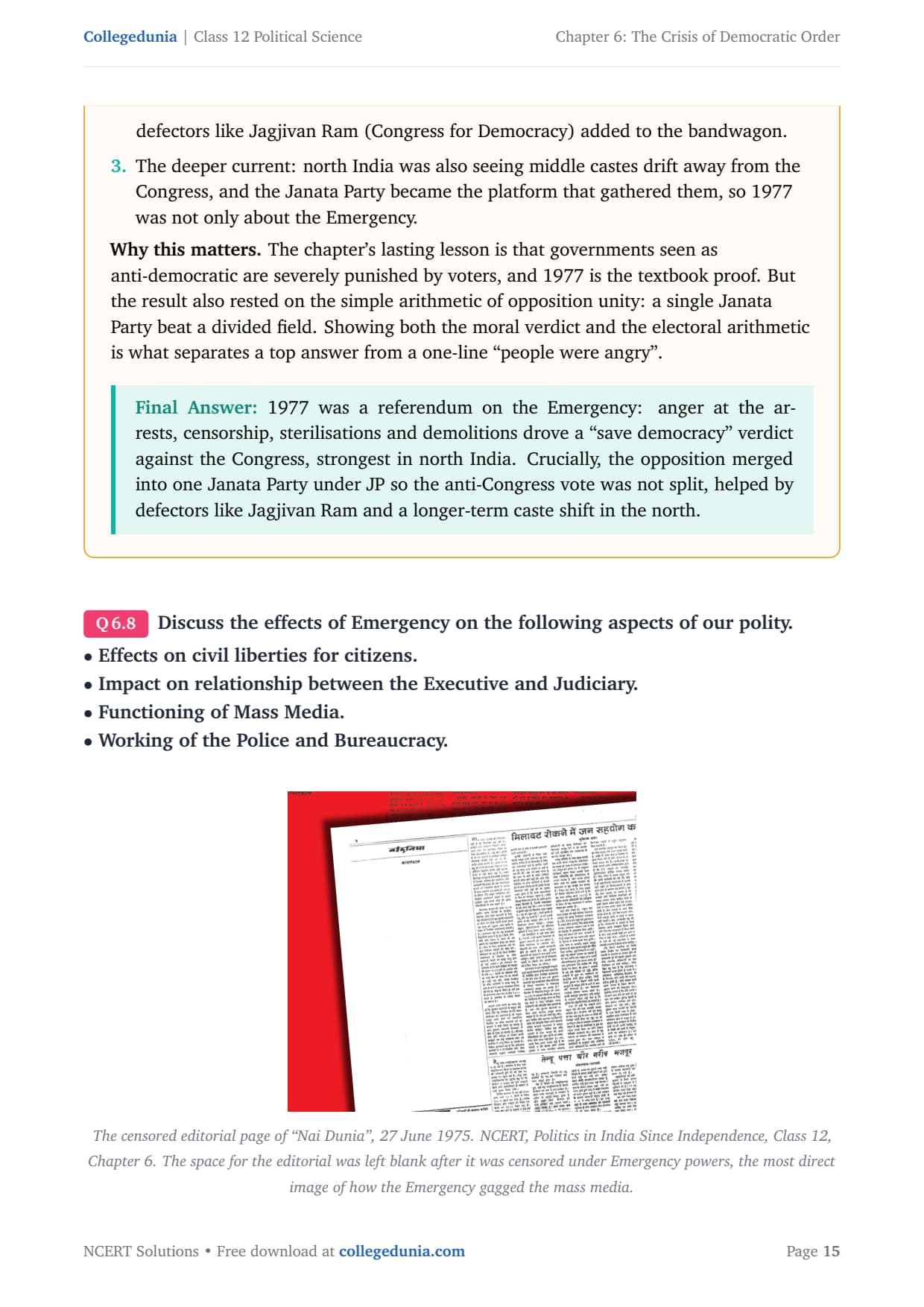
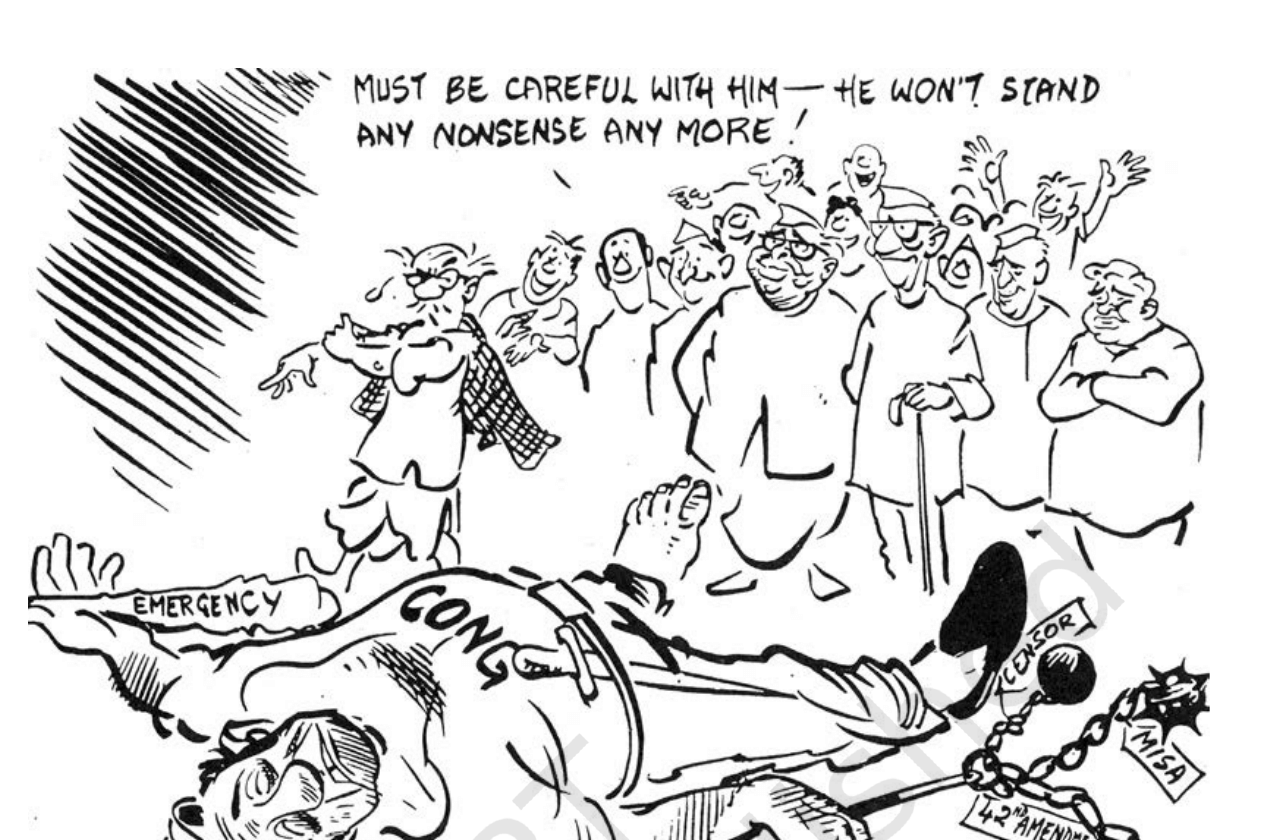
R. K. Laxman's cartoon (The Times of
India, 29 March 1977). NCERT, Politics in India Since Independence, Class 12,
Chapter 6. The common man stands tall while the ``Emergency'' lies defeated; the
opposition leaders, Jagjivan Ram, Morarji Desai, Charan Singh and Atal Behari
Vajpayee, gather behind him after the 1977 verdict.
Concept used. The question asks for the reasons the opposition defeated
the Congress for the first time in 1977. The chapter calls the 1977 election a
referendum on the Emergency: a vote in which the public passed its
verdict on the Emergency experience. Build the answer around that idea plus the
new unity of the opposition.
The election became a referendum on the Emergency. The opposition
fought the election on the slogan of ``save democracy'', and the campaign
focused on the non-democratic character of the Emergency rule. The people's
verdict was decisively against the Emergency.
Public anger at the excesses. The arrests of thousands of people,
the censorship of the press, and the forced sterilisations and slum
demolitions had turned public opinion sharply against the Congress,
especially in north India where the impact of the Emergency was felt most
strongly.
The opposition united as the Janata Party. The major opposition
parties came together on the eve of the election and formed a single new
party, the Janata Party, under the moral leadership of Jayaprakash Narayan.
This ensured that the non-Congress votes would not be divided among many
parties, a decisive change from earlier elections.
Jayaprakash Narayan as a symbol. JP had become the popular symbol
of the restoration of democracy. Some Congress leaders opposed to the
Emergency, such as Jagjivan Ram, also left and formed the Congress for
Democracy, which later merged with the Janata Party, adding to the
anti-Congress momentum.
Long-term changes in north India. Beyond the Emergency, the middle
castes of north India were moving away from the Congress, and the Janata
Party became a platform that brought these sections together.
The Emergency plus the united opposition
Two reasons carry the most marks: the election was a referendum on the Emergency
and its excesses, and the opposition's unity as the Janata Party stopped the
non-Congress vote from splitting. Lead with these two, then add JP's symbolism and
the north-India caste shift for depth.
The 1977 election became a referendum on the Emergency, fought on the
slogan ``save democracy''. Anger at the arrests, censorship, forced sterilisations
and slum demolitions, felt most in north India, turned the public against the
Congress. The opposition united into a single Janata Party under Jayaprakash
Narayan, so the non-Congress vote was not divided, and defectors like Jagjivan Ram
added to the wave. A long-term shift of north Indian middle castes away from the
Congress completed the result.
SR
Siddharth Rao
MA Political Science, Jamia Millia Islamia
Verified Expert
Strategic angle. Separate the two engines of the 1977 result: a
negative vote against the Emergency, and a positive change in how the
opposition organised. Both were needed; either alone might not have toppled the
Congress.
The negative engine: the election turned into a referendum on the
Emergency. The opposition campaigned on ``save democracy'' and on the
excesses, mass arrests, press censorship, forced sterilisations and slum
demolitions, that had outraged north India in particular. The verdict went
decisively against the Congress.
The positive engine: for the first time the non-Congress parties merged
into a single Janata Party, so anti-Congress votes were no longer split.
Jayaprakash Narayan, the symbol of the restoration of democracy, gave it
moral authority, and Congress defectors like Jagjivan Ram (Congress for
Democracy) added to the bandwagon.
The deeper current: north India was also seeing middle castes drift away
from the Congress, and the Janata Party became the platform that gathered
them, so 1977 was not only about the Emergency.
Why this matters. The chapter's lasting lesson is that governments seen
as anti-democratic are severely punished by voters, and 1977 is the textbook proof.
But the result also rested on the simple arithmetic of opposition unity: a single
Janata Party beat a divided field. Showing both the moral verdict and the electoral
arithmetic is what separates a top answer from a one-line ``people were angry''.
1977 was a referendum on the Emergency: anger at the arrests, censorship,
sterilisations and demolitions drove a ``save democracy'' verdict against the
Congress, strongest in north India. Crucially, the opposition merged into one
Janata Party under JP so the anti-Congress vote was not split, helped by defectors
like Jagjivan Ram and a longer-term caste shift in the north.
Q 6.8
Discuss the effects of Emergency on the following aspects of our
polity. [3pt]
• Effects on civil liberties for citizens. • Impact on relationship between the Executive and Judiciary. • Functioning of Mass Media. • Working of the Police and Bureaucracy.
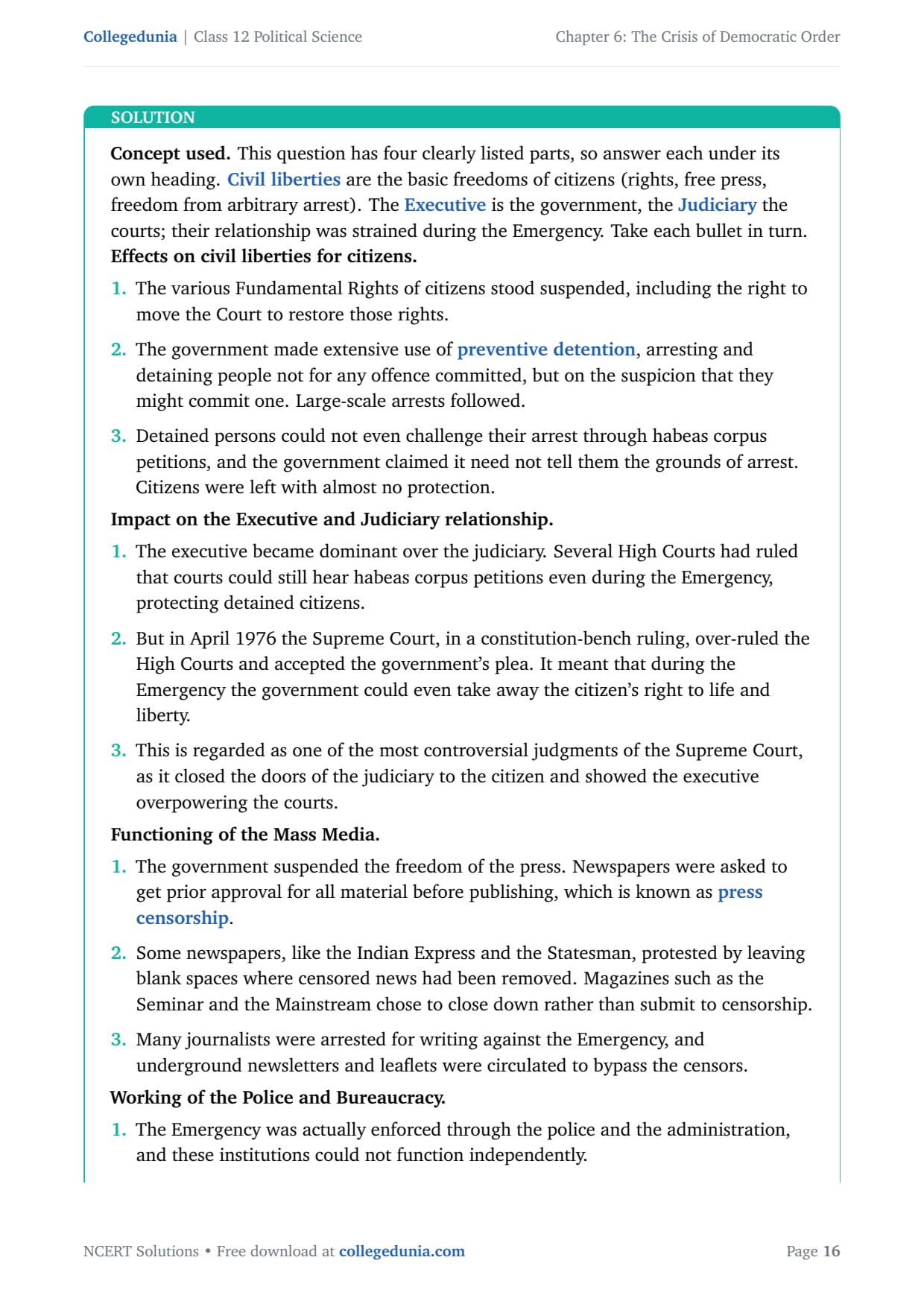
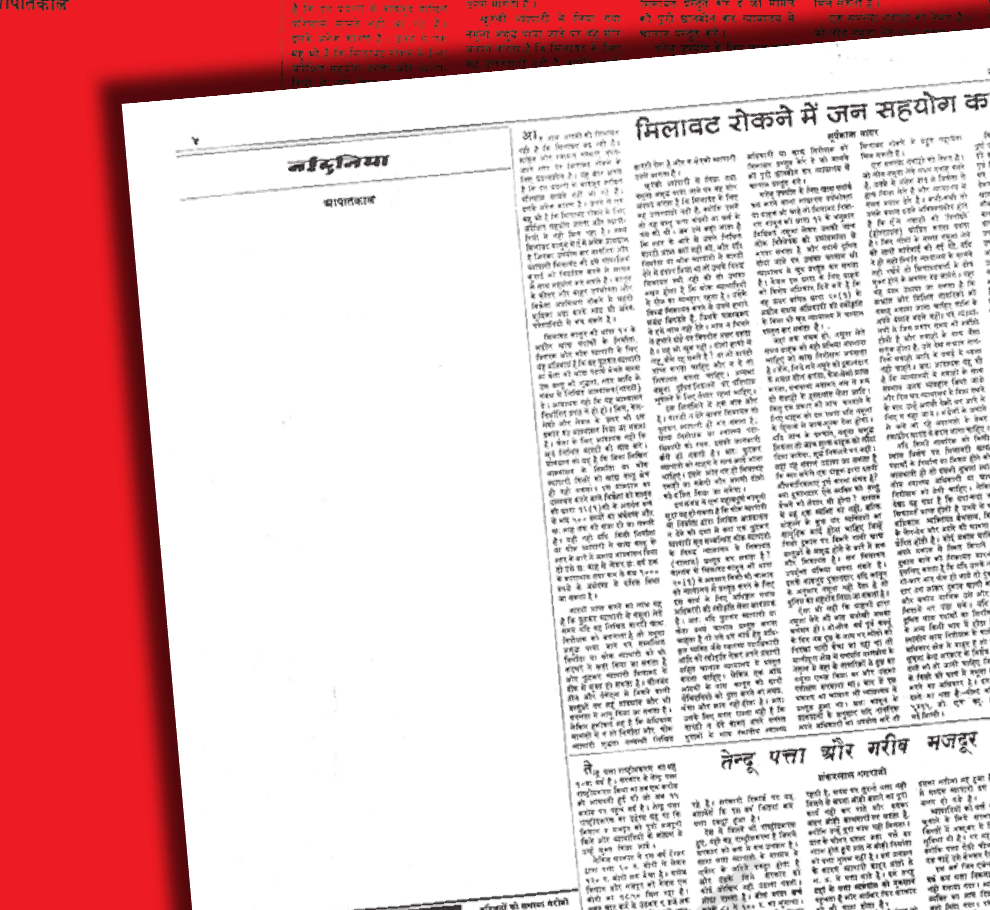
The censored editorial page of ``Nai Dunia'',
27 June 1975. NCERT, Politics in India Since Independence, Class 12, Chapter 6. The
space for the editorial was left blank after it was censored under Emergency
powers, the most direct image of how the Emergency gagged the mass media.
Concept used. This question has four clearly listed parts, so answer each
under its own heading. Civil liberties are the basic freedoms of
citizens (rights, free press, freedom from arbitrary arrest). The
Executive is the government, the Judiciary the courts; their
relationship was strained during the Emergency. Take each bullet in turn.
Effects on civil liberties for citizens.
The various Fundamental Rights of citizens stood suspended, including the
right to move the Court to restore those rights.
The government made extensive use of preventive detention,
arresting and detaining people not for any offence committed, but on the
suspicion that they might commit one. Large-scale arrests followed.
Detained persons could not even challenge their arrest through habeas
corpus petitions, and the government claimed it need not tell them the
grounds of arrest. Citizens were left with almost no protection.
Impact on the Executive and Judiciary relationship.
The executive became dominant over the judiciary. Several High Courts had
ruled that courts could still hear habeas corpus petitions even during the
Emergency, protecting detained citizens.
But in April 1976 the Supreme Court, in a constitution-bench ruling,
over-ruled the High Courts and accepted the government's plea. It meant
that during the Emergency the government could even take away the citizen's
right to life and liberty.
This is regarded as one of the most controversial judgments of the Supreme
Court, as it closed the doors of the judiciary to the citizen and showed
the executive overpowering the courts.
Functioning of the Mass Media.
The government suspended the freedom of the press. Newspapers were asked to
get prior approval for all material before publishing, which is known as
press censorship.
Some newspapers, like the Indian Express and the Statesman, protested by
leaving blank spaces where censored news had been removed. Magazines such
as the Seminar and the Mainstream chose to close down rather than submit to
censorship.
Many journalists were arrested for writing against the Emergency, and
underground newsletters and leaflets were circulated to bypass the censors.
Working of the Police and Bureaucracy.
The Emergency was actually enforced through the police and the
administration, and these institutions could not function independently.
According to the Shah Commission Report, the administration and the police
became vulnerable to political pressures. They were turned into political
instruments of the ruling party rather than neutral public servants.
This problem, the chapter stresses, did not vanish even after the Emergency
ended.
Answer all four bullets
The commonest way to lose marks here is to write a long account of one or two
bullets and skip the rest. The question lists four aspects; give a short, separate
paragraph for each, civil liberties, executive-judiciary, mass media, and police
and bureaucracy.
Civil liberties: fundamental rights were suspended and mass preventive
detention left citizens unable to challenge their arrest. Executive and Judiciary:
the executive dominated; the April 1976 Supreme Court ruling over-ruled the High
Courts and let the government suspend even the right to life and liberty, one of
its most controversial judgments. Mass media: press freedom was suspended through
censorship, some papers left blank spaces or closed, and journalists were arrested.
Police and Bureaucracy: they enforced the Emergency, lost their independence, and,
per the Shah Commission, became political instruments of the ruling party.
NJ
Neha Joshi
MA Political Science, University of Delhi
Verified Expert
Structural observation. The question gives you the structure, so use it:
four mini-answers, one per bullet, each with one or two concrete examples from the
text. Examiners award marks bullet by bullet, so balance the length across all four.
Civil liberties: fundamental rights, including the right to approach the
Court, stood suspended; preventive detention was used on a large scale
against people who had committed no offence; detainees could not file
habeas corpus or even learn the grounds of their arrest.
Executive versus Judiciary: the executive prevailed. High Courts had tried
to keep habeas corpus alive during the Emergency, but in April 1976 the
Supreme Court over-ruled them and accepted that the government could suspend
even the right to life and liberty, a judgment widely seen as the Court's
most controversial.
Mass media: press freedom was suspended through prior censorship.
Newspapers had to get approval before publishing, so some protested with
blank editorial spaces (the Indian Express, the Statesman and the Nai Dunia
editorial of 27 June 1975), magazines like the Seminar and the Mainstream
chose to close down rather than submit, and many journalists were arrested
for writing against the Emergency.
Police and bureaucracy: these were the institutions that actually enforced
the Emergency, and they could not act independently. According to the Shah
Commission, they became vulnerable to political pressures and were turned
into political instruments of the ruling party rather than neutral public
servants, a problem the chapter says did not vanish once the Emergency ended.
Why this matters. Taken together, the four effects show why the chapter
calls the Emergency both a constitutional and a political crisis: every institution
meant to check power, the courts, the press, the bureaucracy and the police, was
either silenced or bent to the executive. The deeper warning is that the
Constitution's own wide Emergency powers made this possible, so the safeguard
against repetition is not just better laws but a citizenry and institutions that
value civil liberties. The lasting lesson is that the Emergency made everyone more
aware of that value, and the courts later took a more active role in protecting it,
while new civil-liberties organisations grew up to guard it.
Civil liberties were suspended and preventive detention left citizens
defenceless; the executive overpowered a yielding judiciary (the April 1976
Supreme Court ruling); the press was censored, with blank spaces, closures and
arrests; and the police and bureaucracy lost independence and became, per the Shah
Commission, instruments of the ruling party.
Q 6.9
In what way did the imposition of Emergency affect the party system in
India? Elaborate your answer with examples.
Concept used. The party system is the pattern of how parties
compete and share power in a country. Before 1977 India had a system of Congress
dominance. The question asks how the Emergency, and the 1977 election that
followed, changed that pattern. Explain the shift with named examples.
The end of Congress dominance at the Centre. For the first time
since Independence, the Congress was defeated in the 1977 Lok Sabha
elections. It won only 154 seats and its share of the popular vote fell
below 35 per cent. The long era of one-party dominance was broken.
The rise of a united opposition: the Janata Party. The Emergency
pushed the scattered opposition parties to unite. On the eve of the 1977
election they merged into a single Janata Party, which won 295 seats, and
with its allies took 330 of the 542 seats. A credible non-Congress
alternative now existed at the Centre.
A brief two-party-like phase. Indian democracy came close to a
two-party system in 1977, the Congress on one side and the Janata Party on
the other. The chapter notes this was the nearest India had come to such a
pattern.
The Congress changed its own character. From 1969 the Congress
had been shedding its character as an ``umbrella party'' that
accommodated many viewpoints. It now identified with a particular
ideology, claiming to be the only socialist and pro-poor party, and leaned
on the appeal of one leader, Indira Gandhi. Other parties responded by
relying on ``non-Congressism''.
The rise of backward-caste politics. The 1977 results were partly
due to a shift of the backward castes of north India. After 1977 the issue
of reservations for ``other backward classes'' grew, and the Mandal
Commission was appointed by the Janata government, a lasting change in the
party system.
Give numbers and named parties
``The Emergency changed the party system'' is too vague. Anchor it with concrete
examples: Congress reduced to 154 seats, the Janata Party's 295 seats, the brief
two-party-like phase, and the rise of backward-caste politics and the Mandal
Commission. Examples turn a general claim into a marked answer.
The Emergency broke the long Congress dominance: in 1977 the Congress
lost for the first time, falling to 154 seats and under 35 per cent of the vote.
The scattered opposition united into the Janata Party (295 seats, 330 with allies),
creating a real non-Congress alternative and a brief two-party-like phase. The
Congress had also changed from an umbrella party into an ideology-and-leader-based
party, prompting others to rely on ``non-Congressism''. After 1977 backward-caste
politics rose, leading to the Mandal Commission.
MD
Mehul Desai
MA Political Science, University of Hyderabad
Verified Expert
Strategic angle. Show the change on three levels: who held power (Congress
dominance ends), how parties lined up (a united opposition and a near two-party
phase), and what new force entered politics (backward-caste mobilisation). Pin a
fact to each level.
Power changes hands: the Congress was defeated at the Centre for the first
time in 1977, reduced to 154 seats and under 35 per cent of the vote, ending
the era of one-party dominance.
The line-up changes: the Emergency forced the opposition to merge into the
Janata Party, which won 295 seats (330 with allies), so India briefly looked
like a two-party system, Congress versus Janata. Meanwhile the Congress
itself had stopped being an umbrella party and had become an
ideology-driven, leader-centred party, pushing rivals towards
``non-Congressism''.
A new force enters: the 1977 verdict drew partly on a shift of north Indian
backward castes, and the welfare of the ``other backward classes'' became a
major issue, leading the Janata government to appoint the Mandal Commission,
a permanent change in the texture of party competition.
Why this matters. The Emergency is a hinge in the story of India's party
system. It ended Congress dominance, created the habit of opposition unity against
the Congress, and opened the door to the backward-caste politics that would reshape
the 1980s and 1990s. Linking the short-term shock (1977) to the long-term change
(Mandal) is exactly the elaboration the question asks for.
The Emergency ended Congress dominance (Congress fell to 154 seats in
1977), forced the opposition to unite as the Janata Party (295 seats) and produced
a brief two-party-like phase. The Congress had itself become an ideology- and
leader-centred party, spurring ``non-Congressism'', and the post-1977 rise of
backward-caste politics, leading to the Mandal Commission, reshaped the party
system for good.
Q 6.10
Read the following passage and answer the questions below:
``Indian democracy was never so close to a two-party system as it was during the
1977 elections. However, the next few years saw a complete change. Soon after its
defeat, the Indian National Congress split into two groups The Janata
Party also went through major convulsions '' (David Butler, Ashok
Lahiri and Prannoy Roy, quoted by Partha Chatterjee) [3pt]
(a) What made the party system in India look like a two-party system in 1977?
(b) Many more than two parties existed in 1977. Why then are the authors
describing this period as close to a two-party system?
(c) What caused splits in Congress and the Janata parties?
Concept used. This is a passage-based question. Read the passage closely
and answer each part using both the passage and the chapter. A two-party
system is one in which two major parties dominate and alternate in power. The
passage says 1977 came close to this, then broke down.
(a) What made the party system look like a two-party system in 1977.
On the eve of the election, the major non-Congress opposition parties
merged into a single party, the Janata Party. So the main contest narrowed
to two big camps: the Congress on one side and the Janata Party on the
other.
Because the opposition fought as one bloc rather than many separate
parties, the election looked like a straight, two-sided fight, which is why
it resembled a two-party system.
(b) Why it is called ``close to'' a two-party system despite many parties.
Many more than two parties did exist in 1977. The Janata Party was not a
single, unified party but a merger of several different parties and groups
that kept their own identities.
So India had not truly become a two-party system; it only looked
like one because the many opposition groups had temporarily come together
to face the Congress. That is why the authors say ``close to'', not ``a''
two-party system.
(c) What caused the splits in the Congress and the Janata parties.
The Janata Party split because it was a hurried merger of many
groups with different ideologies and no common programme. Once their shared
opposition to the Emergency faded, the lack of unity, direction and
leadership, plus the power struggle among Morarji Desai, Charan Singh and
Jagjivan Ram, pulled it apart.
The Congress split as it changed its character. Since 1969 it had
been shedding its umbrella character and identifying with one ideology and
one leader, Indira Gandhi. After its 1977 defeat these internal differences
broke it into two groups.
Use the passage and the chapter together
Part (a) and (b) come from reading the passage carefully; part (c) needs the
chapter's account of why both parties were fragile, the Janata Party's hurried
merger and the Congress's shift to a one-leader party. Combining the two sources is
what earns full marks on a passage question.
(a) The opposition merged into a single Janata Party, so the contest
became Congress versus Janata, a two-sided fight. (b) It only looked two-party:
the Janata Party was itself a merger of many parties that kept their identities, so
India had not truly become a two-party system, only come ``close'' to one. (c) The
Janata Party split because it was a hurried merger with no common programme and a
power struggle once anti-Emergency unity faded; the Congress split because it had
become a one-ideology, one-leader party and broke into two groups after its 1977
defeat.
IP
Ishaan Pillai
MA International Relations, Jadavpur University
Verified Expert
Strategic angle. Treat the three parts as ``appearance'', ``reality'' and
``cause''. (a) why it looked two-party, (b) why that look was only skin-deep, and
(c) why both blocs then cracked. Keep the passage in view for the first two and the
chapter for the third.
Appearance (a): on the eve of the poll the opposition combined into one
Janata Party, which then won 295 seats (330 with allies), so the field
reduced to two big contestants, Congress against Janata, the look of a
two-party contest in which one big bloc could replace the other.
Reality (b): that single Janata Party was really a coalition of many parties
with their own identities (the old Congress (O), the Bharatiya Jana Sangh,
the Bharatiya Lok Dal, the Socialists and others), so India had not become a
genuine two-party system; it had only come ``close'' to one for a single
election, because the rivals had merged for that contest alone.
Cause (c): the Janata Party split because it lacked a common programme and
was riven by the Desai, Charan Singh and Jagjivan Ram rivalry once the
anti-Emergency glue dissolved, and the government fell in under 28 months;
the Congress split because, having become a one-ideology, one-leader party
since 1969, it fractured after the shock of its 1977 defeat.
Why this matters. The passage captures a deep truth about Indian politics:
opposition unity against the Congress was real enough to win an election but too
shallow to survive governing. The ``two-party'' look of 1977 was a coalition of
convenience, which is why it dissolved within a few years and the Congress returned
in 1980. Seeing the gap between the appearance (one big rival bloc) and the reality
(a fragile merger of many parties) is the heart of a strong passage answer, and it
explains why India did not in fact settle into a lasting two-party system.
(a) The merger of the opposition into one Janata Party made it a
Congress-versus-Janata contest. (b) The Janata Party was itself a merger of many
parties, so it only resembled, and did not become, a two-party system. (c) The
Janata Party split over its lack of a common programme and its leadership struggle;
the Congress split after 1977 because it had become a one-ideology, one-leader
party.
FAQs on The Crisis of Democratic Order Class 12 NCERT Solutions
The Crisis of Democratic Order Class 12 Political Science Common Questions
Ques. Where can I get the class 12 political science chapter 6 NCERT Solutions PDF?
Ans. You can download the The Crisis of Democratic Order Class 12 Political Science NCERT Solutions PDF directly from this page. It is free, follows the 2026-27 NCERT, and answers all 10 exercise questions step by step.
Ques. How many questions are there in The Crisis of Democratic Order class 12 questions and answers?
Ans. The chapter has 10 exercise questions. The first three are correct or incorrect, odd one out and match-the-following items, while Questions 4 to 10 are short and long written answers, including a passage-based question on the 1977 election.
Ques. Why was the Emergency declared in 1975?
Ans. The government declared the Emergency on 25 June 1975 under Article 352 on the ground of a threat of internal disturbance. The immediate trigger was the Allahabad High Court verdict against Indira Gandhi and the opposition's call for her to resign, set against the unrest of 1974 to 1975.
Ques. What were the main effects of the Emergency?
Ans. Fundamental rights were suspended and leaders were jailed without trial, the press was censored, the executive grew very powerful while the courts were curbed, and the police and bureaucracy carried out excesses such as forced sterilisation and slum demolitions.
Ques. Why did the Congress lose the 1977 election?
Ans. The 1977 election became a referendum on the Emergency. Voters, especially in the north, turned against the Congress because of the Emergency's excesses, and the opposition united as the Janata Party. The Congress was defeated for the first time since 1947, winning only 154 seats.
Ques. Is class 12 political science chapter 6 easy to score in the board exam?
Ans. Yes. It is one of the easier scoring chapters if you keep the dates straight and give a balanced view on the Emergency. Practise the match and odd-one-out items and keep the effects-of-Emergency list and the 1977 reasons ready for the long answers.








Comments