




NCERT Handwritten Notes for Class 11 Entrepreneurship Chapter 1 Entrepreneurship: Concept and Functions help students revise the meaning of entrepreneurship, entrepreneur traits, enterprise formation, functions and the need for entrepreneurship in the 2026-27 syllabus.
- Resource: Class 11 Entrepreneurship Chapter 1 handwritten revision notes PDF.
- Chapter focus: entrepreneur, entrepreneurship, enterprise, innovation, risk-taking and functions.
- Revision use: quick definitions, NCERT examples, function groups and answer frames.
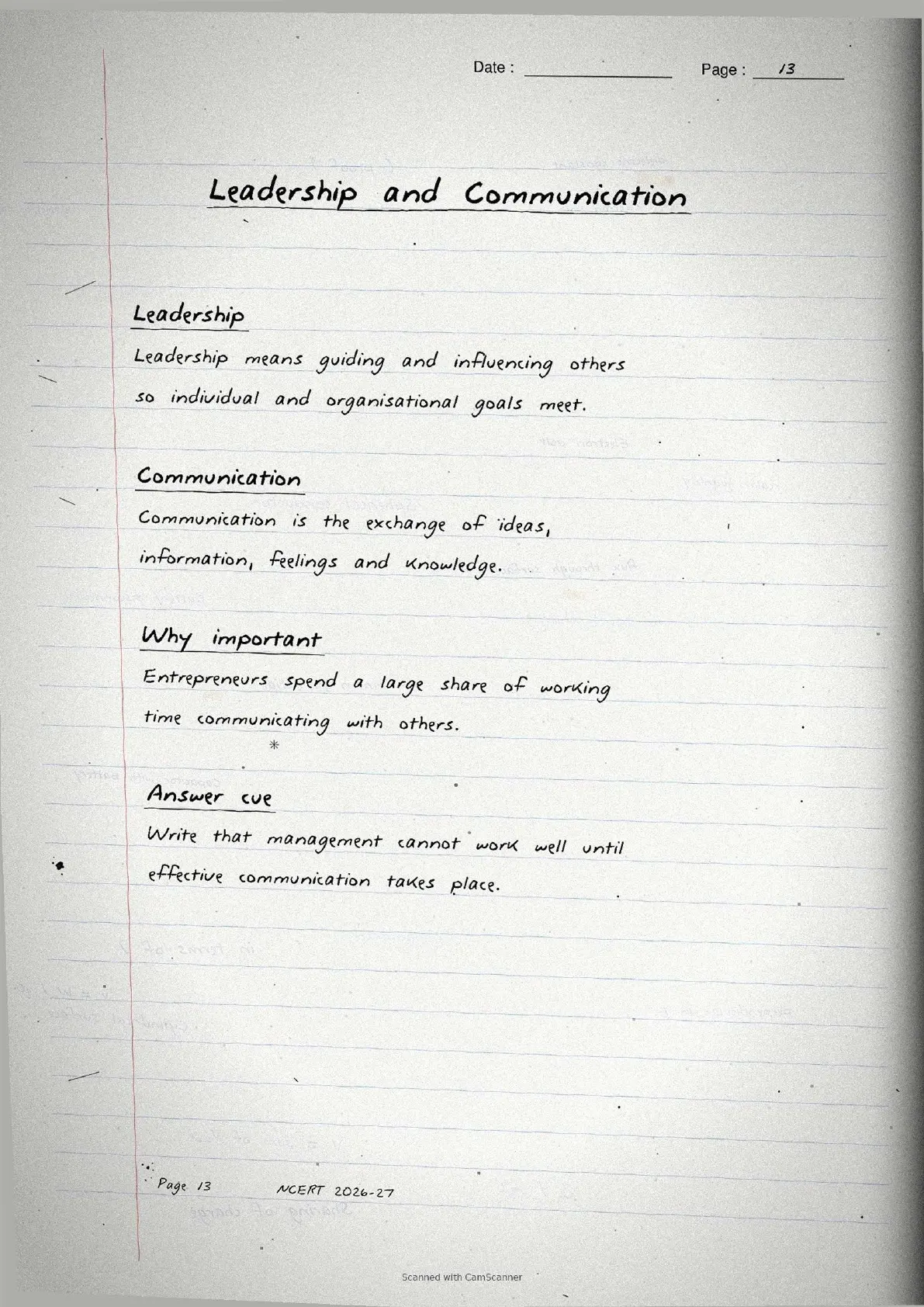
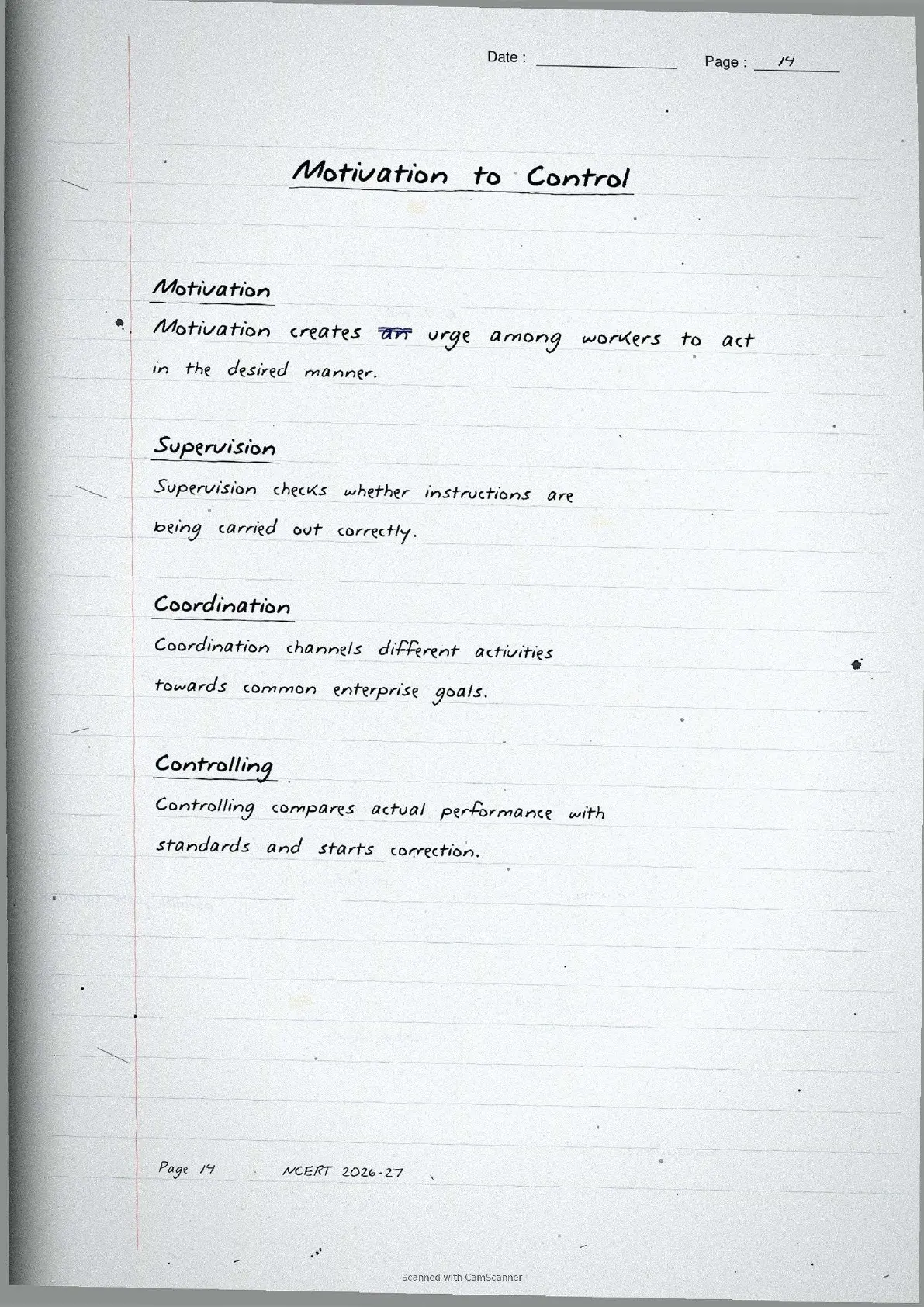
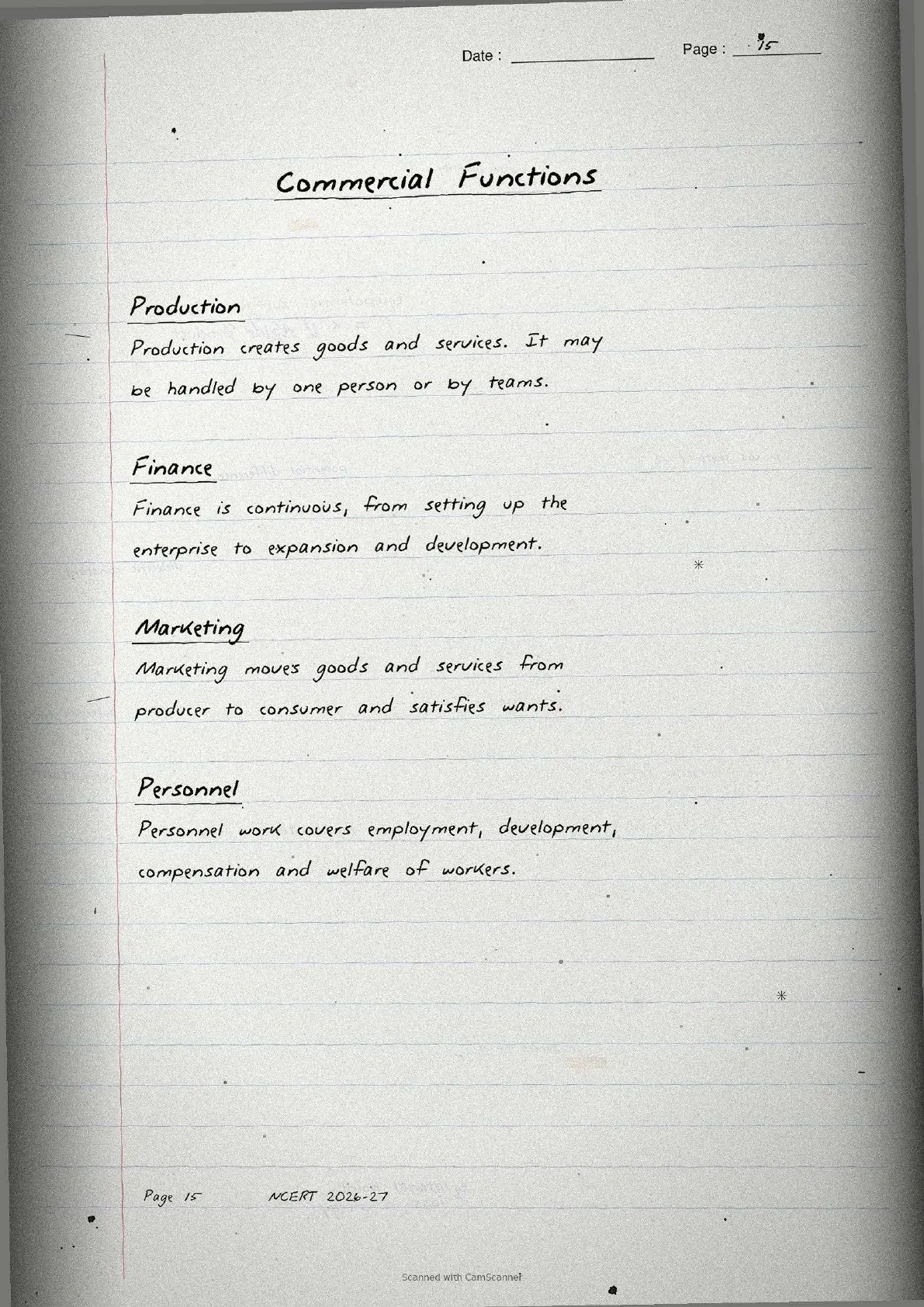
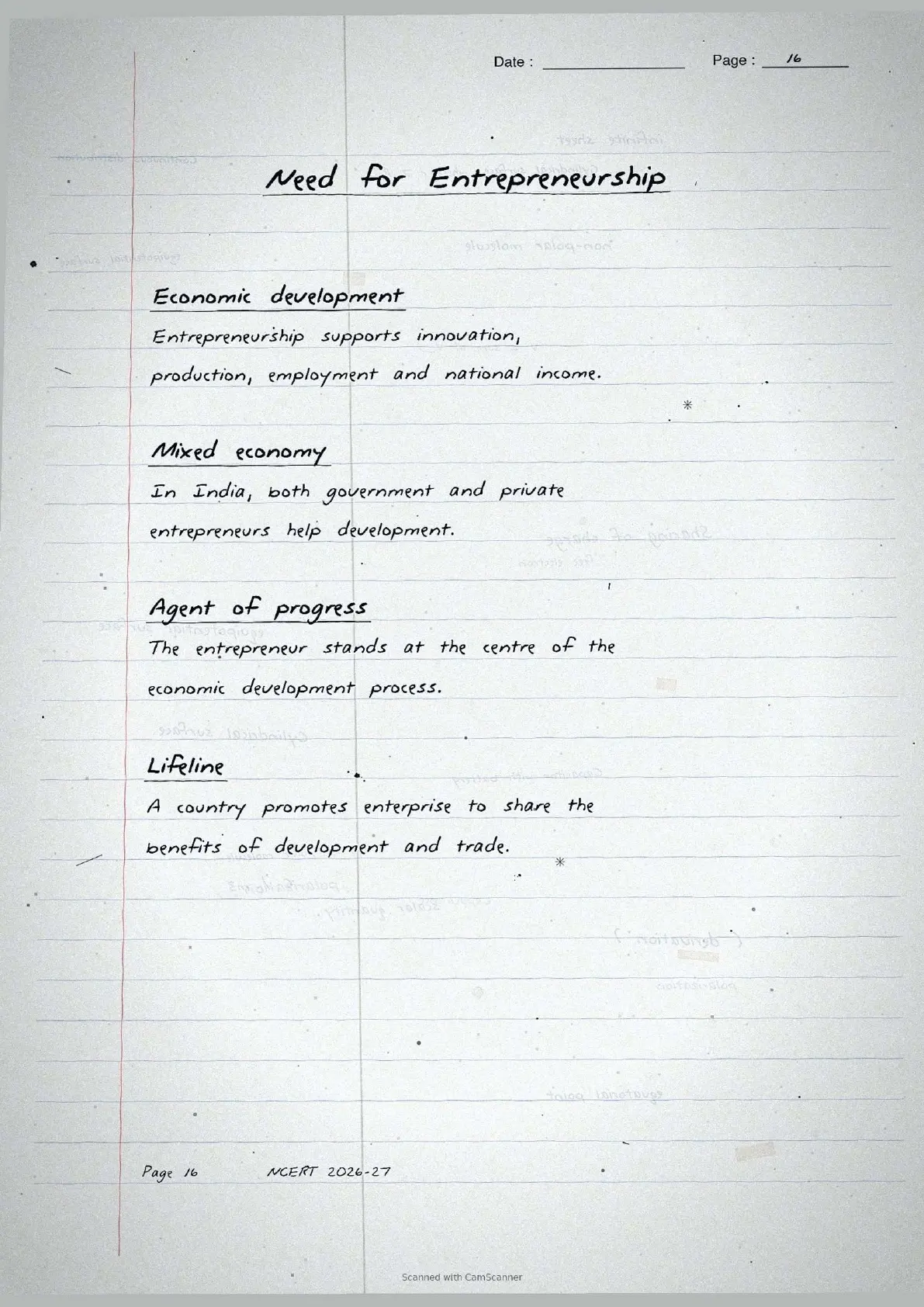
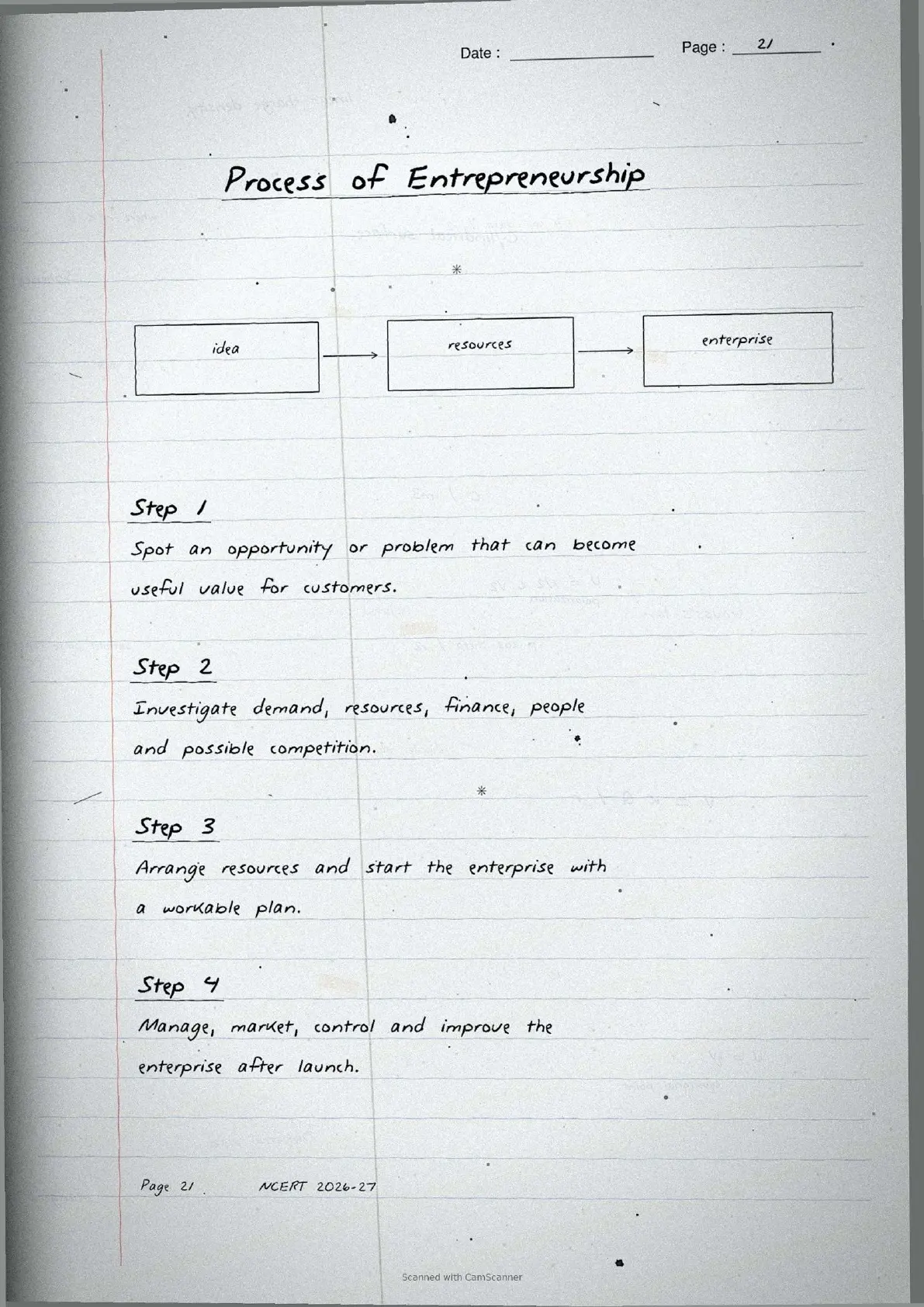
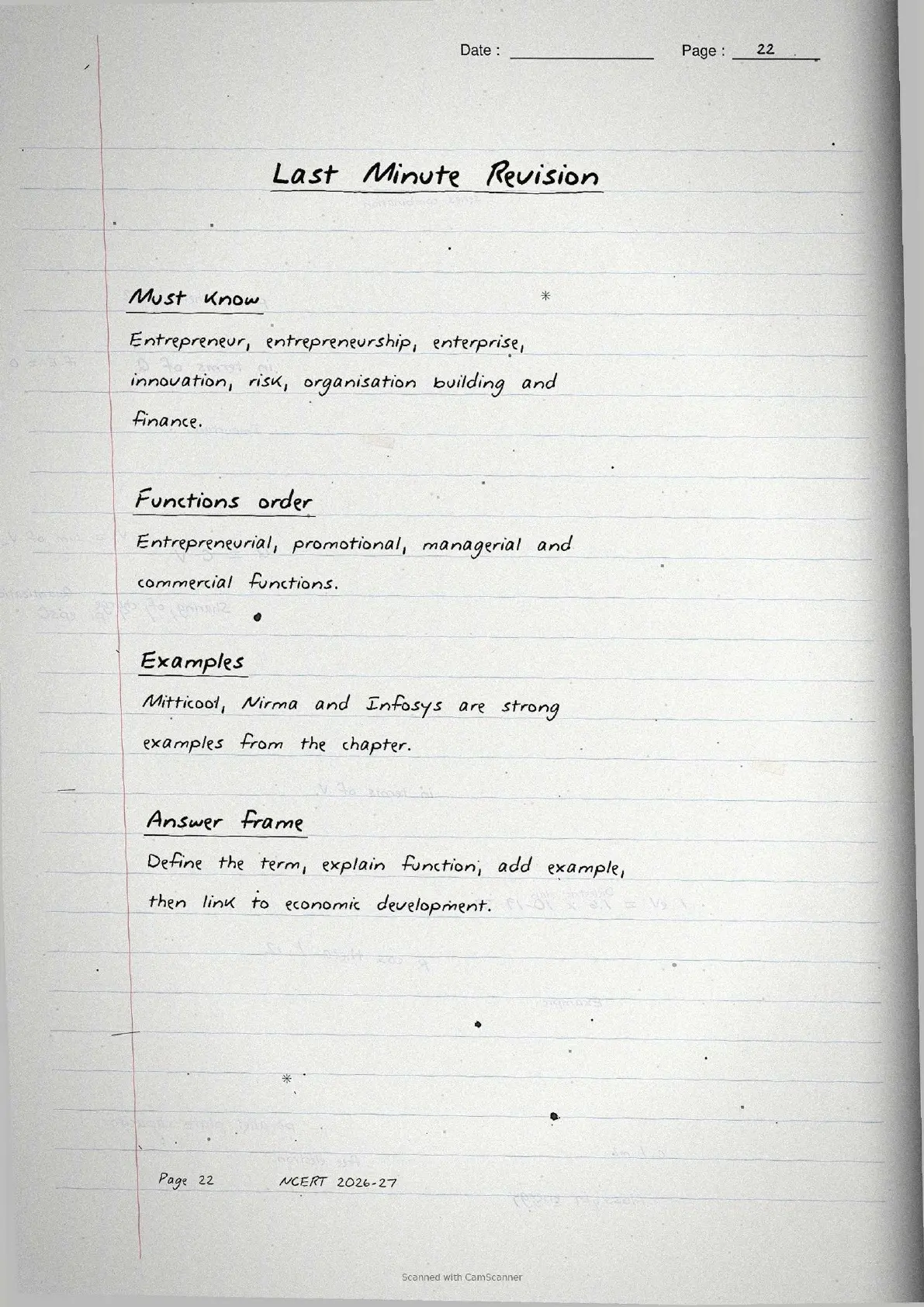
Student Feedback: Students usually revise this chapter faster when they keep the person, process and outcome difference clear before learning the functions.
Entrepreneurship Concept and Functions Overview
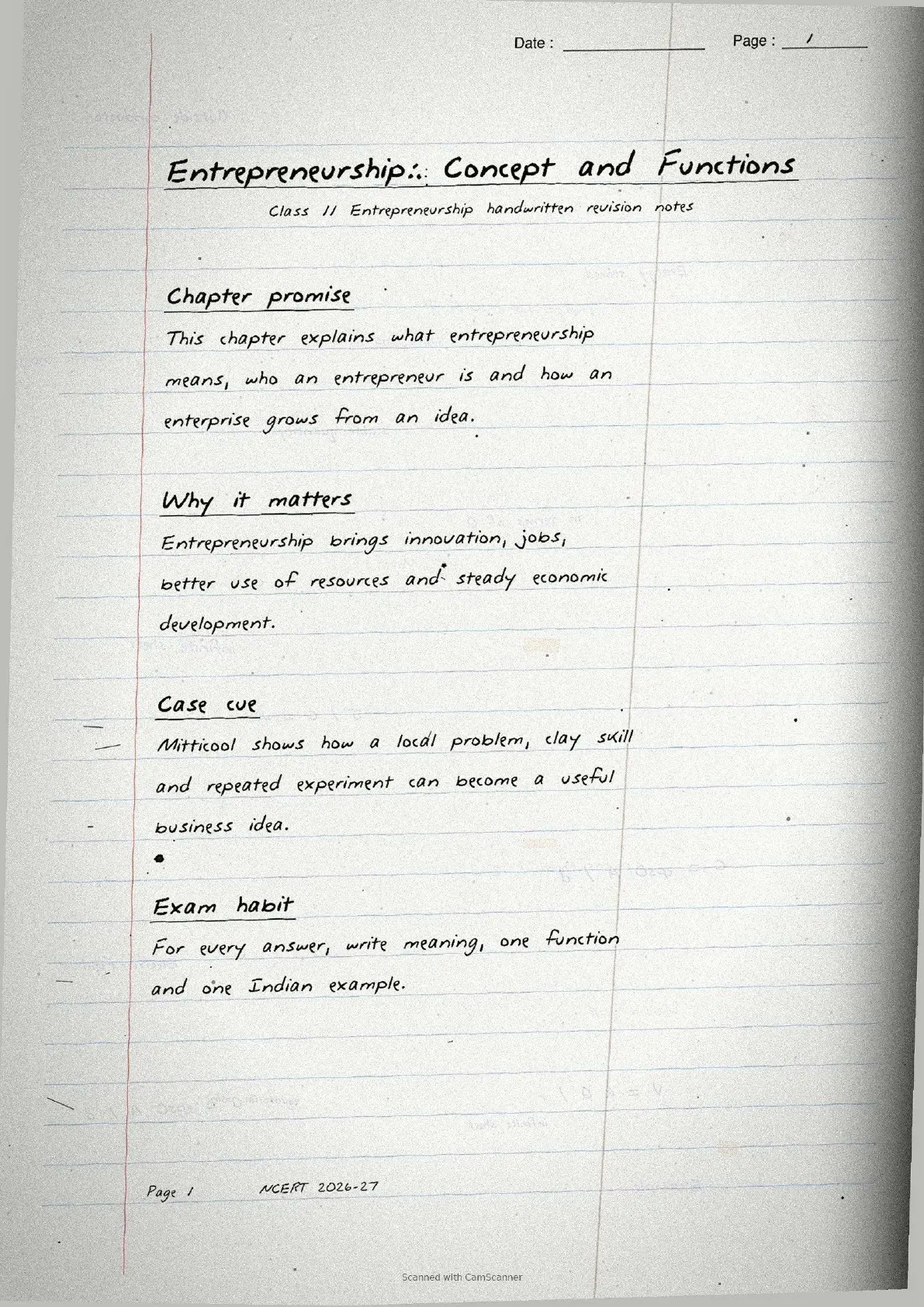
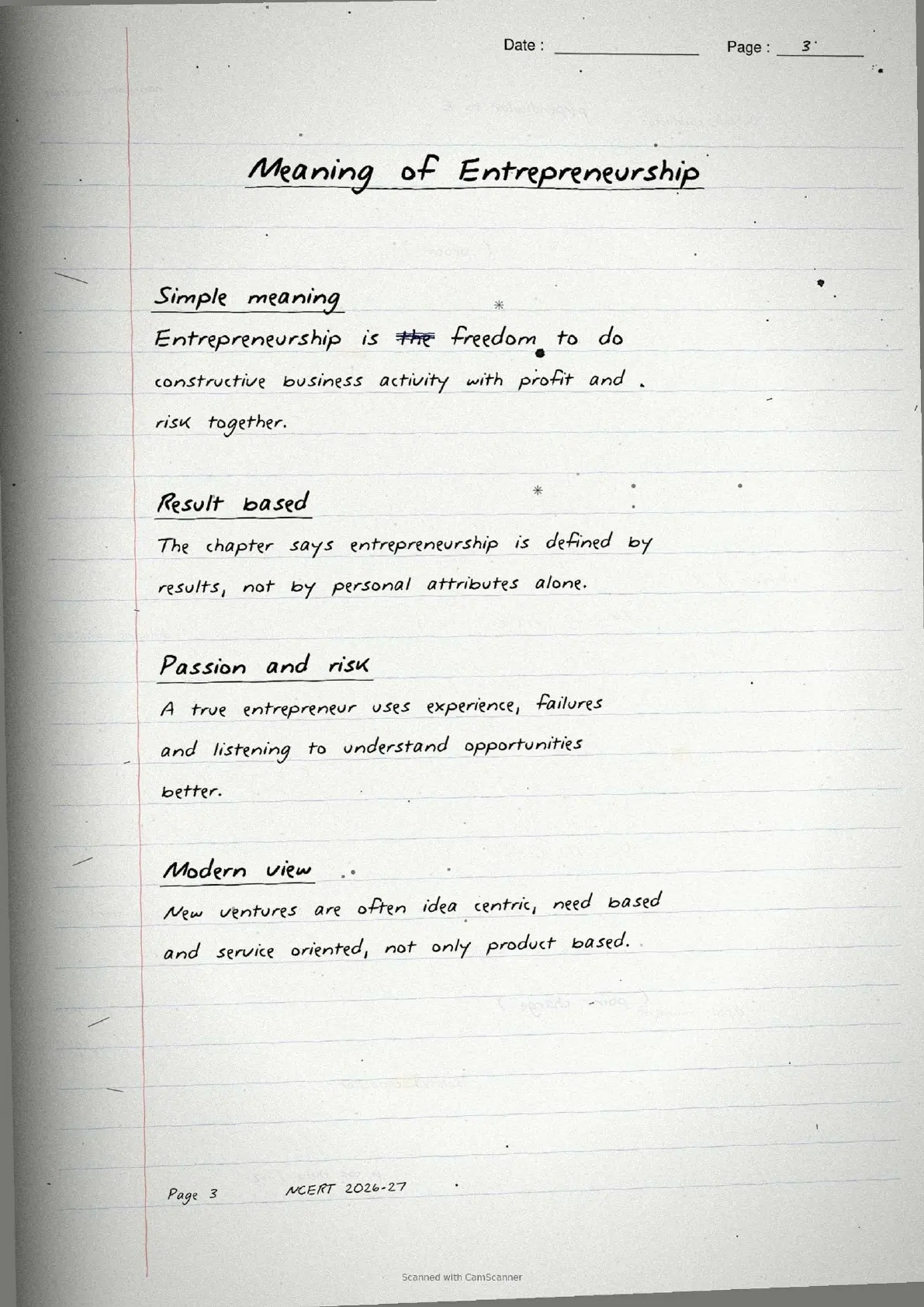
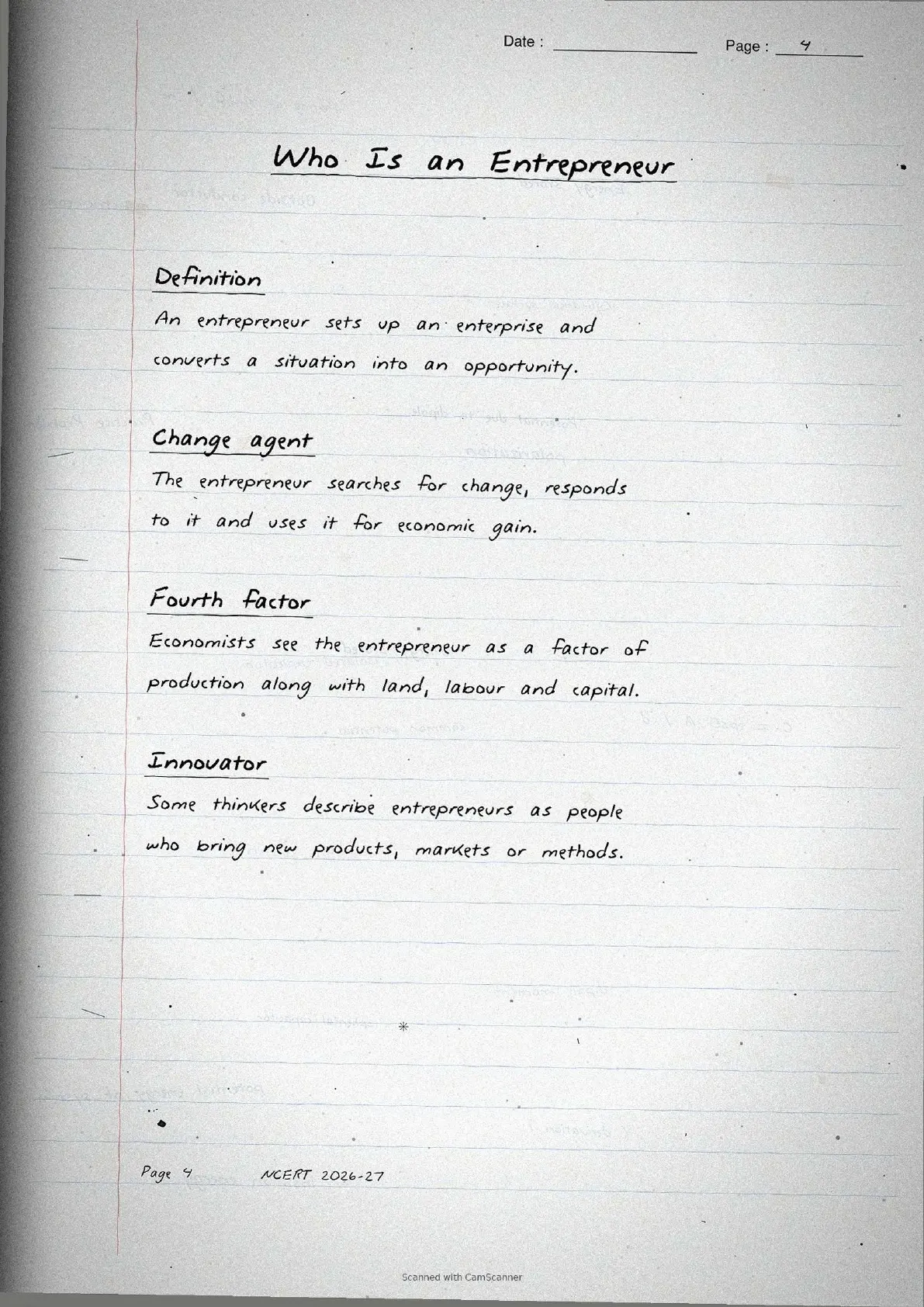
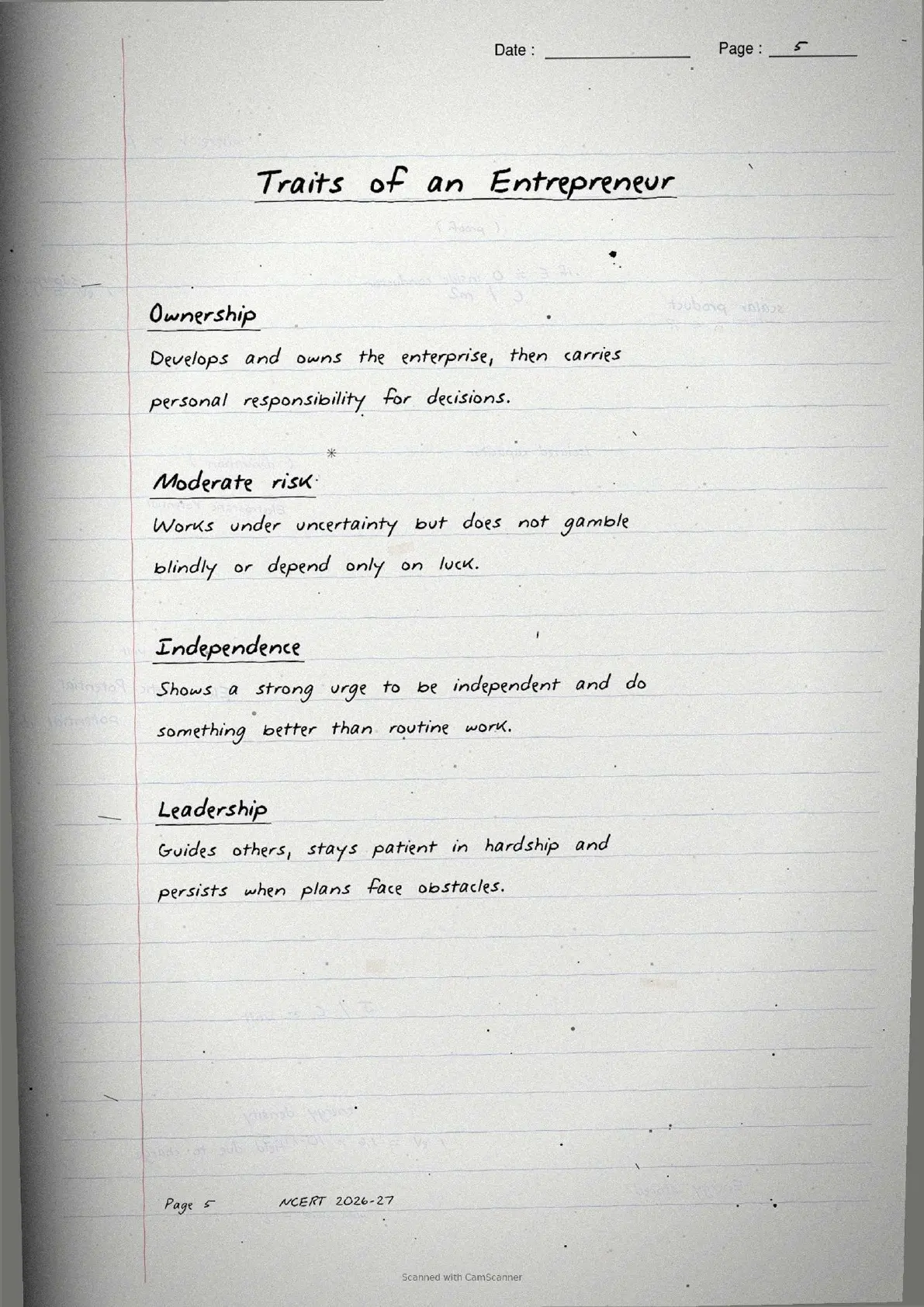
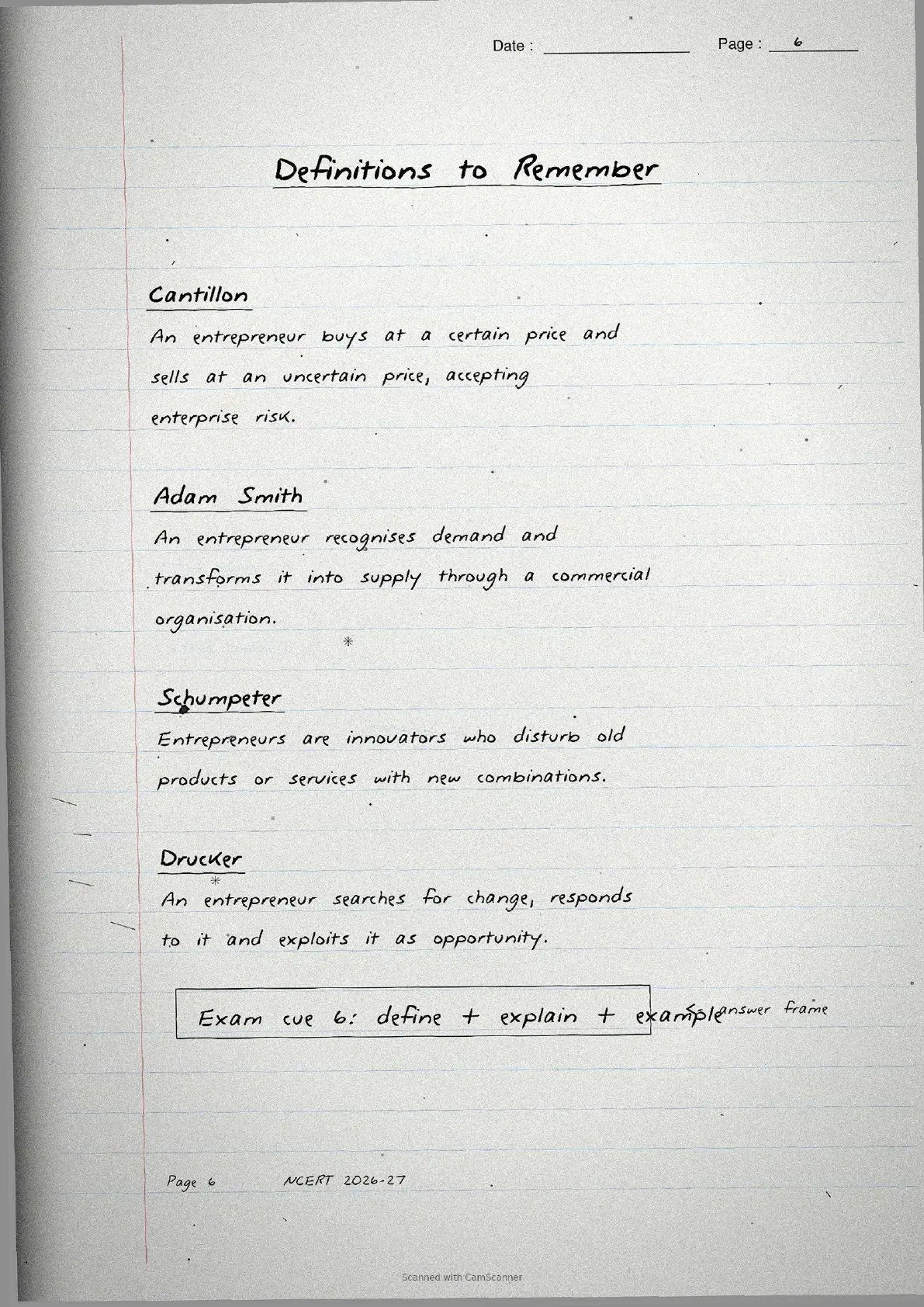
Class 11 Entrepreneurship Chapter 1 explains entrepreneurship as a result-oriented process that turns ideas, risks and resources into an enterprise. The handwritten notes keep the chapter in short revision pages so students can revise definitions, thinkers and functions quickly.
The chapter also uses Indian examples such as Mitticool, Nirma and Infosys to show that enterprise can grow from local needs, careful investigation and persistence.
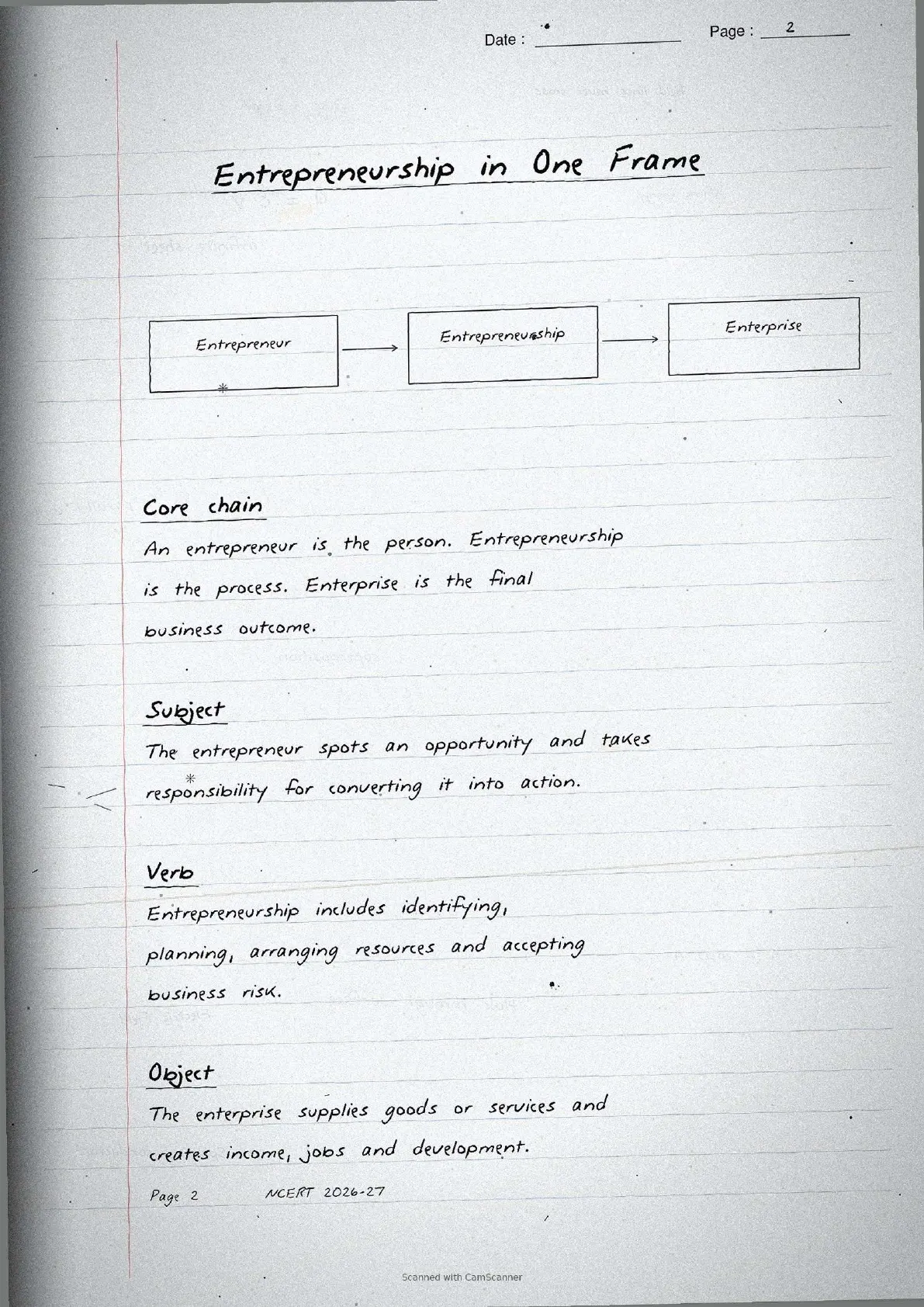
Entrepreneurship Concept Map
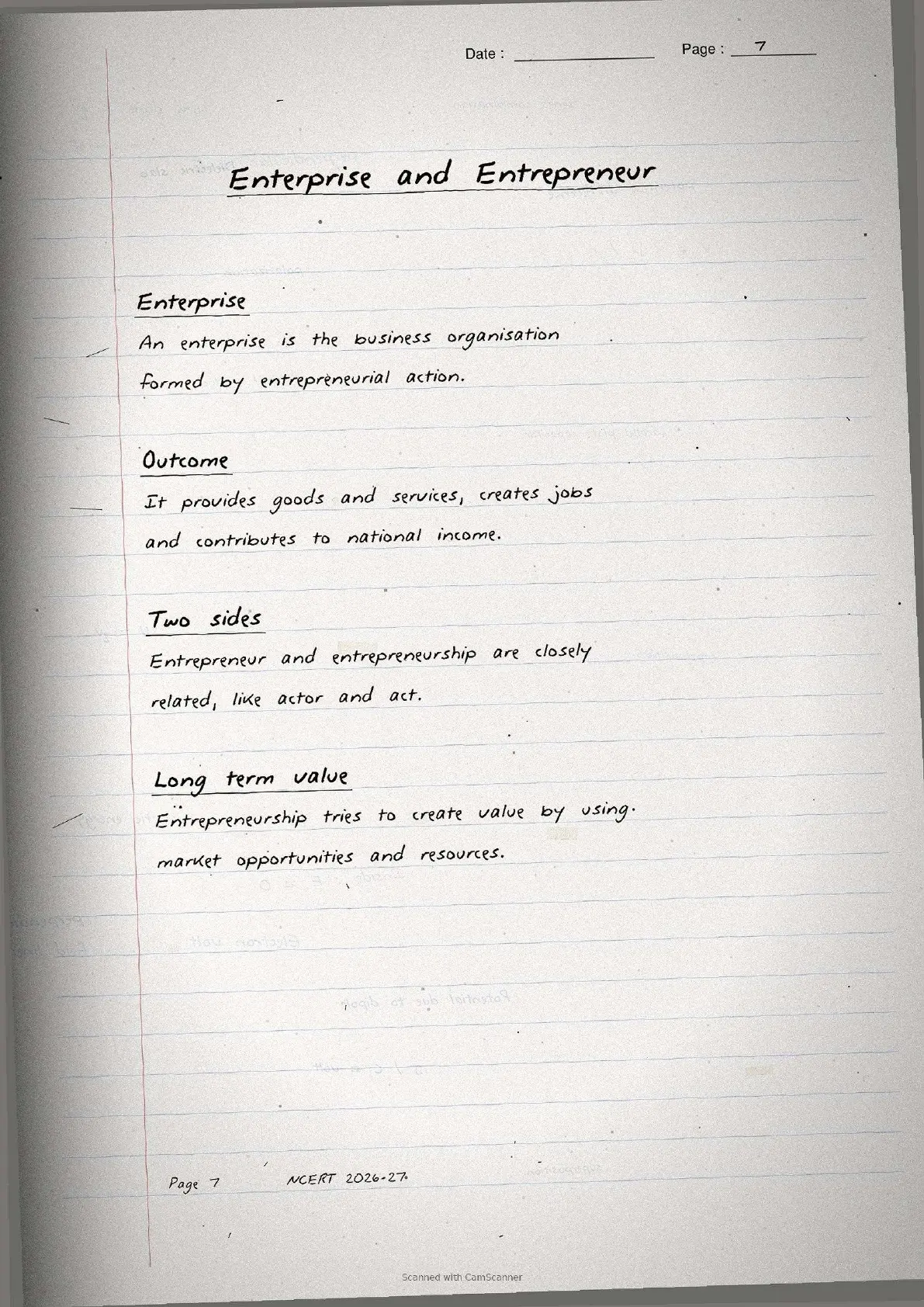
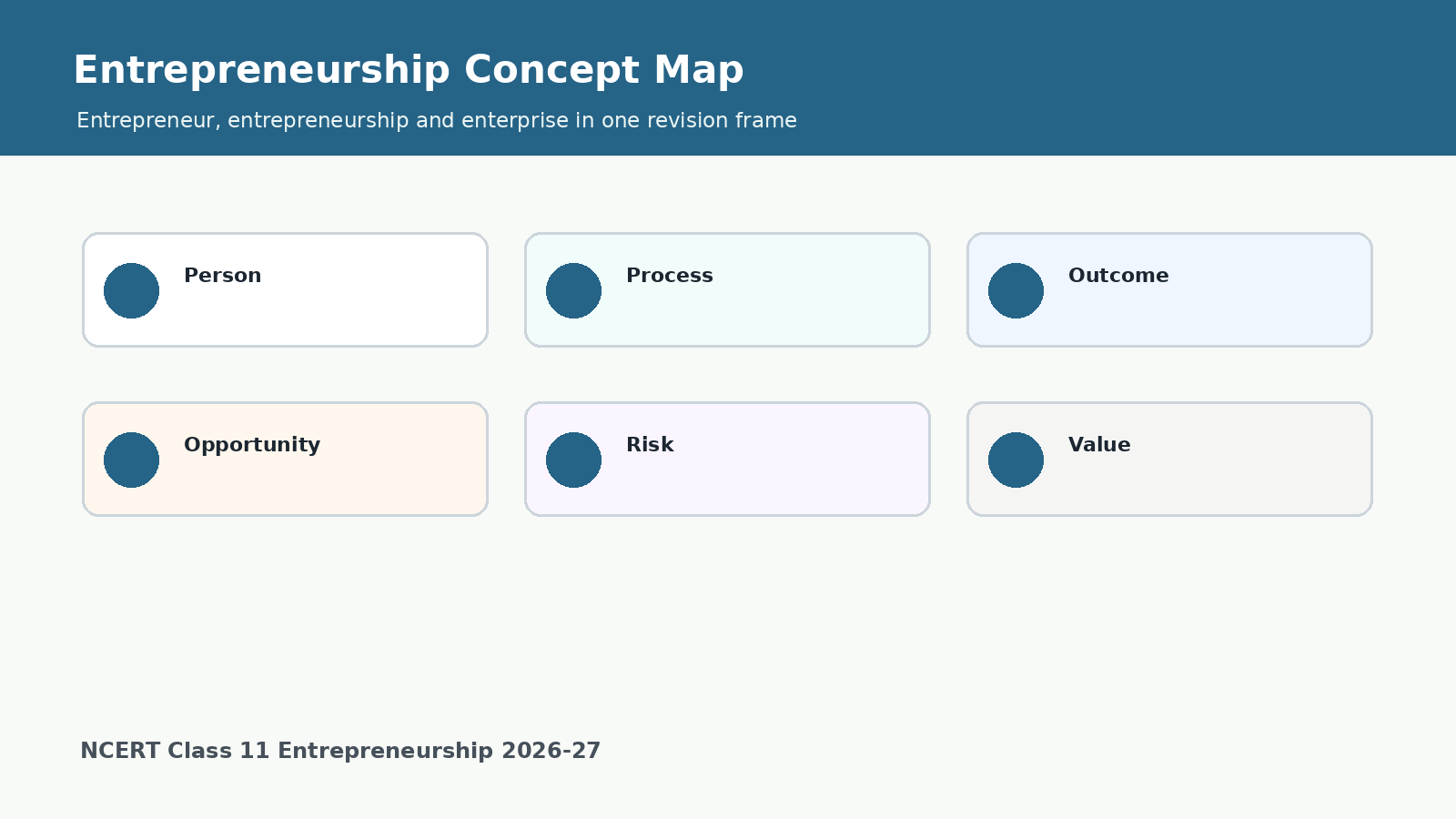
The most important chapter distinction is between entrepreneur, entrepreneurship and enterprise. Students should write this chain in answers before expanding the explanation.
| Term | Meaning | Exam cue |
|---|---|---|
| Entrepreneur | The person who starts or organises the enterprise. | Write person or actor. |
| Entrepreneurship | The process of identifying opportunity and using resources. | Write process or action. |
| Enterprise | The business organisation created as the outcome. | Write outcome or object. |
| Opportunity | A problem or market need that can become value. | Use Mitticool or Nirma as example. |
Entrepreneurship Chapter 1 Explanation Video
Source: YouTube classroom video
Functions of an Entrepreneur
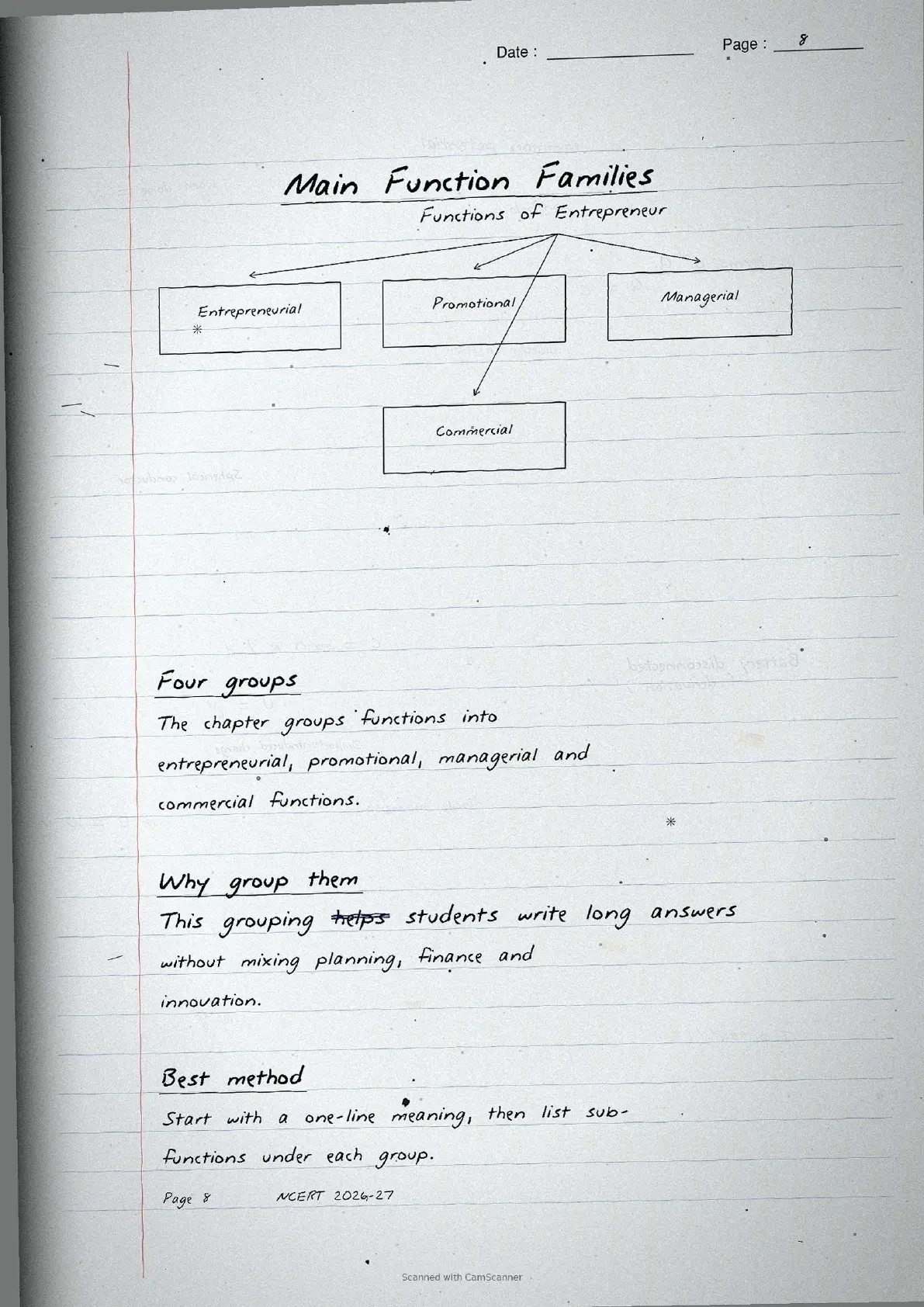
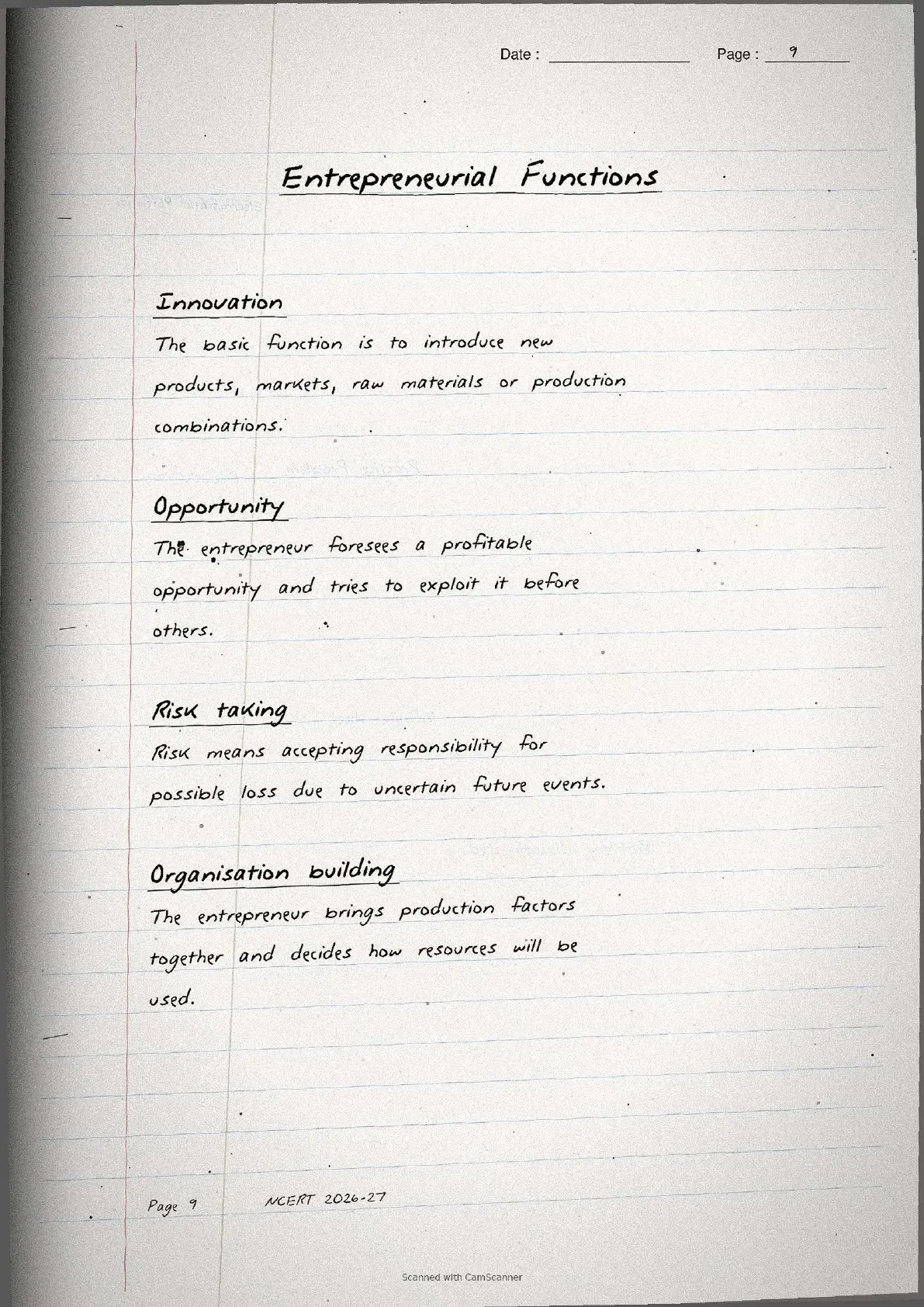
The chapter classifies entrepreneur functions into four groups. This grouping is useful for long answers because it keeps innovation, investigation, management and commerce separate.
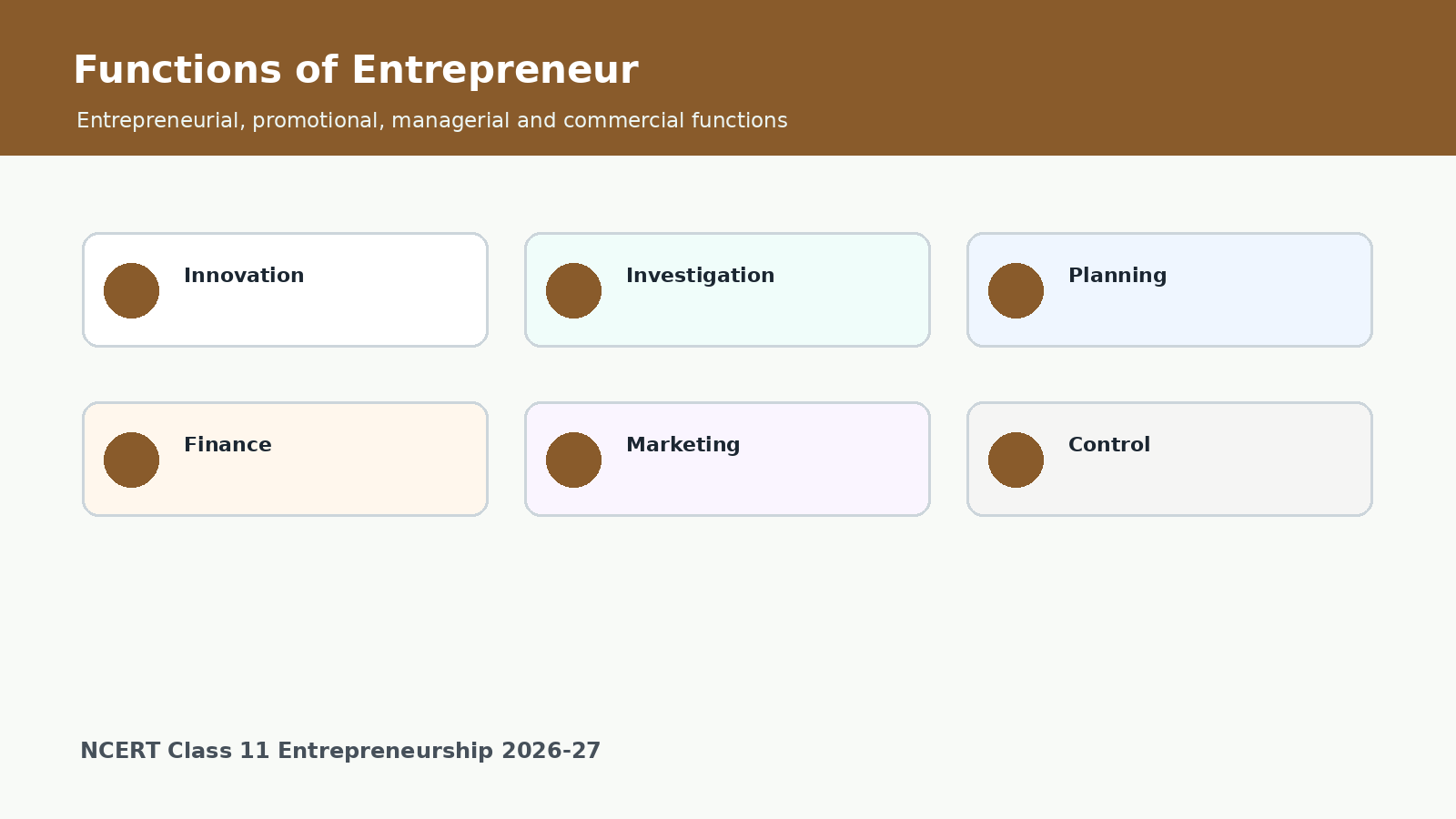
| Function group | Includes | How to revise |
|---|---|---|
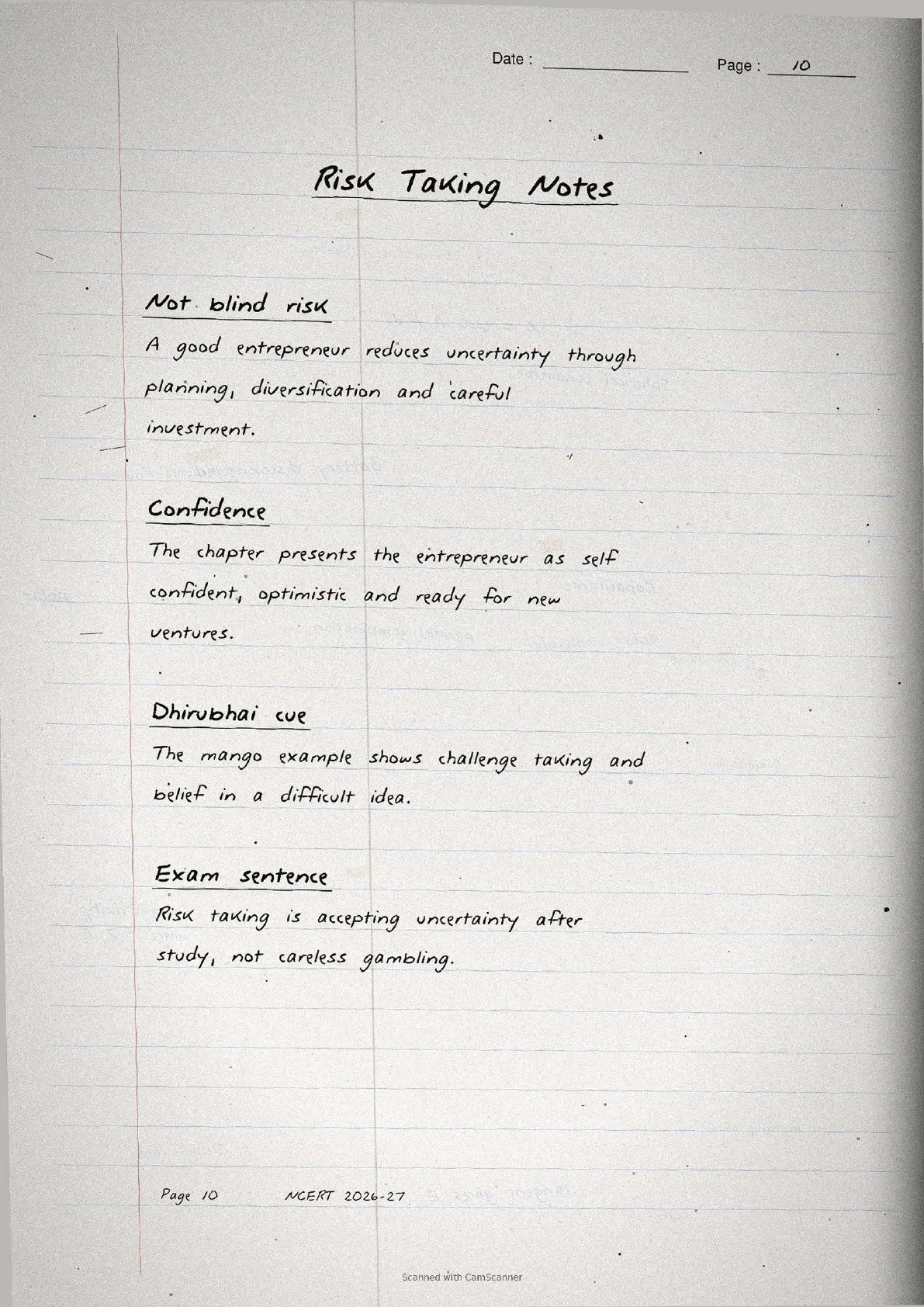
| Entrepreneurial | Innovation, risk-taking and organisation building. | Write this for core entrepreneur work. |
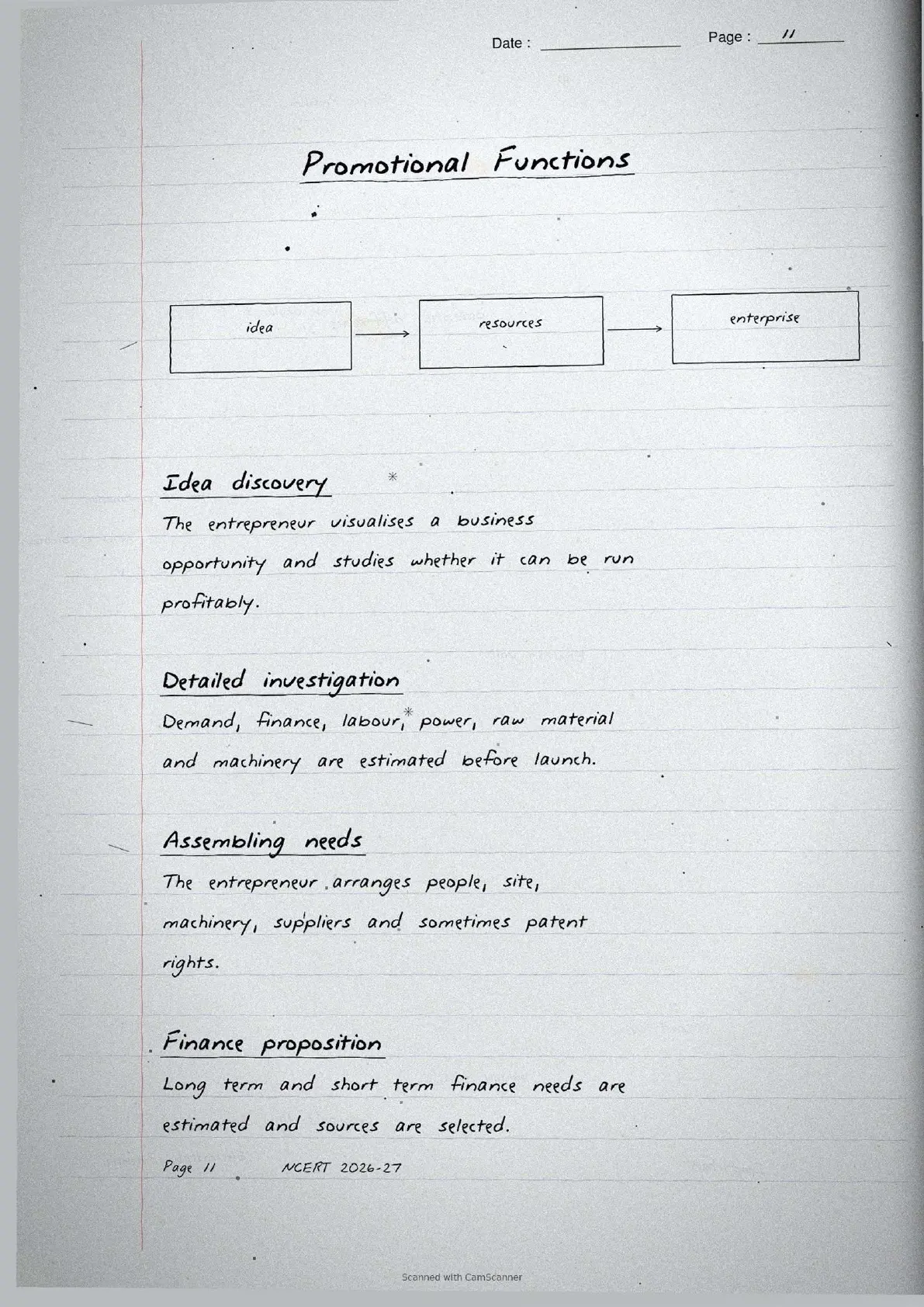
| Promotional | Idea discovery, investigation, assembling requirements and finance. | Use before-starting-business points. |
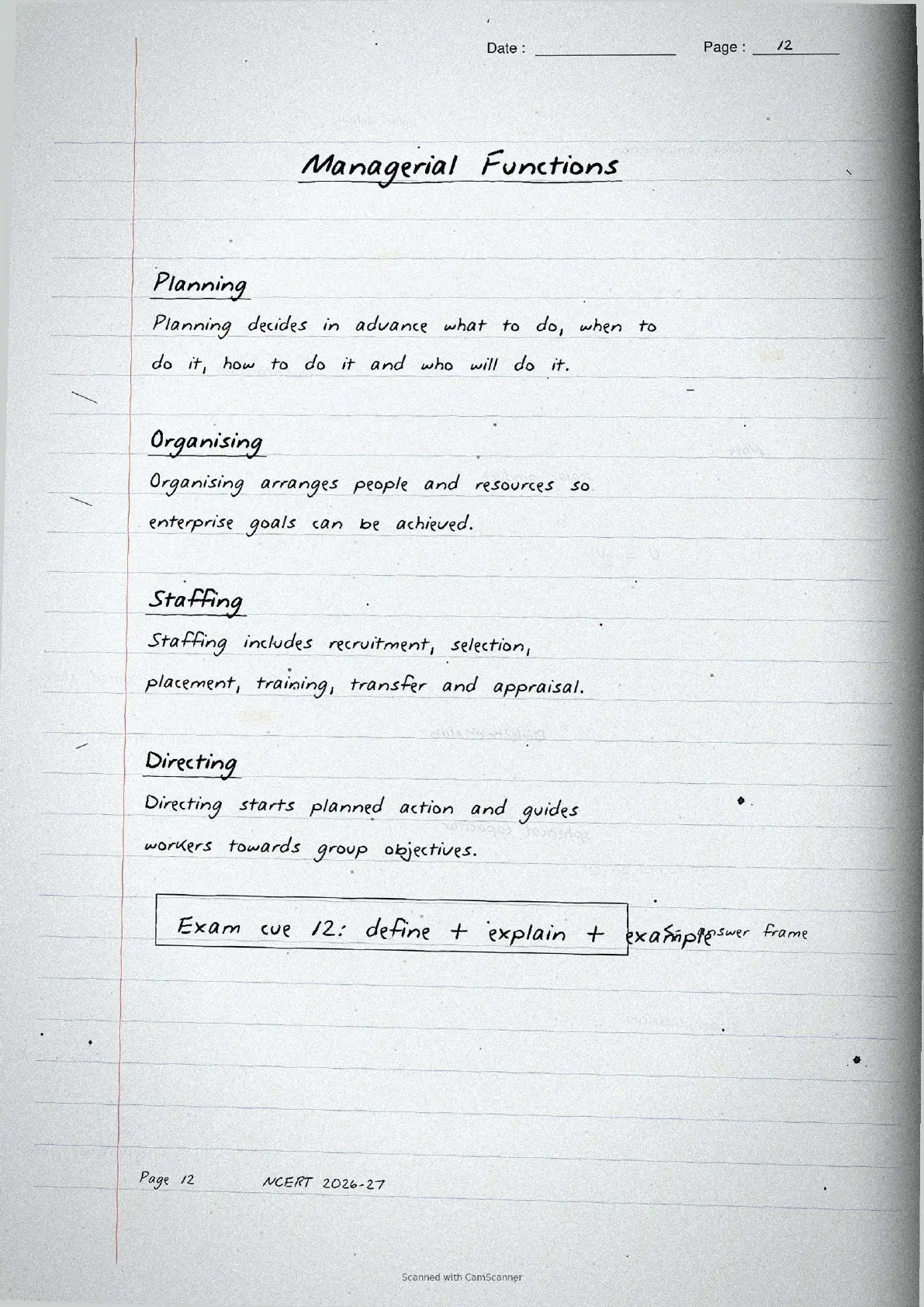
| Managerial | Planning, organising, staffing, directing and controlling. | Use for running the enterprise. |
| Commercial | Production, finance, marketing, personnel and accounting. | Use for daily business activity. |
Need and Myths of Entrepreneurship
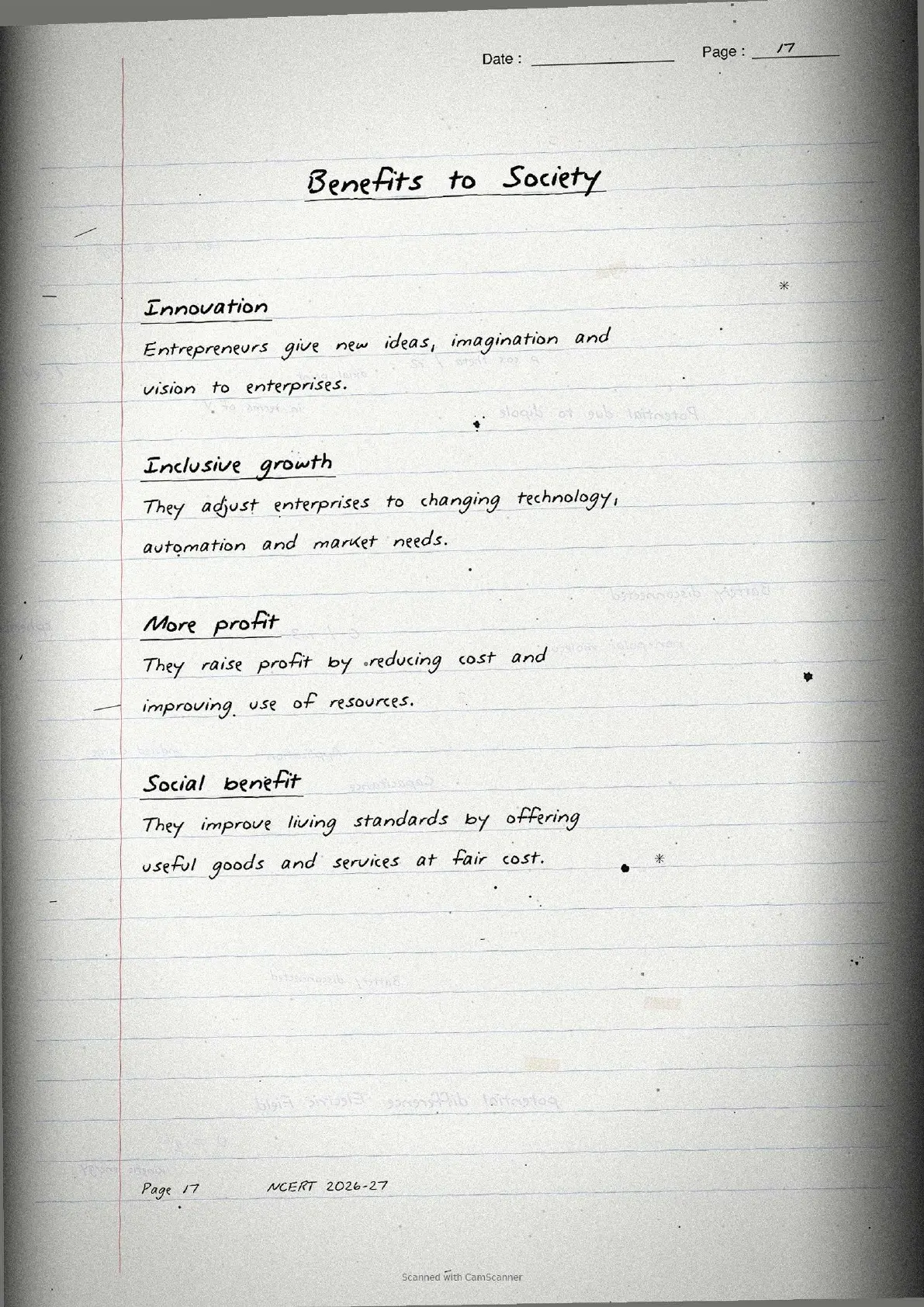
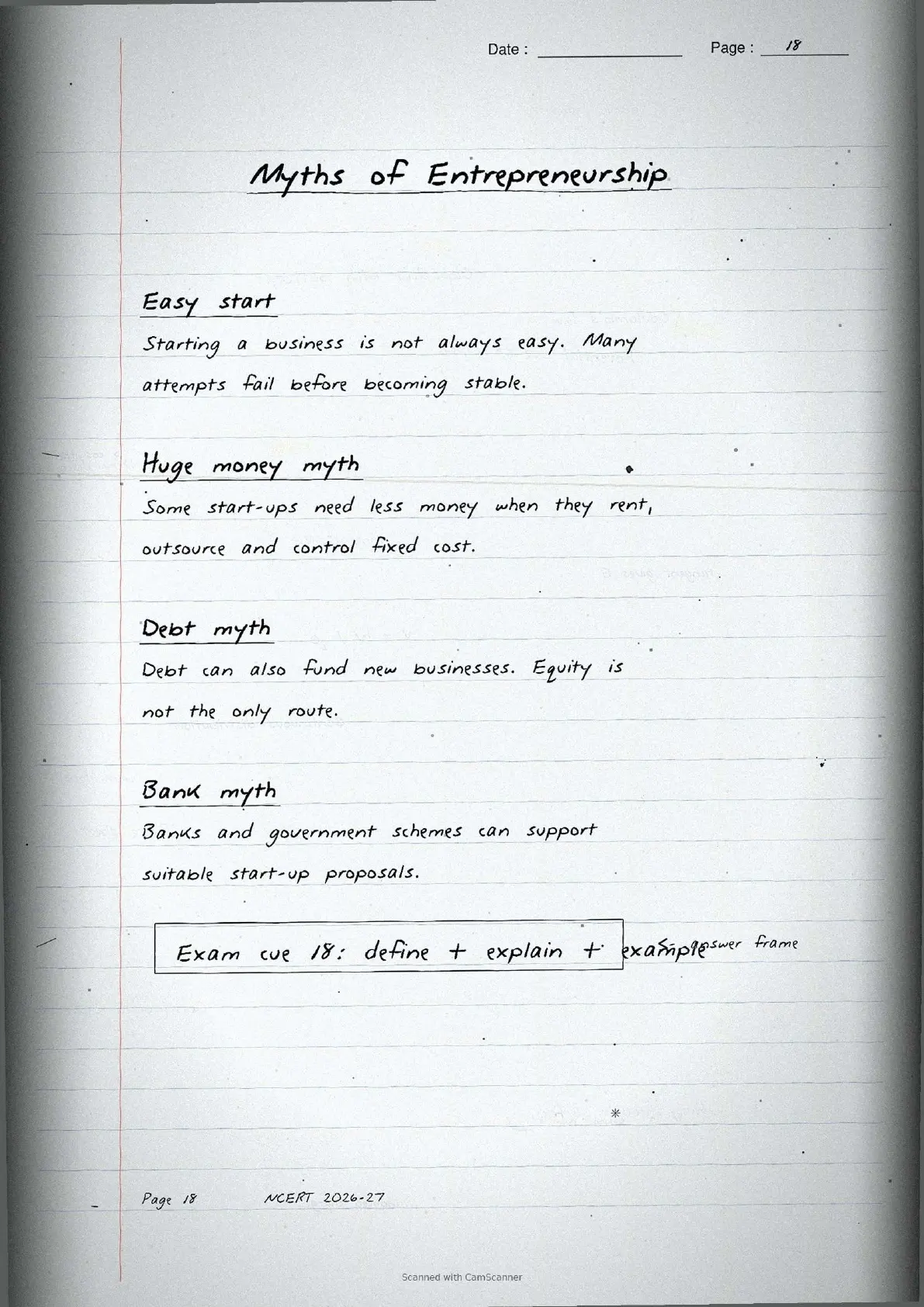
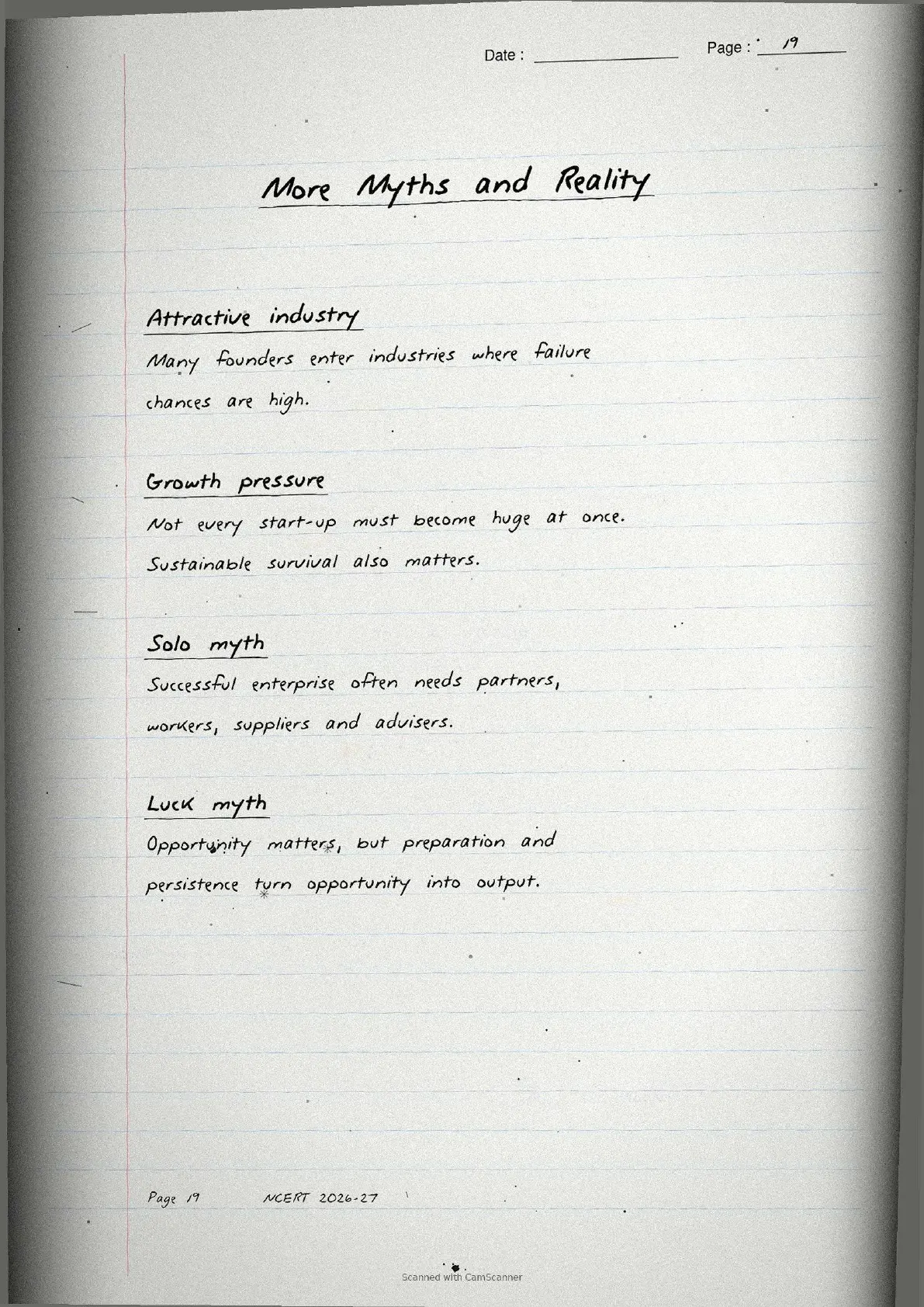
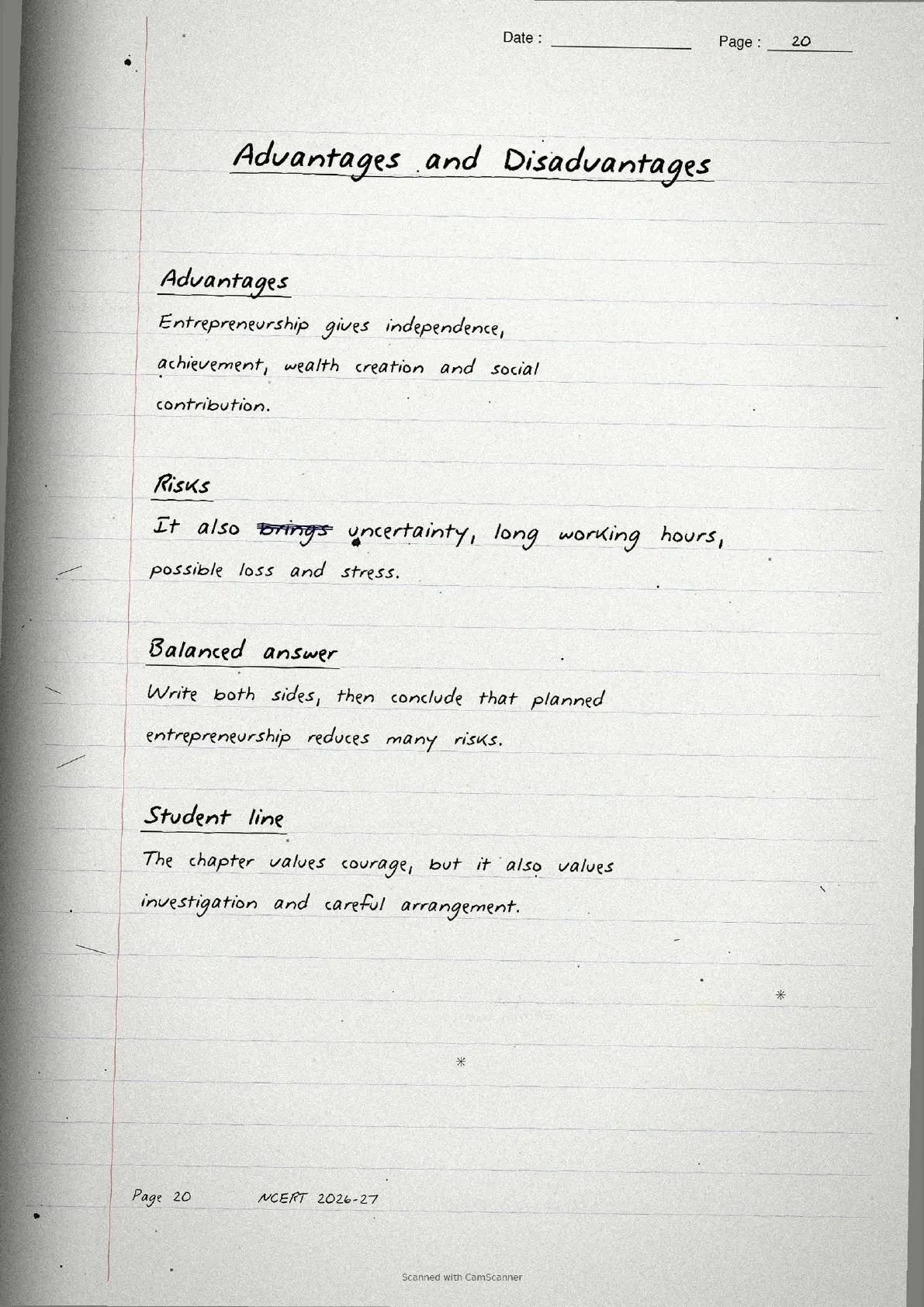
Entrepreneurship is needed for economic development, innovation, employment opportunities, better use of resources and social benefits. The handwritten notes also mark common myths, such as the idea that starting a business is always easy or that every start-up needs huge capital.
- Economic development: entrepreneurs bring new ideas and increase productivity.
- Employment: enterprises create direct and indirect job opportunities.
- Social benefit: useful goods and services raise living standards.
- Reality check: good entrepreneurs study risk and do not depend only on luck.
How to Use the Handwritten Notes PDF
Use the PDF after reading the NCERT chapter once. First revise the concept chain, then read the function pages and finally memorise one example for each long answer.
- Use the definition pages for short-answer questions.
- Use the function pages for 5-mark and 6-mark answers.
- Use the myths and need pages for value-based questions.
- Use the final revision page for quick pre-test recall.
Related Class 11 Entrepreneurship Resources
Use these related resources with the handwritten notes for complete Class 11 Entrepreneurship Chapter 1 preparation.
| Resource | Use it for | Link |
|---|---|---|
| NCERT Solutions | Exercise answers and textbook questions | Open solutions |
| NCERT Notes | Typed chapter summary and quick revision | Open notes |
| NCERT Book PDF | Official source chapter reading | Open book PDF |
All Class 11 Entrepreneurship Handwritten Notes
The table below keeps the same resource type together so students can move chapter by chapter through the Class 11 Entrepreneurship handwritten notes.
| Chapter | Title | Handwritten notes link |
|---|---|---|
| Chapter 1 | Entrepreneurship: Concept and Functions | Open handwritten notes |
| Chapter 2 | An Entrepreneur | Open handwritten notes |
| Chapter 3 | Entrepreneurial Journey | Open handwritten notes |
| Chapter 4 | Entrepreneurship as Innovation and Problem Solving | Open handwritten notes |
| Chapter 5 | Concept of Market | Open handwritten notes |
Class 11 Entrepreneurship Chapter 1 Handwritten Notes FAQs
Ques. What do the Class 11 Entrepreneurship Chapter 1 handwritten notes cover?
Ans. The notes cover entrepreneurship meaning, entrepreneur traits, enterprise, functions, need for entrepreneurship, myths, advantages and NCERT examples for 2026-27.
Ques. What is the difference between entrepreneur and entrepreneurship?
Ans. An entrepreneur is the person who starts or organises the enterprise. Entrepreneurship is the process or action through which the opportunity is converted into an enterprise.
Ques. What are the main functions of an entrepreneur?
Ans. The main function groups are entrepreneurial, promotional, managerial and commercial functions. They include innovation, risk-taking, planning, finance, marketing and control.
Ques. Are these handwritten notes aligned with the 2026-27 NCERT book?
Ans. Yes. The handwritten notes are prepared for Class 11 Entrepreneurship Chapter 1 Entrepreneurship: Concept and Functions in the 2026-27 NCERT syllabus.



Comments