




NCERT Handwritten Notes for Class 12 English (Suppl.) Chapter 13 Kaleidoscope: Blood help students revise Kamala Das's poem through clear handwritten revision notes, memory maps and NCERT answer points for the 2026-27 reprint.
- Resource: Class 12 English Supplementary Chapter 13 handwritten revision notes PDF.
- Chapter focus: ancestral house, old blood, great-grandmother, tradition, class criticism and conscience.
- Revision use: quick poem summary, image clusters, glossary, short answers and long-answer frames.
Chapter13Kaleidoscope:BloodHandwrittenNotes.pdf?page=1&dpi=150)
Chapter13Kaleidoscope:BloodHandwrittenNotes.pdf?page=2&dpi=150)
Chapter13Kaleidoscope:BloodHandwrittenNotes.pdf?page=3&dpi=150)
Chapter13Kaleidoscope:BloodHandwrittenNotes.pdf?page=4&dpi=150)
Chapter13Kaleidoscope:BloodHandwrittenNotes.pdf?page=5&dpi=150)
Chapter13Kaleidoscope:BloodHandwrittenNotes.pdf?page=6&dpi=150)
Chapter13Kaleidoscope:BloodHandwrittenNotes.pdf?page=7&dpi=150)
Chapter13Kaleidoscope:BloodHandwrittenNotes.pdf?page=8&dpi=150)
Chapter13Kaleidoscope:BloodHandwrittenNotes.pdf?page=9&dpi=150)
Chapter13Kaleidoscope:BloodHandwrittenNotes.pdf?page=10&dpi=150)
Chapter13Kaleidoscope:BloodHandwrittenNotes.pdf?page=11&dpi=150)
Chapter13Kaleidoscope:BloodHandwrittenNotes.pdf?page=12&dpi=150)
Chapter13Kaleidoscope:BloodHandwrittenNotes.pdf?page=13&dpi=150)
Chapter13Kaleidoscope:BloodHandwrittenNotes.pdf?page=14&dpi=150)
Chapter13Kaleidoscope:BloodHandwrittenNotes.pdf?page=15&dpi=150)
Chapter13Kaleidoscope:BloodHandwrittenNotes.pdf?page=16&dpi=150)
Chapter13Kaleidoscope:BloodHandwrittenNotes.pdf?page=17&dpi=150)
Chapter13Kaleidoscope:BloodHandwrittenNotes.pdf?page=18&dpi=150)
Chapter13Kaleidoscope:BloodHandwrittenNotes.pdf?page=19&dpi=150)
Chapter13Kaleidoscope:BloodHandwrittenNotes.pdf?page=20&dpi=150)
Chapter13Kaleidoscope:BloodHandwrittenNotes.pdf?page=21&dpi=150)
Chapter13Kaleidoscope:BloodHandwrittenNotes.pdf?page=22&dpi=150)
Chapter13Kaleidoscope:BloodHandwrittenNotes.pdf?page=23&dpi=150)
Chapter13Kaleidoscope:BloodHandwrittenNotes.pdf?page=24&dpi=150)
Student Feedback: Students usually revise Blood faster when they separate house images, old blood pride, class criticism and the speaker's final apology.
Blood Handwritten Notes Overview
Class 12 English Supplementary Chapter 13 studies Kamala Das's poem Blood. The poem begins with childhood memory, moves through the decay of a three-hundred-year-old ancestral house, and ends with an adult apology shaped by guilt, class criticism and old blood pride.
The handwritten notes focus on the points students need for answers: the authentic house details, the great-grandmother's grief, class criticism, tradition and modernity, the childhood promise and the conflict in the speaker's conscience.
Blood House Memory Map
Blood is easiest to revise as a movement from place to memory. The house is not just a building. It carries family pride, the mother-line, ritual history, adult defeat and the speaker's final apology.
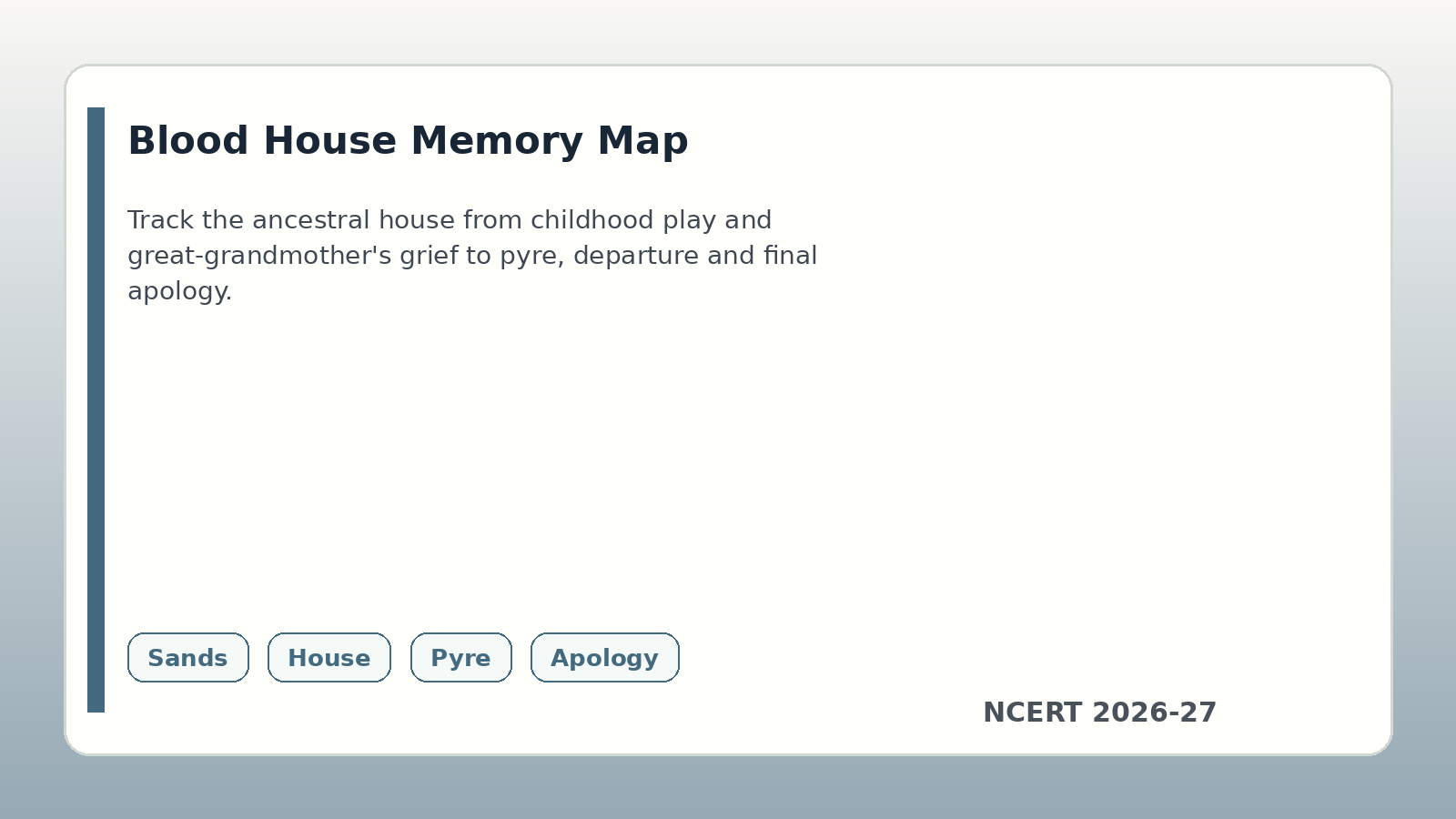
| Moment | What to notice | Answer cue |
|---|---|---|
| Childhood | Brother and sister play on the sands | memory frame |
| House decay | Cracked walls, fallen tiles, rats and lichen | authentic detail |
| Old grandeur | Elephant ride, jewel box, brocade and prince | tradition and status |
| Final apology | Old house, mother-line and blood defence | conscience conflict |
Blood by Kamala Das Class 12 Explanation Video
Source: Magnet Brains on YouTube
Old Blood, Class Pride and Conscience
The title points to lineage, inherited status and moral pressure. The great-grandmother calls old blood thin, clear and fine, but the same speech looks down on the poor and the new-rich. The adult speaker respects memory, yet questions that pride.
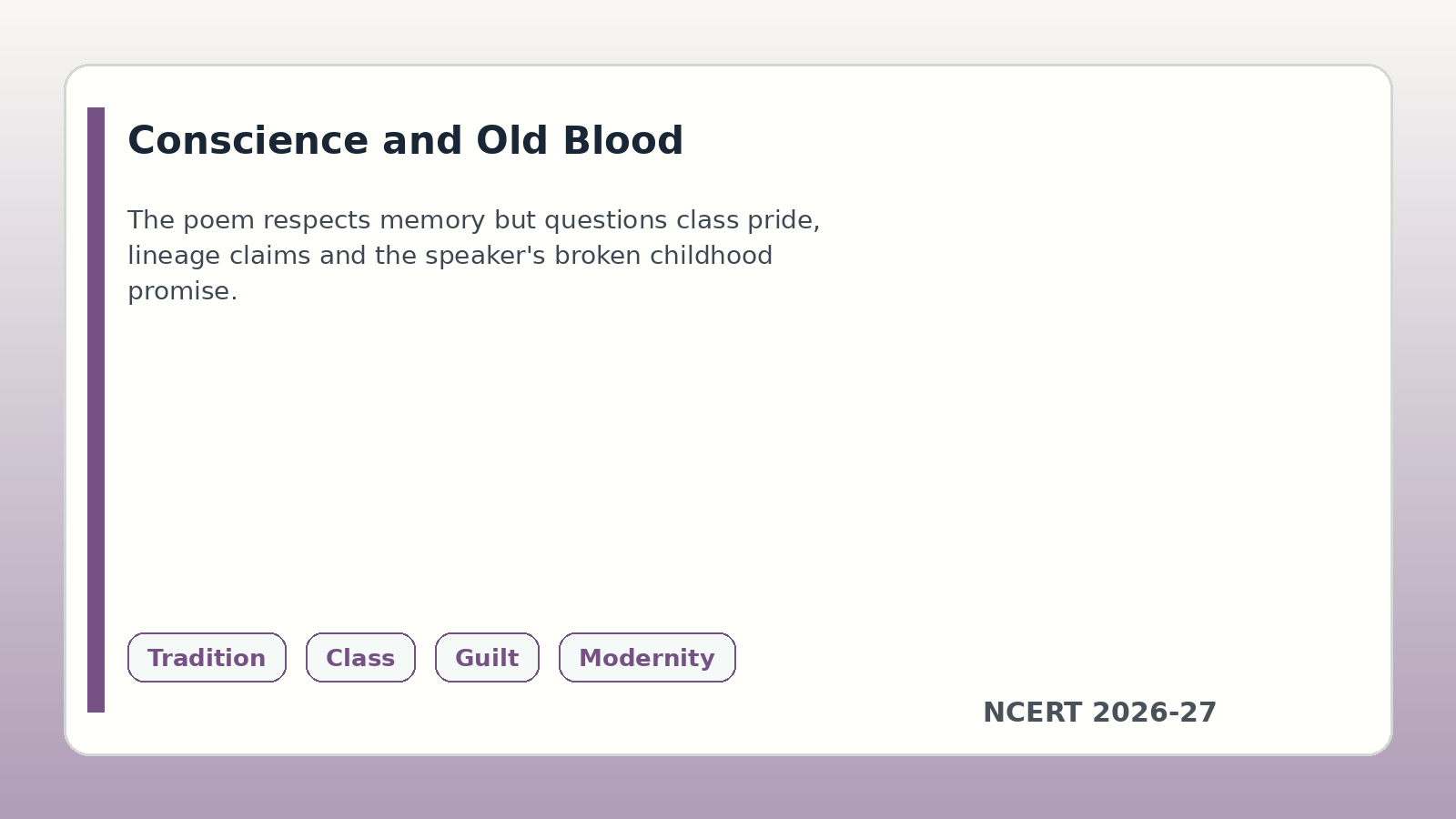
| NCERT focus | Best example | How to write it |
|---|---|---|
| Authentic house | Cracks, tiles, rats, shrine and lichen | Show concrete details before symbolism. |
| Class criticism | Poor and new-rich blood images | Explain inherited prejudice. |
| Tradition and modernity | Shrines and old blood versus other towns | Use both sides in one answer. |
| Conscience | Call me callous, but do not blame my blood | Show guilt and defence together. |
Themes and Literary Devices in Blood
The main themes are memory, inheritance, decay, class criticism, guilt and modern change. The poem is personal, but it also studies Indian society through the language of family pride and a dying ancestral house.
- Memory: childhood scenes remain active in the adult speaker's mind.
- Inheritance: blood carries pride, family line and moral pressure.
- Class criticism: the poem exposes contempt for poor and new-rich people.
- Personification: the house crouches, groans, sighs and closes its windows like eyes.
How to Use the Blood Handwritten Notes PDF
Use the PDF after reading the NCERT poem once. First revise the house-memory map, then write one paragraph on class criticism, one on tradition and modernity and one on the conflict in the speaker's conscience.
- Use the authenticity page for the crumbling house question.
- Use the old blood page for class distinction and revolt against royal grandeur.
- Use the promise and defeat page for the selfishness question.
- Use the model answer pages to practise 4 to 5 line responses.
Related Class 12 English Supplementary Resources
Use these related resources with the handwritten notes for full chapter preparation.
| Resource | Best use | Link |
|---|---|---|
| NCERT Solutions | Step-by-step answers for Blood | Open solutions |
| NCERT Notes | Typed revision notes for the same chapter | Open notes |
| NCERT Book PDF | Official poem and questions | Open book PDF |
All Class 12 English Supplementary Handwritten Notes
The table below keeps the same resource type together, so students can move chapter by chapter through the Class 12 English Supplementary Kaleidoscope handwritten notes.
| Chapter | Title | Handwritten notes link |
|---|---|---|
| Chapter 1 | I Sell my Dreams | Open handwritten notes |
| Chapter 2 | Eveline | Open handwritten notes |
| Chapter 3 | A Wedding in Brownsville | Open handwritten notes |
| Chapter 4 | Tomorrow | Open handwritten notes |
| Chapter 5 | One Centimetre | Open handwritten notes |
| Chapter 6 | A Lecture upon the Shadow | Open handwritten notes |
| Chapter 7 | Poems by Milton | Open handwritten notes |
| Chapter 8 | Poems by Blake | Open handwritten notes |
| Chapter 9 | Kubla Khan | Open handwritten notes |
| Chapter 10 | Trees | Open handwritten notes |
| Chapter 11 | The Wild Swans at Coole | Open handwritten notes |
| Chapter 12 | Time and Time Again | Open handwritten notes |
| Chapter 13 | Blood | Open handwritten notes |
Blood Class 12 English Handwritten Notes FAQs
Ques. What do the Blood handwritten notes cover?
Ans. The notes cover Kamala Das, the ancestral house, old blood, the great-grandmother, class criticism, tradition, modernity and NCERT answer cues for 2026-27.
Ques. What is the main idea of Blood by Kamala Das?
Ans. Blood presents an adult speaker who remembers a ruined ancestral house, respects her great-grandmother's feelings and questions inherited pride based on class and lineage.
Ques. Why does the speaker fail to rebuild the house?
Ans. The speaker learns that becoming rich is difficult, leaves for other towns and cannot restore the old house or the social world it represents.
Ques. Are these notes aligned with the 2026-27 NCERT book?
Ans. Yes. The notes are prepared for Class 12 English Supplementary Kaleidoscope Chapter 13 Blood in the 2026-27 NCERT reprint.



Comments