



The NCERT Class 7 Social Science Chapter 2 Understanding the Weather notes explain temperature, humidity, rainfall, wind, pressure and weather warnings from the 2026-27 NCERT textbook. The PDF helps students revise how daily weather is observed, recorded, mapped and used for safety.
- Best for revision: weather elements, instruments, warnings, rainfall maps and map reading.
- Use with the PDF: read the summary first, then answer the textbook questions.
- 2026-27 focus: follows the new Exploring Society textbook chapter order.
Ch2UnderstandingtheWeatherNotesNCERT2026-27.pdf?page=1&dpi=150)
Ch2UnderstandingtheWeatherNotesNCERT2026-27.pdf?page=2&dpi=150)
Ch2UnderstandingtheWeatherNotesNCERT2026-27.pdf?page=3&dpi=150)
Ch2UnderstandingtheWeatherNotesNCERT2026-27.pdf?page=4&dpi=150)
Ch2UnderstandingtheWeatherNotesNCERT2026-27.pdf?page=5&dpi=150)
Ch2UnderstandingtheWeatherNotesNCERT2026-27.pdf?page=6&dpi=150)
Ch2UnderstandingtheWeatherNotesNCERT2026-27.pdf?page=7&dpi=150)
Ch2UnderstandingtheWeatherNotesNCERT2026-27.pdf?page=8&dpi=150)
Ch2UnderstandingtheWeatherNotesNCERT2026-27.pdf?page=9&dpi=150)
Ch2UnderstandingtheWeatherNotesNCERT2026-27.pdf?page=10&dpi=150)
Ch2UnderstandingtheWeatherNotesNCERT2026-27.pdf?page=11&dpi=150)
Ch2UnderstandingtheWeatherNotesNCERT2026-27.pdf?page=12&dpi=150)
Ch2UnderstandingtheWeatherNotesNCERT2026-27.pdf?page=13&dpi=150)
Ch2UnderstandingtheWeatherNotesNCERT2026-27.pdf?page=14&dpi=150)
Ch2UnderstandingtheWeatherNotesNCERT2026-27.pdf?page=15&dpi=150)
Ch2UnderstandingtheWeatherNotesNCERT2026-27.pdf?page=16&dpi=150)
Ch2UnderstandingtheWeatherNotesNCERT2026-27.pdf?page=17&dpi=150)
Ch2UnderstandingtheWeatherNotesNCERT2026-27.pdf?page=18&dpi=150)
Ch2UnderstandingtheWeatherNotesNCERT2026-27.pdf?page=19&dpi=150)
Ch2UnderstandingtheWeatherNotesNCERT2026-27.pdf?page=20&dpi=150)
Ch2UnderstandingtheWeatherNotesNCERT2026-27.pdf?page=21&dpi=150)
Ch2UnderstandingtheWeatherNotesNCERT2026-27_flat_MobileCard.pdf?page=1&dpi=150)
Ch2UnderstandingtheWeatherNotesNCERT2026-27_flat_MobileCard.pdf?page=2&dpi=150)
Ch2UnderstandingtheWeatherNotesNCERT2026-27_flat_MobileCard.pdf?page=3&dpi=150)
Ch2UnderstandingtheWeatherNotesNCERT2026-27_flat_MobileCard.pdf?page=4&dpi=150)
Ch2UnderstandingtheWeatherNotesNCERT2026-27_flat_MobileCard.pdf?page=5&dpi=150)
Ch2UnderstandingtheWeatherNotesNCERT2026-27_flat_MobileCard.pdf?page=6&dpi=150)
Ch2UnderstandingtheWeatherNotesNCERT2026-27_flat_MobileCard.pdf?page=7&dpi=150)
Ch2UnderstandingtheWeatherNotesNCERT2026-27_flat_MobileCard.pdf?page=8&dpi=150)
Ch2UnderstandingtheWeatherNotesNCERT2026-27_flat_MobileCard.pdf?page=9&dpi=150)
Ch2UnderstandingtheWeatherNotesNCERT2026-27_flat_MobileCard.pdf?page=10&dpi=150)
Ch2UnderstandingtheWeatherNotesNCERT2026-27_flat_MobileCard.pdf?page=11&dpi=150)
Ch2UnderstandingtheWeatherNotesNCERT2026-27_flat_MobileCard.pdf?page=12&dpi=150)
Ch2UnderstandingtheWeatherNotesNCERT2026-27_flat_MobileCard.pdf?page=13&dpi=150)
Ch2UnderstandingtheWeatherNotesNCERT2026-27_flat_MobileCard.pdf?page=14&dpi=150)
Ch2UnderstandingtheWeatherNotesNCERT2026-27_flat_MobileCard.pdf?page=15&dpi=150)
Ch2UnderstandingtheWeatherNotesNCERT2026-27_flat_MobileCard.pdf?page=16&dpi=150)
Ch2UnderstandingtheWeatherNotesNCERT2026-27_flat_MobileCard.pdf?page=17&dpi=150)
Ch2UnderstandingtheWeatherNotesNCERT2026-27_flat_MobileCard.pdf?page=18&dpi=150)
Ch2UnderstandingtheWeatherNotesNCERT2026-27_flat_MobileCard.pdf?page=19&dpi=150)
Ch2UnderstandingtheWeatherNotesNCERT2026-27_flat_MobileCard.pdf?page=20&dpi=150)
Ch2UnderstandingtheWeatherNotesNCERT2026-27_flat_MobileCard.pdf?page=21&dpi=150)
Ch2UnderstandingtheWeatherNotesNCERT2026-27_flat_MobileCard.pdf?page=22&dpi=150)
Ch2UnderstandingtheWeatherNotesNCERT2026-27_flat_MobileCard.pdf?page=23&dpi=150)
Ch2UnderstandingtheWeatherNotesNCERT2026-27_flat_MobileCard.pdf?page=24&dpi=150)
Ch2UnderstandingtheWeatherNotesNCERT2026-27_flat_MobileCard.pdf?page=25&dpi=150)
Ch2UnderstandingtheWeatherNotesNCERT2026-27_flat_MobileCard.pdf?page=26&dpi=150)
These notes follow the 2026-27 NCERT Class 7 Social Science textbook and focus on the weather terms, maps and warning symbols students need for quick revision.
Student Feedback: In a Collegedunia student poll of 11,260 Class 7 students before the 2026 school assessments, most students said weather maps became easier after learning the symbols before reading the colours.
Understanding the Weather Notes: What the Chapter Covers
Understanding the Weather teaches students to read daily atmospheric conditions like a simple report. Weather is not one thing. It is a mix of temperature, air pressure, wind, humidity, clouds and precipitation at a place and time.
The chapter also explains why weather changes quickly. A sunny morning can become a rainy evening because air, water vapour and pressure keep moving. Students should connect every term with a daily example.
| Weather element | What it means | Simple clue |
|---|---|---|
| Temperature | How hot or cold the air is | Measured with a thermometer |
| Humidity | Water vapour present in the air | High humidity feels sticky |
| Wind | Moving air from one place to another | Shown by speed and direction |
| Precipitation | Water falling from clouds | Rain, snow, hail or drizzle |
Understanding the Weather Video Recap for Class 7
Source: Magnet Brains on YouTube
Weather Elements Every Class 7 Student Must Know
The chapter uses weather elements to show why conditions differ from place to place. A coastal city may feel humid, while an inland desert may feel dry. A hill station may be cool even when the plains are hot.
- Temperature: changes with season, time of day, altitude and cloud cover.
- Air pressure: helps explain wind movement and storm formation.
- Clouds: show how water vapour cools and condenses in the sky.
- Rainfall: affects farming, water supply, travel and warnings.
How Weather Is Recorded and Forecast
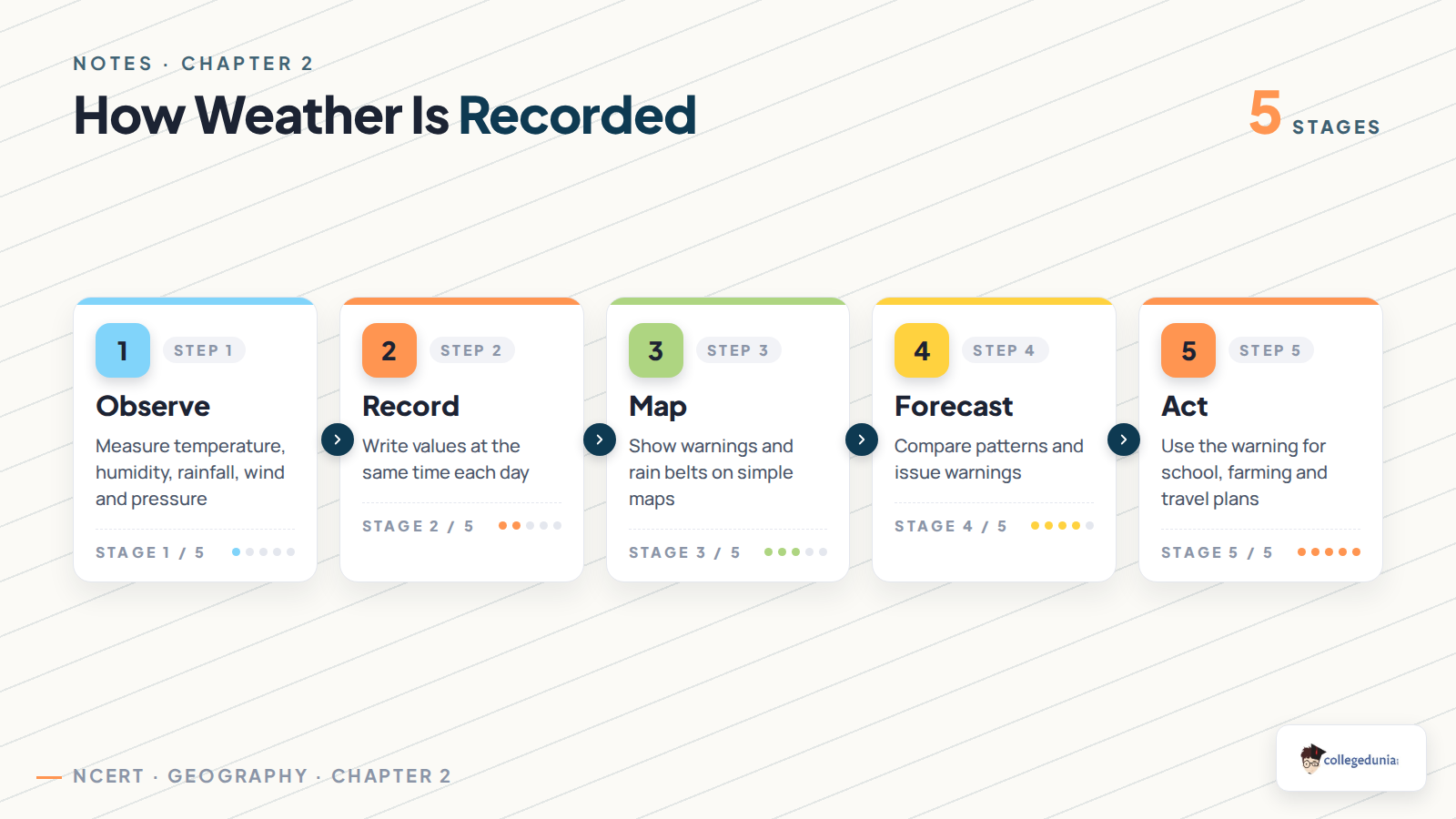
Weather stations collect readings at fixed times. They use instruments like thermometers, rain gauges, barometers and wind vanes. These readings are then shown in tables, charts or maps so students can compare places.
Forecasting means using recorded data to estimate what may happen next. A forecast is useful for farmers, travellers, schools, fishers and disaster teams. The textbook also trains students to read warning maps with colours and symbols.
| Instrument or map | What it helps students read | Answer clue |
|---|---|---|
| Thermometer | Temperature | Hot, cold or mild day |
| Rain gauge | Rainfall amount | Light rain or heavy rain |
| Wind vane | Wind direction | Where the wind comes from |
| Warning map | Safety message for an area | Heat wave, heavy rain or strong wind |
Weather and Climate Difference for Class 7
Students often mix weather with climate. Weather is about short-term conditions. Climate is the usual pattern studied over many years. Weather tells you what is happening now; climate tells you what usually happens.
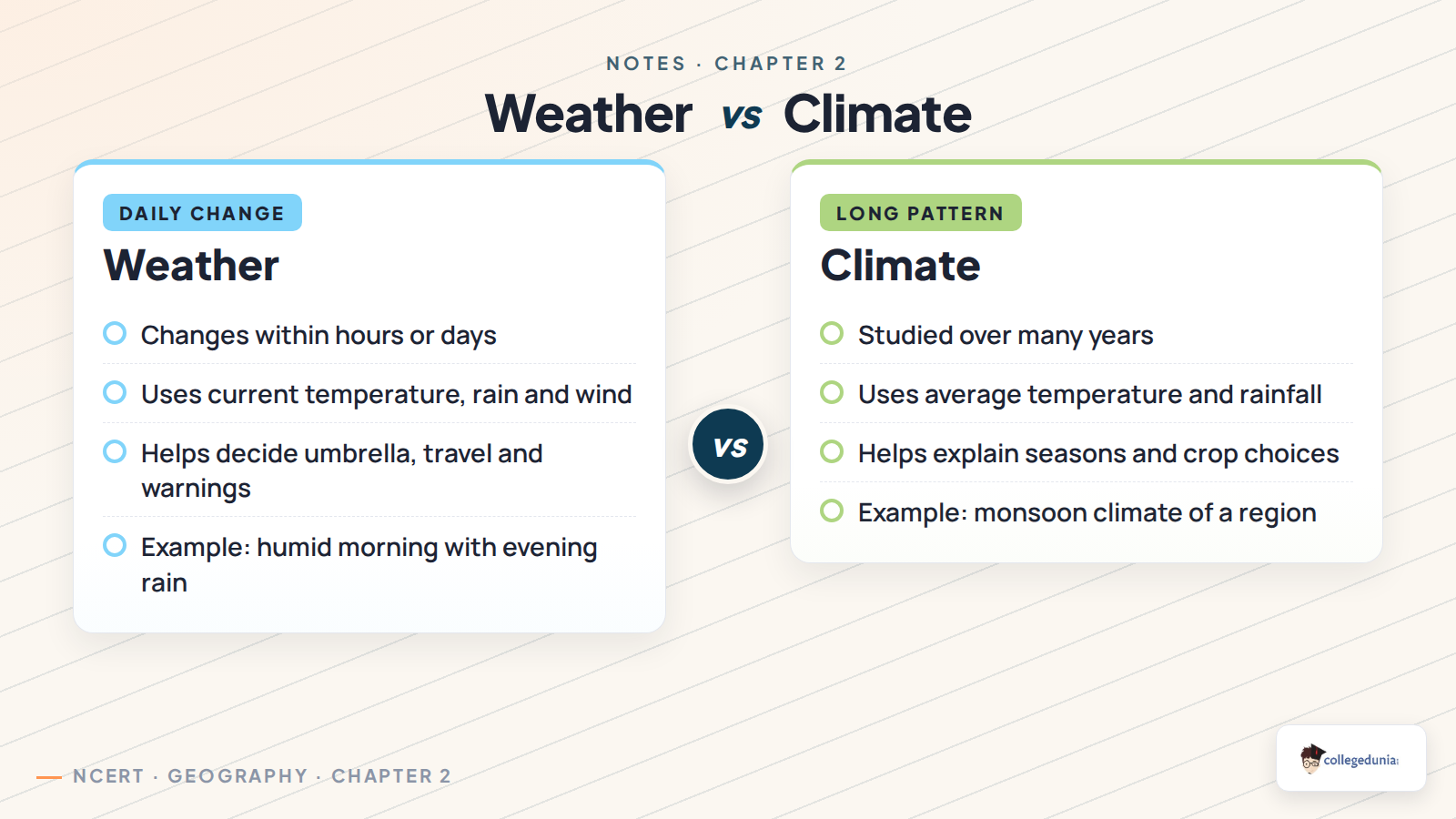
- Weather changes fast, sometimes within a few hours.
- Climate changes slowly and is studied through long records.
- A rainy day is weather. A monsoon season pattern is climate.
- Daily forecasts use weather data, while crop planning often uses climate knowledge.
Common Mistakes in Understanding the Weather Notes
Students can score better by writing exact terms. A vague answer like "the day is bad" should become a clear line about rain, wind, humidity or temperature.
- Do not write weather and climate as the same thing.
- Do not treat humidity as rain. Humidity means water vapour in air.
- Do not ignore the map legend. Colours and symbols carry the warning message.
- Do not write a forecast as a sure fact. It is a careful estimate.
Class 7 Social Science Chapter 2 Cross Resource Links
Use the notes with the official textbook and question-answer pages for full chapter practice.
| Resource | Use it for | Link |
|---|---|---|
| NCERT Notes | Quick revision before class tests | Understanding the Weather Class 7 Notes |
| NCERT Book PDF | Official textbook reading | Class 7 Social Science Chapter 2 Book PDF |
| NCERT Solutions | Textbook question answers | Class 7 Social Science Chapter 2 Solutions |
| Handwritten Notes | One-shot revision | Class 7 Social Science Chapter 2 Handwritten Notes |
All Chapters in Class 7 Social Science Part 1 Notes
The same notes series helps students revise the Exploring Society India and Beyond Part 1 textbook in chapter order.
| Chapter | Notes page |
|---|---|
| Chapter 1 | Geographical Diversity of India Notes |
| Chapter 2 | Understanding the Weather Notes |
| Chapter 3 | Climates of India Notes |
| Chapter 4 | New Beginnings Cities and States Notes |
Understanding the Weather Class 7 Notes FAQs
Ques. What is weather in Class 7 Social Science Chapter 2?
Ans. Weather is the condition of the atmosphere at a place and time. It includes temperature, wind, humidity, pressure, clouds and precipitation.
Ques. What is the difference between weather and climate?
Ans. Weather changes over hours or days. Climate is the usual weather pattern of a place studied over many years.
Ques. Which instruments are useful for understanding weather?
Ans. A thermometer measures temperature, a rain gauge measures rainfall, a barometer measures air pressure and a wind vane shows wind direction.
Ques. Why are weather warnings important?
Ans. Weather warnings help people prepare for heavy rain, heat waves, strong winds or storms. They support safer travel, farming and school planning.



Comments