



NCERT Class 8 Science Chapter 5 Exploring Forces Notes help students revise push and pull, contact forces, non-contact forces, weight, spring balance readings, upthrust and floating for the 2026-27 NCERT Curiosity textbook.
- Best for revision: covers force effects, friction, magnetic force, electrostatic force, gravity and buoyant force.
- Useful for classwork: includes tables, diagrams, activity maps and short answer frames.
- Free PDF: download the full Exploring Forces notes with 20 pages of exam-ready revision.
Chapter5ExploringForcesNotes.pdf?page=1&dpi=150)
Chapter5ExploringForcesNotes.pdf?page=2&dpi=150)
Chapter5ExploringForcesNotes.pdf?page=3&dpi=150)
Chapter5ExploringForcesNotes.pdf?page=4&dpi=150)
Chapter5ExploringForcesNotes.pdf?page=5&dpi=150)
Chapter5ExploringForcesNotes.pdf?page=6&dpi=150)
Chapter5ExploringForcesNotes.pdf?page=7&dpi=150)
Chapter5ExploringForcesNotes.pdf?page=8&dpi=150)
Chapter5ExploringForcesNotes.pdf?page=9&dpi=150)
Chapter5ExploringForcesNotes.pdf?page=10&dpi=150)
Chapter5ExploringForcesNotes.pdf?page=11&dpi=150)
Chapter5ExploringForcesNotes.pdf?page=12&dpi=150)
Chapter5ExploringForcesNotes.pdf?page=13&dpi=150)
Chapter5ExploringForcesNotes.pdf?page=14&dpi=150)
Chapter5ExploringForcesNotes.pdf?page=15&dpi=150)
Chapter5ExploringForcesNotes.pdf?page=16&dpi=150)
Chapter5ExploringForcesNotes.pdf?page=17&dpi=150)
Chapter5ExploringForcesNotes.pdf?page=18&dpi=150)
Chapter5ExploringForcesNotes.pdf?page=19&dpi=150)
Chapter5ExploringForcesNotes.pdf?page=20&dpi=150)
Chapter5ExploringForcesNotes_flat_MobileCard.pdf?page=1&dpi=150)
Chapter5ExploringForcesNotes_flat_MobileCard.pdf?page=2&dpi=150)
Chapter5ExploringForcesNotes_flat_MobileCard.pdf?page=3&dpi=150)
Chapter5ExploringForcesNotes_flat_MobileCard.pdf?page=4&dpi=150)
Chapter5ExploringForcesNotes_flat_MobileCard.pdf?page=5&dpi=150)
Chapter5ExploringForcesNotes_flat_MobileCard.pdf?page=6&dpi=150)
Chapter5ExploringForcesNotes_flat_MobileCard.pdf?page=7&dpi=150)
Chapter5ExploringForcesNotes_flat_MobileCard.pdf?page=8&dpi=150)
Chapter5ExploringForcesNotes_flat_MobileCard.pdf?page=9&dpi=150)
Chapter5ExploringForcesNotes_flat_MobileCard.pdf?page=10&dpi=150)
Chapter5ExploringForcesNotes_flat_MobileCard.pdf?page=11&dpi=150)
Chapter5ExploringForcesNotes_flat_MobileCard.pdf?page=12&dpi=150)
Chapter5ExploringForcesNotes_flat_MobileCard.pdf?page=13&dpi=150)
Chapter5ExploringForcesNotes_flat_MobileCard.pdf?page=14&dpi=150)
Chapter5ExploringForcesNotes_flat_MobileCard.pdf?page=15&dpi=150)
Chapter5ExploringForcesNotes_flat_MobileCard.pdf?page=16&dpi=150)
Chapter5ExploringForcesNotes_flat_MobileCard.pdf?page=17&dpi=150)
Chapter5ExploringForcesNotes_flat_MobileCard.pdf?page=18&dpi=150)
Chapter5ExploringForcesNotes_flat_MobileCard.pdf?page=19&dpi=150)
Chapter5ExploringForcesNotes_flat_MobileCard.pdf?page=20&dpi=150)
Chapter5ExploringForcesNotes_flat_MobileCard.pdf?page=21&dpi=150)
Chapter5ExploringForcesNotes_flat_MobileCard.pdf?page=22&dpi=150)
Chapter5ExploringForcesNotes_flat_MobileCard.pdf?page=23&dpi=150)
Chapter5ExploringForcesNotes_flat_MobileCard.pdf?page=24&dpi=150)
Chapter5ExploringForcesNotes_flat_MobileCard.pdf?page=25&dpi=150)
Chapter5ExploringForcesNotes_flat_MobileCard.pdf?page=26&dpi=150)
Chapter5ExploringForcesNotes_flat_MobileCard.pdf?page=27&dpi=150)
Chapter5ExploringForcesNotes_flat_MobileCard.pdf?page=28&dpi=150)
Chapter5ExploringForcesNotes_flat_MobileCard.pdf?page=29&dpi=150)
Chapter5ExploringForcesNotes_flat_MobileCard.pdf?page=30&dpi=150)
Chapter5ExploringForcesNotes_flat_MobileCard.pdf?page=31&dpi=150)
Chapter5ExploringForcesNotes_flat_MobileCard.pdf?page=32&dpi=150)
Student Feedback: In a Collegedunia poll of 12,900 Class 8 students, many students said Exploring Forces became easier after sorting examples into contact and non-contact forces.
|
Table of Contents |
Exploring Forces Notes Overview for Class 8 Science
Exploring Forces starts with simple pushes and pulls, then shows how force changes motion, direction or shape. These Class 8 Science notes follow the 2026-27 NCERT Curiosity sequence and keep the main definitions short enough for quick school revision.
Each Exploring Forces notes PDF is prepared for Class 8 students who need quick definitions, activity conclusions and diagrams before tests.
Exploring Forces Video Lesson for Class 8 Science
Source: Magnet Brains on YouTube
Force Effects in Exploring Forces Class 8 Notes
A force may make an object move from rest, stop a moving object, change speed, change direction or change shape. Force always comes from interaction between two objects, even when the objects do not touch each other.
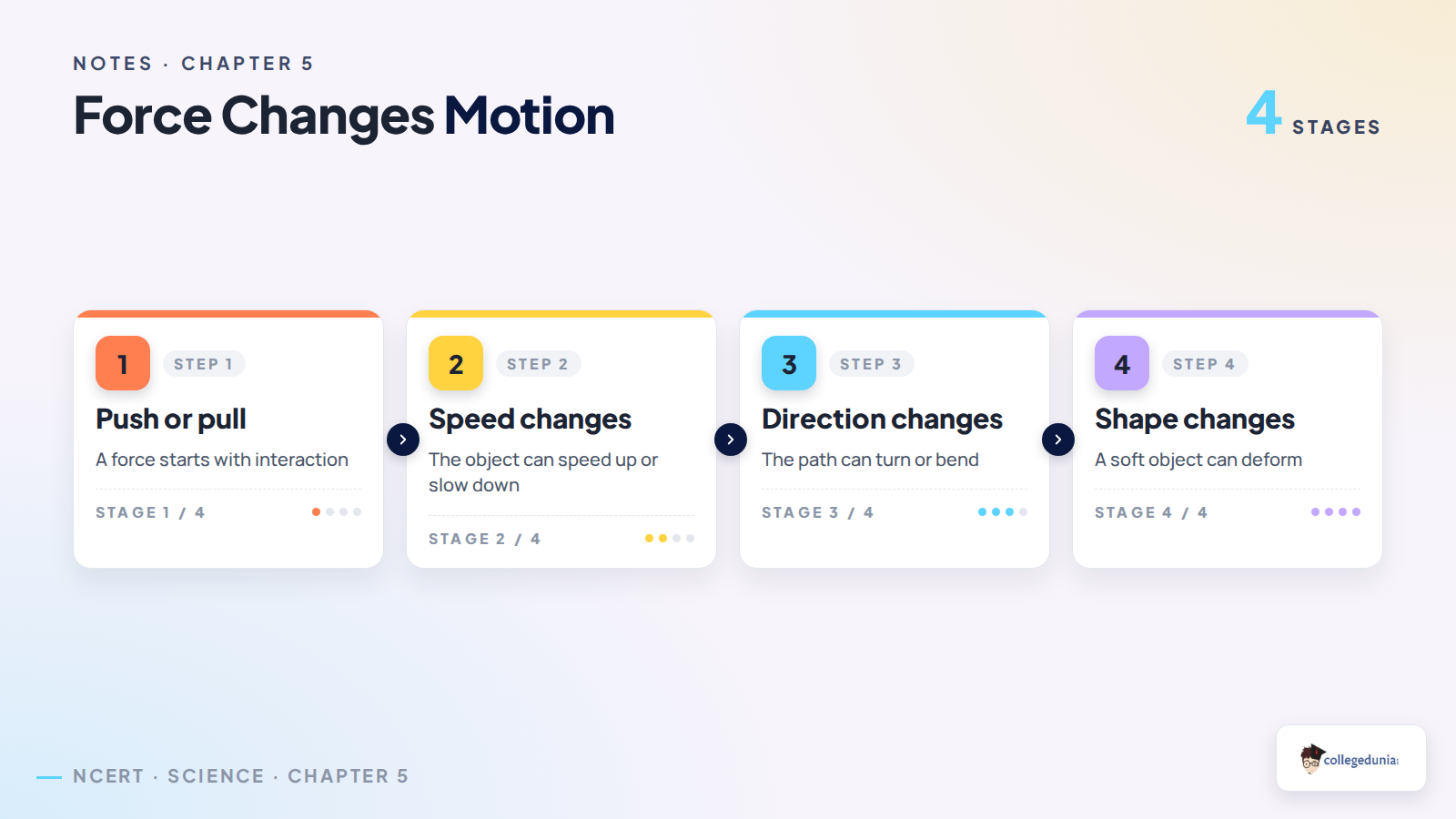
- Push or pull: the starting idea of every force example.
- Effect: speed, direction, shape or more than one change.
- Unit: force is measured in newton, written as N.
Contact and Non-contact Forces in Exploring Forces
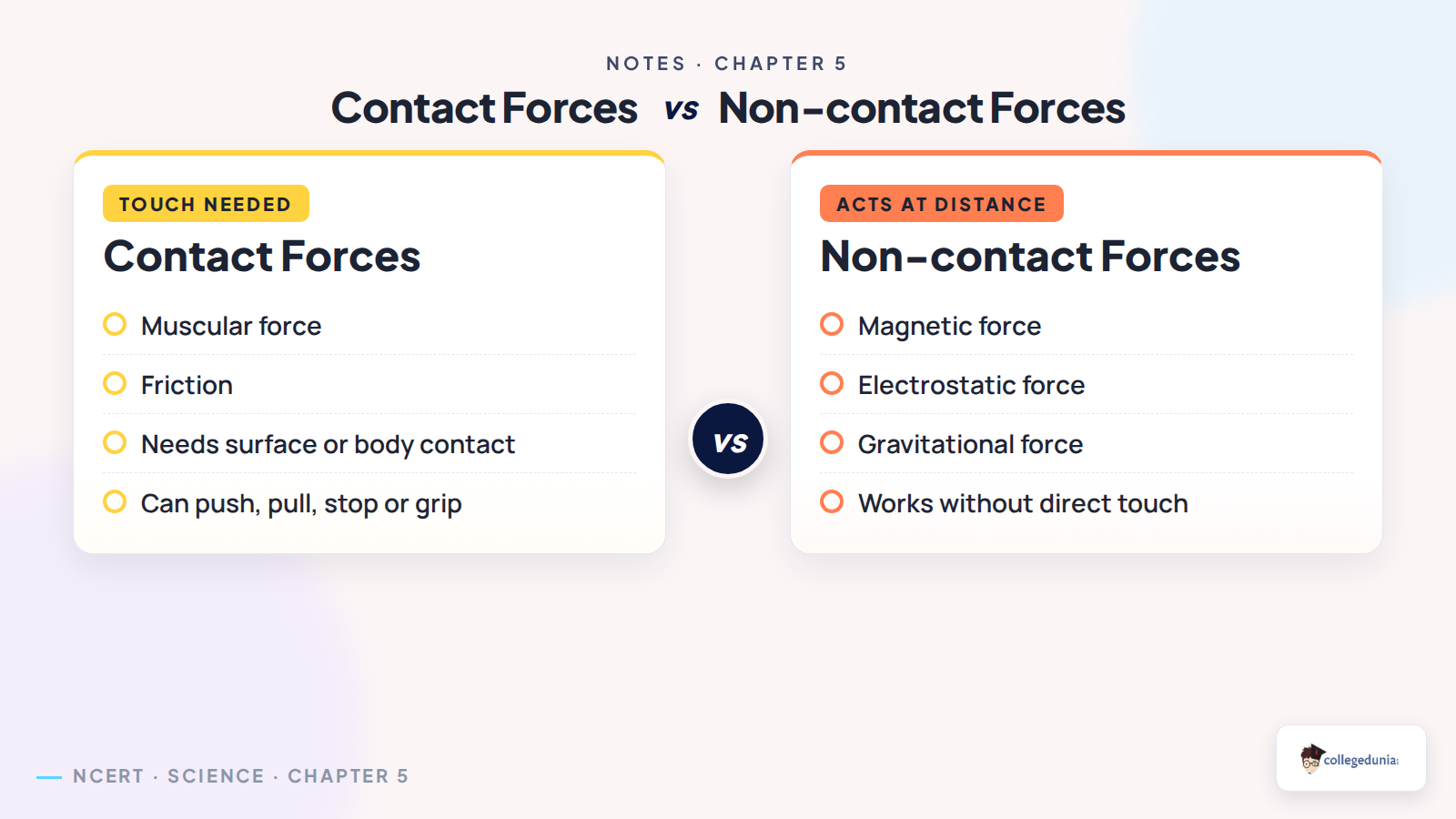
Contact forces act when objects touch. Muscular force and friction are contact forces. Non-contact forces act from a distance. Magnetic force, electrostatic force and gravity are non-contact forces.
| Force type | Needs contact? | Examples |
|---|---|---|
| Muscular force | Yes | Lifting a bag, cycling, pushing a box |
| Friction | Yes | Ball slowing on ground, shoes gripping floor |
| Magnetic force | No | Magnet attracting iron, like poles repelling |
| Electrostatic force | No | Rubbed scale attracting paper pieces |
| Gravity | No | Ball falling back to Earth |
Weight, Spring Balance and Upthrust in Exploring Forces
Weight is the force with which Earth pulls an object. It is measured in newton, while mass is measured in gram or kilogram. A spring balance measures weight by showing how much the spring stretches.
- Range: maximum value an instrument can measure.
- Least count: smallest value the instrument can read.
- Upthrust: upward force applied by a liquid on an object.
- Floating: happens when upthrust balances the object's weight.
Exploring Forces Revision Tables for School Exams
| Common question | Answer clue |
|---|---|
| Why does a ball stop rolling? | Friction acts opposite to motion. |
| Why do rubbed balloons repel? | They get similar charges, and like charges repel. |
| Why does a coin sink in water? | Its weight is greater than the upthrust. |
| Why does weight change on the Moon? | The Moon's gravitational pull is weaker than Earth's pull. |
Exploring Forces Related Resources
| Resource | Link |
|---|---|
| NCERT Solutions | Class 8 Science Exploring Forces NCERT Solutions |
| NCERT Book PDF | Class 8 Science Exploring Forces Book PDF |
| Handwritten Notes | Class 8 Science Exploring Forces Handwritten Notes |
Class 8 Science Curiosity Notes for All Chapters
| Chapter | Notes |
|---|---|
| Chapter 1 | Exploring the Investigative World of Science Notes |
| Chapter 2 | The Invisible Living World Beyond Our Naked Eye Notes |
| Chapter 3 | Health The Ultimate Treasure Notes |
| Chapter 4 | Electricity Magnetic and Heating Effects Notes |
| Chapter 5 | Exploring Forces Notes |
Student Doubts on Exploring Forces Notes
Exploring Forces Class 8 Science Notes FAQs
Ques. What is force in Class 8 Exploring Forces?
Ans. A force is a push or pull on an object due to interaction with another object. It is measured in newton.
Ques. What are contact forces in Exploring Forces?
Ans. Contact forces act only when objects touch. Muscular force and friction are the main contact forces in this chapter.
Ques. What are non-contact forces in Exploring Forces?
Ans. Non-contact forces act without direct touch. Magnetic force, electrostatic force and gravitational force are examples.
Ques. Where can I download Class 8 Science Exploring Forces notes PDF?
Ans. Students can download the free PDF from the PDF card above the article body on this page.



Comments