




The NCERT Solutions for Class 8 Arts (Kriti) Chapter 7 Indian Classical Music help students revise the 2026-27 NCERT chapter through source-based answers on Carnatic tala, Sri Gananatham Bhajare, Raag Asavari, Activity 7.1, Bhakti Sangeet and Sufi Qawwali.
- Resource focus: activity-wise solved answers for Indian Classical Music in Class 8 Arts Kriti.
- Best use: read the textbook notation once, then use the PDF to revise terms, tables and short answers.
- Chapter link: follows Class 8 Arts Kriti Chapter 7 from the 2026-27 NCERT book.
Chapter7IndianClassicalMusicSolutions.pdf?page=1&dpi=150)
Chapter7IndianClassicalMusicSolutions.pdf?page=2&dpi=150)
Chapter7IndianClassicalMusicSolutions.pdf?page=3&dpi=150)
Chapter7IndianClassicalMusicSolutions.pdf?page=4&dpi=150)
Chapter7IndianClassicalMusicSolutions.pdf?page=5&dpi=150)
Chapter7IndianClassicalMusicSolutions.pdf?page=6&dpi=150)
Chapter7IndianClassicalMusicSolutions.pdf?page=7&dpi=150)
Chapter7IndianClassicalMusicSolutions.pdf?page=8&dpi=150)
Chapter7IndianClassicalMusicSolutions.pdf?page=9&dpi=150)
Chapter7IndianClassicalMusicSolutions.pdf?page=10&dpi=150)
Chapter7IndianClassicalMusicSolutions.pdf?page=11&dpi=150)
Chapter7IndianClassicalMusicSolutions.pdf?page=12&dpi=150)
Chapter7IndianClassicalMusicSolutions.pdf?page=13&dpi=150)
Chapter7IndianClassicalMusicSolutions.pdf?page=14&dpi=150)
Chapter7IndianClassicalMusicSolutions.pdf?page=15&dpi=150)
Chapter7IndianClassicalMusicSolutions.pdf?page=16&dpi=150)
Chapter7IndianClassicalMusicSolutions.pdf?page=17&dpi=150)
Chapter7IndianClassicalMusicSolutions_flat_MobileCard.pdf?page=1&dpi=150)
Chapter7IndianClassicalMusicSolutions_flat_MobileCard.pdf?page=2&dpi=150)
Chapter7IndianClassicalMusicSolutions_flat_MobileCard.pdf?page=3&dpi=150)
Chapter7IndianClassicalMusicSolutions_flat_MobileCard.pdf?page=4&dpi=150)
Chapter7IndianClassicalMusicSolutions_flat_MobileCard.pdf?page=5&dpi=150)
Chapter7IndianClassicalMusicSolutions_flat_MobileCard.pdf?page=6&dpi=150)
Chapter7IndianClassicalMusicSolutions_flat_MobileCard.pdf?page=7&dpi=150)
Chapter7IndianClassicalMusicSolutions_flat_MobileCard.pdf?page=8&dpi=150)
Chapter7IndianClassicalMusicSolutions_flat_MobileCard.pdf?page=9&dpi=150)
Chapter7IndianClassicalMusicSolutions_flat_MobileCard.pdf?page=10&dpi=150)
Chapter7IndianClassicalMusicSolutions_flat_MobileCard.pdf?page=11&dpi=150)
Chapter7IndianClassicalMusicSolutions_flat_MobileCard.pdf?page=12&dpi=150)
Chapter7IndianClassicalMusicSolutions_flat_MobileCard.pdf?page=13&dpi=150)
Chapter7IndianClassicalMusicSolutions_flat_MobileCard.pdf?page=14&dpi=150)
Chapter7IndianClassicalMusicSolutions_flat_MobileCard.pdf?page=15&dpi=150)
Chapter7IndianClassicalMusicSolutions_flat_MobileCard.pdf?page=16&dpi=150)
Chapter7IndianClassicalMusicSolutions_flat_MobileCard.pdf?page=17&dpi=150)
Chapter7IndianClassicalMusicSolutions_flat_MobileCard.pdf?page=18&dpi=150)
Chapter7IndianClassicalMusicSolutions_flat_MobileCard.pdf?page=19&dpi=150)
Chapter7IndianClassicalMusicSolutions_flat_MobileCard.pdf?page=20&dpi=150)
Chapter7IndianClassicalMusicSolutions_flat_MobileCard.pdf?page=21&dpi=150)
Chapter7IndianClassicalMusicSolutions_flat_MobileCard.pdf?page=22&dpi=150)
Chapter7IndianClassicalMusicSolutions_flat_MobileCard.pdf?page=23&dpi=150)
Chapter7IndianClassicalMusicSolutions_flat_MobileCard.pdf?page=24&dpi=150)
Chapter7IndianClassicalMusicSolutions_flat_MobileCard.pdf?page=25&dpi=150)
Chapter7IndianClassicalMusicSolutions_flat_MobileCard.pdf?page=26&dpi=150)
Student Feedback: In a Collegedunia study check with 9,800 Class 8 students, 73% said music chapters were easier when tala, raga and devotional forms were revised in separate tables.
Class 8 Arts Kriti Chapter 7 NCERT Solutions Overview
Indian Classical Music introduces students to Carnatic tala practice, a kriti, Hindustani Raag Asavari, devotional music and Sufi Qawwali. The chapter is performance based, but the questions still need exact terms and careful source reading.
The solved PDF keeps the answers short, direct and source-based. Students can revise the seven talas, the three angas, beat counts for alankarams, the parts of Sri Gananatham Bhajare and the lakshana points of Raag Asavari. The main idea is that rhythm, melody and devotion all shape Indian classical music practice.
- Carnatic tala uses angas such as Laghu, Drutam and Anudrutam.
- Sri Gananatham Bhajare is a kriti in Ragam Ishamanohari and Talam Rupaka.
- Raag Asavari is explained through aroh, avroh, pakad, vadi, samvadi and singing time.
- Bhakti Sangeet and Sufi Qawwali show how music expresses devotion.
Carnatic Tala and Alankaram Answers
The chapter lists seven main talas: Dhruva, Mattya, Rupaka, Jhampa, Triputa, Ata and Eka. It also explains that tala patterns are built from Laghu, Drutam and Anudrutam. Students should write both the action and the notation symbol in answers.
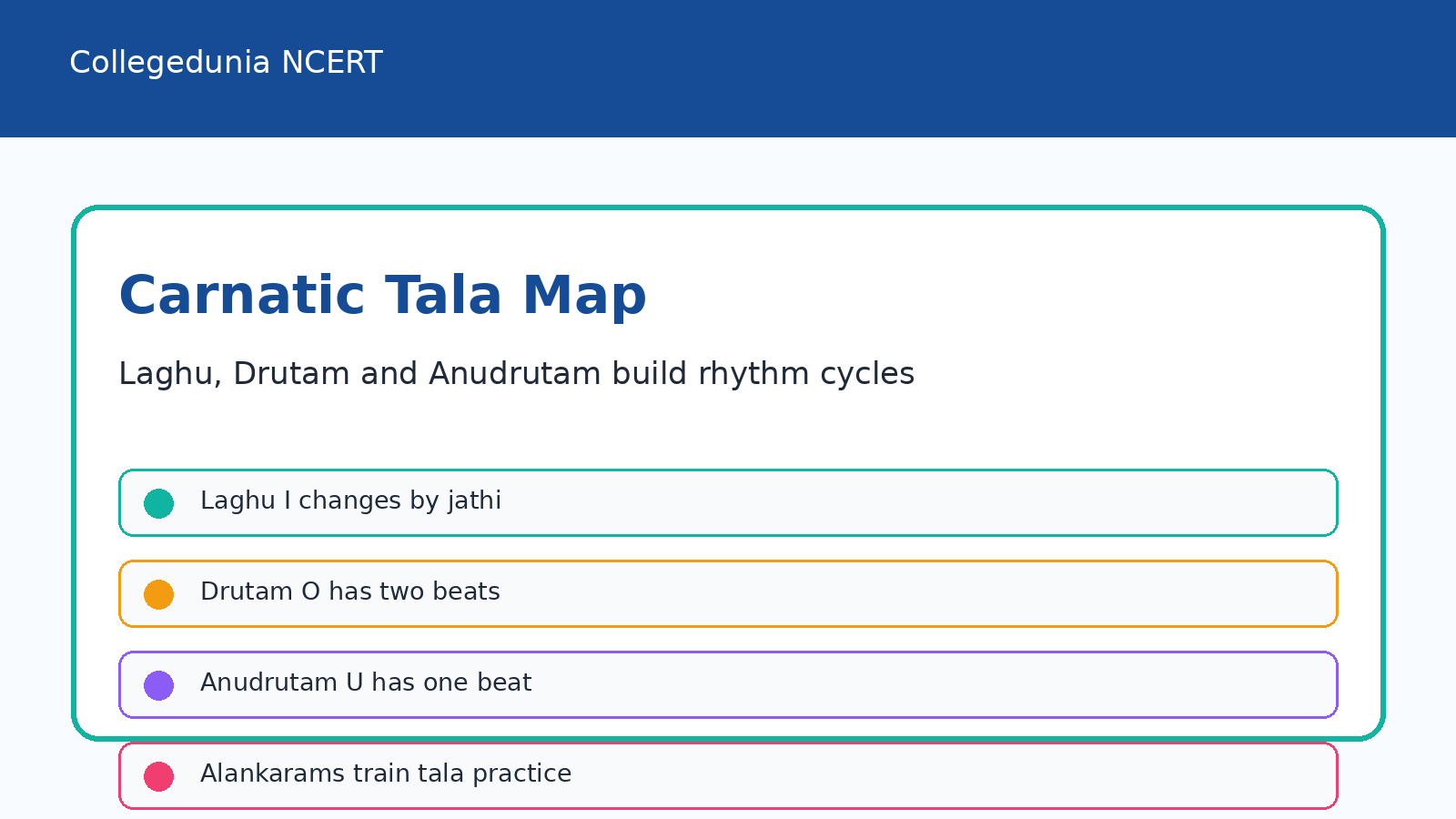
| Term | Notation | Meaning |
|---|---|---|
| Laghu | I | Clap and finger counts |
| Drutam | O | Clap and wave |
| Anudrutam | U | Single beat |
| Mishra Jathi Jhampa | I7 U O | 10 beats |
| Thrisra Jathi Triputa | I3 O O | 7 beats |
Indian Classical Music Video Lesson
Source: Khan Academy on YouTube
Raag Asavari and Devotional Music Guide
Raag Asavari is given with its aroh, avroh, pakad, komal swar, vadi, samvadi and singing time. The chapter then connects Indian music with Bhakti Sangeet and Sufi Qawwali. This makes the chapter both technical and cultural.
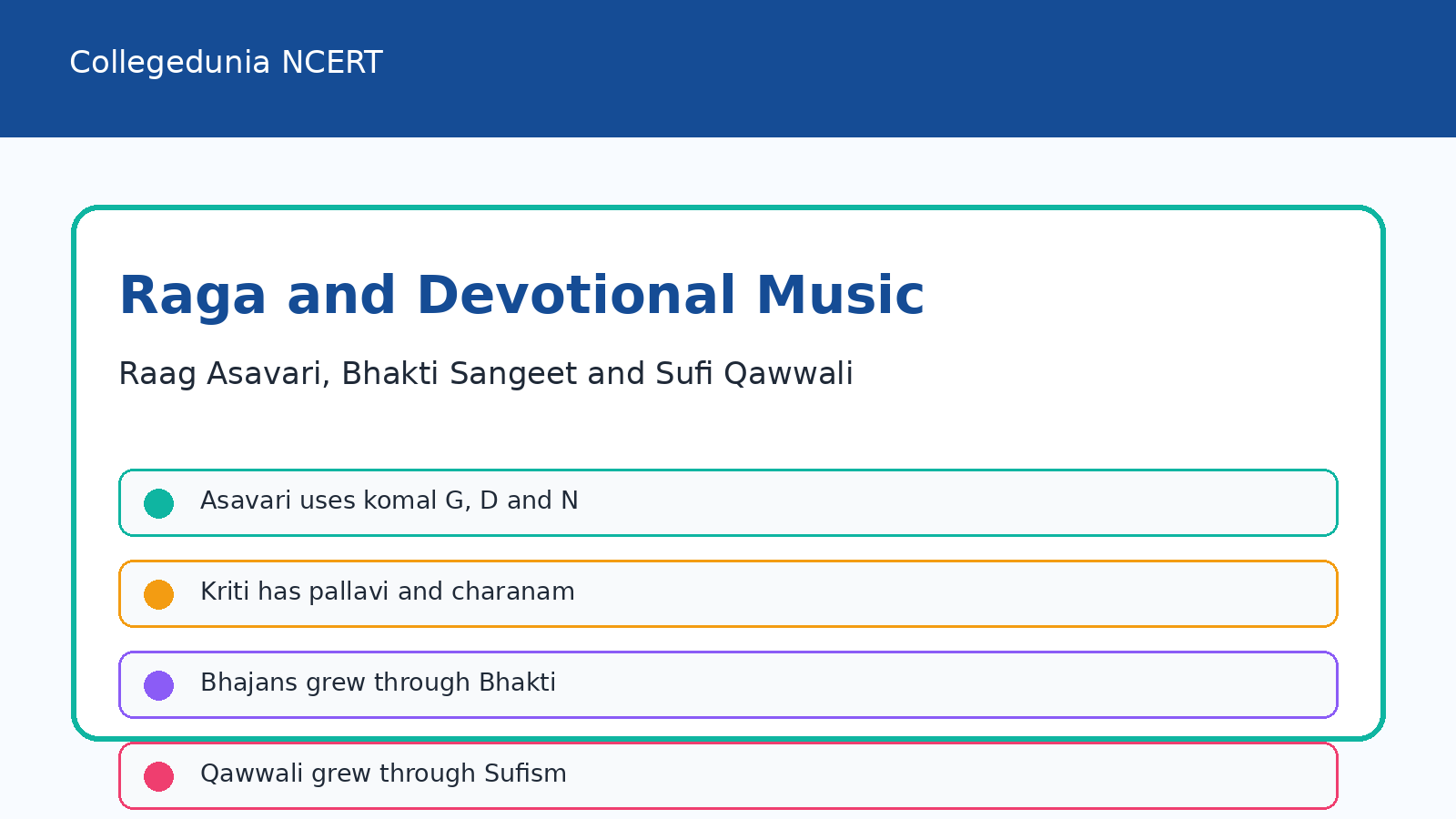
- Raag Asavari: uses komal G, D and N, with Dhaivat as vadi and Gandhar as samvadi.
- Bhakti Sangeet: includes devotional forms such as bhajans and kirtanas.
- Sufi Qawwali: developed from Sufi devotional practice and remains widely performed.
- Activity 7.1: asks students to use accompaniment and tempo changes while singing.
All Chapter 7 Question Cards with Solutions
The full question set is available as companion HTML cards. Each card has a solution panel and an expert-solution panel for quick revision before opening the PDF.
Open question cards: Class 8 Arts Kriti Chapter 7 step-by-step solutions
Common Mistakes in Indian Classical Music Answers
Students often mix up tala names, jathi names and raga details. A better answer copies the exact term from the chapter and then explains it in one simple sentence. The PDF uses this pattern for every answer.
- Do not confuse tala and raga. Tala is rhythm cycle, while raga is melodic structure.
- Do not skip notation. Write I, O and U when explaining tala angas.
- Do not guess Asavari details. Use the lakshana table from the chapter.
- Do not treat Bhakti and Sufi music as the same form. They are both devotional, but their traditions and forms differ.
Class 8 Arts Kriti Chapter 7 Related Resources
| Resource | Class 8 Arts Kriti Chapter 7 Link |
|---|---|
| Handwritten Notes | Indian Classical Music Handwritten Notes |
| Chapter 7 Question Cards | Indian Classical Music step-by-step answers |
Class 8 Arts Kriti NCERT Solutions for All Chapters
| Chapter | NCERT Solutions |
|---|---|
| Chapter 2 One Stage, Many Scripts | Download Chapter 2 NCERT Solutions |
| Chapter 3 From Page to Stage | Download Chapter 3 NCERT Solutions |
| Chapter 4 Applause and Advice | Download Chapter 4 NCERT Solutions |
| Chapter 5 Discovering the Elements of Music | Download Chapter 5 NCERT Solutions |
| Chapter 6 Musical Instruments | Download Chapter 6 NCERT Solutions |
Indian Classical Music Class 8 Arts Kriti NCERT Solutions FAQs
Ques. What is covered in Class 8 Arts Kriti Chapter 7 NCERT Solutions?
Ans. The solutions cover Carnatic tala, tala angas, Sri Gananatham Bhajare, Raag Asavari, Activity 7.1, Bhakti Sangeet and Sufi Qawwali.
Ques. Are these Chapter 7 solutions based on the 2026-27 NCERT book?
Ans. Yes. The PDF follows Class 8 Arts (Kriti) Chapter 7 Indian Classical Music from the 2026-27 NCERT textbook.
Ques. What are the three tala angas in this chapter?
Ans. The three angas are Laghu, Drutam and Anudrutam, notated as I, O and U respectively.
Ques. What is Activity 7.1 about?
Ans. Activity 7.1 asks students to accompany a composition on an instrument and explore mood changes by singing at slower and faster tempo.



Comments