



Education Journalist | Study Abroad Lead
Acid-Base Titration can be defined as a method of quantitative analysis that is used for determining the concentration of an acid or base. This concentration of an acid or base is determined by neutralizing it with a standard solution of base or acid having a known concentration. In Acid-Base Titration, an acid is titrated with a base, and a base (alkali) is titrated with an acid. Acid-Base Titration is a method used in experiments to learn more about a solution containing an acid or base. One can ascertain whether they have acidic or basic qualities using titration.
| Table of Content |
Key Terms: Titration, Neutralization, Acid, Base, Solution, Concentration, Indicator, Endpoint, Redox, Participation
Acid-Base Titration
[Click Here for Sample Questions]
An acid-base titration is a qualitative analysis technique for precisely neutralizing acid or base with a uniform base or acid solution of known concentration. It is crucial to understand that not all chemical reactions are titrations. Only if a reaction complies with certain requirements can it be referred to as a titration. In order to evaluate whether a reaction is a titration, the following factors must be met:
- The response must be quick.
- For the reaction to be spontaneous, the change in free energy during the reaction must be sufficiently large.
- There must always be a method to determine whether a response is complete.
Also Read:
History of Acid-Base Titration
[Click Here for Previous years Questions]
Guillaume-François Rouelle first proposed the acid-base reaction in 1754, referring to a substance that reacts with an acid to change it into a solid by using the name "base" (in the form of a salt). Most bases have an unpleasant taste to them.
Read More: Types of Titration
Example of Acid Base Titration
[Click Here for Sample Questions]
When performing titrations, precise volume measurements are crucial. The titration tool in use is known as a burette. It is a kind of liquid dispensing device that accurately displays the volume of a liquid. Take this as a practical example. Consider titrating an unknown quantity of NaOH with 25.66 ml (0.02566 L) of 0.1078 M HCL. How much NaOH was present in the sample?
The amount of HCL that has been reacted can be calculated as follows:
mol HCL = (0.02566) (0.1078 M) = 0.002766 mol HCL
Additionally, the chemical equation interaction between HCL and NaOH is balanced: HCL + NaOH = NaCl + H2O
In order to translate the quantity of NaOH that reacted, we can now create a conversion factor. 0.002766 mol HCL x 1 mol NaOH /1 mol HCL = 0.002766 mol NaOH
Now, using the molar mass of NaOH, we can convert this amount to mass (40.00G/mol). 0.002766 mol HCL x 40.00 g NaOH / 1 mol HCL = 0.1106 g NaOH. The sample contains 0.1106 g of NaOH.
Titration includes this calculation.
Apparatus of Titration
[Click Here for Previous years Questions]
Here is the apparatus set up for acid-base titration:
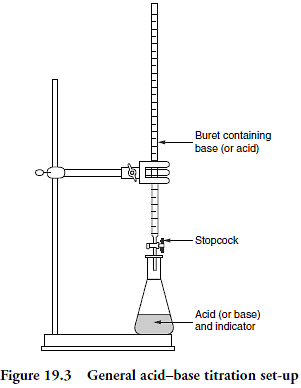
Apparatus set up for acid-base titration
Read More: Conductometric Titration
Procedure
[Click Here for Sample Questions]
- Using a pipette, a known volume of the solution is added to the titration flask.
- The other solution is injected into the burette, which is graduated in cubic centimeters and has a stop cock at the bottom to regulate the flow into the flask.
- The solution that has to be titrated is placed in the flask and is known as the titrating, while the solution that needs to be used for the titration is placed in the burette and is known as the titrant.
The endpoint or equivalence point refers to the point at which the volume of one solution has been added to the other to precisely finish the reaction between the two.
Read More: Difference between Endpoint and Equivalence Point
Types of Acid-Base Titration
[Click Here for Previous years Questions]
The following table lists several types and instances of strong and weak acids and bases.
| Types | Examples |
|---|---|
| Strong acid - Strong base | Hydrochloric acid and sodium hydroxide |
| Weak acid - Strong base | Ethanoic acid and sodium hydroxide |
| Strong acid - Weak base | Hydrochloric acid and ammonia |
| Weak acid - Weak base | Ethanoic Acid and ammonia |
Titration Curves
[Click Here for Sample Questions]
The equivalency point in titration is the point at which precisely the same quantity of hydroxide ions and hydrogen ions have been introduced. Titration is complete if the base is added from the burette and the acid has been precisely measured into a flask. Each and every titration curve has a form that is typical for the particular acid-base titration. As the acid is introduced, the pH does not alter consistently. Each curve features horizontal areas where a large number of bases can be added without significantly altering the pH. Except for weak acid and weak base, when a single drop of the base affects the pH by several units, each curve also has a very steep part. Even though the equivalency point is not centered on pH 7, there is a significant pH change there. This has an impact on the indicators selected for each sort of titration.
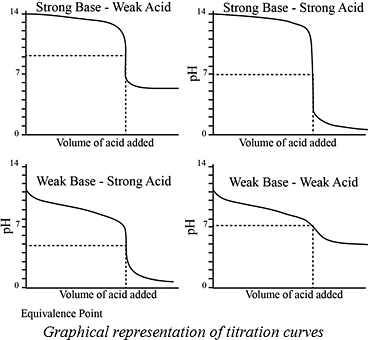
Graphical Representation of titration curves
Acid-Base Indicator
[Click Here for Previous years Questions]
Acid-base indicators are compounds that, at a specific pH, change color or become turbid. They measure pH in addition to locating the equivalency point. They exhibit significant color changes, are soluble, and are themselves acids or bases. They have organic makeup. The change in color is caused by an electron isomerism resonance. Varying indicators exhibit a change in color at various pH intervals because they have different ionization constants. Three general categories can be used to organize acid-base indicators are:
- The phthaleins and sulphophthaleins (e.g.; Phenolphthalein)
- Azo indicators (e.g.; Methyl orange)
- Triphenylmethane indicators (e.g.; Malachite green)
Selection of Suitable Indicator
The indicator used should change color in the same pH range as needed around the equivalence point.
- Any indication from methyl orange, methyl red, phenolphthalein, or bromothymol blue can be used to calculate the endpoint for a titration of a strong acid against a strong base.
- Only phenolphthalein is an indicator that works well for titrating weak acids like acetic acid against strong bases.
- Methyl orange, methyl red, or bromothymol blue can all be employed as indicators for titrating weak bases against strong acids.
- No indication has been discovered to operate adequately for the titration of a weak acid with a weak base.
Read More: Titration of Hydrochloric Acid against Standard Sodium Carbonate
Things to Remember
- An acid-base titration is a qualitative analysis technique for precisely neutralizing acid or base with a uniform base or acid solution of known concentration.
- An acid is titrated with a base and a base is titrated with an acid.
- Acid-base indicators are compounds that, at a specific pH, change color or become turbid.
- Varying indicators exhibit a change in color at various pH intervals because they have different ionization constants.
- There are four types of acid-base titration- Strong acid–strong base, Weak acid–strong base, Strong acid–weak base, and Weak acid–weak base.
Previous Years Questions
- What Is The Correct Increasing Order Of Bronsted
- Which Of The Two Acids Form Anhydrides I Oxalic Ac
- The Sequence Of Acidic Character Is
- The Pk A Of Acetylsalicylic Acid Aspirin Is 3 5 Th
- The Ph Value Of N 10 Naoh Is
- The Ph Value Of 0 001 M Aqueous Solution Of Nacl I
- The Ph Range For Phenolphthalein Is
- The Ph Of Tears Coming Out Of A Person S Eye Is Ap
- The Ph Of Succus Entericus Is
- The Ph Of Neutral Water Is 6 5 Then The Temperatur
- The Ph Of Human Urine Is Approximately
- The Ph Of D 2o And H 2o At 298 K Is
- The Ph Of A Solution Prepared By Mixing 2 0 Ml Of
- The Ph Of A 0 1 M Aqueous Solution Of Nh 4oh Is K
- The Dissociation Constants Of Two Acids Ha 1 And H
- The Conjugate Base Of Hpo 2 4 Is
- The Bronsted Acid Which Gives The Weakest Conjugate
- Species Acting Both Bronsted Acid And Base Is
- One Of The Following Is A Bronsted Acid But Not A
- Nh 4oh Is A Weak Base But It Becomes Still Weaker
Sample Questions
Ques. Which learning goals are associated with titration? (3 Marks)
Ans. Finding the causes of the common reaction that occurs in every lab because so many substances can act as bases and acids is one of the learning objectives. This reaction produces salt and water. Another reason is that acid-base reactions are frequently seen; as a result, they are frequently used to quantify the amount of one or the other. The titration procedure is now used to perform a chemical reaction in order to quantitatively identify the exact amount of a reagent. Almost any chemical reaction for which we have a balanced chemical equation can be the subject of titration.
Ques. What are some uses for acid-base titration? (2 Marks)
Ans. By neutralizing it with an acid or a base with a known concentration, an acid-base titration is performed to determine the unknown acid or base concentration. The reaction's stoichiometry can be used to determine the unknown concentration.
Ques. What is the exact process for carrying out an acid-base titration? (5 Marks)
Ans. The process of carrying out an acid-base titration is:
- Determining OH-: We must first identify the OH- because we are aware that every mole of NaOH contains at least one mole of OH-.
- Calculating the amount of OH- moles: The next step is to determine the number of OH- moles that are present. This can be done by using the following formula:
- Counting the quantity of H+ moles: The number of moles of H+ must be determined since it is identical to the number of moles of OH- after the acid is neutralized by the base, which is the third crucial step to keep in mind.
- Calculating the HCl concentration: Finding out the concentration of HCL is the fourth and final stage to keep in mind because every mole of HCL creates one mole of H+, making the number of moles of HCl equal to the number of moles of H+. There is a straightforward formula to determine the HCL concentration:
Molarity = No of moles/volume
Ques. How do the titration indicators function? (3 Marks)
Ans. An acid with a known concentration or a standard solution is progressively introduced to a base that is unknown in an acid-base titration procedure. The procedure is also reversible. A base is now given a few drops of an indicator solution. When the colour of the solution changes, the indicator will alert. The titration comes to a conclusion at the equivalent point, which is when H+ equals OH-, neutralizing the base. Calculations allow us to determine the concentration of the other solution when we are aware of the quantities of the acid and base that were employed as well as the concentration of the standard solution.
Ques. How is an indicator chosen for acid-base titrations to detect pH changes? (3 Marks)
Ans. An indicator is a substance that changes colour as an element in a solution gains or loses an electron. Methyl orange, for instance, provides a red colour to solutions that are extremely acidic (pH 1-3), an orange colour to solutions that are slightly acidic (pH 3-5), and yellow colour to solutions that are basic (pH > 5). Phenolphthalein, however, does not add colour to acidic solutions and only adds a vivid pink hue to basic solutions (pH > 8). So, based on the chemical reaction, the indication is chosen.
Ques. How many different titration techniques exist in addition to acid-base titration? (5 Marks)
Ans. Titration is a crucial concept that is likely to come up in exams, students should memorize the four primary forms of titrations used in chemistry. The following are the four categories of titrations:
- Acid-base Titration: One of the four titration techniques, acid-base titration is a quantitative method for analyzing and determining the concentration of bases or acids in a solution by accurately neutralizing them with the use of a standard solution, which could be either a base or an acid of known concentration.
- Complexometric Titration: We can determine the complexometric titrations when an undissociated complex forms at an equivalency point.
- Precipitation Titration: Precipitation titration is based primarily on the production of an insoluble precipitate when two reacting chemicals come into contact with one another.
- Redox Titration: The chemical process known as redox titration involves the transfer of electrons among the reacting ions in aqueous solutions. A common alternative name for redox titration is an oxidation-reduction reaction.
Ques. Give examples of acid-base indicators. (3 Marks)
Ans. Red cabbage juice, litmus paper, phenolphthalein, and other substances are examples of acid-base indicators. The weak acid and its conjugate base, or the weak base and its conjugate acid, are produced when a weak acid or weak base dissociates in water. The species and their hybrids come in a variety of hues.
Ques. What safety measures apply to acid-base titration? (3 Marks)
Ans. Precautions taken during acid base titration are:
- Burettes should first be tight and leak-free.
- Furthermore, always read the lower meniscus in colourless solutions and the upper meniscus in coloured solutions.
- Third, use caution when pipetting acid.
- Fourthly, caution should be taken when handling acids and bases.
Ques. Define the following: (3 Marks)
Titration
Equivalence Point
Buffer Solution
Ans. Titration: Titration is a procedure in which a volume of a treated sample containing an indicator is introduced to a solution of known strength. Equivalence Point: The equivalence point is the point at which only a sufficient amount of reagent is added to cause a substance to react totally. Buffer Solution: A substance that maintains its pH balance even after being diluted with water if a strong acid or base is introduced.
Ques. In an acid-base titration, which indicator is used? Give reason. (2 Marks)
Ans. Strong acid-strong base titration is done with a phenolphthalein indicator. Because it exhibits colour changes in the pH range of 8.3 to 10, phenolphthalein was chosen. This indicator will be pink in basic solutions and clear in acidic ones.
For Latest Updates on Upcoming Board Exams, Click Here: https://t.me/class_10_12_board_updates
Also check:



Comments