



Education Journalist | Study Abroad Lead
Acids donate protons when they are dissolved in water. It is a sour chemical that turns blue litmus red and neutralizes bases when dissolved in water. Bases, on the other hand, have a bitter taste, turn red litmus blue, and neutralize acids.
- Acid is a chemical that forms a bond by donating protons or accepting a pair of valence electrons.
- A base is a material that can absorb protons or contribute a pair of valence electrons to create a bond.
- The experiments on acids and bases help to determine their properties
- The purpose of the experiment is to investigate the characteristics of acids (dilute HCl) and bases (dilute NaOH) using Litmus solution (red/blue), zinc metal, and solid sodium carbonate.
Key Terms: Acids, Bases, pH Test, Litmus Paper, Chemical Reactions, Zinc Metal, Sodium Carbonate, Hydrochloric Acid, Sodium Hydroxide
Aim
[Click Here for Sample Questions]
To study the properties of acids (dilute HCl) and bases (dilute NaOH) using the following –
- Solid sodium carbonate
- Litmus solution (red/blue)
- Zinc metal
Materials Required
[Click Here for Sample Questions]
The materials required for understanding the properties of acids and bases through an experiment are –
- Test Tube Stand, Test tube holder, Test Tubes
- Cork
- Boiling tube
- Droppers
- Flat bottom flask, Thistle funnel, and beakers
- Burner and Matchbox
- Litmus paper/solution
- Fresh lime water
- Glass rod
- Dilute HCl
- Dilute NaOH
- Zinc granules
- Solid sodium carbonate
Read More: Sodium Bicarbonate
Theory of Acids and Bases
[Click Here for Sample Questions]
What is Acid?
Acids are chemical entities that contribute protons or release H+ ions when dissolved in water.
- They change the color of the blue litmus solution to red.
- Zinc chloride and hydrogen gas are formed when hydrochloric acid combines with zinc metal. The following is the reaction:
Zn(s) + 2HCl(aq) → ZnCl2(aq) + H2(g)
- As calcium carbonate is formed, hydrochloric acid combines with Na2CO3 to create carbon dioxide, turning the lime water milky.
When the solution is exposed to more carbon dioxide than is required, the milkiness that has developed vanishes. The following is the reaction:
- Na2CO3 (s/aq) + 2HCl (aq) → 2NaCl (aq) + H2O (l) + CO2 (g) [CO2 develops milkiness]
- Ca(OH)2 (aq) + CO2 (g) → CaCO3 (s) + H2O (l) [Milkiness Vanishes]
- CaCO3 (s) + H2O (l) + CO2 (g) → Ca(HCO3)2 (aq)
Viva VoceQues. The ions released by bases when they dissolve in water are? Ans: Hydroxide (OH–) ions. Ques. What is the formula of Hydrochloric Acid? Ans. HCl Ques. What is the color of Zn granules when they react with HCl? Ans. Black |
What is Base?
Bases are chemical entities that emit OH– ions when dissolved in water.
- Sodium hydroxide is a powerful base with a pH value of above 7. As a result, the red litmus solution becomes blue.
- When sodium chloride interacts with zinc metal, sodium zincate and hydrogen gas are formed. The following is the reaction:
Zn (s) + 2NaOH (aq) → Na2ZnO2 (aq) + H2 (g)
- As both sodium hydroxide and solid sodium carbonate are basic, they do not react.
Na2CO3 (s) + NaOH (aq) → no reaction
- Salt is made when sodium hydroxide neutralizes hydrochloric acid (sodium chloride)
NaOH(aq) + HCl(aq) → NaCl(aq) + H2O(l)
Read More:
Procedure of the experiment
[Click Here for Sample Questions]
The experiment can be performed in the following way –
-
Experimental Setup for Litmus Test Procedure
Acids
- Place two test tubes on top of a test tube stand.
- Test tubes 1 and 2 should be labeled as such.
- Fill test tube 1 with 5 mL of blue litmus solution.
- In test tube 2, pour 5 mL of red litmus solution.
- Fill both test tubes with equal amounts of hydrochloric acid using a dropper.
- Keep an eye on the color change.
Base
- Take two test tubes and place them in a test tube stand.
- Label them as test tubes 1 and 2.
- Add 3 mL of blue litmus solution to test tube 1.
- Add 3 mL red litmus solution to test tube 2.
- Using a dropper, add equal amounts of sodium hydroxide to both test tubes.
- Observe the color change.
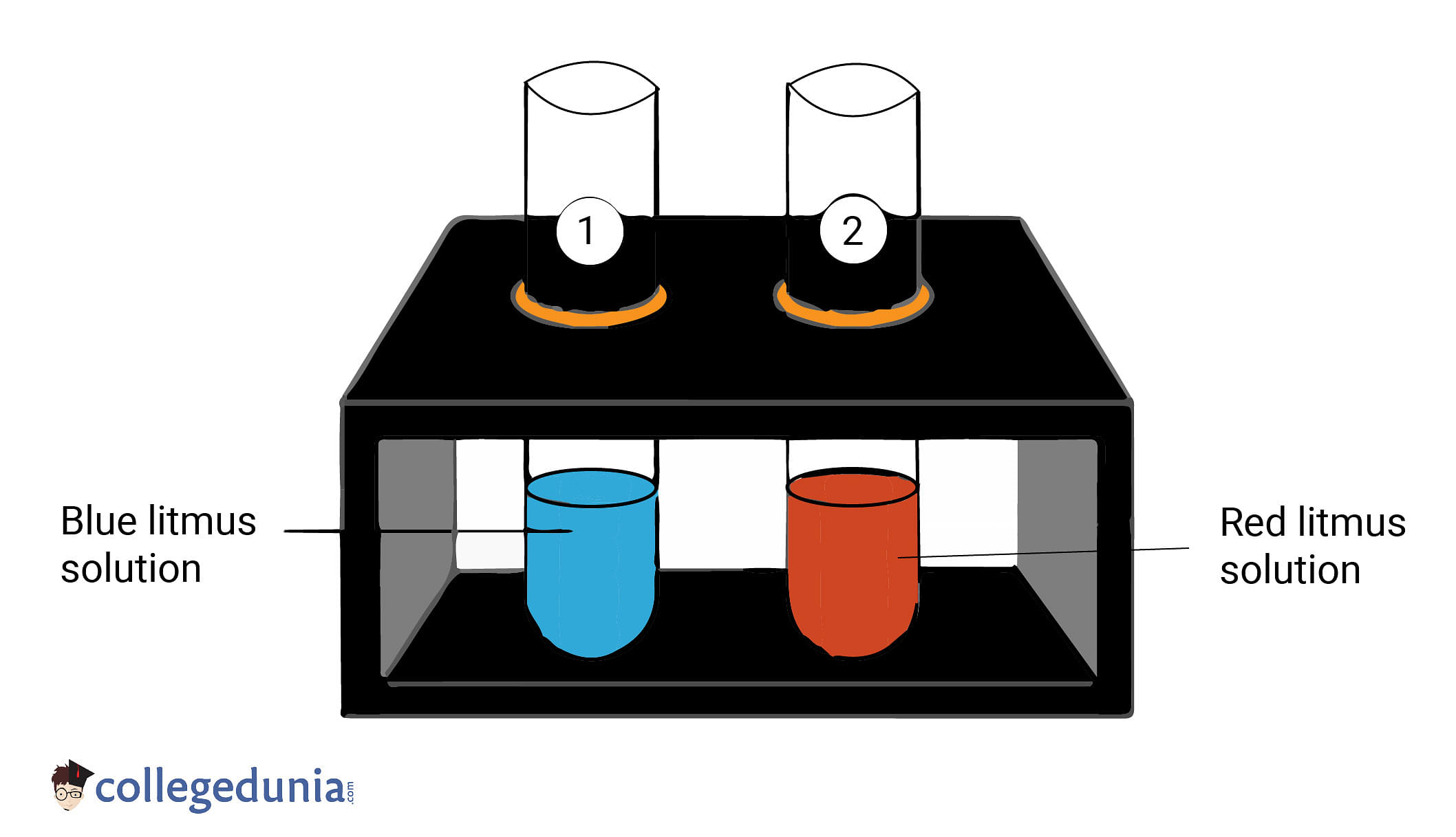
Reactions of Acids and Bases with Litmus
Read More: Difference Between Acid and Base
-
Reaction with Zinc Metal
Acids
The steps to test acid properties with Zn metal are as follows –
- Take a dry and clean test tube.
- Toss in some zinc granules in the test tube.
- Add hydrochloric acid to the test tube to submerge the zinc granules.
- Close the test tube's mouth with a cork.
- Between 2-3 minutes, a powerful explosion occurs, releasing a colorless and odorless gas.
- When a lit match is placed at the mouth of the glass tube, the gas emits a faint blue flame with a pop sound.
The reaction of Zinc with HCL will be –
2HCl (aq) + Zn(s) → ZnCl2(aq) + H2↑

Bases
- Take a dry test tube and clean it.
- Add some zinc granules to it.
- Add sodium hydroxide to the test tube so that the zinc granules are submerged.
- Use a cork to close the mouth of the test tube.
- A powerful explosion takes place in 2 to 3 minutes and odorless and colorless gas is released.
- When you place a lit match near the glass tube's mouth, the gas emits a faint blue light and a pop sound.
The reaction of Zinc with NaOH will be –
2NaOH(aq) + Zn(s) → Na2ZnO2(aq) + H2↑
Read More: List of Strong Acids
-
Reaction with Solid Sodium Carbonate
Acid
- Fill a flat-bottom flask halfway with distilled water and 1 gram of solid sodium carbonate.
- Take a double-bore cork and thistle funnel with a delivery tube that is clean and dry.
- With the double-bore cork, close the mouth of the flat flask.
- Add 2 mL of diluted hydrochloric acid to the mixture.
- The gas is colorless and odorless, and it passes through the lime water via the delivery tube.
- The lime water's color shifts to a milky white.
The reaction will be
Na2CO3(s/aq) + 2HCl(aq) → 2NaCl(aq) + CO2↑+ H2O(l)
Ca(OH)2(aq) + CO2↑ → CaCO3(s) + H2O(l)
CaCO3(s) + H2O(l) + CO2(g) → Ca(HCO3)2(aq)

Base
- In a test tube, place 1 gm of solid sodium carbonate.
- Fill the test tube with a few drops of NaOH using a dropper.
- There are no visible reactions.
Read More: Examples of Weak Acids
Observations
[Click Here for Sample Questions]
Acid
| Experiment | Observation |
|---|---|
| Litmus Test | In test tube 1, the blue litmus solution turns red, however, there is no change in color in test tube 2 with the red litmus solution. |
| Reaction with Zinc metal | Acids such as HCl react with active metals such as zinc to liberate hydrogen gas. The gas burns with a pop sound when a burning splinter is brought near it. |
| Reaction with Na2CO3 | Sodium carbonate and hydrochloric acid react and produce carbon dioxide gas that turns lime water milky. When excess CO2 gas is passed through the solution, the milkiness is disappeared. |
Base
| Experiment | Observation |
|---|---|
| Litmus Test | There is no change in color in test tube 1 (blue litmus solution) while the red litmus solution in test tube 2 turns blue. |
| Reaction with Zn metal | Bases such as NaOH react with active metals such as zinc to release hydrogen gas. The gas ignites with a pop sound when a burning splinter is placed close to it. |
| Reaction with Na2CO3 | There is no reaction between NaOH and Na2CO3. |
Read More: Phenolic Acid
Result
[Click Here for Sample Questions]
The results of the experiment to determine the properties of acids and bases are as follows –
- When hydrochloric acid is added to the blue litmus solution in the litmus test, it becomes red.
- When sodium hydroxide is added to the red litmus solution in the litmus test, it becomes blue.
- On the combination of hydrochloric acid with active metals like zinc, zinc chloride is formed, and hydrogen gas is liberated.
- When sodium hydroxide combines with active metals like zinc, sodium zincate is formed, and hydrogen gas is released.
- When HCl combines with sodium carbonate, carbon dioxide gas is produced.
- Sodium carbonate does not react with NaOH.
Hence, acids like HCl have an acidic nature, and bases such as NaOH have a basic nature.
Read More:
| Chapter Related Articles | ||
|---|---|---|
| Aluminum Hydroxide | Lewis acid and base | Aluminium phosphate |
| Acid Strengths | Citric Acid | Importance of pH in everyday life |
Precautions to be taken during the experiment
[Click Here for Sample Questions]
The precautions to take care of in the case of the experiment is as follows –
- Clean test tubes are used for the experiment.
- As HCl is caustic, it should be handled with caution.
- As NaOH is corrosive, do not heat the zinc and NaOH combination to the boiling point.
- To carry out the experiments, you'll need a modest amount of ingredients.
- Do not spill the solution or reaction mixture while shaking.
- Pass carbon dioxide gas through the solution and shake the test tube by pressing your thumb on its mouth to get speedy results for the lime water test.
Acids and Bases Experiment – Viva VoceQues. If the pH of a solution is 8.3, what is it? Ans. Less acidic Ques. Why there is no reaction between Na2CO3 and NaOH? Ans. They do not react as they both are alkali. Ques. What is formed when CO2 gas is passed through lime water? Ans. CaCO3 is formed which turns the lime water milky. Ques. Which gas is evolved when dilute HCl is added to a test tube containing zinc metal leading to the evolution of gas bubbles? Ans. Hydrogen (H2) gas is evolved. Ques. What can be used to identify the gas evolved when dilute HCl reacts with zinc metal? Ans. A burning splinter can be used. |
Read More: Acids, Bases and Salts Revision Notes
Things to Remember
- Acids are chemical entities that release protons or H+ ions when dissolved in water.
- Acids cause the blue litmus solution to turn red.
- Bases are chemical entities that release OH– ions when dissolved in water.
- With a pH of greater than 7, sodium hydroxide is a strong basic.
- Bases turn red litmus solution into the blue.
- Zinc chloride is created when hydrochloric acid reacts with active metals like zinc, and hydrogen gas is generated.
- Sodium zincate is generated when sodium hydroxide reacts with active metals like zinc, releasing hydrogen gas.
- When HCl reacts with sodium carbonate, carbon dioxide gas is generated.
- NaOH is not reactive with sodium carbonate.
Sample Questions
Ques. What are the characteristics of acids? (5 Marks)
Ans. The following are the properties of acids:
- Electrolytes are acidic aqueous solutions that conduct electricity due to their acidity.
- Few acids are classified as potent electrolytes because they totally ionize in water and create a considerable quantity of ions.
- When acids are dissolved in water, which is mostly non-ionized, they are weak electrolytes.
- Acids have a sour aftertaste. Acid-containing foods include lemons, vinegar, and sour candies.
- When exposed to acids, some acid-base detectors change color. Two frequent indicators are litmus and phenolphthalein. When exposed to oxygen, blue litmus turns crimson.
- Combining acids and bases produces salt compounds and water.
Ques. What are some of your go-to bases, and how do you employ them? (3 Marks)
Ans. The following are several bases, along with their chemical formulas and applications:
- Soaps and detergents, as well as oven and drain cleaners, all include sodium hydroxide or NaOH.
- The chemical compound calcium hydroxide (Ca(OH)2) is used to manufacture cement and lime water. It is also used to make acidic soil less acidic.
- Ammonia, or NH3, is a chemical component that is utilized in the manufacture of several medicinal products as well as commercial cleaning solutions. This chemical is used to make fertilizers.
Ques. When you say alkaline, what precisely do you mean? Is it true that alkalinity is present in all bases? (2 Marks)
Ans. Although they are not the same, basic solutions are frequently referred to as "alkaline." All bases are not alkalis since they are not soluble in water. Bases that dissolve in water to produce the hydroxyl ion (OH-) are known as alkalis, and they are all Arrhenius bases.
Water-soluble alkalis, such as barium carbonate, become water-soluble after interacting with an acidic solution containing water. Chemical substances that can receive hydrogen ions are known as bases.
Ques. What role do acids and bases have in our bodies? (1 Mark)
Ans. Acids and bases are necessary for living things because our food must be processed in an acidic or alkaline environment. Many enzymes operate exclusively at certain pH levels, and we require either acid or base to keep them working.
Ques. Define the base and state its characteristics. (5 Marks)
Ans. Although bases are not as widespread as meals, they may be found in a variety of household items. Many cleaners include ammonia, which is basic. Sodium hydroxide is found in drain cleaning. Antacids are antacids that are used to treat ulcers in the stomach. Bases have several qualities that are diametrically opposed to those of acids.
- Bases are dissolved in water to form electrolytes. Bases, like acids, can be either strong or weak.
- Bases have a strong flavor and are present in fewer foods than acids. Various bases, such as soaps, are extremely slippery to the touch.
- The colors of indicators are also affected by the bases. In the presence of a base, litmus turns blue, whereas phenolphthalein turns pink.
- Acids react with metal, whereas bases do not.
- The interaction of base and acids produces salt and water.
- It is important to remember that tasting and touching chemicals is not a good lab practice and should be always avoided.
Ques. When dry litmus paper is exposed to dry HCl gas, why does the color of the paper not change? (1 Mark)
Ans. Because HCl does not produce hydrogen ions, it has no acidic properties, and the color of the litmus paper does not change when it interacts with HCl gas.
Ques. Why can't typical indicators tell you what a solution's pH is? (3 Marks)
Ans. Common indicators like litmus, methyl orange, and phenolphthalein can quickly tell us if a solution is acidic or alkaline, but they cannot tell us how much stronger one acidic solution is than another. It implies they are unable to accurately determine the pH of various acidic or alkaline solutions. We cannot identify the difference between pH levels of 5,6 and 7 in the case of litmus. Similarly, pH readings between 3 and 8 will not be particularly accurate in the case of methyl orange.
Ques. How can one tell the difference between acids and bases? (3 Marks)
Ans. Since acid is a contributing product, count the number of hydrogens before and after the reaction to determine if the supplied chemical is acid or basic. A material is an acid if the number of hydrogens in the solution falls, whereas a substance is a base if the number of hydrogens in the solution grows.
Read More:



Comments