



Exams Prep Master
A chemical indicator is a material that gives a clear indication of the presence or absence of a critical concentration of a chemical species such as an acid or basic in a solution by changing the colour. When they meet acidic and basic solutions, they undergo a physical change. The most typical use of an indication is for determining where a situation's endpoints are. A chemical called methyl yellow, for example, gives an alkaline solution a yellow colour. When acid is gently added, the solution remains yellow until all the alkalies have been neutralized, at which point it becomes red. Let’s discuss the chemical indicators in detail along with some important questions.
| Table of Content |
Key Takeaways: Phenolphthalein, Alkalis, Litmus, Neutralization, pH, Synthetic Indicator.
Read More: Number of Moles Formula
Acids and Bases
[Click Here for Sample Questions]
Acids: In the past, everything that tasted sour was thought to be acid. Any substance that can transfer a hydrogen ion to another molecule or compound is an acid, according to the current definition. To put it another way, any molecule that can give up an H+ ion and yet remain is considered an acid. Acids have a sour flavour and can be either strong or mild acids.

Bases: In the past, anything with a bitter flavour was termed a base. Any substance that can take a hydrogen ion thrown away by acid is based, according to the current definition. To put it another way, any molecule that can take an H+ ion from acid and still exist is considered a base.
Alkalis are water-soluble bases that are water-soluble. Salt and water are formed when acids and bases react with one other. This is referred to as a neutralizing reaction.
Acid + Base → Salt + Water
Example:
HCl (Acid) + NaOH (Base) → NaCl (Salt) + H2O (Water)
Types of Chemical Indicators
[Click Here for Sample Questions]
There are three types of indicators:
- Natural Indicators: Natural indicators are indicators that arise naturally in the environment. For example, Litmus, Turmeric, and so on.
- Artificial Indicators: Artificial indicators are those that are generated by a chemical reaction that does not occur naturally or that are manufactured intentionally in the laboratory. Phenolphthalein, Methyl orange, and so on.
- Olfactory Indicators: These are indicators that, when added to acid or base, do not change colour but do change scent. Thus, olfactory markers are those whose scent varies depending on whether the medium is acidic or basic.
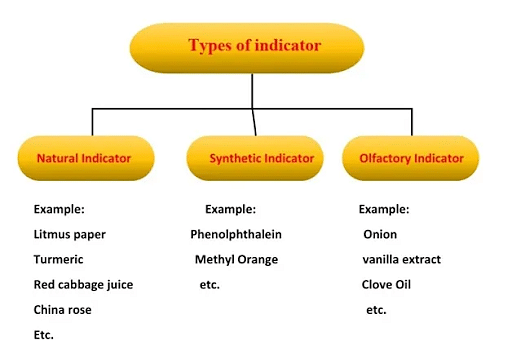
Natural Indicators
Natural Indicator is a type of indicator found in nature that may be used to determine whether a substance is acidic or basic. Examples include red cabbage, turmeric, grape juice, turnip peel, curry powder, cherries, beets, onion, tomato, and other natural ingredients.
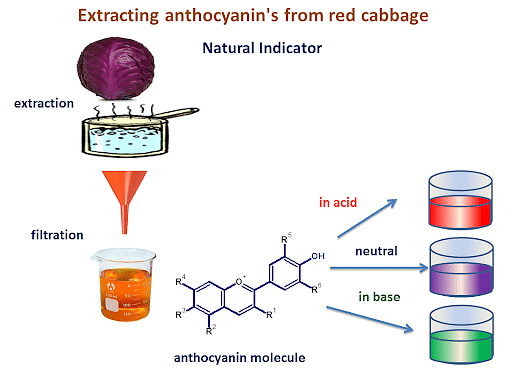
The following are some regularly used natural indicators:
Turmeric: Turmeric, also known as Haldi, is a naturally occurring indication. It's a vibrant yellow colour. Turmeric paste can be used to determine whether a substance is acidic or basic. Turmeric is yellow in an acidic environment and does not change colour, however, it turns red in a basic one.
Red Cabbage Indication: Red cabbage is a common vegetable that may also be used as an indicator. A natural indication is red cabbage. The pigment anthocyanin is responsible for red cabbage's colour shift when exposed to an acid or base. As an indication, red cabbage extract is employed. The colour of red cabbage is naturally rich purple. In an acidic media with a pH of less than 7, the red cabbage extract turns red, whereas, in an alkaline or basic medium with a pH of more than 7, it turns bluish-green.
Read More: Significant Figures
Artificial Indicators
Artificial Indicators, also known as Synthetic Indicators, are chemical indicators used to determine what is basic and what is acidic. Phenolphthalein, Methyl Orange, and other artificial markers are examples.
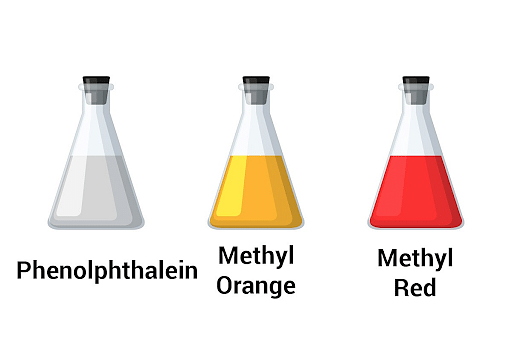
The following are some examples of artificial indicators:
Phenolphthalein: Phenolphthalein is a dark purple dye that is water-soluble. It is used to test for acid and base in the form of a solution. It becomes colourless in an acidic environment and pale pink in a basic environment. Acid-base titrations are the most common use. The hue of phenolphthalein in acidic and basic media is given below.
Methyl Orange: Methyl Orange is also a colour indicator that displays how acids and bases change colour. It was originally orange in colour. Only mineral acids and strong bases can be used with methyl orange. It is unable to detect weak acids or bases. Methyl orange becomes red in an acidic environment and yellow in a basic one. Methyl orange has the following structure:
Olfactory Indicators
An olfactory indicator is a substance that alters its aroma when mixed with an acidic or basic solution. Olfactory indicators may be used in the laboratory to assess if a solution is basic or acid, a process known as olfactory titration. Olfactory markers are chemicals in acid and basic solutions that have unique odours, to put it simply. Vanilla extract, onion and clove oil, and other similar products have different scents. Visually impaired students can use olfactory clues to distinguish acids and bases.

The following are some olfactory indicators:
- Onion Extract is made by heating water and add chopped onion to it. The onion extract is ready after the water has cooled. Onion extract demonstrates the difference in scent between acids and bases. It keeps its strong odour when introduced to acid, but it becomes utterly odourless when put to a base.
- Vanilla Extract: Vanilla extract is like onion extract in that it has a similar effect. In an acidic solution, it keeps its pleasant odour, but in a basic medium, it loses it.
Read More: Relation between Molarity and Molality
Importance of Indicators
[Click Here for Sample Questions]
- In biology, chemistry, civil engineering, water purification, agriculture, forestry, food science, environmental science, water treatment, oceanography, medicine, nutrition, and agronomy, among other areas, the nature of a substance is important.
- Litmus is even made from lichens. It's a colour combination that goes away when you put it in water. It's then absorbed into filter paper to make one of the first pH indicators, which is used to assess whether something is acidic or basic.
Read More: Dalton’s atomic theory
Things to Remember
- Over a large range of pH, the usual indicators may or may not display colour change, but only for a narrow range. This makes identifying the acids and bases challenging.
- Universal indicators are used to overcome this problem. Multiple indicators are combined to create a universal indication that changes colour across a wide pH range.
- The presence or absence of indicators is indicated by indicators. All nitrate tests, for example, use indications, as do pregnancy tests and lead tests. A blood sugar test suitable for diabetics should be similarly simple to use.
- One interesting aspect to remember is that red cabbage juice may be a reliable signal. The cross will be plainly visible at the beginning of the response once you start looking in the flask.
- When turmeric stain was cleaned with soap, it developed a reddish-brown tint, but when lemon was put on it, it returned to its original yellow colour.
- When it comes to identifying acids, bases, and other compounds, chemical indicators are known to have a certain range. Most of the indicators will change colour, but some will change turbidity. As a result, the indicator has a translucent appearance. This shift might be caused by the presence of a specific chemical, or it can be an indication of neutralisation.
- In general, an indicator is a weak acid or weak base that dissociates into ions in a solution. To determine whether a medium is acidic or basic, indicators are utilised.
Read More: Gay-Lussac’s Law
Sample Questions
Ques: Explain why a sodium sulphate aqueous solution is neutral and a sodium carbonate aqueous solution is basic in nature. (3 marks)
Ans: Aqueous sodium sulphate solution is hydrolyzed to generate sodium hydroxide and sulphuric acid, both of which are strong bases and acids. As a result, the aqueous solution is pH neutral.
When sodium carbonate is dissolved in water, it is partially hydrolyzed, yielding sodium hydroxide and carbonic acid. Sodium hydroxide is now a strong base that is completely ionized and produces a significant number of hydroxide ions [OH– (aq)]. Carbonic acid, on the other hand, is a weak acid that is only minimally ionized and hence produces a modest number of hydrogen ions [H+ (aq)]. The mixture contains more hydroxide ions than hydrogen ions, so it is basic in nature.
Ques: Why does a curry stain on a white fabric turn reddish-brown after being cleaned with soap and then turn yellow again after being rinsed with plenty of water? (3 marks)
Ans: Turmeric, which works as an acid-base indicator, is found in curry. Turmeric contains a yellow pigment that, when cleaned with soap on a stain of curry on white material, becomes red in basic solutions. This is due to the fundamental nature of soap solution, which turns the colour of turmeric into the curry stain red-brown. When the fabric is cleaned with plenty of water, the stain turns yellow again because the basic soap is washed away.
Ques: (A) Create universal indicators. Mention that it has a single application.
(B) When a drop of phenolphthalein indicator is put to Solution A, it becomes pink. When a drop of methyl orange is put to Solution B, it becomes red. What are the types of solutions A and B, and which of the two will have a higher pH value?
(C) Name one salt whose solution has a pH of more than 7 and one salts with a pH less than 7. (3 marks)
Ans: (a) A universal indication is a combination of many separate indicators that produce varied colours at various pH levels across the pH scale. It changes colour as the concentration of hydrogen ions in a solution changes.
(b) When a drop of phenolphthalein indicator is added to Solution A, it becomes pink, indicating that A is a base.
When a drop of methyl orange is put to Solution B, it becomes red, indicating that B is an acid. As a result, solution A will have a lower hydrogen ion concentration than solution B.
As a result, A will have a pH greater than 7 due to the pH value of
an acid solution < 7;
a base solution > 7; and
a neutral solution = 7.
(c) Strong acids and weak bases combine to form an acidic solution with a pH of less than 7. Ammonium chloride, for example, has a pH of less than 7. The salts of weak acids and strong bases give a basic solution having a pH of more than 7. For Example, Na2CO3, Sodium Carbonate will have a pH of more than 7.
Ques: What role does pH play in everyday life? (3 marks)
Ans:
- Living creatures can only live in a limited range of pH fluctuations. When acidic rainwater flows into rivers, it lowers the pH of the water, making aquatic life harder to survive. Plants require a precise pH range to thrive properly.
- Our stomach and intestines have a certain pH range in which they operate. The stomach works in a slightly acidic environment, whereas the small intestine works in a slightly alkaline environment to digest the meal.
- Tooth decay begins when the mouth's pH falls below 5.5.
Ques: Determine the calcium compound that is a yellowish-white powder that is used to disinfect drinking water. Make a note of the chemical name and formula. What is the process of making it? Create a chemical equation for the reaction in question. List two more applications for the chemical. (3 marks)
Ans:
- Bleaching powder is the substance.
- Calcium oxychloride is a chemical compound.
- CaOCl2 is the chemical formula.
- Chlorine reacts with dry slaked lime to make it.
- Ca(OH)2 + Cl2 = CaOCl2 + H2O
Uses:
- It's used in paper mills to bleach wood pulp.
- Many chemical industries utilize it as an oxidizing agent.
Ques: Explain the following: (3 marks)
(i) The dry blue litmus paper does not change colour when exposed to dry HCl gas.
(ii) Although hydrogen is present in alcohol and glucose, they do not conduct electricity.
(iii) When an acid solution is diluted, the H3O+ ion cone is altered.
Ans:
- Because dry HCl gas contains no hydrogen ions, it does not exhibit acidic behaviour. Because it contains no hydrogen ions [H+ (aq)], dry HCl gas does not modify the colour of dry blue litmus paper. When HCl gas dissolves in water, however, it creates hydrogen ions, resulting in acidic behaviour.
- Because their hydrogen does not break out as hydrogen ions [H+ (aq) ions] when dissolved in water, glucose and alcohol aqueous solutions do not have an acidic character. As a result, they are not conductors of electricity.
- An acid is a chemical that breaks down into hydrogen ions [H+ (aq) ions] when it dissolves in water.
In a solution, hydrogen ions do not exist as H+ ions; instead, they bind themselves to polar water molecules to produce H3O+ ions.
H3O+ = H+ + H2O
The quantity of [H3O+] ions per unit volume reduces as an acid solution is diluted. As a result, the pH of the solution rises.
Ques: (a) What is the name for bases that are very water-soluble? Give a specific example. (3 marks)
(b) How does pH affect tooth decay? What can be done to avoid it?
(c) What causes the discomfort and irritation caused by a bee sting? The sting might be relieved by using baking soda on the affected region. How?
Ans: (a) Alkalis are water-soluble bases, such as NaOH and KOH.
(b) Tooth decay begins when the mouth's pH falls below 5.5. By degrading sugar and food particles that remain in the mouth after eating, bacteria in the mouth create acids. This may be avoided by brushing your teeth and mouth with toothpaste that is normally basic and can neutralise excess acid.
(c) When a honeybee stings a person, an acidic substance is injected into the skin, causing severe pain and inflammation. Relief can be obtained by rubbing a mild base such as baking soda solution on the stinging region of the skin. This is because baking soda, being a base, neutralises and cancels the acidic liquid pumped by bee stings.
Ques: (a) There are two options: A and B. Solution A has a pH of 6 while Solution B has a pH of 8. (3 marks)
(i) Determine which solution is acidic and which is basic.
(ii) Which solution contains the highest concentration of H+ ions? Give a rationale for your response.
(b) What makes HCl so much stronger than acetic acid? Explain.
Ans: (a) Solution A (pH = 6)
pH = 8 in Solution
(i) Solution A is acidic, while Solution B is basic.
(ii) Solution A contains a larger concentration of H+ ions because a lower pH value corresponds to a higher concentration of hydronium ions.
(b) Because acid strength is determined by the amount of H+ ions generated, HCl is a stronger acid than acetic acid. When the same concentrations of HCl and acetic acid are used, differing quantities of hydrogen ions are produced. HCl creates more H+ ions, making it a strong acid, whereas acetic acid produces less H+ ions, making it a weak acid.
Ques: What is the chemical difference between plaster of Paris and gypsum? What are the possibilities for interconversion? Is it possible to write one usage of plaster of Paris? (2 marks)
Ans: The anhydrous form of gypsum is plaster of Paris. The gypsum is heated to make it.
Surgical bandages with plaster of Paris are used to fix fractured bones. It is combined with water before being applied to the broken bone, resulting in hydration and the transformation of the material into gypsum. The gypsum's hard bulk maintains the bones in place.
Plaster of Paris and Gypsum may be interconverted by the reaction.
Ques: Give two examples of how washing soda and baking soda may be used. (2 marks)
Ans: Here are some of the things you can do with washing soda:
- Agent for cleaning.
- The hardness of the water is permanently removed.
- Paper, glass, and soap industries all use it.
Baking soda can be used in the following ways:
- Baking powder production.
- It works as an antacid.
Physics Related Links:



Comments