



Content Curator
The alimentary canal is a continuous tube that extends from the mouth to the anus and transports food and other nutrients to the digestive system's many organs as well as allowing waste to depart the body.
- Although there are many differences amongst living things, only species with bilateral symmetry have an alimentary canal.
- Cells that enclose digestive enzymes in various parts of the alimentary canal allow food to be broken down.
- Humans and other extremely complex creatures have various organs and tissues that make up the alimentary canal.
Key Terms: Alimentary Canal, Mouth, Salivary Gland, Digestive System, Gastrointestinal Tract, Esophegus, Pharynx, Tongue
Alimentary Canal Meaning
[Click Here for Sample Questions]
The alimentary canal is a long, muscular tube extending from the mouth to the anus. It is responsible for the digestion and absorption of food in the body.
- It is also called the gastrointestinal (GI) tract or the digestive system.
- The food material travels in a single path along the alimentary canal as it passes through a number of specialised organs.
- The Alimentary Canal is a similar tube whose main purpose is to facilitate food particle circulation and ultimately assist in nourishment.
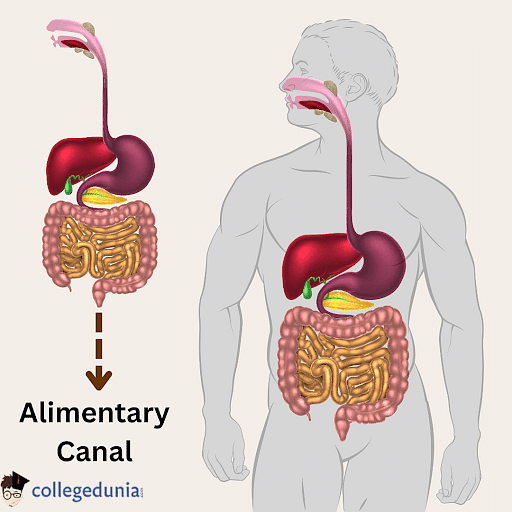
Alimentary Canal
- The buccal cavity, oesophagus, stomach, small and large intestines, and the anus make up the human alimentary canal.
- It includes breaking down complicated foods into simpler parts that the body may easily absorb and assimilate, as well as discharging the unabsorbed digested material from the body.
Also Read:
Parts of Alimentary Canal
[Click Here for Previous Year Questions]
The alimentary canal consists of several organs, including the mouth, esophagus, stomach, small intestine, large intestine (colon), rectum, and anus.
These organs further function together to break down the food we eat into small particles, which can be absorbed by the body.
The Mouth
In biology, the mouth is the opening through which humans consume food and drinks.
- It is the initial part of the digestive system.
- It is the first stage in breaking down food into its constituent components.
- In humans, the mouth is located on the face and is bounded by the lips, cheeks, palate, and tongue.
Salivary Gland
Saliva is produced by the salivary glands and released into the buccal cavity when we eat.
- When food enters the mouth through mastication (the process of chewing), it is broken down into smaller pieces, allowing salivary enzymes to break down the food.
- Salivary glands are exocrine glands, producing and secreting saliva into the oral cavity.
- There are three pairs of major salivary glands in the human body: the parotid glands, submandibular glands, and sublingual glands.
- The tongue contains glands that produce saliva, which helps to moisten food and initiate the process of digestion.
Teeth
An adult's buccal cavity contains 32 teeth.
- The teeth helps food break down and get crushed by using our teeth.
- The bicuspids and molars (back teeth) crush and grind food into smaller bits that are easier to digest while the incisors and canines (front teeth) shred and chop it.
Types of Teeth:
| Name | Functions |
|---|---|
| Molars | Used for Grinding and Chewing |
| Premolars | Used for Chopping |
| Canines | Used for Tearing |
| Incisors | Used for Cutting |
Tongue
The tongue is a triangular, three-lobed organ.
- It seems muscular and beefy.
- It spans the entire bottom of the buccal cavity.
- It is covered by a mucous membrane consisting of numerous papillae, small structures that house taste buds, which are responsible for detecting the different tastes of food.
Pharynx
The pharynx is found near the back of the mouth.
- It is the junction between the oesophagus and the mouth.
- Both the food we consume and the air we breathe travel through it on a regular basis.
- The glottis, also known as the respiratory system's aperture in the pharynx, is shielded by the cartilaginous flap called the epiglottis.
Oesophagus
The oesophagus is a muscular, tube structure that transfers the bolus from the pharynx to the stomach when there are peristaltic motions.
- It is roughly 25 cm long in a healthy adul.
- It has epithelial cells that produce mucus, which facilitates the bolus's smooth movement.
- The oesophageal sphincter, sometimes referred to as the cardiac sphincter, relaxes as the bolus is prepared to enter the stomach and permits the bolus to flow into the stomach.
Abdomen
The stomach is a pouch-like organ that rests right below the diaphragm and has very strong walls.
Mechanism of Digestion
[Click Here for Sample Questions]
The stomach engages in both chemical and mechanical processes during digestion.
- While the bottom muscles of the stomach contract frequently to mix and churn the food with the stomach's gastric secretions, the higher involuntary muscles of the stomach relax to allow more food to be stored.
- The main stomach acid, hydrochloric acid, as well as gastric enzymes including pepsin, gastric amylase, lipase, and gelatinase assist in the subsequent chemical breakdown of food.
- This partially digested food becomes chyme, which is pushed through the small intestine as a thick, creamy, semi-solid substance (duodenum).
What is Small Intestine?
[Click Here for Previous Year Questions]
The small intestine and large intestine make up the human intestine. The small intestine is the upper portion of the intestine, after the stomach and before the large intestine. It's separated into:
- The Duodenum: The Duodenum begins at the bottom of the stomach and continues to the jejunum, is the first segment of the small intestine. It is the division where enzymes are used to digest chemicals.
- The Jejunum: Located in the heart of the small intestine, it plays a significant role in the absorption of both proteins and carbohydrates. Villi, which are small, finger-like projections that cover the inner surface of the jejunum's mucous membrane, increase the surface area of tissue that is available to absorb nutrients from the gut's contents.
- The Ileum: The ileum is the section of the large intestine that connects to the jejunum.It is the small intestine's final and most likely longest segment. Cobalamin (Vitamin B12), bile salts, and any other digestive byproducts that the jejunum was unable to absorb are the primary functions of the ileum.
What is Large Intestine?
[Click Here for Sample Questions]
The large intestine, also known as the colon, is the last part of the digestive system. It is a long, muscular tube almost 5 feet long in adults and is wider and thicker than the small intestine.
- Right below or at the right waist, the right iliac area of the pelvis marks the beginning of the large intestine, which is later linked to the small intestine's lower end.
- Its typical length is 1.5 metres (4.9 feet), or around one-fifth of the length of the alimentary canal.
- The large intestine helps the body absorb water from the remainder of the indigestible meal and compacts the faeces prior to discharge (the process of throwing the nitrogenous waste out of the body through the anal canal).
Components of Large Intestine
Large Intestine Components include:
- Appendix: The appendix is an internal organ that is connected to the inferior surface of the cecum and has no known function of its own.
- Cecum: The cecum is a pouch-like structure that is often peritoneal and is regarded as the beginning of the big intestine.
- Colon: The large intestine's portion is referred to as the digestive system's final segment. This comes before the anus and after the ileum. The colon is made up of several parts:
- Ascending Colon: The portion of the colon that travels further up the abdomen is known as the ascending colon.
- Transverse Colon: The section of the colon that spans the width of the abdomen.
- Descending Colon: The section of the colon that slopes down (descends) toward the start of the sigmoid colon
- Sigmoid Colon: The large intestine's S-shaped portion, which is also the colon's final segment and ends in the rectum, is referred to as the sigmoid colon. - Rectum: The final section of the large intestine where faeces are temporarily held before being discharged into the anal canal is known as the rectum. It has a length of around 15 centimetres and is split between the rectum proper and the anal canal.
Things to Remember
- The alimentary canal, also known as the digestive tract or gastrointestinal tract, is a long, muscular tube that extends from the mouth to the anus.
- The small intestine absorbs the digested food material and continues to metabolise it after leaving the stomach, which assists in digestion.
- The main functions of the large intestine are to absorb water and electrolytes from the undigested food which has passed via the small intestine.
- The process is finished in the large intestine, where the leftover food is concentrated and sent out as faeces.
- The main organs of the alimentary canal include the mouth, esophagus, stomach, small intestine, and large intestine.
- There are other accessory organs that contribute to the digestive process, such as the salivary glands, liver, and pancreas.
Check More:
Previous Year Questions
- Goblet cells of alimentary canal are modified from…[NEET 2020]
- In which layer of the wall of alimentary canal, s… [GUJCET 2008]
- In the wall of alimentary canal what is the actual sequence from outer to inner… [JIPMER 2005]
- The alimentary canal of the frog is short Frogs…
- Villi are present in the… [JIPMER 2003]
- How does a gastrovascular cavity differ from an…
- Stomach is the site of digestion mainly for… [WBJEE 2006]
Sample Questions
Ques. Which seven components make up the alimentary canal? (1 mark)
Ans. The mouth, pharynx, oesophagus, stomach, small and large intestines, rectum, and anus are all parts of the alimentary tract.
Ques. What are the alimentary canal's primary purposes? (5 marks)
Ans. The digestion of food and the absorption of nutrients from it are the main tasks of the alimentary canal.
- The purpose of the alimentary canal is to take in and break down food material into small molecules that can be absorbed and usedby the body.
- This involves a variety of processes, including ingestion, digestion, absorption, and elimination of waste products.
- During ingestion, food is taken into the mouth and mechanically broken down by the teeth and mixed with saliva.
- Then, the food travels down the esophagus and enters the stomach where it is further broken down by gastric juices.
- From the stomach, food passes into the small intestine where it is broken down into its component molecules and absorbed into the bloodstream.
- The waste products then pass into the large intestine where they are formed into feces and eventually eliminated from the body.
- The entire process is regulated by the nervous system and hormones to ensure that the body receives the nutrients it needs for growth, repair, and energy.
Ques. What function does E. coli serve in the human intestine? (1 mark)
Ans. E. coli are non-harmful bacteria that help in vitamin K production, food particle breakdown during digestion, and small intestine absorption.
Ques. How is the gastrointestinal tract organised? (2 marks)
Ans. The organs that food and liquids pass through on their way to being ingested, broken down, absorbed, and expelled as faeces. The mouth, pharynx (throat), oesophagus, stomach, small intestine, large intestine, rectum, and anus are among these organs.
Ques. What are the alimentary canal's three main sections? (2 marks)
Ans. The oesophagus, stomach, and intestines are all included in the lengthy organ tube known as the alimentary canal, which extends from the mouth to the anus.
Ques. What is the significance of Alimentary canal? (2 marks)
Ans. The alimentary canal, also known as the digestive tract, is an important organ system in the human body. Its main function is to digest and absorb nutrients from the food we eat, which is essential for maintaining our overall health and well-being.
Ques. What function does Meisner's Nerve Plexus serve? (1 mark)
Ans. It controls the gastrointestinal tract's secretions and local blood flow and aids in the start of peristaltic movement.
Ques. Describe the Purpose of the stomach in Digestion. (2 marks)
Ans. The stomach employs both mechanical and chemical actions to break down food.
- The lower muscles of the stomach contract rhythmically to churn and mix the food with the gastric juices present in the stomach, while the top involuntary muscles relax to allow for the storage of additional food.
- The hydrochloric acid in the stomach and the actions of enzymes including pepsin, gastric amylase, gelatinase, and lipase aid in further breaking down the food in chemical processes.
Ques. What is Bile? (2 marks)
Ans. Bile is a yellow-green fluid that is produced by the liver and stored in the gallbladder. It is a digestive juice that aids in the digestion of fats. Bile is composed of water, bile acids, bilirubin, cholesterol, and electrolytes. It is released into the small intestine when fat is present in the digestive system, where it emulsifies the fat into smaller droplets, which can be more easily digested by enzymes.
Ques. Describe the large intestine and its components. (5 marks)
Ans. A segment of the alimentary canal called the big intestine starts at the right iliac region of the pelvis, which is located immediately below or at the right waist. It aids in the digestion of dietary waste and water absorption. The following organs make up the large intestine:
- Appendix: This internal organ, which is linked to the inferior surface of the cecum, has little purpose in humans.
- Cecum: This peritoneal structure resembles a pouch and is typically regarded as the start of the big intestine.
- Colon: The final segment of the large intestine, which is further split into the ascending, transverse, descending, and sigmoid colons.
- Appendix: The appendix is an internal organ that is connected to the inferior surface of the cecum and has no known function of its own.
- Cecum: The cecum is a pouch-like structure that is often peritoneal and is regarded as the beginning of the big intestine.
- Colon: The large intestine's portion is referred to as the digestive system's final segment.
- Rectum: The final section of the large intestine where faeces are temporarily held before being discharged into the anal canal is known as the rectum. It has a length of around 15 centimetres and is split between the rectum proper and the anal canal.
For Latest Updates on Upcoming Board Exams, Click Here: https://t.me/class_10_12_board_updates
Check-out:



Comments