



Education Content Expert
Angular Displacement is the shortest angle between the initial and the final positions for an object in a circular motion. Angular displacement is a vector quantity. It has magnitude as well as direction. Angular displacement is represented by a circular arrow pointing from the initial to the final position. The arrow can be either in the clockwise or anti-clockwise direction.
Key Terms: Angular Displacement, Angular Displacement Formula, Vector, Circular Motion, Displacement, Motion, Radian, Rotational Motion
What is Angular Displacement?
[Click Here for Sample Questions]
Rotational motion is the motion of a body along a circular path. The displacement caused due to such type of motion differs from the displacement done on linear motion. Here, the displacement is usually in the form of an angle and is referred to as Angular Displacement.
- Angular Displacement is the angle made by a body from its point of rest at any point in a rotational motion.
- It is the shortest angle between the initial and the final position for an object in a circular motion around a fixed point.
- It is classified as a vector quantity as it has both magnitude and direction.
- The SI unit of Angular Displacement is Degrees or Radian.
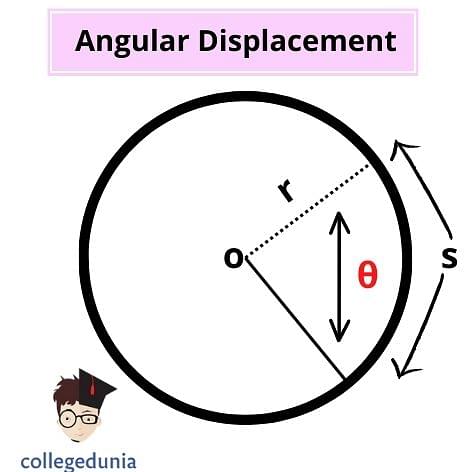
Angular Displacement
Read More:
Angular Displacement Formula
[Click Here for Previous Years' Questions]
The formula for angular displacement is as follows:
Angular Displacement = θf − θi
Where
θ = s/r
Here,
- θ denotes the angular displacement of the object.
- S denotes the distance covered by the object on the circular path.
- r denotes the radius of curvature of the given path.
Read More: NCERT Solutions For Class 11 Physics System of Particles & Rotational Motion
In case the acceleration of the object, the initial angular velocity and the time are given, angular displacement can be calculated using the following formula:
θ = ωt + 1/2αt2
Where
- θ: Angular Displacement of the object.
- s: Distance covered on the circular path.
- r: Radius of Curvature of the given path.
- ω: Initial Angular Velocity.
- t: Time
- α: Angular Acceleration
Derivation of Angular Displacement Formula
[Click Here for Sample Questions]
Consider object A having a linear motion with initial velocity u and acceleration a. After time t, the final velocity of the object is v with total displacement s.
As we know, acceleration is the rate of change of velocity. Thus,
a = dv/dt
∴ dv = a x dt
On integrating both sides,

∴ v – u = at
Also,
a = dv/dt
∴ a = (dv/dx) × (dx/dt)
We know that v=dx/dt, so
∴ a = (dv/dx)v
∴ v dv=a dx
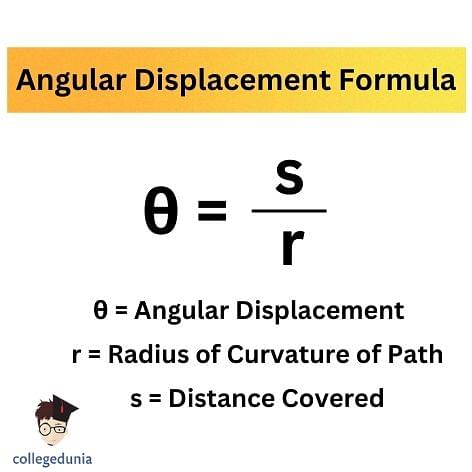
Angular Displacement Formula
On integrating both sides,

v2 - u2 = 2as
Substituting the value of u from equation 1 into equation 2, we get,
v2 - (v-at)2 = 2as
2vat - a2t2 = 2as
Now, dividing both the sides of the equation by 2a, we get
∴ s = vt – 1/2(at2)
Lastly, on substituting the value of v instead of u, we will get
∴ s = ut + 1/2(at2)
Read More: System of Particles & Rotational Motion Important Questions
Solved ExampleExample 1: Anjali walks around a circular track that has a diameter of 8.5 m. Determine her angular displacement if she runs around the complete track for a distance of 60 m. Solution: According to the question,
R = d/2 = 8.5/2 = 4.25 m. Now, using the angular displacement formula, θ = s/r θ = 60/4.25 θ = 14.12 radians. Thus, the angular displacement of Anjali will be 14.12 radians. |
Read More:
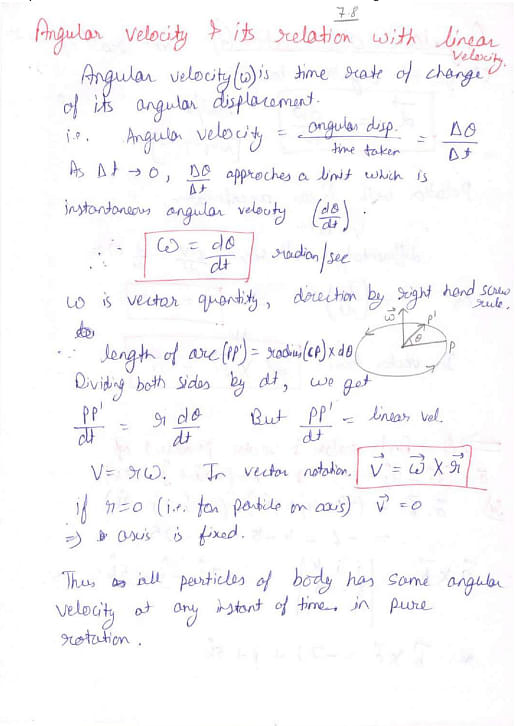
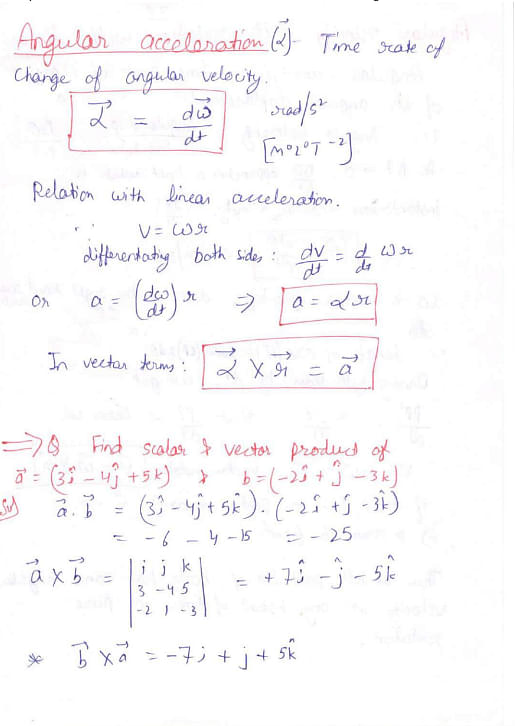
Handwritten Notes on System of Particles and Rotational Motion
[Click Here for Sample Questions]
Given below are the handwritten notes for System of Particles and Rotational Motion:




Things to Remember
- Angular Displacement is the shortest angle between the initial and the final position for an object in a circular motion around a fixed point.
- Angular Displacement is a vector quantity as it has both magnitude and direction.
- Angular Displacement is calculated in Degrees or Radians (SI Unit).
- Angular displacement of a given point is given by the formula θf−θi, where, θ = s/r.
- The formula for angular displacement is θ=wt+1/2αt2 when the acceleration of the object (α), the initial angular velocity (ω) and the time (t) is given.
Read More: System of Particles and Rotational Motion MCQs
Previous Years’ Questions (PYQs)
- The displacement, velocity and acceleration in a simple harmonic motion… (JKCET 2013)
- A wheel has an angular acceleration of 3.0…
- Particle moves a distance x in time t according to equation…
- Angular momentum is conserved… (BITSAT 2016)
- A bullet moving with a speed of 100 m/s can just penetrate two… (KCET 2004)
- A flywheel at rest is to reach an angular velocity of 24 rad/s… (MHT CET 2017)
- To get a resultant displacement of 10 m two displacement vectors…
- The displacement-time graphs of two moving particles make… (KCET 2011)
- Fig shows the time-displacement curve of the particles P…
- The displacement of an object attached to a spring and executing… (AMUEEE 2015)
Sample Questions
Ques. Raghav walks around a circular track with a diameter of 7 m. He walks around the entire track for a distance of 50 m, what will be his angular displacement? (3 Marks)
Ans. As per the question,
- Linear displacement (s) of Raghav = 50 m
- Diameter of the circular track (d) = 7 m
- Radius of the track (r) =?
We know that, r = d/2
r =7/2= 3.5 m
Using the angular displacement formula,
θ=s/r
θ = 50m /3.5 m
θ = 14.28 radians.
Thus, the angular displacement of Raghav will be 14.28 radians.
Ques. Angular displacement in a certain case is given as 0.267 radians with the radius being 6 m. What will be the distance travelled by the object on the circular path? (3 Marks)
Ans. According to the question,
Angular Displacement θ = 0.267 radians
Radius r = 6 m
According to the Angular Displacement Formula:
θ = s/r
s = θ × r
s = 0.267 × 6
s = 1.602 m
Thus, the distance travelled by the object on the circular path is 1.602 m.
Ques. Suyash runs around a circular track of diameter 12m. If he runs around the entire track for 70 m, what will be his angular displacement? (3 Marks)
Ans. According to the question,
- Linear displacement (s) of Raghav = 70 m
- Diameter of the circular track (d) = 12 m
- Radius of the track (r) =?
r = d/2 =12/2= 6 m
Using the angular displacement formula,
θ = s/r
θ = 70/6
θ = 11.66 radians
Thus, the angular displacement of Suyash will be 11.66 radians.
Ques. Ritik purchased a pizza of 0.5 m radius. A fly sits on the pizza and then walks around the edge for a distance of 80 cm. Calculate what will be the angular displacement of the fly? (3 Marks)
Ans. According to the question,
Distance travelled by the fly (s) = 80 cm = 0.08 m
Radius of pizza (r) = 0.5 m
As per the angular displacement formula,
θ=s/r
θ = 0.08/0.5
θ = 0.16 radians
Thus, the angular displacement of the fly would be 0.16 radians.
Ques. In a particular case, the angular displacement is 34.2 radians and the distance travelled by the object on the circular path is given as 23 m. What will be the radius of curvature of the circular path? (3 Marks)
Ans. According to the question,
- Angular Displacement θ = 34.2 radians
- Distance travelled on circular path = 23 m
- Radius of Curvature of Circular Path =?
As per the Angular Displacement formula:
θ = s/r
So, r = s/θ
r = 23/34.2
r = 0.67 m
Thus, the radius of curvature of the circular path is 0.67 m.
Ques. A baker made a huge round circular cake for a wedding purpose of a radius of 0.5 m. An insect lands on it and walks around the edge for a distance of 60 cm. What will be the angular displacement of the insect? (3 Marks)
Ans. According to the question,
Distance travelled by the insect (s) = 60 cm = 0.06 m
Radius of wedding cake (r) = 0.5 m
Using the angular displacement formula,
θ=s/r
θ = 0.06/0.5
θ = 0.12 radians
Thus, the angular displacement of the insect would be 0.12 radians.
Ques. A girl runs around 400 m of a circular track with a radius of 35 meters. Calculate what will be her angular displacement. (3 Marks)
Ans. As per the given information,
Distance travelled by the girl (s) = 400 m
Radius of the circular track (r) = 35 m
Angular Displacement is calculated as
θ=s/r = 400 / 35
θ = 11.42 radians
Therefore, the angular displacement of the girl will be 11.42 radians.
Ques. A circular track has a diameter of 9 m. A dog runs about a 60 m distance around the entire track, what will be the angular displacement? (3 Marks)
Ans. According to the question,
Linear displacement of dog (s) = 60 m
Diameter of the circular track (d) = 9 m
So, r = d/2
r =9/2= 4.5 m
Using the formula for angular displacement,
θ = 60m /4.5 m
θ = 13.33 radians
Thus, the angular displacement of the dog will be 13.33 radians.
Check-Out:



Comments