



Content Writer
Aufbau principle is defined as a type of principle in which electrons are filled in the increasing order of energy level in the atomic orbital. It was discovered in the early 1920s and depicts that in the ground state of an atom.
- It means atomic orbitals with the lowest energy are filled before occupying the upper atomic orbital.
- Aufbau Principle is also known as the Aufbau Rule.
- It is derived from a German word which means construct or build up.
- The order in which the atomic orbitals are filled is like 1s, 2s, 2p, 3s, 3p, 4s, 3d, 4p and more.
- An arrow is used to depict the electrons in an Aufbau Principle.
- The behaviour of electron are explained by Hund’s rule.
- The Aufbau principle follows the n+l rule,which is said to be the energy.
- In the formula, n is a magnetic quantum number, and l is an azithumal quantum number.
- The order during which orbitals are filled is given by the Madelung rule.
Read More: Energy Level Diagram
Key Terms: Aufbau Principle, Magnetic Quantum Number, Azithumal Quantum Number, Electrons, Hund’s Rule, Atomic Orbital, Madelung Rule, Energy
Salient Features of Aufbau Principle
[Click Here for Sample Questions]
The ground-state electron configuration has four rules in case of an atom with two or more electrons:
Decrease in the Energy of the Electrons
The electrons before filling the upper atomic orbital will fill the lowest available energy state. Electrons will first occupy ground orbitals in order to decrease the entire energy.
- The two quantum numbers that are associated with energy in multielectron atoms are n and l.
- Therefore the atomic orbitals with the minimum values of n and l will be filled at most.
Pauli Exclusion Principle
Pauli Exclusion Principle states that one orbital can contain only two electrons with opposite spin which means any atomic orbital cannot accommodate more than two electrons with opposite spin.
- Each electron in an atom must have a special set of quantum numbers.
- There are 4 quantum numbers principles (n), azimuthal (l), magnetic (m), and spin(s).
Obeys Hund's Rule of Maximum Multiplicity
According to Hund’s rule of maximum multiplicity, in a given electron arrangement, the maximal multiplicity falls lowest in energy. As per this principle, electrons pairing up in p, d, and f orbitals can’t occur until there is one electron each in the orbit of a given subshell.
- Electrons will first fill the single orbitals.
- Next, if two or more orbitals are available and then fill double orbitals.
- The electrons will have the same spin which will increase the multiplicity in the orbitals.
- The rule says that the lowest-energy electronic configuration is attained with the utmost number of parallel electron spins.
- It is useful to predict the ground state of atoms only when there is an availability of equal energy orbitals.
Read More: Electron Shells
Considers the Exchange Interaction
The exchange interaction may be an aggregate mechanical effect that occurs between the indistinguishable particles. It is also called exchange energy or exchange force. The exchange interaction creates a state of electron configuration with the non-bonded electrons, all of them being of an interchangeable quantum state.
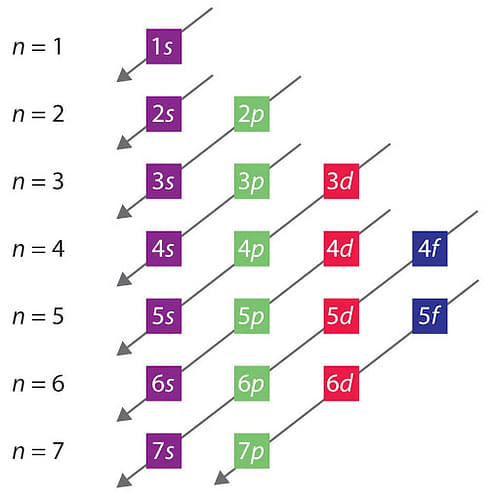
The order of filling of an atomic orbital
Read More:
Electronic Configuration using Aufbau Principle
[Click Here for Sample Questions]
The electronic configuration of various elements are provided below:
Electronic Configuration of Sulphur
The sulphur has 16 electrons since its atomic number is 16. According to the Aufbau principle, 2 electrons of sulphur are a part of the 1s subshell, 8 are a part of 2s and 2p, and the remaining are scattered between the 3s and 3ps.
- Hence, sulphur’s electron configuration can be written as 1s22s22p63s23p4
Read More: Atomic Radii
Electronic Configuration of Nitrogen.
Nitrogen has an atomic number of 7; hence, its number of electrons is also equal to 7. The electrons are distributed between 1s, 2s and 2p orbitals. 1s²2s²2p³ can be written as Nitrogen’s electronic configuration.
Read More: Franck hertz experiment
Limitations of the Aufbau Principle
[Click Here for Sample Questions]
Aufbau's principle says that electrons fill atomic orbitals of the lowest available energy state before occupying the upper level. But like other principles, there are also some limitations to this.
- d and f block elements don’t always follow the Aufbau Principle.
- The reason is that the d and f subshell, whether they are filled or half-filled, add stability to the atoms.
- According to the Aufbau Principle, the order of orbital energies is always fixed between elements.
- However, this statement is not fully true.
- As the Aufbau Principle says, only two electrons can be placed into atomic orbitals of fixed energy.
- In fact, the energy of all the electrons determines the energy of electrons in an atomic orbital.
- Hydrogen-like atom has only one electron and the energy is the same in the s-orbital and the p-orbital shell.
- In the actual hydrogen atom there are different numbers of protons in its nucleus.
- The energy levels are slightly split by the magnetic field of the nucleus, which alters the energy on each electron.
- Aufbau Principle works tremendously well for the ground state of the atoms till 18 elements.
- It does not work well for the remaining 100 electrons following.

Aufbau Principle
Read More: Charge to Mass Ratio of Electron
Exceptions to the Aufbau Principle
[Click Here for Sample Questions]
The exceptions to the aufbau principle are listed below:
Electronic Configuration of Chromium
Chromium has an electron configuration of [Ar]3d54s¹ instead of [Ar]3d44s2 as it is said in the Aufbau principle. This exception is caused due to various factors such as an increase in the stability caused by half-filled subshells and the comparatively low energy gap in between the 3d and 4s subshells.
Half-Filled Subshells
Half-filled subshells lead to the repulsion of the lower electrons in the orbitals, hence increasing the stability. The fully filled subshells also lead to an increase in the stability of the atom.
- Hence the configuration of electrons in case certain atoms don't obey the Aufbau principle.
- Copper can be distinguished as another such element that does not follow the Aufbau principle of electron configuration.
Read More:
| Related Articles | ||
|---|---|---|
| Protons | Quantum theory of light | Electronegativity |
| Limitations of Bohr’s Model | Hund’s Rule of Maximum Multiplicity | Pauli Exclusion Principle |
Things to Remember
- Aufbau Principle states that electrons are filled in increasing order of energy.
- It is based on the n + ℓ, which is said to be the energy.
- Based on this, n represents the principal quantum number, and ℓ represents the azimuthal quantum number.
- d and f block elements do not follow the principle of Aufbau.
- Half-filled subshells and chromium electronic configurations are exceptions to the Aufbau principle.
Read More: Lewis Dot Structures
Sample Questions based on Aufbau Principle
Ques. What is the Aufbau Principle in chemistry? (2 marks)
Ans. The Aufbau principle or Aufbau rule got its name from the German, Aufbauprinzip, which means to construct or to build up. It depicts that in the ground state of an atom, electrons fill atomic orbitals in order of their increasing energy. This means that the atomic orbitals with the lowest energy are filled by the electrons before occupying the upper atomic orbital.
Ques. Which elements are the exceptions in the Aufbau Principle and what does the German word "Aufbau" mean? (2 marks)
Ans. The two elements that are the exceptions in the Aufbau principle are copper and chromium. The German word "Aufbau" means to build up.
Ques. How do you write the Aufbau Principle? (2 marks)
Ans. According to the Aufbau law the electrons are placed to the atomic orbitals in respect to the increasing energetic content. In order to calculate the energy level the Madelung rule is used. The order in which the atomic orbitals are filled by electrons is like, 1s, 2s, 2p, 3s, 3p, 4s, 3d, 4p, 5s, 4d, 5p, 6s, 4f, 5d, 6p, 7s, 5f,6d, 7p, and more. An arrow is used to depict the electrons in an Aufbau Principle.
Ques. Why is the Aufbau Principle needed? (2 marks)
Ans. The Aufbau principle helps in understanding how the electrons are placed in an atom’s atomic orbitals in their ground state. Hence by studying the Aufbau principle we can learn about the electron configuration for atoms and ions. Every shell can contain only a limited number of electrons and for the first energy level it is two electrons.
Ques. Explain the limitation of Aufbau principle? (5 marks)
Ans. The limitation of aufbau principle are as follows:
- Aufbau's principle says that electrons fill atomic orbitals of the lowest available energy state before occupying the upper level.
- But like other principles, there are also some limitations to this.
- d and f block elements don’t always follow the Aufbau Principle.
- The reason is that the d and f subshell, whether they are filled or half-filled, add stability to the atoms.
- According to the Aufbau Principle, the order of orbital energies is always fixed between elements.
- Hydrogen-like atom has only one electron and the energy is the same in the s-orbital and the p-orbital shell.
- In the actual hydrogen atom there are different numbers of protons in its nucleus.
- Aufbau Principle works tremendously well for the ground state of the atoms till 18 elements.
- It does not work well for the remaining 100 electrons following.
Ques. What are the exception to the aufbau principle? (3 marks)
Ans. The exceptions to aufbau principle are listed below:
- Electronic Configuration of Chromium: Chromium has an electron configuration of [Ar]3d54s¹ instead of [Ar]3d44s2 as it is said in the Aufbau principle. This exception is caused due to various factors such as an increase in the stability caused by half-filled subshells and the comparatively low energy gap in between the 3d and 4s subshells.
- Half-Filled Subshells: Half-filled subshells lead to the repulsion of the lower electrons in the orbitals, hence increasing the stability. The fully filled subshells also lead to an increase in the stability of the atom. Hence the configuration of electrons in case certain atoms don't obey the Aufbau principle. Copper can be distinguished as another such element that does not follow the Aufbau principle of electron configuration.
Ques. What is the electronic configuration of sulphur and nitrogen? (3 marks)
Ans. Electronic Configuration of Sulphur: The sulphur has 16 electrons since its atomic number is 16. According to the Aufbau principle, 2 electrons of sulphur are a part of the 1s subshell, 8 are a part of 2s and 2p, and the remaining are scattered between the 3s and 3ps. Hence, sulphur’s electron configuration can be written as 1s22s22p63s23p4
Electronic Configuration of Nitrogen: Nitrogen has an atomic number of 7; hence, its number of electrons is also equal to 7. The electrons are distributed between 1s, 2s and 2p orbitals. 1s²2s²2p³ can be written as Nitrogen’s electronic configuration.
Ques. What is Pauli Exclusion Principle? (3 marks)
Ans. Pauli Exclusion Principle states that one orbital can contain only two electrons with opposite spin which means any atomic orbital cannot accommodate more than two electrons with opposite spin.
- Each electron in an atom must have a special set of quantum numbers.
- There are 4 quantum numbers principles (n), azimuthal (l), magnetic (m), and spin(s).
- In this only two electron can occupy same place in the orbital.
- It is used to determine the structure of the shell of an atom.
Ques. What is the electronic configuration of oxygen and lithium? (3 marks)
Ans. Electronic Configuration of Oxygen: The oxygen has 4 valence electrons since its atomic number is 8. Its 1s orbital is completely full. It has 2 electrons in an s orbital which means it has 2 electrons in 1s orbital making it 1s2. Its 2s orbital is full. It has 2 electrons in an s orbital which means it has 2 electrons in 2s orbital making it 2s2. Hence, oxygen electron configuration can be written as 1s22s22p4.
Electronic Configuration of Lithium: Lithium has an atomic number of 3; hence, its number of electrons is also equal to 3. There are 2 electrons in an s orbital which means that it has 2 electrons in its 1s orbital making it1s2. Hence the electronic configuration of lithium is 1s22s1
Ques. What is Hund’s Rule? (3 marks)
Ans. According to Hund’s rule of maximum multiplicity, in a given electron arrangement, the maximal multiplicity falls lowest in energy. As per this principle, electrons pairing up in p, d, and f orbitals can’t occur until there is one electron each in the orbit of a given subshell. Electrons will first fill the single orbitals.
- Next, if two or more orbitals are available and then fill double orbitals.
- The electrons will have the same spin which will increase the multiplicity in the orbitals.
- The rule says that the lowest-energy electronic configuration is attained with the utmost number of parallel electron spins.
- It is useful to predict the ground state of atoms only when there is an availability of equal energy orbitals.
Ques. What is the electronic configuration of potassium and magnesium? (3 marks)
Ans. Electronic Configuration of Potassium: On the basis of potassium position in the periodic table, it is determined that it has 1 electron in the 4s orbital. Its 1s orbital is completely full. There are 2 electrons in an s orbital; this means that it has 2 electrons in its 1s orbital: 1s2. Its 2s orbital is completely full. It has 2 electrons in an s orbital which means it has 2 electrons in its 2s orbital making it 2s2. Its 2p orbital is completely full. There are 6 electrons in an s orbital which means it has 6 electrons in its 2p orbital making it 2p6. Its 3s orbital is completely full. There are 2 electrons in an s orbital which means it has 2 electrons in its 3s orbital making it 3s2. Its 3p orbital is Completely full. There are 6 electrons in an s orbital which means it has 6 electrons in its 3p orbital making it 3p6. Hence the electronic configuration is 1s22s22p63s23p64s1.
Electronic Configuration of Magnesium: Magnesium has an atomic number of 12; hence, its number of electrons is also equal to 12. The electrons are distributed between 1s, 2s, 2p and 3s orbitals. 1s²2s²2p63s2 can be written as magnesium’s electronic configuration.
Ques. What are the applications of Aufbau principle? (3 marks)
Ans.Various applications of the Aufbau principle are as follows:
- It is used to determine the electronic configuration of ions and electrons.
- The subshell of orbitals is filled using the Aufbau principle.
- The principle can be used to determine the type of bonds between the atoms.
- It helps determine which atom is highly stable to form a chemical bond with another atom.
Ques. What are the salient features of Aufbau principle? (4 marks)
Ans. The salient features of Aufbau principle are as follows:
- Decrease in the Energy of the Electrons: The electrons before filling the upper atomic orbital will fill the lowest available energy state. Electrons will first occupy ground orbitals in order to decrease the entire energy.
- Pauli Exclusion Principle: Pauli Exclusion Principle states that one orbital can contain only two electrons with opposite spin which means any atomic orbital cannot accommodate more than two electrons with opposite spin.
- Obeys Hund's Rule of Maximum Multiplicity: According to Hund’s rule of maximum multiplicity, in a given electron arrangement, the maximal multiplicity falls lowest in energy. As per this principle, electrons pairing up in p, d, and f orbitals can’t occur until there is one electron each in the orbit of a given subshell.
- Considers the Exchange Interaction: The exchange interaction may be an aggregate mechanical effect that occurs between the indistinguishable particles. It is also called exchange energy or exchange force. The exchange interaction creates a state of electron configuration with the non-bonded electrons, all of them being of an interchangeable quantum state.
Ques. Give the tabular representation of different type of orbital on the basis of n+l rule? (5 marks)
Ans. The tabular representation of different type of orbital on the basis of n+l rule
| Type of Orbital | n | l | n+l | Energy Level |
|---|---|---|---|---|
| 1s | 1 | 0 | 1+0 = 1 | Lowest energy |
| 2s | 2 | 0 | 2+0 = 2 | Higher energy than 1s orbital |
| 2p 3s | 2 3 | 1 0 | 2+1 = 3 3+0 = 3 | 2p orbitals(n=2) have lower energy than 3s(n=3) orbital. |
| 3p 4s | 3 4 | 1 0 | 3+1 = 4 4+0 = 4 | 3p orbitals(n=3) have lower energy than 4s(n=4) orbitals. |
| 3d 4p | 3 4 | 2 1 | 3+2 = 5 4+1 = 5 | 3d orbitals(n=3) have lower energy than 4p(n=4) orbitals. |
Ques. Explain the steps required to draw an Aufbau diagram? (3 marks)
Ans. The steps required to draw an Aufbau diagram are
- First calculate the number of electrons in an atom.
- Next, fill the s orbital in the energy level with the first two electron.
- Now, fill the second energy level with the second two electron.
- In the next step one electron is place in each of the three p orbital in the second energy level.
- Continue the process in the similar way until all electrons are allotted.
Check Out:



Comments