



Education Content Expert
Average Velocity is the total displacement of an object over time. Velocity of an object is defined as the rate at which its location changes in relation to time.
- Average velocity is calculated by dividing the total displacement by the total time taken.
- It is measured in the units of meter per second (m/s).
- Average Velocity is a vector quantity with both direction and magnitude.
- It is always less than or equal to average speed.
Average Velocity is calculated using the formula:
| \(\begin{array}{l}\bar{v}=\frac{\Delta x}{\Delta t}=\frac{x_{f}-x_{0}}{t_{f}-t_{0}}\end{array}\) |
Read More: NCERT Solutions For Class 11 Physics Motion in a Straight Line
Key Terms: Average Velocity, Velocity, Average Speed, Time, Displacement, Time, Vector, Average Velocity Formula
What is Average Velocity?
[Click Here for Sample Questions]
Velosity is the speed of an object in a particular direction.
- Average Velocity is the total change in position of an object or displacement divided by the total time interval.
- Average velocity can be positive or negative depending upon the sign of the displacement.
- The SI unit of average velocity is meters per second (m/s or ms-1).
Motion in a Straight Line Video Explanation
Read More:
Average Velocity Formula
[Click Here for Previous Year Questions]
Average Velocity is calculated by dividing the total displacement by the total time taken. Average Velocity Formula is given as
| \(\begin{array}{l}\bar{v}=\frac{\Delta x}{\Delta t}=\frac{x_{f}-x_{0}}{t_{f}-t_{0}}\end{array}\) |
Where
- Δx is Displacement
- Δt is Total Time
- xf and x0 are Initial and Final Positions
- tf and t0 are Starting and Ending Time
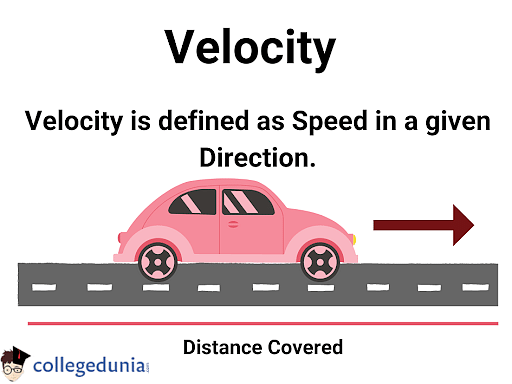
Velocity
If starting time is Zero (0) , then the Average Velocity Formula becomes:
| \(\begin{array}{l}\bar{v}=\frac{\Delta x}{t}\end{array}\) |
| Solved Example Example: A runner’s position changes from 60 m to 40 m in 4 seconds. What is his average velocity? Solution: The change in the displacement of the runner will be
Using the Average Velocity Formula, Vaverage = Δx/Δt = -20 m/ 4 s = -5 m/s Thus, the average velocity of the runner will be -5 m/s. |
Read More: Motion in a Straight Line Important Questions
Difference Between Average Speed and Average Velocity
[Click Here for Sample Questions]
Speed is a scalar quantity that only considers distance travelled, but velocity is a vector quantity that also considers direction and depends upon displacement.
Here are the key differences between Average Speed and Average Velocity:
| Average Speed | Average Velocity |
|---|---|
| Average Speed is defined as the ratio of total distance traveled to total time covered. | Average Velocity is defined as the ratio of displacement and total time taken. |
| It is a scalar quantity with only magnitude only. | It is a vector quantity with both direction and magnitude. |
| Average Speed is always positive. | Average Velocity can be zero and both positive and negative. |
| Average speed is always more than average velocity. | Average velocity cannot be greater than the average speed. |
Check More:
Things to Remember
- Average Velocity is the change in position or displacement divided by the time taken during which the displacement occurs.
- Average velocity is zero when the initial and final positions are same as the displacement is zero.
- It can be either be positive or negative based on the direction of displacement.
- Average Velocity is a vector quantity as it has both magnitude and direction.
- Average Velocity Formula is given as \(\begin{array}{l}\bar{v}=\frac{\Delta x}{\Delta t}=\frac{x_{f}-x_{0}}{t_{f}-t_{0}}\end{array}\).
Previous Years’ Questions
- The ratio of magnitudes of average velocity to average speed, is… (AIIMS - 1997)
- The average velocity of a freely falling body is numerically equal…
- Average velocity of a particle executing… (NEET - 2019)
- The motion of a particle in a straight line is an example of… (JKCET 2013)
- A particle is moving along a straight line path according to the…
- For a particle moving in a straight line, the displacement of the particle… (NTA Abhyas 2020)
- A particle moving in a straight line covers half the distance with speed… (KEAM)
- A man can swim at a speed of 4 km/h…
- A vehicle travels half the distance L with speed…
- A bullet of mass 40g moving with a speed of…
Sample Questions
Ques. An object travels 1200 m in 30 s. Calculate its average velocity. (2 Marks)
Ans. Average Velocity is defined as the rate of change in the displacement of an object in reference to time.
Thus,
Average Velocity = Δx/Δt
Average Velocity = 1200m/30s = 40m/s
Thus, the average velocity of the object is 40m/s.
Ques. What can be said about the typical velocity of objects launched into the air and returning to earth after a specific height? (2 Marks)
a. The average speed is not zero.
b. The average velocity is zero.
c. The average velocity exceeds zero.
d. The average velocity is below zero.
Ans. b. The average velocity is zero.
Explanation: Since the ball covers both the positive displacement and the negative displacement as it moves up and down, the total displacement is zero. The average velocity is therefore zero.
Ques. What is Average Velocity? (2 Marks)
Ans. Average Velocity is defined as a measure of the total displacement of an object in time ‘t’. It is defined as the ratio of the total displacement of the object to the total time taken. Average Velocity is denoted by the symbol Vav and is measured in the units of m/s. It is a vector quantity as it has both directions as well as magnitude.
Ques. An object is displaced 304 m north in 180 s. Find the average velocity of the object. (3 Marks)
Ans. It is given that,
- Displacement = 304 m
- Time = 180 s
Using the Average Velocity Formula,
Vav = Displacement / Time
Vav = 304m/180s = 1.7 m/s North
Ques. What will happen to a body's average velocity when it experiences terminal velocity under gravity? (2 Marks)
a. A rise in average velocity.
b. The average velocity falls.
c. The average speed is constant.
d. Exponential variations in average velocity.
Ans. c. The average speed is constant.
Explanation: When a body moves at terminal velocity, the velocity remains constant. This implies that at regular intervals. The average velocity stays the same as a result.
Ques. Is the average speed a scalar or a vector? (1 Mark)
Ans. Average velocity is a vector quantity as it has both magnitudes as well as directly associated with it.
Ques. What can be said about an automobile traveling around a pole in a circle at an average speed? (1 Mark)
a. The average speed is not zero.
b. The average velocity is zero.
c. The average velocity exceeds zero.
d. The average velocity is below zero.
Ans. b. The average velocity is zero.
Explanation: The car is driving in a circle; thus, it will eventually return to the same location after a specific amount of time.
Ques. Find the average velocity for the first 4, the next 4, and the final 6 seconds using this graph. (3 Marks)
Ans. According to the data,
| Time (s) | 0 | 2 | 4 | 6 | 8 | 10 | 12 | 14 | 16 |
|---|---|---|---|---|---|---|---|---|---|
| Displacement (m) | 0 | 2 | 4 | 4 | 4 | 6 | 4 | 2 | 0 |

Ques. A car travels in a straight road towards the east for 120 meters in 5 seconds, then turns west for 60 meters in 1 second. Determine average velocity. (3 Marks)
Ans. Given that
- Distance = 120 m + 60 m = 180 m
- Displacement = 120 m – 60 m = 60 m towards the east.
- Total Time = 5 sec + 1 sec = 6 sec
Average Velocity = Displacement/Time = 60 m/ 6 sec = 10 m/s
Ques. A jogger is running inside a rectangular track with a length of 50 m and a width of 20 m. He runs a rectangle track twice, running back to the starting point. If the total time he takes to run around the track is 100 seconds, determine the average velocity. (3 Marks)
Ans. First, we need to calculate the perimeter of the rectangular track, which is the distance covered in one round
= 2 x (50 + 20) = 2 x 70 = 140 meters
When the runner runs around the rectangle twice, the distance will be
2 x 140 = 280 m
Thus,
Distance = 280 meters
Displacement = 0 m (The jogger came back to the starting point)
Thus, Average Velocity = 0/100 seconds = 0 m/s.
Check-Out:



Comments