



Content Curator
Magnitude is defined as “How much of a Quantity”. For Example, Magnitude can be used for explaining the comparison between the speeds of a car and a bicycle or to explain the distance traveled by an object and tell the amount of an object in terms of its magnitude.
| Table of Content |
Key Terms: Magnitude in Physics, Magnitude of Earthquake, Displacement, Vector, Scalar quantity, Force
What is Magnitude in Physics?
[Click Here for Sample Questions]
Magnitude in physics is the maximum extent of size and the direction of an object. Magnitude is used in both scalar and vector quantities, the common factor. For example, A scalar quantity has magnitude only, it does not have a direction for describing itself.
- Magnitude helps to compare the speed of different moving objects and the distance covered by a moving object with its amount.
- For example, in the case of a moving truck which is moving faster than a car, the magnitude of the speed of the truck is more than the magnitude of the speed of the car. There are two types of quantities in physics: Scalar and Vector.
There are different ways in which magnitude is used.Which are:
- Magnitude of earthquake
- Magnitude of charge on an electron
- Magnitude of force
- Magnitude of displacement
- Magnitude of gravitational force
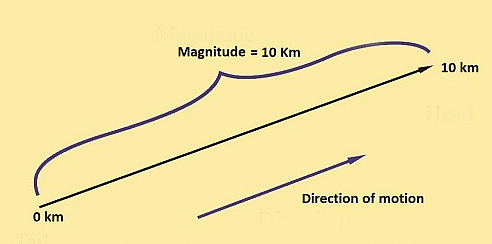
Magnitude
Also Read:
Magnitude of Earthquake
[Click Here for Previous Years Questions]
Magnitude of an earthquake is in terms of length, breadth and width. Earthquakes are measured in terms of magnitude. They have a single magnitude. The shaking caused by the earthquake has different values at different places because of factors such as the type of surface material and the distance from the epicenter.
- Earthquake’s magnitude is expressed in decimal fractions as well as in whole numbers.
- A moderate earthquake has a magnitude of 5.3 and strong earthquake if the magnitude is 6.3.

Magnitude of Earthquake
Magnitude of Charge on an Electron
[Click Here for Sample Questions]
The charge of an electron is the same as that of the magnitude of the elementary charge, with a negative sign.
- Elementary charge value is 1.602 x 10⁻¹⁹ C.
- There are two types of electric charges- positive and negative. The negatively charged are known as electrons while the positively charged are known as protons
- The net charge of an object is positive if there are more protons than electrons. Similarly, the net charge of an object is said to be negative if there are more electrons than protons.
- When the number of electrons and protons are equal in nature, then the object is said to be electrically neutral.
Magnitude of Force
[Click Here for Previous Years Questions]
The magnitude of force refers to the sum of all the forces that are acting on an object. When all the forces are acting in the same direction, then the magnitude of the force increases and when the forces are acting on an object in different directions, then the magnitude of the force decreases.

Force in Same Direction

Force in Opposite Direction
Magnitude of Displacement
[Click Here for Sample Questions]
Magnitude of displacement is defined as the shortest distance traveled between the initial and final position of the object. When an object is in motion, the magnitude is either less than or equal to the distance traveled.
For Example- Imagine if two friends are living on opposite sides of a lake. Bill intends to visit Ben. To drive around the edge of the lake is a journey of 20km. To row directly across is a journey of 2km. He doesn't feel like rowing today, so he drives 20km - but the magnitude of his displacement is still 2km.

The shortest distance is called displacement with direction and magnitude.
placement

The red line shows displacement and if a body covers displacement of 5m then the magnitude is 5.
Do check out:
| Related Topics | ||
|---|---|---|
| Relation Between Escape Velocity and Orbital Velocity | Universal Gravitation Formula | GRAVITATION |
| Inverse Square Law Formula | Force of Attraction Formula | Free Fall Formula |
Things To Remember
- Magnitude in physics is the maximum extent of size and the direction of an object.
- Magnitude is used in both scalar and vector quantities.
- Earthquakes are measured in terms of magnitude. They have a single magnitude.
- There are two types of electric charges, and they are positive and negative-The charge of an electron is the same as that of the magnitude of the elementary charge, with a negative sign.
- When all the forces are acting in the same direction, then the magnitude of the force increases and when the forces are acting on an object in different directions, then the magnitude of the force decreases.
- Magnitude of displacement is the shortest distance traveled between the initial and final position of the object.
Previous years questions
- A semicircular arc of radius r and a straight wire along the diameter, both are carrying same current i. Find out magnetic force per unit length at point P.
- If θ1 and θ2 be the apparent angles of dip observed in two vertical planes at right angles to each other, then the true angle of dip θ is given by :
- If a magnet is suspended at an angle 30∘ to the magnetic meridian, the dip needle makes angle of 45∘ with the horizontal. The real dip is
- What will be the field when 2I wire is switched off?
- The time taken by the dipole to complete 20 oscillations is (π≃3)
- If gA and gB are the acceleration due to gravity at the surfaces of the planets, the gA:gB equals
- A simple second pendulum is mounted in a rocket. Its time period will decrease when the rocket is:
- A synchronous relay satellite reflects TV signals and transmits TV programme from one part of the world to the other because its
- Which of the following graphs represents the gravitational field intensity due to solid sphere of radius R ?
- The relation between G and K is described as
- A satellite is in an orbit around the earth. If its kinetic energy is doubled, then
- If g is the acceleration due to gravity on the surface of the earth, the orbital speed of the satellite is
- If it stops suddenly, the speed with which it will strike the surface of earth would be (ve= escape velocity of a body on earth's surface)
- The ratio F2/F1 will be
- A solid sphere of uniform density and radius 4 units is located with its centre at the origin O of coordinates.
- A test mass can undergo circular motion under the influence of the gravitational field of particles. Its speed v as a function of distance r from the centre of the system is represented by"
- A spring balance A and a beam balance B are used to weigh the same object at a place on the equator and a place on the pole of the earth. Then
- When you move from equator to pole, the value of acceleration due to gravity (g):
- Where is the intensity of the gravitational field of the earth maximum?
- What will be the acceleration due to gravity at a depth d where g is acceleration due to gravity on the surface of earth?
Sample Questions
Ques. What is magnitude in physics with an example? (2 marks)
Ans. The size of the object or the amount is its magnitude. Like in the case of speed, a car is traveling faster than a motorbike. In this case, the magnitude of the speed of the car is more than that of a motorbike.
Ques. What is the difference between magnitude and intensity? (3 marks)
Ans. A Magnitude is a quantitative number while intensity gives us the idea of impact. For example – suppose two persons are riding a car and a bike at the same speed of 100km/hr.
The bike rider will probably damage the engine at such a speed. This speed will not have any impact on the car’s engine. The magnitude of both car and bike is the same i.e 100km/hr, but both have a different impact because of the intensity. Magnitude remains the same while intensity changes..
Ques. What is Magnitude in Physics When it comes to an earthquake? (4 marks)
Ans. During the earthquake, energy is released producing seismic waves, which travels in all directions causing vibrations. The magnitude of an earthquake gives information which is helpful in calculating the probability in the coming times.
- Magnitude is the quantitative value of seismic energy.
- Specific value having no relation with distance and direction of the epicenter.
- Earthquake magnitude is measured with the help of the Richter scale. (Charles. F. Richter invented it in 1934).
- The Richter scale measures the largest magnitude of all seismic waves without taking into consideration the type of wave. In the logarithmic scale magnitude increases 10 times with each increase in number.
Ques. How to Calculate Magnitude of a Vector? (3 marks)
Ans. Vector quantities have magnitude with direction. Some Vector quantities are – velocity, displacement, acceleration, force, etc. The magnitude of a vector is measured by its absolute value.
- The two vectors will only be equal if both have the same direction and magnitude. When we multiply a vector with a positive number, its magnitude will change but the direction always remains the same.
- Similarly, when we multiply a vector with a negative number, the magnitude and direction both change.
Ques. What is the Scalar quantity? (2 marks)
Ans. A scalar is a physical quantity that has only magnitude. For example, mass, temperature, density, volume, etc. To define a scalar quantity, magnitude and unit is needed.
Scalar Quantity= magnitude + unit and in the case of scalar, to calculate magnitude, you have to follow the linear algebraic rule.
Ques. Is magnitude always positive in physics? (2 marks)
Ans. Yes, A negative magnitude should be a positive magnitude with 180 degrees of phase.
Two terms are often confused, magnitude and amplitude. Magnitude is always a positive number and phase information is not included. The amplitude is a complex number, which can be negative, imaginary, and all combinations. In fact, the amplitude has a magnitude and a phase.
Ques. How do you find the magnitude and direction of an unknown force? (5 marks)
Ans. In the given forces we can calculate the resultant using vector addition. If given the resultant and one force we can calculate the other force using vector subtraction.
When we know or can calculate the acceleration and know the mass then Newton's F=ma. Rotation of this would be Centripetal force in this case.
When the object is stationary (or moving at constant velocity) the acceleration is zero. Net force here is also zero. When there are some known forces then the unknown ones must make the net force sum to zero. Use vector addition and subtraction.
When the power and velocity is mentioned. Then,
Power = Force * Velocity.
When there is a change in momentum in a given time -
Change in momentum = Force * Time.
Change in momentum mass * Change in Velocity.
For example forces on charges or current carrying wires moving in magnetic fields, Gravitational attraction etc.
Ques. Can the magnitude of a vector never be positive and negative? (2 marks)
Ans. Etymologically Magnitude means greatness of some character. So, the magnitude of a vector means its size. For Example- It makes no sense to say the length of my table is negative six foot. Scalar quantities are always positive.
Ques. Can magnitude be negative? (2 marks)
Ans. Magnitude means the size or extent of something. There is a magnitude for everything.
Magnitude of a vector, then it can never be negative. Magnitude of vector means square root of sum of squares of all the components of the vector. Squaring any real number results in a positive number that can never be negative. Logarithmic magnitudes can be negative.
Do Check Out:



Comments