



Education Journalist | Study Abroad Lead
Avogadro’s number is the number of units in one mole of any substance which is defined as its molecular weight in grams. The value of Avogadro Number is 6.02214076 x 10²³.
The units can be electrons, atoms, ions, or molecules, depending on the character of the reaction and the nature of the substance. Avogadro's constant has the dimension of one divided by the amount of substance (in SI Unit Dimension). Thus, the number in front of the unit will change as the unit changes. Example: 30 minutes is the same as 0.5 hours even though 30 is not the same as 0.5.
Avogadro’s number helps to form a bridge between the macroscopic world and the microscopic world by giving a relationship of the amount of substance to the number of particles. It also helps to give a relationship between other physical constants as well, including:
- It gives the relationship between the gas constant R and the Boltzmann constant. Thus, kB: R=kBNA
- It gives the relationship between the Faraday constant F and the elementary charge. Thus, e: F=NAe
- It gives the relationship between atomic mass unit u and molar mass constant. Thus, Mu: 1u=Mu/NA
| Table of Content |
Key Terms: Avogadro's Constant, Molecular mass, Atomic Mass, Electron, Atom, Boltzmann Constant, Faraday's Constant, Proton, Coulomb’s Per Electron
What is Avogadro’s Number?
[Click Here for Sample Questions]
The number of particles, ions, or atoms present in one mole (1 mol) of a given substance is known as Avogadro’s number.
- Simply, it is a proportionality constant that relates the molar mass of a substance to the mass of a sample.
- A mole is a chemist unit of counting particles like atoms, molecules, ions, electrons, protons which are represented by a value of 6.022 x 10²³.
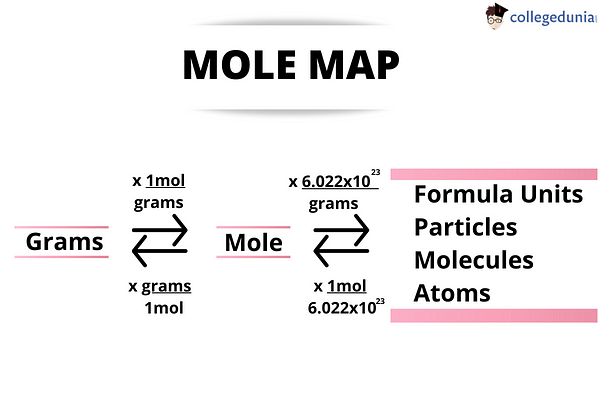
Avogadro’s Number
- A mole of the hydrogen atom is to say 6.022 x 10²³ atoms of hydrogen, while a mole of the hydrogen molecule means 6.022 x 10²³ molecules of hydrogen or 2 x 6.022 x 1023 atoms of hydrogen.
- Similarly, a mole of oxygen molecule means 6.022 x 10²³ molecules of oxygen or 2 x 6.022 x 1023 atoms of oxygen.
- Avogadro's number can be indicated using the symbol L or NA.
- Avogadro's number, on its own, is known to be a dimensionless quantity.
- For example, in case the number of particles in 3 moles of a substance was to be determined, the value would be:
= 3 x 6.023 x 1023 = 1.81 x 1024 particles
Avogadro’s Number Derivation
It can be said that:
- The estimate of the value of Faraday is 96,485.3383 coulombs per mole of electrons.
- The charge of an electron based on modern experiments is 1.60217653 x 10⁻¹⁹ coulombs per electron.
- If the division of the charge on one mole of an electron occurs by the charge on a single electron, it can result in the value of Avogadro’s number of 6.02214154 x 10²³ particles per mole.
- Another method to determine Avogadro’s number, on the macroscopic scale, is with detailed measurements of the density of an ultrapure sample of a material.
- As per the atomic scale, the measurement of the material density occurs by employing x-ray diffraction techniques.
- It helps to determine the number of atoms per unit cell present in the crystal.
- This also helps to evaluate the distance between the equivalent points that define the unit cell.
Also check:
| Important Concepts | ||
|---|---|---|
| Alpha-particle Scattering and Rutherford’s Nuclear Model of Atom | Atoms MCQ | Bohr Model of the Hydrogen Atom |
| Laser Light | Alpha Particle Mass | Laser |
Facts about Avogadro’s Number
[Click Here for Previous Year Questions]
The number of units/ constituent particles/ ions/ atoms present in one mole of a substance is called Avogadro's constant or Avogadro’s number.
- It is represented by NA or L.
- Avogadro Constant is equal to 6.022140587 x 10²³ mol-1 in the SI Unit System.
- The number of particles in one mole of any substance is equal to 6.023 x 10²³. For example, one mole of hydrogen implies 6.023 x 10²³. Similarly, one mole of water molecule implies 6.023x10²³ molecules, etc.
- The units can be electrons, ions, or molecules and depend on the nature of the substance and the character of the reaction.
- Example: The number of constituent particles in 5 moles of substance will be equal to: = 5 x 6.023 x 1023 = 30.01 x 10²³ particles.
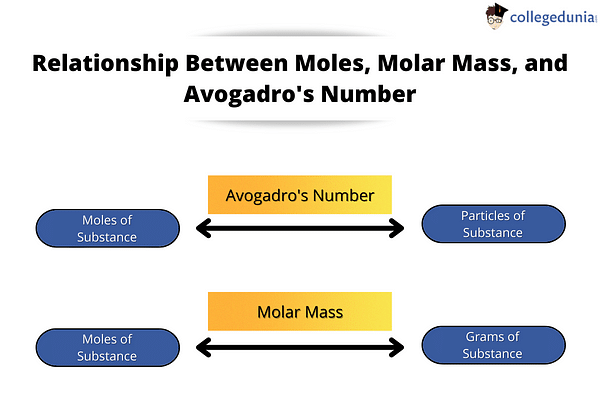
Avogadro’s Number History
[Click Here for Sample Questions]
How was Avogadro’s Number Measured?
Specifically, Gay-Lussac’s law of combining volumes interested Avogadro.
- Thus, the brainchild behind this entire concept was Amedeo Avogadro, who in 1811 had proposed that the volume of gas was proportional to the number of molecules, irrespective of the nature of the gas.

- His ideas were inconclusive and met opposition from Dalton. After his death, a chemist named Stanislao Cannizzaro brought attention to the world about Avogadro’s ideas.
- In 1909, a Nobel Prize winner physicist named Jean Baptiste Perrin named the number after Avogadro in his honor.
- It is also known as the Loschmidt constant in a few of the German works and was defined as the number of molecules in 12 grams of the isotope carbon-12 (12C).
Frequently Asked QuestionsQues. Which among 4 mol of H2O and 5 mol of CH3COOCH contains the greatest number of hydrogen atoms? Ans. Between 4 mol of H2O and 5 mol of CH3COOCH, 5 mol of CH3COOH comprises more hydrogen atoms. It is because, in 4 mol of H2O, an amount of 4N molecules are there, wherein N equals Avogadro’s number. In a 5 mol of CH3COOH, 5N molecules can be found (here, N = Avogardro’s number). The hydrogen atoms in the formula are equal to the total number of hydrogen atoms present in the sample. Hence, in 4 mol of H2O, 8N hydrogen atoms can be found, whereas, in 5 mol of CH3COOH, 20N hydrogen atoms are present. Thus, 5 mol of CH3COOH has the greatest number of hydrogen atoms. Ques. Determine the 7.1 mol of Al in grams. Ans. 7.1 mol of Al is 26.98g/1mol. Thus, in grams, it is 191.56 of Al. |
Significance of Avogadro’s Number
[Click Here for Previous Year Questions]
Avogadro’s number defines the relationship between macroscopic and microscopic worlds by relating to the amount and number of particles in a substance. It also gives the relationship between several physical constants and their properties, such as:
- Gas constant (R) and Boltzmann constant (kB): R = NAkB.
- Faraday constant (F) and the elementary charge (e): F = NAe
- Atomic mass unit (u) and molar mass constant (M): 1u = Mu/NA
At the microscopic level or more precisely at atomic levels, substances are measured in atomic mass units (amu). The atomic mass unit (amu) is defined as 1/12th weight of the mass of one carbon (C-12) atom.
Thus, 1 amu = 1.66 x 10⁻²⁴ grams
Important Terms During Calculations
Some important terms are:
- Atomic mass: Mass of one atom of an element.
- Atomic mass unit (amu): 1/12th the mass of a carbon-12 atom.
- Molar mass: Molar Mass, which is also known as gram atomic mass, it is the numerical value of atomic mass. Units change from u to g.
- Molecular mass- The sum of all atomic masses comprising the molecule.
- The conversion formulae for Avogadro’s number, number of particles, and moles.
| Number of moles (n) = Given the number of particles / Avogadro number |
Molecular Mass Calculation
[Click Here for Sample Questions]
A simple example to calculate molecular mass is shown below.
Consider a molecule of H2SO4. It consists of 2 hydrogen, 1 sulfur, and 4 oxygen atoms.
Solution: Molecular mass = 2(Atomic mass of hydrogen) + 1 (Atomic mass of sulfur) + 4 (Atomic mass of oxygen)
H: 2 x 1= 2g
S: 1 x 32= 32g
O: 4 x 16= 64g
Molecular mass = 2g + 32g + 64g= 100g
Consider a mole of HCl. It consists of 1 hydrogen and 1 chlorine atom.
Solution: Molecular mass= 1(Atomic mass of hydrogen) + 1 (Atomic mass of chlorine)
= 1 + 35.5
Molecular mass= 36.5g
Previous Year Questions
- With increasing principal quantum number, the energy difference…
- The following sets of quantum numbers represent four… (AIEEE 2012)
- Which quantum number is not related to the Schrodinger… (Rajasthan PMT 2002)
- As the electron in Bohr’s orbit of hydrogen atom passes from state…
- The correct set of four quantum numbers for the outermost electron… (KCET 2012)
- The correct set of four quantum numbers for the valence electrons… (JEE Main 2013)
- Principal, azimuthal and magnetic quantum numbers are… (AIIMS 1999)
- What is size of gold nuclei...?
- How the linear velocity v of an electron in the Bohr orbit is related...?
- The value of Planck's constant (h) is… (VITEEE 2017)
- Wave mechanical model of the atom depends upon…
- Dual behavior of matter was proposed by… (JKCET 2010)
- Though the quantum theory of light can explain…
Things to Remember
- Avogadro’s number can be defined as the number of units in one mole of a substance that can be expressed as its molecular weight in grams.
- Avogadro Constant formula 6.02214076 x 10²³.
- Avogadro indicated by NA or L.
- It helps to give the relation between gas constant R and the Boltzmann constant, Faraday constant F and the elementary charge, atomic mass unit u and molar mass constant.
- Avogadro's number is known to be a dimensionless quantity, if considered on its own.
Also check:
Sample Questions
Ques. What is the mass of 3 moles of Al atoms? (1 mark)
Ans. The atomic mass of an Al atom= 27g
Therefore, mass of 3 moles of Al= 3 x 27 = 81g
Ques. How many atoms are there in 48g of boron? (1 mark)
Ans. Atomic mass of B= 10.8
48g x (1mol B/ 10.8g) x 6.023 x 10²³ atoms = 26.76 x 10²³ atoms
Ques. Which has a greater number of hydrogen atoms? 4 mol of CH3COOH or 3 mol of H2O. (2 marks)
Ans. In CH3COOH there are 4 hydrogen atoms. Hence 4 mol of CH3COOH contains 4 x 4= 16N molecules. (N=Avogadro’s constant)
Now, consider H2O. It has 2 hydrogen atoms. So, 3 mol of H2O implies 3 x 2= 6N molecules. (N=Avogadro’s constant).
Hence, 4 moles of CH3COOH has a higher number of hydrogen atoms compared to 3 moles of water molecules.
Ques. How many atoms of sodium are in three moles of Na2S? (2 Marks)
Ans. There are two sodium atoms per molecule. For calculating the number of atoms of sodium: Multiply the total moles of sodium by Avogadro's number.

Ques. Calculate the number of hydrogen atoms in 46.3g of ethanol. (2 marks)
Ans. The formula for ethanol is CH6O.
Molar mass= 12+ 6(1) + 16= 34 g/mol
Now, 46.3g of ethanol implies 46.3g x 1mol/34g = 1.36 mol of CH6O.
1.36mol of CH6O = 1.36 x (6 mol H/ 1 mol CH6O)
=8.17 mol H
8.17 mol H x 6.023 x 1023 = 49 x 1023 H atoms.
Ques. How much copper can be obtained from 100 g of copper sulphate (CuSO4)? The atomic mass of copper is 63.5 amu. (2 marks)
Ans. One mole of CuSO4 contains 1 mole (1 g of atom) of Cu
Molar mass of CuSO4 = 63.5 + 32 + 4 x 16 = 159.5 g mol-1
Therefore, Cu that can be obtained from 159.5 g of CuSO4 = 63.5 g

Ques. Calculate the mass sodium acetate (CH3COONa) required to make 500 mL of 0.375 molar aqueous solution. Molar mass of sodium acetate is 82.0245 g mol-1. (2 marks)
Ans. 0.375 M aqueous means 1000 mL of the solution contain sodium acetate = 0.375

Ques: Calculate the concentration of nitric acid in moles per litre in a sample that comprises a density of 1.41 g mL-1 and the mass percent of nitric acid in it is 69%. (2 marks)
Ans. The mass percent of 69% implies that 100g of nitric acid solution contains 69 g of nitric acid by mass.
Molar mass of nitric acid is: HNO3 = 1 + 14 + 48 = 63 gmol-1

Ques. How many atoms are in 50g of calcium? (3 Marks)
Ans. In order to determine how many atoms are in this sample, we need to convert this sample into moles. Calcium has a molar mass of 40.08 grams per mole.
50g Ca∗1mol Ca/40.08g Ca
= 1.25mol Ca
Avogadro's number tells us that there are 6.022∗1023 atoms in one mole of any element.
This conversion is used in determining the total number of atoms in the sample.
1.25moles∗6.022∗1023atoms/1mol
= 7.5∗1023 atoms
Ques. In three moles of ethane (C2H6), calculate the following: (3 marks)
i) Number of moles on carbon atoms
ii) Number of moles of hydrogen atoms
iii) Number of molecules of ethane
Ans.
- 1 mole of C2H6 contains 2 moles of carbon atoms
Therefore, 3 moles of C2H6 will C-atoms = 6 moles
- 1 mole of C2H6 contains 6 moles of the hydrogen atoms
Therefore, 3 moles of C2H6 will contain H-atoms = 18 moles
- 1 mole of C2H6 contains Avagardo’s no., i.e., 6.02 x 10²³ molecules
Therefore, 3 moles of C2H6 will contain ethane molecules = 3 x 6.20 x 1023 =18.06 x 10²³ molecules
Ques. Avogadro’s number is NOT equal to:
A. the number of atoms in 11.2Lof O2 at STP
B. the number of atoms in 1 molof He at STP
C. the number of electrons in 96,500 coulombs
D. the number of SO42 - ions in 1L of 0.5M sulphuric acid (4 Marks)
Ans. Avogadro constant is the proportionality factor that relates the number of particles (usually molecules, atoms or ions) in a sample with the amount of substance in that sample.
Its SI unit is the reciprocal mole (mol).
It is defined as NA = 6.02214076×10²³. It is named after the Italian scientist Amedeo Avogadro.
Avogadro number = NA = 6.02214076×10²³
One mole of any substance has NA = 6.02214076×10²³ number of atoms, molecules or ions.
Thus, moles of SO42 - ions in 1L of 0.5MH2SO4 are: Molarity = moles/volume.
According to the values given in the question, the expression will become: 0.5 = moles.
Thus, the number of moles will be 0.5 mol.
According to Avogadro’s number, one mole of every substance is equal to Avogadro’s constant.
For Latest Updates on Upcoming Board Exams, Click Here: https://t.me/class_10_12_board_updates
Check out:



Comments