



Education Journalist | Study Abroad Lead
Bird skeletal system consists lightweight skeleton made of mostly thin and hollow bones. Birds have evolved a very distinctive skeletal structure in the animal kingdom over millions of years. Although flying is a highly evolved evolutionary adaptation, birds make significant sacrifices to acquire it.
- Pneumatic bone structure, extended necks, tiny heads, modified ribs, and a high degree of stiffness are the key flight adaptations in the avian skeletal system.
- Birds have evolved without teeth, thus they do not need robust and hefty jaws to sustain them.
- Their wings and legs have the same fundamental components as our own limbs, but they have been drastically changed.
- The sternum, or breastbone, is especially notable for its greatly modified keel-like structure.
- The rib cage in birds is highly adapted in that the ribs reach from the back to the sternum and each rib is connected to the next rib by a tiny bone.
Read More: Fish Skeletal System
| Table of Content |
Key Terms: Birds, Aves, Skeleton system, Wings, Skull, Mammals, Ribs, Sternum.
Bird Skeleton Anatomy
[Click Here for Sample Questions]
The skeleton of a bird consists of wings, two feet, a beak, and a feathered body. Bird skeletal diagrams can help with comprehension.
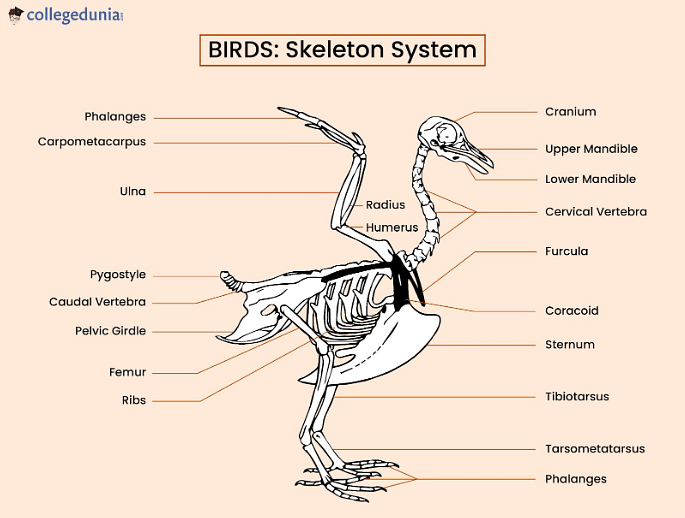
Bird Skeleton Anatomy
- Skull– The frontal (top of the head), parietal (back of the head), premaxillary and nasal (top beak), and mandible (bottom beak) bones comprise the skull.
- A normal bird's skull typically weighs roughly 1% of the bird's total body weight.
- The eye takes up a large portion of the skull and is encircled by a sclerotic eye-ring, which is a ring of small bones.
- The anatomy of the bird skull has a significant impact on their eating habits.
- Ribcage– The ribs of birds have uncinate processes. They are linked with each other via smaller bones providing them with great support and flexibility.
- Vertebrae– The number of vertebrae ranges from 39 to 63. The most common vertebral articulation is saddle-shaped heterocoelous. Each of the 3 to 10 chest (thoracic) vertebrae ordinarily has a pair of full ribs, one dorsal vertebral rib articulating with the vertebra, and one ventral sternal rib articulating with the breastbone (sternum).
- Each vertebral rib has a flat, backward-pointing spur, known as the uncinate process in birds.
- The sternum, ribs, and their articulations serve as the structural foundation for a bellows movement, which moves air through the lungs.
- The synsacrum is a set of 10 to 23 fused vertebrae posterior to the thoracic vertebrae to which the pelvic girdle is connected.
- Heart– Birds have bigger hearts than mammals (in comparison to body size and mass). Birds' comparatively big hearts may be required to sustain the high metabolic needs of flying. Smaller birds have bigger hearts than larger birds. Hummingbirds have the biggest hearts of any bird, most likely due to the energy required to hover.
- In addition, avian hearts pump more blood per unit of time than mammalian hearts.
- In other words, avian cardiac output is often larger than that of mammals of the same body mass.
- Heart rate and stroke volume both impact cardiac output.
- Beaks– The bill of a bird that protrudes from the face and is used for feeding, grooming, and pecking is referred to as a beak. They are lightweight in nature.
- Legs– The feathers that make up the wings cover the bird's front legs. The majority of them have four toes, while others only have three. Although the number of toes is the same in all varieties, their arrangement varies.
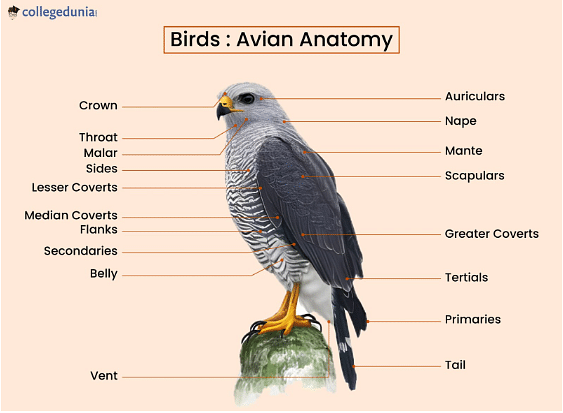
Bird: Avian Anatomy
Read More: Central Nervous System
Bird Wings
[Click Here for Sample Questions]
The bird's hand has been significantly altered: parts of its bones have been shortened, while others have combined. A carpometacarpus is formed by the union of three metacarpal bones and a portion of the carpal bones. Three finger bones are linked to it.
- The one in front has an alula, which is a clump of feathers that behave like airplane slats.
- This finger typically has one phalanx bone, the following two have two, and the rear has one.
- Terrestrial birds have fewer or no wings, but aquatic birds have wings that serve as flippers.
- The shoulders, forearm, and hand are all part of the avian wing anatomy.
- The wing form is critical in determining flying capability.
- There are four types of bird wings. Elliptical wings, high-speed wings, high aspect ratio wings, and flying wings with slots are all examples of bird skeletal wings.
- The form of a bird's wing is significant in influencing its flying capabilities.
- Different designs represent different trade-offs between benefits such as speed, low energy use, and maneuverability.
Read More: Synovial Joints
Flying Mechanism
[Click Here for Sample Questions]
Birds fly by flapping their wings and primarily guiding with their tails. In comparison to airplane components, a bird's wing serves as both a wing and a propeller. The basal region of the wing provides the majority of the supporting surface, while the wing tip provides the majority of the propelling power. A bird's wing may be shortened or lengthened by flexion; the feathers at the tip can be spread or closed; and the angle of the entire wing or its parts on one side or both can be changed.
- Birds cannot fly in the absence of a keel. A hinge between the frontal and nasal bones provides flexibility for the upper jaw.
- With the quadrate bone at the base of the jaw, a hinge-like expression may move the lower jaw.
- The form of a bird's tail appears to be linked to flying as well.
- Frigate birds and terns utilize their forked tails to change direction quickly, while the barn swallow uses its highly forked tail to create elaborate patterns in its elegant flight.
- Birds' flying styles vary greatly, and different forms of wings correspond to different types of flight.
- The speed at which birds fly varies widely, and individual birds may alter their speed as well.
Read More: Flight Adaptations
Human vs Bird Skeleton
[Click Here for Sample Questions]
The avian (bird) skeleton is similar to the human skeleton in many ways.
- Human arm bones are made up of the humerus, radius, and ulna. These bones are likewise found in birds, but at the end of the arm, whereas humans have five digits. The wings of birds have three digits.
- The human leg is made up of a lengthy femur and two lower leg bones, however, in the avian skeleton, these two bones, the tibia and fibula, are fused together.
- The skull of both birds and humans is covered by a big cranium, and the top jaw of the human and the upper beak of the bird are both made up of a bone called the maxilla. The mandible is the bone that makes up the lower jaw and lower beak.
- Birds, unlike humans, have no teeth in their mouths.
- The fundamental difference between the human and bird skeletons is that the bird's skeleton is designed for flight.
- Human bones are solid and packed with bone marrow, but the bones of birds are hollow, allowing air to flow into bones and increase oxygen supply. These bones are lighter due to a lack of bone marrow.
- The forelimbs of the bird are wings, and they require a robust support system.
- The bird's collarbone is united to create the furculum or wishbone, and the sternum is big and located beneath the body.
- The keel is the ridge of a bird's sternum where massive flying muscles attach.
- A bird's spine has multiple vertebrae fused together to create a bone called the pygostyle, which humans do not have.
- The pygostyle is a robust structure that allows muscles and tail feathers to adhere, which is essential for takeoff and landing.
Read More: Leg Muscles
Advantages of Bird Anatomy
[Click Here for Sample Questions]
Few key points of bird anatomy's advantages over mammals are–
- Birds, like mammals, breathe in oxygen and expel carbon dioxide. In addition to their lungs, they have specific air sacs with hollow bones that let these gases to travel more readily about the body. This indicates that a single avian breath travels further, is more steady, and does more effort than a single human breath.
- To keep their flying muscles functional, birds must circulate blood fast throughout their bodies. To do this, their hearts are considerably larger and more powerful than those of mammals.
- Because of their hollow bones, bird skeletons are incredibly light for their size. Frigatebirds have a wingspan of nearly two meters yet a skeleton that is lighter than their feathers. Birds have lightweight beaks rather than hefty teeth and jawbones.
- The major limb bones of a bird are hollow, having specific struts within to reinforce them. As a result, they are stronger than mammals without being heavier. Other bones in a mammal's skeleton are more stiff.
- Birds do have more muscle support because of their larger breastbone, helping them in flying.
Read More: Difference between Catabolism and Anabolism
Things to Remember
- Bird skeletal system consists lightweight skeleton made of mostly thin and hollow bones.
- Birds have evolved without teeth, thus they do not need robust and hefty jaws to sustain them.
- Their wings and legs have the same fundamental components as our own limbs, but they have been drastically changed.
- The frontal (top of the head), parietal (back of the head), premaxillary and nasal (top beak), and mandible (bottom beak) bones comprise the skull.
- Birds have bigger hearts than mammals.
- Birds fly by flapping their wings and primarily guiding with their tails.
- Birds cannot fly in the absence of a keel.
Sample Questions
Ques: How durable are the bones of birds? (2 Marks)
Ans: The bone density studies reported here show that, in general, avian skeletons are stronger and stiffer in contrast to their weight than those of small mammals, notably rodents.
Ques: In what manner does the beak of a bird help it? (3 Marks)
Ans: The beak of a bird, like all other bodily parts, has a purpose. It aids the bird in its quest for food. A beak's additional duties include defense against prey, mating, feeding its young, feeding itself, controlling body temperature, constructing nests, and combing its feathers. Every bird has a distinctive beak. Predators, for example, have a keen, powerful, and hooked beaks to grab their prey. A sparrow has a tiny mouth for picking little grains, but a hummingbird has a long, thin beak for sucking nectar from flowers.
Ques: Why is it not possible for a human to fly? (2 Marks)
Ans: The birds have hollow bones that allow them to fly light, which humans do not have. Humans are massive. Furthermore, the birds have a balance between body size and wing span, and muscular strength. In the case of humans, the strength-to-size ratio is different. Humans do not have a streamlined physique, nor do they have feathers to aid in flight.
Ques: In what manner does the feather of a bird help in flying? (2 Marks)
Ans: A bird's feathers are waterproof, provide insulation, and aid in decreasing the bird's body weight, allowing the bird to fly. A bird's breast muscles are robust and aid in flapping its wings. The wings have a certain form that allows them to move in the air when the plane is flying. The feathers also assist a bird's body buoyancy and reduce heat loss.
Ques: What makes bird skeletons special? (1 Mark)
Ans: A bird's limbs' primary bones are hollow, with reinforcing struts inside.
Ques: Why do birds have few bones? (2 Marks)
Ans: Birds have minimal bones because flying requires robust bones while being lightweight. This is performed by combining tiny bones and removing others. The bones are hollow and filled with air gaps, allowing them to fly fast.
Ques: What bones are involved in the breathing mechanism in birds? (2 Marks)
Ans: Birds have chambers called air sacs that capture as much oxygen as possible. When the birds inhale, oxygen enters their air sacs. The air sacs propel the air to the lungs, where it is expelled.
Ques: How do birds fly even when there is a loss of feathers? (2 Marks)
Ans: Birds shed their feathers on a regular basis, a process known as molting. This might be a progressive loss over time or a sudden loss. They make certain that they do not participate in activities that take a lot of energy when molting.
For Latest Updates on Upcoming Board Exams, Click Here: https://t.me/class_10_12_board_updates
Check-Out:



Comments