



Content Curator
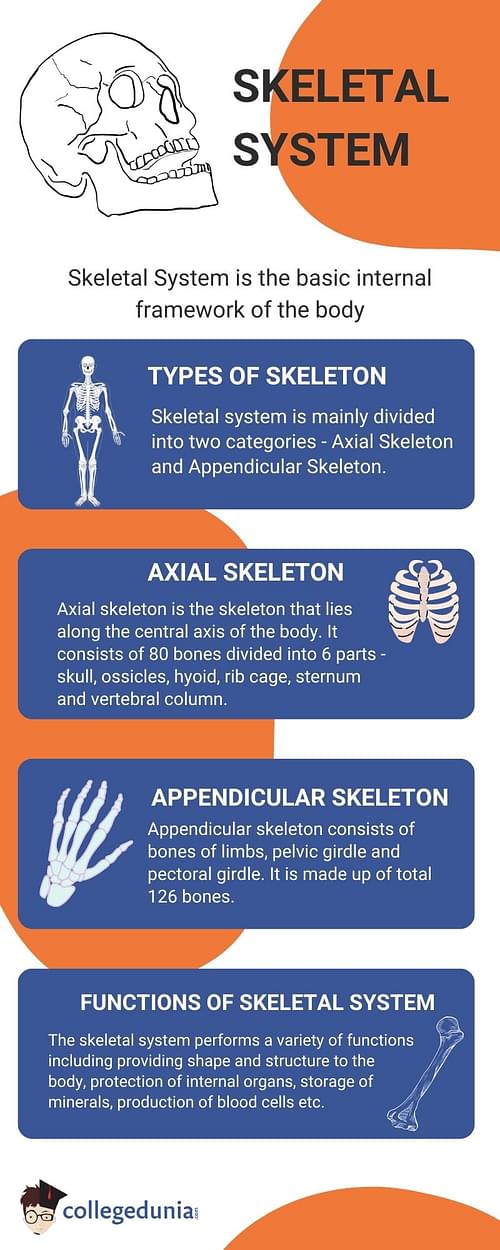
Skeletal system is composed of all the bones in the body along with the associated connective tissues. It is the basic internal framework of the human body. Skeletal system along with its associated tissues supports the structure of the body and allows movement. Depending upon the species, the skeletal system of the living beings differs from each other. There is a lot of difference between the skeleton of terrestrial and aquatic animals.
Joints are an important component of skeletal system. They allow for movement of different body parts. A skeleton mainly includes all the rigid components of the body associated with each other through various connective tissues like tendons, ligaments, cartilage etc.
| Table of Contents |
Key Terms: Skeletal System, Axial Skeleton, Appendicular Skeleton, Vertebral Column, Pectoral Girdle, Pelvic Girdle
Anatomy of Skeletal System
[Click Here for Sample Questions]
Human body consists of 206 bones arranged in a specific pattern in the body. This arrangement allows the body to perform its different functions including locomotion and movement. The skeletal system of humans is mainly divided into two categories:
- Axial Skeleton
- Appendicular Skeleton
Axial Skeleton
The axial skeletal system is present along the body's central axis i.e. on its longitudinal axis. It includes the skull, spine, sternum, auditory ossicles, hyoid, and ribs. The axial skeleton of an adult is composed of 80 different bones. Some of the bones of the axial skeleton are as follows:
- Skull – The skull acts as the protective cage for the brain. Since the brain is a delicate part, it is well protected by the skull. Skull mainly contains 22 bones divided into two types – Cranial and Facial. A skull with 2 occipital condyles is named dicondylic. Human skull is dicondylic.
- Auditory Ossicles – The bones of the auditory ossicles are found in the inner ear canal. It consists of 6 small bones, three on each side of the head. The bones are named malleus, incus and stapes. These bones helps in transmission of sound waves from outside to the inner ear.
- Hyoid – It is the U-shaped bone present at the base of the jaw. It serves to attach muscles and ligaments in the neck.
- Vertebral Column – The vertebral column or spine is made up of 26 bones including 24 vertebrae and two other bones sacrum and coccyx. The sacrum and coccyx bones are made of fused vertebrae.
- Thoracic Cage – It includes the sternum and the ribs. There are 12 pairs of ribs in a human body. Thoracic cage act as a protective covering for the organs like heart and lungs.
Vertebral ColumnThe vertebral column is composed of 26 bones which encloses the spinal cord and supports head. It is divided into 5 regions mentioned below:
Both sacral and coccygeal vertebrae support the weight of the body while sitting. |
Appendicular Skeleton
The appendicular skeletal system comprises of 126 bones which includes limbs, pelvic girdle, and pectoral girdles. These bones make up the arms and legs of the humans.
- Pectoral Girdle – It is the region where the bones of the arms gets attached to the axial skeleton. This region is made up of two bones for each arm – Clavicle and Scapula.
- Pelvic Girdle – Pelvic girdle forms the hip region. It is the region where legs attach to the axial skeleton. The bones of the pelvic girdle includes Ilium, Ischium, and Pubis.
- Limbs – There are different bones that makes up the upper and the lower limb. The upper limbs (or the arms) includes bones known as humerus, radius, ulna, carpals, metacarpals and phalanges. The bones of the lower limb (legs) are femur, tibia, fibula, patella, tarsals, metatarsals and phalanges.
Upper LimbThe bones of the upper limb are as follows:
To remember phalanges, its formula for the human hand is 2,3,3,3,3. Lower LimbIn each lower limb, 30 bones are found. These are –
|
Functions of Skeletal System
[Click Here for Sample Questions]
The skeletal system performs a wise range of functions for the human body. While its main functions is to provide structure and allow movement of body parts, it also helps in production of blood cells and storage of minerals. The various functions perform by the body are as follows:
- Support to the Body – Skeletal system provides an internal rigid framework to the body which helps support its internal organs. It also provides a shape to the body.
- Movement of Body Parts – Movement is the key functions of the skelatal system. There are different types of joints formed by the skeleton. These joints allow the movement of the different body parts. Without the joints, the body would have been a stiff, rigid structure with no movement.
- Protection of Internal Organs – The skeletal system serves to protect the internal, delicate organs of the body. For example, skull protects the brain, thoracic cage protects the heart and the lungs etc.
- Storage of Minerals – Skeleton also serves to store various essential minerals required for growth and repair of the cells. These minerals are stored in the bone matrix and released into the blood whenever required.
- Production of Blood Cells – The bone marrow present inside the bones is responsible for producing the red and white blood cells in our body.
Read More:
Diseases of Skeletal System
[Click Here for Sample Questions]
There are different types of diseases associated with the skeletal system. The most common diseases of the skeletal system includes:
- Osteoporosis – In this condition, the strength of the bone gradually decreases at a rate higher than that of the bone growth. It can be due to genetic reasons and lack of essential nutrients like calcium or vitamin D.
- Osteoarthritis – It refers to the condition in which the cartilage that protects the ends of the bones in joints gets broken down. Because of the absence of the cartilage at the joints, the rubbing of bones occurs leading to pain and damage to the bones.
- Leukemia – Leukemia is a type of cancer in bone marrow and the lymphatic system. It affects blood cells and other body functions.
Things to Remember
- Skeleton is the hard, rigid internal framework of the human body.
- The Skeleton system is made up of all the bones in the body along with the connective tissues like tendons, ligaments etc.
- The skeletal system can be diversified into two systems – the axial and appendicular skeleton.
- The axial skeleton is present on the body's central axis and includes the bones of skull, spine, sternum, auditory ossicles, hyoid, and ribs.
- The appendicular system comprises 126 bones which include limbs, pelvic girdles, and pectoral girdles.
- Skull is a frame of bones that protects the brain from any harm. Human skull is dicondylic and contains total 29 bones.
- The vertebral column or the spine is a complex, web-caged connection of bones, nerves, tendons, ligaments, and muscles.
Also Read:
Sample Questions
Ques. Define a joint with respect to the skeletal system. (2 Marks)
Ans. A joint is a place in the body/skeletal system at which two or more two bones attach to allow movement. At the point of joints, the surfaces of the two bones are facing exactly opposite to one another. These joints help in the movement of the bones in many different ways. There are six types of freely mobile joints. These are - ball and socket joint, saddle joint, pivot joint, hinge joint, condyloid joint, and gliding joint.
Ques. What is a ball and socket joint? Where is it found in the body? (2 Marks)
Ans. A ball and socket joint is a freely movable joint in which the rounded part of one bone is fixed into the socket (or hollow part) of the other bone. This arrangement allows for the movement of the bone in all directions. This type of joint is found in shoulders.
Ques. Name some diseases of the skeletal system? (2 Marks)
Ans. The diseases of the skeletal system includes the following:
- Osteoporosis
- Osteoarthritis
- Muscular Dystrophy
- Tetany
- Gout
Ques. State the differences between pectoral and pelvic girdles. (3 Marks)
Ans. There are various differences between the pectoral and pelvic girdle. Its size is one of the important differences. The pectoral girdle is massive, while the pelvic one is lightweight. The pelvic girdle has deep sockets for limb attachment, a pectoral girdle has a more shallow socket.
The pelvic girdle consists of 2 bones: One is the sacrum and the other is the coccyx. It is formed of paired hip bones each made up of ilium, ischium, and pubis. On the other hand, the pectoral girdle is a set of 4 bones that are connected to the arm on each side.
Ques. List some biological functions of a skeleton. (3 Marks)
Ans. Some of the functions of skeletal system are:
- It acts as an attachment surface for the muscles to lie on.
- It helps in the process of erythropoiesis.
- It performs as a storage house of phosphate and calcium minerals.
- Ear ossicles help in the propagation of sound which helps us to hear.
- Red bone marrow helps in the process known as Haemopoiesis. It is present inside the marrow cavity of long bones such as the humerus, femur and in the gap between spongy bones of vertebrae, sternum, scapula, etc which helps in the formation of RBCs, WBCs, and platelets of the blood.
Ques. Write in detail about the functions of girdles? (5 Marks)
Ans. In the skeleton system there are total of two girdles in the body i.e. the pelvic girdle and the pectoral girdle.
Functions of the pectoral girdle are:
- It helps in the smooth movement of the upper limbs with the axial skeleton. It consists of two bones i.e. Scapula or shoulder bone and Clavicle or collar bones.
- It allows a full range of motion, supports the weight of the shoulder, and safeguards the nerves and blood vessels that run throughout the upper limbs.
Functions of the pelvic girdle are:
- It helps in the smooth movement of the lower limbs with the axial skeleton. It is consists of three bones i.e. the upper ileum, inner pubis and ischium.
- It balances the body and supports the intestines, urinary bladder, and internal sex organs.
Ques. Explain different kinds of joints in the human body. (5 Marks)
Ans. A joint is a place in the body/skeletal at which two or more two bones attach to allow movement. The different types of joints are as follows:
- Perfect Joints: The perfect joints have synovial joints. Basically, they can move in more than one plane. They are of the following 6 types: Hinge (elbow), saddle (carpometacarpal joint), gliding (acromioclavicular joint), pivot (atlantoaxial joint), condyloid (metacarpophalangeal joint), and ball and socket (hip joint)
- Imperfect Joint: Imperfect joints are those joints that don't have synovial property or the connecting ability of ligaments.
- Immovable Joints: Joints that are permanently fixed or immobile in nature and cannot perform any movement are called immovable joints. For example – bones of the skull and pelvic girdle.
Ques. Differentiate between Endoskeleton and Exoskeleton. (5 Marks)
Ans. Endoskeleton:
- The Endoskeleton also known as the internal skeleton exists inside the body.
- It is made up of rock-solid bones and cartilages.
- Endoskeleton is found in vertebrates i.e. amphibians, reptiles, fishes, birds, and mammals.
Exoskeleton:
- The Exoskeleton is also known as the external skeleton exists outside the body.
- It is made up of scales, cuticles, and shells from the tissues.
- Exoskeleton is found in invertebrates i.e. insects, crabs, etc.
Check Also:



Comments