



Content Curator
Cardioid is a heart-shaped curve in a two-dimensional plane. Cardioid word is derived from the Greek word, “heart”. Thus, the curve is called a heart-shaped figure. The shape of the cardioid is similar to the cross-section of an apple. Cardioid is formed when a point on the surface of the circle is traced and spins onto another circle of the same radius.
| Table of Content |
Also Read: Introduction to Two-Dimensional Geometry
Cardioid
[Click Here for Sample Questions]
Cardioid is a heart-shaped curve drawn in a two-dimensional plane. Some two-dimensional figures are circles, triangles, quadrilaterals, and other polygons. Cardioid is defined as a locus of a point on the surface of a circle that rolls externally on the surface of another circle of the same radius (or diameter).
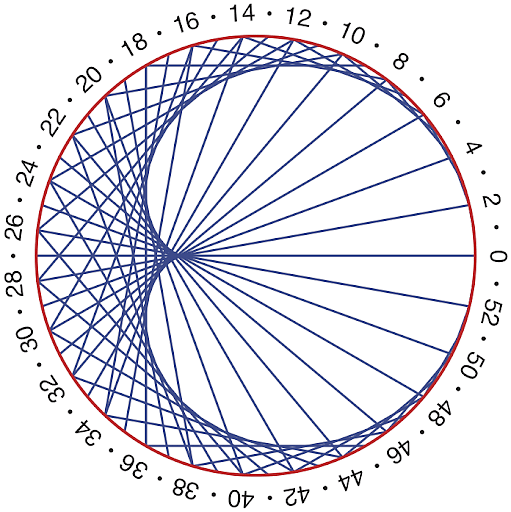
Cardioids
The curve of the cardioid is in the form of spiral sinusoidal. The cardioid curve can be formed by inverting a parabola whose focus is at the centre of inversion. Only 3 parallel tangents can be drawn to the cardioid with a specific gradient. The cardioid has a cusp formed by intersecting two branches of a curve. The arc length passing through the cusp is 4a, here ‘a’ is the radius of the circle.
Graph of Cardioid
[Click Here for Sample Questions]
In a two-dimensional plane, a cardioid is defined as a heart-like figure. A graph of a cardioid can be formed by drawing the locus of the point on the surface of a circle that is rolling onto the surface of another circle of the same radius. We can represent the cardioid in either polar or cartesian coordinate systems. The graph of the cardioid is given by:
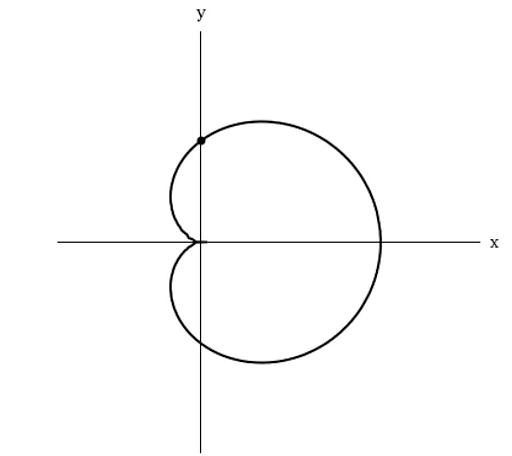
Cardioid in Two-Dimensional Plane
Also Read:
Cardioid Equation
[Click Here for Sample Questions]
In mathematics, there are two ways of representing the cardioid equation. In the polar and cartesian coordinate systems respectively.
Polar Form Equation
The equation of horizontal cardioid in polar form is given by:
r = a(1 ± cosθ)
Likewise, the equation of vertical cardioid in the polar form is given by:
r = a(1 ± sinθ)
Here, ‘a’ is the radius of a tracing circle while θ is the polar angle.
Cartesian Form Equation
A Cardioid equation in cartesian form is given by:
(x2 + y2 + ax)2 = a2(x2 + y2)
The parametric equation as,
x = a cos t (1 - cos t)
y = a sin t (1 - cos t)
Also Read:
Area of Cardioid
[Click Here for Sample Questions]
Area of the cardioid is defined as the region enclosed by the curve in a two-dimensional plane. The area of a cardioid depends on the radius of that tracing circle.
Area = 6 π a2
Where ‘a’ is the radius of the tracing circle.
From the formula of area, we can say that the area of a cardioid is six times the area of its tracing circle.
Also Read:
Length of Arc
[Click Here for Sample Questions]
The length of an arc formed by cardioid is given by:
Arc Length = 16a
Things to Remember
- Cardioid is a heart-shaped curve in a two-dimensional plane.
- A graph of a cardioid can be formed by drawing the locus of the point on the surface of a circle that is rolling onto the surface of another circle of the same radius.
- Polar and cartesian coordinate systems are the two ways of representing the Cardioid equations.
- Area of Cardioid is given by Area = 6 π a2.
Also Read:
Sample Questions
Ques. A cardioid is given as r = 4(2 + 3cosθ). Find the length of the arc of the cardioid. (3 marks)
Ans. The equation of the cardioid is given as r = 4(2 + 3cosθ).
It can be written as r = 8(1 + 3/2cosθ) take 2 as common]
Now, compare it with the general equation of cardioid r = a(1 + cosθ) we have,
a = 8 (the radius of a circle)
The length of an arc of the cardioid is given by 16a
Put a = 8 in the expression
Length of the arc = 16(8)
= 16 x 8
= 128 units
The length of the cardioid given as r = 4(2 + 3cosθ) is 128 units.
Ques. Find the length of the arc and area of the cardioid given as r = 3(2 + 4cosθ). (3 marks)
Ans. The cardioid is given by the equation r = 3(2 + 4cosθ). It can be expressed as
r = 6(1 + 2cosθ) (by taking 2 common)
Comparing it with the general equation of cardioid r = a(1 + cosθ) we have,
The radius of the circle, a = 6.
- The Length of the arc is given as 16a
Length of the arc = 16(6)
= 16 x 6
= 96 units
- The area of the cardioid is given as 6 π a2
Area of cardioid = 6 π (6)2
= 6 x π x 36
= 216 π
= 216 x 22/7
= 678.85 square units
Ques. A circle with equation r = 4sinθ and cardioid r = 1 + 2sinθ intersects each other. Find the angle and quadrant of the intersection. (3 marks)
Ans. Given, a circle r = 4sinθ and cardioid r = 1 + 2sinθ intersect each other
For intersection we have,
4sinθ = 1 + 2sinθ -------- eq (1)
Solve equation 1
2sinθ = 1
sinθ = 1/2
θ = π/6 or 5π/6
Therefore, these two curves intersect at π/6 or 5π/6. The intersection lies in the 1st and 2nd quadrants.
Ques. Find the equation of cardioid formed by the fixed points A = (1,0) and variable points on the circle of radius 1. Also, determine the arc length of the cardioid formed. (3 marks)
Ans. Given a fixed point on circle A = (1,0)
Any variable point on a circle with radius r is given as (rcosθ, rsinθ)
Thus a variable point with radius 1 is given as (cosθ, sinθ)
The radius of the circle with two points is given by
r2 = (x1 - x2)2 + (y1 - y2)2
r2 = (0 - cosθ)2 + (1 - sinθ)2
r2 = cos2θ + 1 + sin2θ - 2sinθ
r2 = (cos2θ + sin2θ) + 1 - 2sinθ
r2 = 1 + 1 - 2sinθ (cos2θ + sin2θ = 1)
r2 = 2 - 2sinθ
r2 = 2(1 - sinθ)
Thus, the cardioid formed is given by r2 = 2(1 - sinθ).
Comparing it with a general equation of the cardioid we have
a (radius of the circle) = 2
The Length of the arc is given by 16a
Length of the arc = 16(2)
= 16 x 2
= 32 units
Ques. The Cartesian equation of cardioid is given by (x2 + y2)3 = (x + y)4. Find the polar equation of the cardioid. (3 marks)
Ans. The cartesian equation a cardioid is given as (x2 + y2)3 = (x + y)4….(1)
From the parametric equations we can write,
x = rcosθ, y = rsinθ
Put the value of x,y in equation 1 we have,
(r2cos2θ + r2sin2θ)3 = (rcosθ + rsinθ)4
(r2)3 = (rcosθ + rsinθ)4
r6 = r4 (cosθ + sinθ)4
r2 = (cosθ + sinθ)4
r = (cosθ + sinθ)2
r = cos2θ + sin2θ + 2cosθ.sinθ
r = 1 + 2cosθ.sinθ [cos2θ + sin2θ = 1]
r = 1 + sin2θ
Therefore the polar equation of the cardioid (x2 + y2)3 = (x + y)4 is given by r = 1 + sin2θ.
Ques. A cardioid is given as r = 1 + 2cosθ, 0 ≤ θ ≤ π/2 A point P lies on the cardioid such that the tangent at point P to the cardioid is parallel to its initial line. Determine the length OP, O is the pole. (3 marks)
Ans. For the tangent to be parallel to its initial line it must satisfy the condition dy/dx = 0.
Thus, dy/dx = (dy/dθ)/(dx/dθ) = 0
dy/dθ = 0
d(y)/dθ = 0 (y = rsinθ)
d(rsinθ)/dθ = 0 (r = 1 + 2cosθ)
d[(1 + 2cosθ)sinθ]/dθ = 0
d(sinθ + sin2θ)/dθ = 0
cosθ + 2cos2θ = 0
cosθ + 2(2cos2θ - 1) = 0
4cos2θ + cosθ - 1 = 0
solving we have,
cosθ = (-1 θ √33)/8
cosθ = (-1 +√33)/8 as (0 ≤ θ ≤ π/2)
For the length of OP we have,
|OP| = 1 + 2cosθ
put the value of cosθ in the above expression we have,
|OP| = 1 + 2(-1 +√33)/8
= 1 + (-1 +√33)/4
= (3 +√33)/4
Hence, the exact length of the OP is (3 +√33)/4
Ques. Find the derivative dy/dx of the cardioid r = a(1 + cosθ). (3 marks)
Ans. The derivative dy/dx of any polar function is given by
dy/dx = [f’(θ)sinθ + f(θ)cosθ]/[f’(θ)cosθ - f(θ)sinθ] ....(1)
f(θ) = a(1 + cosθ)
f’(θ) = -asinθ
dy/dx = [(-asinθ)sinθ + a(1+cosθ)cosθ]/[(-asinθ)cosθ - a(1+cosθ)sinθ]
dy/dx = [-asin2θ + acosθ + acos2θ]/[-asinθcosθ - asinθ - acosθsinθ]
dy/dx = -sin2θ + cosθ + cos2θ/-sinθcosθ - sinθ - sinθcosθ
dy/dx = [(cos2θ - sin2θ) + cosθ]/[-sinθcosθ - sinθ - sinθcosθ]
By using the double angle formula
cos2θ = cos2θ - sin2θ,
sin2θ = 2sinθcosθ
We have,
dy/dx = -(cos2θ + cosθ/sin2θ + sinθ)
We know the trigonometric identities
cosα + cosβ = 2cos((α + β)/2)cos((α - β)/2), sinα + sinβ = 2sin((α + β)/2)cos((α - β)/2)
Thus we have,
dy/dx = - [2cos (2θ + θ)/2.cos(2θ - θ)/2]/[2sin(2θ + θ)/2.cos(2θ - θ)/2]
dy/dx = - [cos 3θ/2. cos θ/2]/[sin 3θ/2.cos θ/2]
dy/dx = - (cos 3θ/2)/(sin 3θ/2)
dy/dx = - cot 3θ/2
The derivative of f(θ) = r = a(1 + cosθ) is - cot 3θ/2
Ques. Find the angle of intersection of two cardioids given by r1 = (1 + cosθ) and r2 = (1 - cosθ). (3 marks)
Ans. For the angle of intersection, first, calculate the point of intersection.
For of intersection of two cardioids we have,
1 + cosθ = 1- cosθ
2cosθ = 0
cosθ = 0
θ = π/2
Now calculate dy/dx of each curve at θ = π/2
For the cardioid r1 = (1 + cosθ)
(dy/dx)1 = -(sin2θ + cos θ + cos2θ)/(-sinθ cos θ - sin θ - sinθ cosθ)
(dy/dx)1 = - (cos 2θ + cos θ)/(sin 2θ + sin θ)
At θ = π/2
(dy/dx)π/2 = - (cos π + cos π/2)/(sin π + sin π/2)
= - (-1 + 0)/(0 + 1)
= 1
Similarly, for the cardioid r2 = (1 - cosθ)
(dy/dx)2 = (sinθ sinθ + (1 - cos θ)cos θ)/sinθ cosθ - (1- cos θ)sinθ
(dy/dx)2 = (sin2θ + cosθ - cos2θ)/(sinθ cosθ - sinθ + sinθ cosθ)
(dy/dx)2 = - (cos 2θ - cosθ/sin 2θ - sinθ)
At θ = π/2
(dy/dx)π/2 = - (cosπ - cosπ/2/sinπ - sinπ/2)
(dy/dx)π/2 = - (-1 - 0/0 - 1)
(dy/dx)π/2 = -1
The slope m of tangent is equal to the derivative we have, k1 = 1, k2 = -1
Let the angle of intersection be α we have,
tan α = (k2 - k1)/(1 + k1k2)
tan α = (-1 -1)/(1 + 1.(-1))
tanα = ∞
α = π/2
Thus, the angle of intersection of cardioids r1 = (1 + cosθ) and r2 = (1- cosθ) is π/2.
Read Also:



Comments