



Exams Prep Master
Excretion, the biological process by which an organism rid themselves of the excess waste products and the nitrogenous by-products of metabolism through urethra. Moreover, through this process, organisms control osmotic pressure - the balance between inorganic ions and water - and maintain acid-base balance. In this way, homeostasis is promoted, the constancy of the organism’s internal environment.
| Table of Content |
Keyterms: Excretion, Osmotic pressure, Organism, water, acid, ions, CO2, Urea, Ammonia, Uric Acid
What is Excretion?
[Click Here for Sample Questions]
The physiological process of elimination of accumulated waste products i.e., many nitrogen-containing substances, ions, CO2, water, etc, and other toxic substances are known as Excretion.
Excretion
Excretion is an essential process and is common in all living organisms, including the animals, plants, insects, birds and even unicellular organisms.
The nature of nitrogenous waste (Urea, Ammonia, Uric Acid) formed and their excretion waste varies among animals (mammals, aves, fishes, amphibians, insects).
The excretory wastes are generated as the by- products of metabolic processes.
Types of Excretory Wastes
[Click Here for Sample Questions]

Types of Excretory wastes
The excretion also takes place in plants- during photosynthesis, Oxygen and water are excreted, as they are waste for plants at that time and require removal. The Rubber trees exude resins and latex in the process of excretion.
| Organism | Excretory Waste | Process | Toxicity |
|---|---|---|---|
| Bony Fishes, Aquatic Amphibians, Aquatic Insects | Ammonia | Ammonotelism | Highest and most soluble |
| Mammals, Marine Fishes, Terrestrial Amphibians | Urea | Ureotelism | Less toxic and less soluble |
| Reptiles, Birds, Insects, Land Snails | Uric Acid | Uricotelism | Average toxicity, in form of pellets or paste with minimum water loss |
Excretion in Animals
The unicellular organisms and organisms with a single layer of cells (lower organisms) generally do excretion through diffusion. In the organisms with multiple layers of cells, excretion is done through a complex excretory system. In vertebrates, the excretory system has kidneys, urethra, and urinary ducts associated with it.

Excretion in Animals
Eg. A Horse eats and swallows its food through Ingestion. The food then gets broken down in Digestion, energy is absorbed through assimilation, after which, via chemical reaction, CO2, water, O2, Urea and other wastes are produced which have to be removed from the body. And it is done through Excretion.
Excretion in Humans
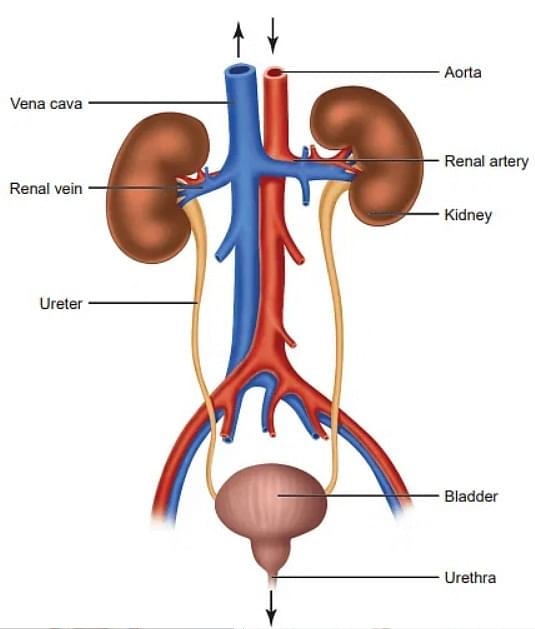
The Human Excretory System consists of a pair of kidneys, a pair of Ureters, a Urinary Bladder and a Urethra.

Excretion in Humans
The functional unit of the Excretory System is Kidney, which comprises over a million tubular structures called nephrons. Nephrons are the functional unit of the kidney. These nephrons help in filtering the blood and collecting the waste and storing it in the kidneys in the form of urine. The urine is passed through the pair of ureters to the Urinary bladder for a short duration. The bladder moves it to urethra and then out of the body in the form of waste containing urine.
Functions of Kidneys
[Click Here for Sample Questions]
- Filtration of blood and later excretion of wastes from the body in the form of urine.
- Maintains Homeostatic condition in the body, including body temperature and pH balance.
- Maintains Ionic balance of extracellular fluids.

Functions of Kidneys
Secondary Excretory Organs
Humans have other excretory organs barring kidney, Ureters, Urinary Bladder and Urethra as well. Those are:
- Skin- contains sweat and sebaceous glands and removes NaCl, Amino acid, water, and glucose through Sweat glands. Excess fat such as sterol and wax are excreted through Sebaceous glands.
- Lungs- Facilitates gaseous exchange and eliminates Carbon dioxide and water from the body.
- Salivary Glands- Excretion of heavy metal ions. Eg., Lead and Mercury.
- Gastrointestinal tract and Intestines: Eliminate Nitrogenous wastes in the form of faeces containing salt, glucose, calcium, iron and fibre.

Secondary Excretory Organs
Excretion in Plants
Plants are also living beings, hence excretion is essential for them too. The major product of plant excretion is Oxygen, a by- product of Photosynthesis.
The plants also remove excess water through transpiration. Some waste products get accumulated in the leaves through translocation and fall off, some are excluded as gums and resins and some plants excrete some waste materials into the soil around the roots.

Excretion in Plants
At cellular level, ions, water, salt, etc are stored in the vacuoles.
The major difference between plants and animal excretion is that animals remove waste either in liquid or solid form (Uric acid pellets), but as the major excretory product of plants is Oxygen, they excrete in the gaseous form.
Sample Questions
Ques: Write Five functions of the Excretory System? (3 marks)
Ans: The functions of Excretory system are as follows:
- Balance Body fluids
- Maintain Homeostasis
- Remove waste products from the body
- Release hormone to control blood pressure and RBC production,
- Controls Calcium and Phosphorus and hence helps in bone health.
Ques: Name the Excretory organs other than Kidney, Bladder, Ureter and Urethra. (1 mark)
Ans: The other Excretory organs are skin, lungs, intestine, and salivary glands.
Ques: What is Hemodialysis? (4 marks)
Ans: In patients having high concentration of urea, urea is removed by a process called hemodialysis.
In this, blood drained from an artery is pumped into a dialysing unit in which an anticoagulant like heparin is already added. The dialysing unit contains a coiled cellophane tube which is surrounded by a dialysing fluid having the same composition as that of plasma except the nitrogenous wastes. The porous cellophane membrane of the tube allows the passage of molecules based on concentration gradient. As the dialysing fluid doesn’t have any nitrogenous wastes, these substances freely move out, thereby clearing the blood. The cleared blood is then pumped back to the body through a vein after adding anti-heparin to it.

Ques: What is the average amount of Urine and Urea an adult excretes in a day? (2 marks)
Ans: The average amount of Urine is 1-1.5 L/ day and the amount of urea excreted by an adult is 25-30g. The urine has a pH of 6.0 which indicates its slightly acidic nature.
Ques: Name some disorders of the Excretory System? (3 marks)
Ans: Some of the disorders of Excretory system are:
- Uremia- Accumulation of urea in Kidney. Hemodialysis id the solution
- Renal failure- Kidney failure, transplantation has to be done to save the patient.
- Renal calculi: Formation of Stone or insoluble mass of crystallised salts (oxalates, etc.) within the kidney.
- Glomerulonephritis: Inflammation of glomeruli of kidney.
Ques: Describe in brief the functions of kidneys, ureter, urinary bladder and urethra. (3 marks)
Ans: The functions of the following are:
- The kidneys help in the filtration process of the blood and concentrate the filtrate to make the urine. Secondly, the kidney also helps regulate blood pressure.
- The ureters pass the urine to the urinary bladder.
- Urinary bladder behaves like a holding tank for the urine until it is ready to be excreted.
- Urethra is the tube that connects the urinary bladder to the outside of the body for excretion.
Ques: (i) Name the organs that together form the excretory system in human beings. (5 marks)
(ii) Describe in brief how urine is produced in the human body.
Ans: (i) The organs that form the excretory system in human beings are:
- Kidneys
- Urinary bladder
- Ureters
- Urethra
Urine is the waste chemical compounds that are formed by the process of filtration of blood in the kidneys. Our body produces wastes such as urea and uric acid and many others that are later released in the form of urine. Nephrons are the basic structures that help in the filtration process, and are present inside the kidneys. Nephrons consist of two parts: Bowman’s capsule and Renal tubule.
Bowman’s capsule is a cup- shaped coiled tube which possesses blood capillaries called glomerulus which helps in filtering out the blood. Few substances such as amino acids, glucose, and some salts get absorbed selectively along with the major amount of water and excess water gets re-absorbed. After that, the rest of the liquid moves within the collecting duct towards the urinary bladder to get stored.
Ques: (i) Define Excretion. (5 marks)
(ii) Name the basic filtration unit that is present in the kidney.
(iii) Draw excretory system in human beings and label the following organs of excretory system which perform following functions:
From urine
Is a long tube which collects urine from kidney
Store urine until it is passed out.
Ans: (i) The physiological process of elimination of accumulated waste products i.e., many nitrogen-containing substances, ions, CO2, water, etc, and other toxic substances are known as Excretion.
Excretion is an essential process and is common in all living organisms, including the animals, plants, insects, birds and even unicellular organisms.
The nature of nitrogenous waste (Urea, Ammonia, Uric Acid) formed and their excretion waste varies among animals (mammals, aves, fishes, amphibians, insects).
The excretory wastes are generated as the by- products of metabolic processes.
(ii) The basic filtration unit in the kidney is called Nephrons.
(iii)

Excretory system in human beings
- The kidney forms urine.
- The ureter is the long tube which collects the urine from the kidney.
- The urinary bladder is the structure where the urine is stored until it is passed.
Ques: Draw a diagram of the human excretory system and label renal artery and urethra. State in brief the functions of: (5 marks)
(a) Renal artery
(b) Kidney
(c) Ureter
(d) Urinary bladder
Ans:
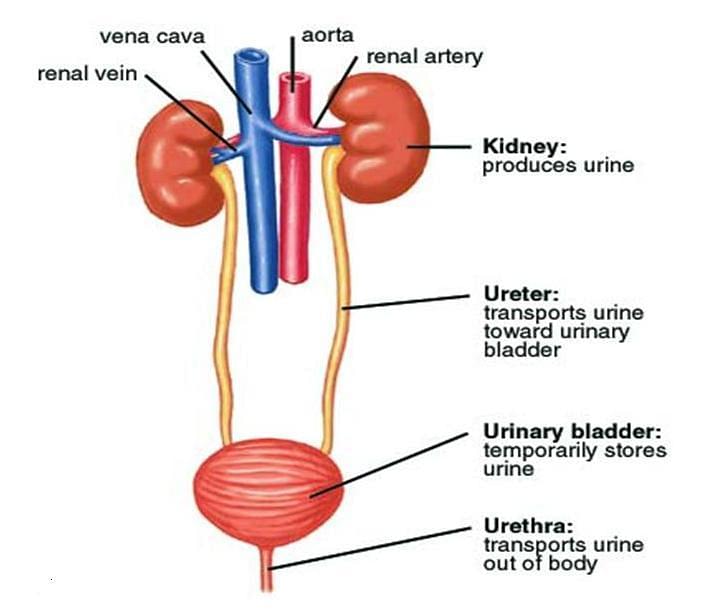
Excretory system in human beings
(a) Renal artery: The renal artery carries blood from abdominal aorta to the kidneys. This blood comes directly from the heart which is sent to the kidneys and is filtered before it passes through the rest of the body. Upto one third of the total cardiac output, per heartbeat is sent to the renal arteries to be filtered by the kidneys. Each kidney possesses one renal artery that supplies it with blood. The filtered blood then can exit the renal vein.
(b) Kidneys: The essential function of removing waste products from the blood and regulating the water fluid levels is being performed by the kidneys. The kidneys regulate the body’s fluid volume, mineral composition, and acidity by excreting and reabsorbing water and inorganic electrolytes.
(c) Ureter: The ureter is a tube that helps in carrying urine from the kidney to the urinary bladder. There are two ureters that are attached to each kidney.
(d) Urinary bladder: The urinary bladder is an expandable muscular sac that stores urine before it is excreted out of the body through the urethra.
Ques: (i) Draw a diagram of the excretory system in human beings and label its following parts: aorta, kidney, urinary bladder and urethra. (5 marks)
(ii) How is urine produced and eliminated?
Ans: (i)

Excretory system in human beings
(ii) The blood from the heart comes into the kidneys, afferent and efferent arterioles from the renal arteries where it enters around 2 to 3 million nephrons per kidney. Then, it passes through the glomerulus, a bunch of blood capillaries and gets rid of some of the unwanted substances such as urea, uric acid, creatinine in the blood and continues through the renal tubules. The loop of Henle reabsorbs certain substances like water. Meaning, if the body is dehydrated, the body will send antidiuretic hormone (ADH) to the kidneys in order to prevent extra water from going into urine and therefore saving water for the body and anything else which is unwanted. Then, the urine goes through the ureters to the bladder then to urethra from where it is excreted out of the body in the form of urine.
For Latest Updates on Upcoming Board Exams, Click Here: https://t.me/class_10_12_board_updates
Also Check:



Comments