



Content Curator
The term reproduction refers to the act of reproducing. It is a biological process in which an organism reproduces offspring who are biologically identical to the organism. Reproduction enables and ensures species continuity generation after generation. It is the most important aspect of life on Earth. Let's take a closer look at reproduction, its different forms, and the many modes of reproduction in plants and animals.
| Table of Content |
Keyterms: Reproduction, biological process, organism, Asexual Reproduction, Sexual Reproduction, vegetative propagation
Read Also: Class 10 Sexual Reproduction
Reproduction Methods
[Click Here for Sample Questions]
There are two types of reproduction: sexual reproduction and asexual reproduction.
- Asexual Reproduction
- Sexual Reproduction
Asexual Reproduction
Asexual reproduction is a type of reproduction in which only one organism produces a new individual.

Asexual reproduction
Because asexual reproduction does not entail gamete fusion, the babies produced are genetically identical to the parent. In nature, the organisms created by asexual reproduction are less diverse. Unicellular creatures use this type of reproduction extensively.
Asexual reproduction is further classified as follows:
Binary fission: It occurs when a cell divides into two, each containing a copy of the parent cell's DNA. As an example, consider the amoeba.
Budding: A little bud-like protrusion gives rise to a new person in this process. Until it is fully formed, the protrusion stays linked to the organism. It detaches and lives as a separate entity. As an example, consider the hydra.
Fragmentation: It occurs when the parent organism divides into multiple sections, each of which matures into a new individual. Planaria, for example.
Sporogenesis: This type of reproduction involves the formation of a new organism from spores. These may grow without fertilization and spread by wind and animals.
Sexual Reproduction
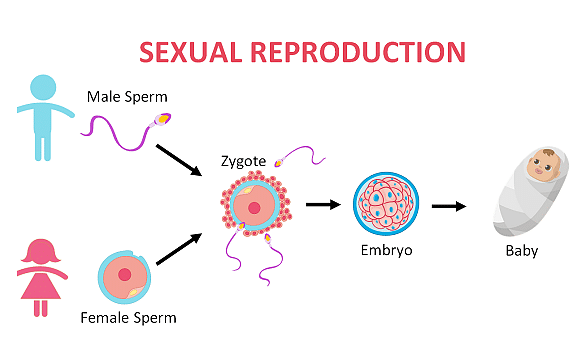
Sexual Reproduction
Sexual reproduction is a type of reproduction that involves the union of male and female gametes to produce an offspring.
Male and female gametes are generated in sexual reproduction to produce offspring. These gametes are produced by either the same individual or by different persons of the opposite sex.
When contrasted to asexual reproduction, this process is typically slow and difficult. The organisms created as a result are genetically diverse. As a result, they can adapt to shifting climatic conditions. Humans and many other multicellular species reproduce sexually.
Read More About Sexual and Asexual Reproduction
Vegetative Propagation
[Click Here for Sample Questions]
Vegetative propagation is asexual plant reproduction that happens in the plant's leaves, roots, and stem. This can happen as a result of plant fragmentation and regeneration of certain vegetative components.
Let's take a closer look at the many methods of vegetative propagation and their applications.

Vegetative propagation
Vegetative Propagation Methods
Among the several types of vegetative propagation are:
Propagation of Vegetables by Natural Means
This occurs when plants grow and develop spontaneously without the intervention of humans. Natural vegetative multiplication can be facilitated by the formation of adventitious roots. As a result, new plants may grow from the parent plant's roots, stem, and leaves.

Propagation of Vegetables by Natural Means
Rhizomes, bulbs, runners, tubers, and other vegetative plant structures that sprout from the stem are known as rhizomes, bulbs, runners, tubers, and so on. The following plants are vegetatively propagated:
Stem
Runners are plants that grow horizontally above the ground. The buds develop at the runners' nodes.
Roots
Tubers are inflated, modified roots that sprout new plants. Buds develop at the base of the stem.
Bulbs
The leaves of bulbs are linked to a subterranean stem. These leaves have the ability to store food. The bulb's center has an apical bud, which produces leaves and flowers. The lateral buds give rise to shoots.
Read More About Vegetative Propagation
Artificial Vegetative Propagation
[Click Here for Sample Questions]

Artificial Vegetative Propagation
This is a sort of vegetative reproduction practiced by humans on farms and in laboratories. The following are the most common types of vegetative reproduction that occur artificially:
Cutting
A plant portion, specifically a stem or leaf, is cut and put in the soil. Hormones are sometimes used to stimulate root growth in these cuttings. The adventitious roots that grow from the cutting produce the new plant.
Grafting
In this case, a cutting from another plant is attached to the stem of a plant that is rooted in the ground. Over time, the graft's tissues integrate with the rooted plant's tissues, resulting in the formation of a single plant.
Layering
The plant's stem is bent to the ground and covered with earth in this method. Adventitious roots emerge from plant portions that have been covered with soil. A layer is a connected stem with developing roots.
Tissue Culture
Plant cells from various areas of a plant are cultivated in the laboratory to create a new plant. This method can help to increase the number of rare and endangered plant species that are unable to flourish in their natural habitat.
Also Read:
| Related Articles | ||
|---|---|---|
| Spore Formation | Chromosomal Theory of Inheritance | |
| Regeneration | Vegetative Propagation | |
Sexual Reproduction in Plants
[Click Here for Sample Questions]
Plant reproduction occurs both sexually and asexually. However, the vast majority of blooming plants reproduce sexually. Flowers are the reproductive component of a plant, producing both male and female gametes. Flowers are the sites of sexual reproduction in plants. The complete flower typically consists of four parts:

Sexual Reproduction in Plants
- Petals
- Sepals
- and Stamen (male reproductive part)
- Carpel/Pistil (female reproductive part)
- The anther and filament make up the stamen (male reproductive component).The anther is a sac-like structure in which pollen is produced and stored.
- The filament is what holds the anther together.
- The pistil (female reproductive portion) is made up of three parts: the stigma, the style, and the ovary.
- The stamen is the most visible component of a flower.
- The style is a lengthy tube that connects the stigma to the ovary.
- The ovary carries a large number of ovules. It is the portion of the plant where seed production occurs.
Read More: How do organisms reproduce?
A flower can be made up of stamens, pistils, or both. A flower can be either unisexual or bisexual based on this. A bisexual flower is made up of all four of the above-mentioned sections, such as a rose or a China rose. Plants such as papaya and cucumber, on the other hand, exclusively produce unisexual blooms.
Fertilization and Pollination
[Click Here for Sample Questions]
Male gametes in pollen grains must fuse with eggs in the ovule to generate a zygote. This is accomplished by a process known as pollination. Pollination is the transfer of pollen grains from the anther – the male portion of a flower – to the stigma – the female component of a flower. Pollination can be divided into two types based on where the pollen lands.

Fertilization
Self-Pollination: A pollination process in which pollen is transferred between the anther and stigma of the same flower.
Cross-Pollination is a type of pollination in which pollen is transferred between the anther and stigma of different blooms of the same plant or distinct plants of the same species.
Pollination is generally accomplished with the assistance of particular agents known as pollinators. Insects, water, birds, wind, and so on are examples.

Pollination
When pollen is transported to the stigma, male gametes from pollen grains are released and unite with the egg in the ovule to generate a zygote. This process of gamete fusion is known as fertilization. The produced zygote divides and grows into an embryo, and then into a seed. The ovary matures into a fruit.
Reproduction in Human Beings
[Click Here for Sample Questions]
Every human being has a sexual mechanism of reproduction. Two parents are engaged in the production of a new individual in this procedure. The merging of gametes (sex cells) from each parent results in offspring. As a result, the newly developed individual will be genetically and physically distinct from the parents. Sexual reproduction is exemplified by human reproduction.
Human reproduction requires the fusing of male and female gametes produced in the reproductive system. The male reproductive system differs from the female reproductive system in both structure and function.
Male Reproductive System
Within the male reproductive system, male gametes, or sperms, are created. Sperms are unicellular entities that have a head, a central section, and a tail.

Male Reproductive System
The male reproductive system is made up of the following components:
Testicles (testes): A pair of oval-shaped organs hidden in the scrotum. They are in charge of producing sperm and the male hormone testosterone.
Scrotum: The scrotum is a sac-like organ that hangs below and behind the penis. It is the home of the testicles, or testes, and maintains the temperature essential for sperm production.
Vas deferens: Sperm produced in the testes are stored in the epididymis, a tube. The sperms develop here before passing to the urethra via the muscular tube known as the vas deferens.
Accessory Glands: Seminal vesicles, prostate gland, and Cowper's gland are examples of accessory glands. The secretions of the three glands combine to generate a fluid known as semen. Semen feeds the sperm, increases its volume, and aids in lubrication.
Penis: The penis is a cylindrical tube that functions as both a reproductive and excretory organ. During sexual intercourse, it releases sperm into the vagina.
Female Reproductive System
Before, during, and after fertilization, the female reproductive system is active. It is made up of the following components:

Female Reproductive System
A pair of ovaries: Ovaries create and store eggs. They also create estrogen, a female hormone.
Fallopian Tube: The site of fertilization is the fallopian tubes (Oviducts). They join the ovaries to the uterus.
Uterus: The uterus is the embryo's development place.
Vaginal: This is the part of the female body that connects the cervix to the rest of the body. It is the path of the penis during coitus as well as the path of a fetus during delivery.
The female reproductive system serves two purposes:
- Production of a female gamete known as an ovum/egg.
- Nutrition and protection for the growing embryo
The eggs in the ovaries begin to develop during adolescence. Ovulation occurs when one of the ovaries releases a developed ovum every 28 to 30 days.
Reproduction Process in Humans
Fertilization is the process of fusing sperm and egg (ovum) to form zygote. Fertilization is an important stage in human reproduction. The fertilized egg is referred to as a zygote. The zygote begins to divide into several cells and develops into an embryo.
The embryo enters the uterus and attaches to its walls. This is known as implantation, and the implanted embryo will eventually develop into a fetus.
Population Control
[Click Here for Sample Questions]
Barrier Methods
These are the physical barriers that hinder sperm from entering and reaching the egg. Condoms, for example, can be used to cover the penis. Condoms also provide protection against STDs (Sexually transmitted disease). Coverings worn in the vagina, such as a diaphragm, can serve a similar role.
Methods involving chemicals
(a) Oral pills: These are hormonal supplements. They work by disrupting the body's hormonal balance, preventing eggs from being released and fertilization from taking place. Because they are administered orally, they are frequently referred to as oral contraceptives (OC).
(b) Vaginal pills: They include spermicides, which kill the sperms.
Intrauterine contraception (IUD)
They are contraceptives that are implanted in the uterus, such as a loop or a copper-T. They impede uterine implantation.

Intrauterine contraception (IUD)
Surgical procedures
(a) Vasectomy: A little part of the vas deferens (sperm duct) is removed in males and the severed ends are subsequently ligated (tied). This prevents the sperm from escaping.

Fig: Vasectomy
(b) Tubectomy: A little piece of the fallopian tubes is cut and the cut ends are subsequently ligated in females (tied). This keeps the egg from entering the fallopian tube.

Fig: Tubectomy
Also Read:
| Related Articles | ||
|---|---|---|
| Micropropagation | Heredity and Evolution | |
| Heredity | Sex Determination | |
Sample Questions on Reproduction
Ques. Differentiate between ‘self-pollination’ and ‘cross-pollination’. Describe double fertilisation in plants. (2007)
Ans.


During fertilisation in plants, the following events take place:
(i) One of the male gamete fuses with the female gamete present in the embryo sac.
(ii) The other male gamete fuses with the two polar nuclei in the embryo sac.
The first fusion product gives rise to the zygote while the second one forms the endosperm.
The process of two fusions occurring in the embryo sac is called double fertilisation.
Ques. What is ‘reproduction’? Mention the importance of DNA copying in reproduction. (2008)
Ans. Reproduction is the process of producing new individuals of the same species by existing organisms of a species, i.e. parents. The importance of DNA copying in reproduction are as follows:
(i) DNA copying is called DNA replication. In this process, one copy each of replicated DNA will be passed to daughter cells.
(ii) Variations may be introduced during DNA copying. This inbuilt tendency for variation during reproduction forms the basis of evolution.
Ques. “Variations that confer an advantage to an individual organism only will survive in a population.” Justify. (2008)
Ans. It is because the chances of survival depend on the nature of variations and different individuals have different kinds of advantages.
For example, a bacteria that can withstand heat will survive better in a heat wave, i.e. the organisms that are fit in the competitive environment and with great variations will be able to survive and adapt. Thus, more offspring and populations with genetic variations will survive.
Ques.
(a) Name the parts labelled A, B, C, D and E. (2009)
(b) Where do the following functions occur?
(i) Production of an egg
(ii) Fertilisation
(iii) Implantation of zygote.
(c) What happens to the lining of uterus:
(i) before the release of a fertilised egg?
(ii) if no fertilisation occurs?
Ans. (a) A – Oviduct or Fallopian tube; B – Ovary; C – Uterus; D – Cervix; E – Vagina.
(b) (i) Ovaries; (ii) Fallopian tube; (iii) Lining of the uterus.
(c) (i) The lining of the uterus becomes (ii) The lining of the uterus slowly breaks and comes out through the vagina as blood and mucus, if no fertilisation occurs.
Ques. Mention the mode of reproduction used by (a) Amoeba (b) Planaria.(1 mark)
Ans. Mode of reproduction used by (a) Amoeba is Binary fission. (b) Planaria is Regeneration.
Ques. Name the information source of making proteins in the cell. State two basic events in reproduction.(2 marks)
Ans. The DNA in the cell nucleus is the information source of making proteins.
The two basic events in reproduction are:
(i) Creation of a DNA copy,
(ii) Additional cellular apparatus by the cell involved in the process.
Ques. State the method used for growing rose plants.(1 mark)
Ans. Artificial methods of vegetative propagation like cutting are used to grow rose plants.
Ques. State what type of method is used for growing jasmine plants.(1 mark)
Ans. Artificial methods of vegetative propagation like layering are used for growing jasmine plants.
For Latest Updates on Upcoming Board Exams, Click Here: https://t.me/class_10_12_board_updates
Also Check:



Comments