



Content Curator
Centrosome is the organelle containing two centrioles. Centrosome contains a complex of proteins that helps in the arrangement of extra microtubules. Before cell division begins, the centrosome duplicates, as division begins, the two centrosomes move to opposite ends of the cell.
| Table of Contents |
Key Terms: Centrosome, Cell Organelles, Centrioles, Eukaryotic Cells, Microtubules, Cell Division, Spindle Fibers, Centrosome, Prophase, Mitosis, Mtoc
What Is Centrosome?
[Click Here for Sample Questions]
Centrosomes are cell organelles, that are the fundamental microtubule structures that play an important role during the process of cell division. They consist of two mutually perpendicular cylindrical structures called ‘centrioles’ and a complex of highly dense proteins that help the tubules to shape.
It serves the main purpose as the MTOC (microtubule organizing center) in Eukaryotic cells and is also a regulator of cell cycle progression. It exists only in animal cells and is not present in plant cells or even fungi cells. Hence plant and fungi cells use alternative structures in place of centrosomes to organize their microtubules.
Structure Of The Centrosome
[Click Here for Previous Year Questions]
Structure of the centrosome is as classified:
- The cell organelle centrosome contains two cylindrical structures called centrioles.
- These centrioles lie perpendicular to each other one is called the daughter centriole which is also referred to as the immature centriole and the other is called the mother centriole of the mature centriole.
- The two centrioles are structurally similar but not identical and also differ in age.
- Each of these centrioles is made up of nine peripheral microtubule fibril triplets of tubulin which are evenly spaced and organized in a cylindrical shape.
- The central part of the centriole also consists of proteinaceous material called the hub and is connected to the tubules of the peripheral triplets by radial spokes also made of protein.
- This is also known as the PCM- Pericentriolar material which is responsible for microtubule nucleation and anchoring of cytoplasmic microtubules.
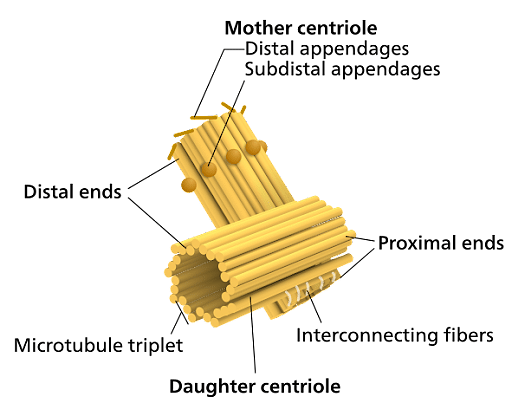
Structure Of Centrosome
Centrosomes are of variable sizes but centrioles are usually of size 0.2 μm in diameter and 0.5 μm in length and are embedded in the PCM. The Centrosome is usually found very close to the Golgi apparatus
During cell division, one centrosome from the parent cell is moved to each daughter cell. In cells that multiply, the centrosome starts separating before the S-stage starts.
The newly shaped centrosome helps in arranging the mitotic axles. And during the interphase stage, the centrosome is composed if an astral beam of microtubules that facilitate in intercellular dealing, cell extremity, cell grip, etc.
Also Read: Nucleoplasm
Centrosome Cycle
[Click Here for Sample Questions]
Centrosome cycle consists of 4 major stages
- The G1 stage wherein the duplication of the centrosome occurs.
- The G2 stage wherein the centrosome develops further is termed maturation.
- Mitotic stage wherein the centrosome division occurs.
- Late mitotic stage wherein chromosome confusion or disorientation occurs.
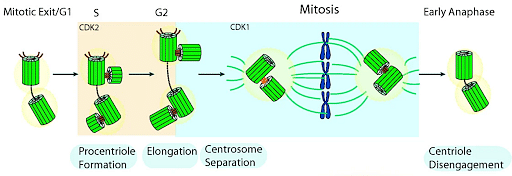
Centrosome Cycle
Functions Of The Centrosome
[Click Here for Previous Year Questions]
Functions of the centrosome include the following:
- Centrosomes play a significant role in cell division.
- It also provides structure to the cell.
- They maintain the number of chromosomes during the process of cell division.
- They also encourage the changes in the shape of the cell membrane during cell division through the process of phagocytosis.
- The centrioles of the centrosomes give rise to the basal body precursors.
- The centrosome nucleates the polymerization of tubulin subunits into microtubules.
- The most important function of the centrosome is that it organizes the microtubules into functional units, for example, the mitotic spindle.
- This function of the centrosome ensures that the centrosomes are distributed evenly to the daughter cells.
- The centrosome also regulates the movement of the microtubules and the
- cytoskeletal structure which helps shape the membrane of the animal cell.
Also Read: Endoplasmic reticulum
Centrosomes In Animal Cells
[Click Here for Sample Questions]
Centrosomes in animal cells are as classified:
- Centrosomes are present in the animal cell, but they are not actually an essential part of the cell. Hence certain species of flies such as the drosophila (fruit flies) and flatworms like Planaria do not possess centrosomes.
- In differentiated animal cells, like the muscle cells, neurons, and the epithelial cells the centrosome is not the MTOC and is mostly inactive because upon differentiation the centrosomes lose the PCM components which often get delocalized to other parts of the cell in the cytoplasmic membrane. And the nuclear membrane which beave as the MTOC.
- Sometimes, centrosomes are not essential for the assembly of mitotic spindles even in cells that possess them.
- The presence of centrosomes, in the process of cell division increases the effectiveness of the process of Mitotic Spindle arrangement.
For example, centrosomes contribute to mitotic fidelity, cytokinesis, and asymmetrical cell division but aren't necessary for the development and proper functioning of the flies.
In human cells, dysfunction of the centrosome can result in cancer due to the instability in the chromosomes or even due to the metastatic capacity of cancer cells. This is more of a speculation than a fact.

Centrosomes In Animal Cell
Centrosomes In Plant Cells
[Click Here for Previous Year Questions]
Centrosomes in plant cells are specified as:
- Centrosomes do not exist in plant cells and hence use alternative MTOC structures to coordinate the Microtubules.
- Plant cells do not particularly have axle post bodies or centrioles exception being the flogging male gametes that are present in certain species of blooming plants(conifer).
- The functions of the MTOC appears to be taken up the atomic envelope during mitosis in plant cells.
- Plant and fungi cells do not possess centrosomes. Plant cells also do not have spindle pole bodies exception being the flogging male gametes.
- The functions of the MTOC of spindle organization and microtubule nucleation appear to be taken up by the nuclear membrane during mitosis in plant cells.
- Animal and plant cells being different do not share the same cytoskeletal elements.
- Plants do not have centrosomes resembling organelles but they possess the ability to build spindles and possess developed cytoskeletal arrays like the prophase band.
- The cortical array and the phragmoplast plays a fundamental role in the growth process.
Things To Remember
- A centriole is a cell organelle that is comprised of two cylindrical mutually perpendicular structures called centrioles.
- Centrioles are made up of 9 microtubule triplets which are also surrounded by a dense proteinaceous matrix called PCM, expanded as pericentriolar material.
- Functions of the centriole include facilitating cell division, maintaining the number of chromosomes during cell division, organizing the microtubules, regulating the movement of microtubules, and providing the cytoskeletal structure of the cell.
- Plant and fungi cells do not possess centrosomes whereas animal cells do.
- In animal cells the centrosomes act as the MTOC- microtubule organizing center.
Important PYQS Based On Centrosomes
- Cellular Organelles With Membranes Are.... [NEET- 2015]
- Cell recognition and adhesion occur due to biochemicals of cell membranes named as..... [NEET- 1993]
- A bivalent of meiosis I consists of.... [KCET- 2013]
- The major event that occurs during the anaphase of mitosis which brings about equal distribution of chromosomes is..... [KCET- 2006]
Sample Questions
Ques. What is a centriole? (2 Marks)
Ans. Centrioles are structures that make up the centrosome. Each centriole consists of 9 peripheral microtubule triplets which are evenly spaced. A centrosome consists of a pair of centrioles that are perpendicular to each other.
Ques. What is a centrosome? (1 Marks)
Ans. A Centrosome is a cell organelle found in animal cells. It consists of a pair of centrioles that act as the MTOC in animal cell division.
Ques. What is the main function of a Centrosome? (2 Marks)
Ans. A centrosome consists of two microtubule rings called centrioles. The main function of these is to organize the microtubule and provide structure to the cell and also pull apart the chromatids of the chromosomes during the process of cell division.
Ques. What is centrosome amplification? (2 Marks)
Ans. Centrosome amplification is known as the origin of cancer. Boveri’s hypothesis indicates that the aneuploidy initiated by centrosome amplification induces tumor.
Ques. Are centrosomes an essential part of a cell? Justify. (3 Marks)
Ans. Centrosomes are not essential for mitosis. Even in the lack of the presence of a centrosome, cell division occurs with a normal spindle. The microtubules form the bipolar spindle can undergo interphase.
Hence, centrosomes are not essential but with their presence, it can be said the division of the cell occurs far more efficiently and smoothly when compared to the cell division process that occurred without centrosomes.
Ques. What is the difference between a centrosome and a centromere? (2 Marks)
Ans. The centrosome is a cell organelle that consists of two centrioles that facilitate microtubule organization. Centromeres, on the other hand, are highly constricted region on chromosomes which holds the sister chromatids together in a replicated chromosome.
Ques. What are the functions of asters? What is a homologous chromosome? Define. (4 Marks)
Ans. Asters hold the two centrioles at the two opposite poles of the cell. These asters provide support and guidance to the chromosomes ensuring that the chromosomes end up in the right place facilitating the smooth process of mitosis.
Homologous chromosomes have corresponding DNA sequences and come from different parents. One homolog comes from the maternal parent and the other comes from the paternal parent. These homologous chromosomes line up and synapse during meiosis.
Ques. What is the role of the centrioles in the process of formation of spindle fibers? (2 Marks)
Ans. In the centrosome, the centrioles align perpendicular to each other organized in a cartwheel pattern. These centrioles form the basal body of cilia and flagella of animal cells and hence assist in the formation of the sperm tail and microtubules and hence give rise to the spindle fibers.
Ques. Under uncontrolled cell division, what pathological condition occurs? (2 Marks)
Ans. Uncontrolled cell division indicates cancer. The cells lose control of the process of cell division due to a mutated or damaged gene resulting in the malformation of the organs where cell division takes place.
Ques. Telophase is the reverse of prophase. Explain the statement. (4 Marks)
Ans. In the prophase stage, the process of condensation of chromosomal material occurs. During this process of chromatin condensation, the chromosomal material untangles. When observed under a microscope, during the prophase stage, the cells do not show Golgi complexes, nucleolus, endoplasmic reticulum, and the nuclear membrane.
In the final stage of mitosis which is the telophase, the chromosomes upon arriving at their respective poles, begin de-condenses. In the last stage of mitosis, all the cell organelles like the Endoplasmic reticulum, the Golgi bodies, and the nucleolus reform, and the nuclear membrane also reforms around the cluster of chromosomes.
Check-Out:



Comments