



Education Journalist | Study Abroad Lead
Cilia or a cilium, are small hair-like structures present outside, on the surface, of eukaryotic cells. Cilia are present in almost all types of polarised cells of the human body. A cilium is a tiny hair-like organelle that is present on the surface of a cell. Cilia performs some very important functions in certain animals, such as carrying food for digestion and absorption in a snail and discharging stinging devices in the jellyfish.
| Table of Content |
Key Terms: Organelles, Prokaryotic Cells, Eukaryotic Cells, Cell, Digestion, Absorption, Locomotion, Proteins, Flagella
What is Cilia?
[Click Here for Sample Questions]
Cilia are the tiny, slender, hair-like organelles present on the surface of all mammalian cells.
- Cilia is the plural form of the cilium.
- They particularly a major role in locomotion and are also involved in mechanoreception.
- The organisms that have cilia are called ciliates.
- Many organisms use cilia to feed and move.
- Cilia are of two types: motile cilia and non-motile (primary) cilia.
- A cell typically has one primary cilium or numerous motile cilia.
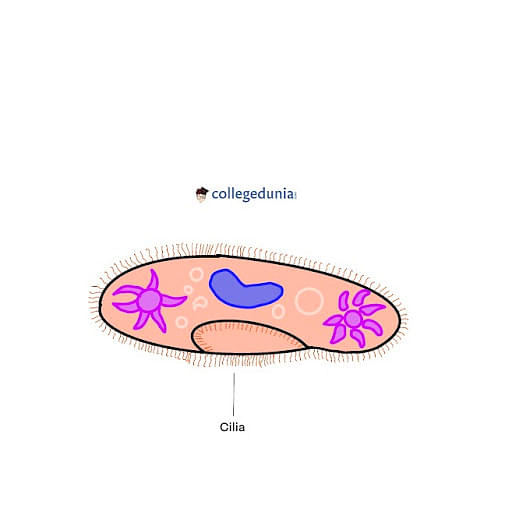
Cilia
Also Read: Placenta
Types of Cilia
[Click Here for Previous Year Questions]
There are two types of cilia
- Motile Cilia
- Non-motile Cilia
Motile Cilia
Motile cilia are found in large numbers on the surface of cells of larger eukaryotic organisms like mammals.
- They beat in synchronized waves.
- They are present on the respiratory epithelium of the respiratory tract in humans.
- There are approximately 200 motile cilia present per cell in the respiratory epithelium.
- Cilia present in the oviduct beats in order to move the ovum from the ovary to the uterus in female mammals.
- For the proper functioning of motile cilia, optimum levels of periciliary fluid needs to be maintained.
Nodal Cilia
The nodal cilium is a motile 9+0 cilium which tends to be present during the early stages of development of an embryo. Nodal Celia has dynein arms that allow it to rotate in a circular direction, just like the primitive cilium.
Also Read: Embryology
Non-motile Cilia
Non-motile cilia, also known as primary cilia, are present on almost all the cells in animals, blood cells being an exception. For a long time, these were overlooked and were assumed some vestigial organelle with no significant function.
- These cilia perform signal transduction and chemosensation.
- Recently, scientists have discovered that they also participate in cell growth.
- Several human organs have primary cilia helping in their operations.
Also Read: Biogenetic Law
Structure of Cilia
[Click Here for Sample Questions]
A cilium has microtubules which are coated by plasma membrane. A total of 20 microtubules are present in each cilium, 9 pairs forming the outside ring and two as central microtubules.
- The axoneme is a microtubule-based cytoskeleton found between cilia and flagella.
- Function of the axoneme is to serve as a scaffold for the axonemal anterior and posterior dynein arms, which transfer motile cilia cells, and also as tracks for molecular motor proteins.
- A cilium is also enclosed by a membrane which not identical to the plasma membrane in structure but has a resemblance with it.
Ciliary Rootlet: It is a cytoskeleton-like structure, that emerges from the proximal end of a cilium's basal body.
Transition Zone: The transition zone is responsible for regulating which proteins must join and leave the cilium to attain a distinct composition. It has a sieve-like feature that is used to monitor selective entry into cilia.
Also Read:
Functions of Cilia
[Click Here for Previous Year Questions]
Cilia perform many important functions, some of which are mentioned below.
- They play an important role in locomotion and sensory functions.
- They participate in cell cycle and replication.
- They are also involved in the development of humans and animals.
- Cilia keep the internal passageways free from mucus or any foreign agent by moving in rhythmic motions.
- They act as an antenna in order to receive sensory information for the cells and process these signals from the surrounding fluids.
- The non-motile cilia in the photoreceptors of the retina help in the transportation of molecules from one end to the other.
Also Read: Single Cell Protein
Cilia Disorders
[Click Here for Sample Questions]
Cilia disorders can cause devastating effects on humans and their growth. Some of these disorders are discussed below.
- Ciliopathies: A genetic disorder of the cilia structures – defects in primary and motile cilia. These cause numerous distressing genetic disorders known as ciliopathies.
- Primary Ciliary Dyskinesia: An autosomal recessive disorder where the cilia do not function properly in the respiratory system. The disease prevents the clearing of mucus from the lungs, ears and sinuses.
Things to Remember
- Cilia are tiny organelles present in the eukaryotic cells.
- There are two types of cilia – motile cilia and non-motile cilia.
- Primary cilia are non-motile cilia which act as sensory organelles.
- A celium’ structure is quite similar to flagella.
- Cilia help in locomotion and sensory functions.
Previous Year Questions
- 70 S ribosomes occur in….[AMUEEE 2014]
- Rough endoplasmic reticulum is actively involved in...[JKCET 2014]
- Perinuclear space is present in...[JKCET 2014]
- Cisternae have a diameter of...[JKCET 2014]
- Cells divide and new cells are formed from pre-existing cells. This concept was given by..[AMUEEE 2010]
- Aleuroplasts in a cell stores...[AMUEEE 2010]
- Axoneme having 9 + 2 doublet microtubule arrangement is found in...[AMUEEE 2009]
- One of the chief functions of smooth endoplasmic reticulum is..[AMUEEE 2009]
- Cilia are :...[JKCET 2004]
- Which is not properly paired?..[JKCET 2004]
- What is true about fluid mosaic model?...[JKCET 2004]
- Besides proteins ribosomes contain :...[JKCET 2004]
- The movement of cilia and flagella is due to the presence of...[JKCET 2013]
- Plasma membrane helps in :...[JKCET 2005]
- Which of the following structure is bounded by single membrane?...[JKCET 2005]
Sample Questions
Ques: What is the importance of cilia? [2 marks]
Ans: Cilia play a major role in locomotion. By assisting in the movement of fluids over the cell, they aid in the removal of pollutants from tissues. Bacteria, Mucus, and other debris are removed from the lungs by cilia line the inside of the nasopharynx and the trachea.
Ques: How flagella and cilia are different? [2 marks]
Ans: Cilia comprise hair-like appendages that protrude from a living cell's surface whereas flagella are the elongated, threadlike appendages on a living cell's surface. Celia are found in eukaryotic cells while flagella are found in prokaryotic cells.
Ques: Do the prokaryotic cells have cilia as well? [1 mark]
Ans: Cilia are found only in the eukaryotic cells. The prokaryotic cells contain whip-like structures called flagella that help them to move.
Ques: What are cilia made up of? [1 mark]
Ans: Cilia are composed of microtubules and a motor protein dynein. These comprise tubulin which are linear polymers of globular proteins.
Ques: Where are the cilia located? [2 marks]
Ans: The non-motile cilia are found in the dendritic knob of the olfactory neurons.
Motile cilia are located on the epithelial cells of several internal organs such as the lungs, trachea, digestive system, etc. They are also found on the protozoans such as paramecium and help them in locomotion.
Ques: Describe the functions of cilia. [2 marks]
Ans: The major functions of cilia are that they act as sensory organelle and help in locomotion in a few organisms. They also assist in feeding and moving in a few ciliates.
Ques: What is ciliopathies? [1 mark]
Ans: Ciliopathies is a genetic disorder of the cilia structures caused due to defects in primary and motile cilia.
Ques: What is an axoneme? [1 mark]
Ans: The axoneme is a microtubule-based cytoskeleton found between cilia and flagella.
Check-Out:



Comments