



Single-cell protein (SCP) is the protein derived from the cells of microorganisms such as yeast, fungus, algae, and bacteria. Protein deficit may be addressed through SCP production in an ever-increasing global population. Agricultural wastes are used to create the microbiological SCP.
- The entire organism or dried microbe cells are extracted and consumed.
- The SCP is utilized in human food supplements and animal feeds as a protein source.
- While the world's population grows, SCP can meet the world's food shortage.
- The yeast protein is the only SCP product that can be consumed by humans, whereas the remainder of the SCP can be utilized as animal feed.
- The majority of SCPs can be grown on waste items, assisting in the reduction of organic pollution.
Keyterms: Protein, Microbes, Cell, Microorganisms, Agricultural waste, Organic pollution, Microbial monoculture, Bacteria, Carbon source, Synthesis, Supplement, Nutrients, Cell culture
Also Read: Test for Protein
What is a Single-Cell Protein?
[Click Here for Sample Questions]
A single-cell protein, or SCP, is a protein that is edible and is generated from a pure microbial monoculture or cell culture of various microorganisms. These bacteria primarily grow on various carbon sources for synthesis.
- The term SCP is often used since these bacteria sprout and evolve mostly as filamentous structures.
- That justifies the definition of single-cell protein.
- Protein derived from this biomass can be used as a supplement by both humans and animals.
- Various poultry farms and animal husbandries can give high-quality ready-to-use proteins to their livestock by producing single-cell proteins.
- SCP can potentially be employed as a feasible solution to the protein insufficiency problem in humans.

The video below explains this:
Single-Cell Protein Detailed Video Explanation:
A flowchart of widely used single-cell protein-producing bacteria is provided below.
| Fungi | Yeast | Bacteria | Algae |
|---|---|---|---|
| Aspergillus niger | Candida utilis | Pseudomonas fluorescens | Chlorella pyrenoidosa |
| Rhizopus cyclopean | Saccharomyces cerevisiae | Bacillus megaterium | Chondrus crispus |
| Aspergillus fumigatus | Candida tropicalis | Lactobacillus | Spirulina sps |
Single-cell Protein Production
[Click Here for Previous Year Questions]
A good source of nitrogen, adequate carbohydrates, and a variety of other nutrients are required for the pure microbial culture for single-cell protein. A highly hygienic environment is also essential for optimal output and to avoid contamination. The steps below are necessary for single-cell protein synthesis.
- Step1 – A suitable strain needs to be selected.
- Step 2 – Fermentation of the microorganism.
- Step 3 – Harvesting in proper condition.
- Step 4 – Post-harvest treatments.
- Step 5 – Single-cell protein processing to make the biomass edible.
- Heat should be used to sterilize the components of the microbial culture media, or they should be filtered via a microporous membrane.
- The selected microorganism is now placed into the growing medium under favorable conditions.
- Proces flow is represented below.
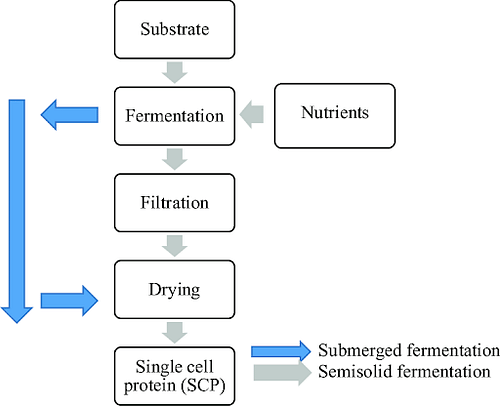
- Because of the aerobic process, a plentiful supply of oxygen is required.
- In the case of algae fermentation, however, this criterion is optional.
- Following breeding, the biomass can be processed for use.
- SCP contains nucleic acids, lipids, carbs, minerals, and vitamins in addition to a significant protein content that accounts for about 60-80 percent of the dry weight of a cell.
- Furthermore, single-cell protein offers a rich source of amino acids that are uncommon in other diets.
- All of these elements combine to make SCP a high-nutrient food. As a result, after weighing all of the benefits and drawbacks of single-cell protein, SCP warrants careful consideration as a food supplement.
Read More: NCERT Solutions for Class 12 Biology Strategies for Enhancement in Food Production
Advantages of Single-Cell Protein
[Click Here for Sample Questions]
The primary advantage of SCP production is the quantity of protein produced. By providing appropriate conditions, microbial culture can create a high amount of protein.
- Microorganisms have a much faster growth rate. Under optimum conditions, these microorganisms can generate a large amount of biomass. Some microbes can double their bulk in 30 minutes.
- The quantity and quality of protein generated from these bacteria are superior to that of other animals and plants.
- Microbes are easy to manipulate genetically. As a result, diverse amino acid compositions can be observed.
- Waste products can be employed as a substrate in the creation of SCPs. This also helps to reduce pollution.
- The fermentation procedures, as well as the culture conditions, are both simple.
- The generation of microorganisms is not affected by environmental factors.

Also Read:
Disadvantages of Single-Cell Protein
[Click Here for Previous Year Questions]
Nonetheless, there are certain downsides to SCP. Single-cell protein has the following disadvantages for human consumption:
- SPC ingestion may be detrimental to humans due to the limited capacity of decomposing nucleic acid. These microorganisms contain 5-15 percent nucleic acid, which can be harmful to humans. It has the potential to induce serious gastrointestinal problems.
- SCP can potentially produce allergic reactions in people who have a delicate digestive system or whose bodies fail to recognize the biomass.
- A high nucleic acid concentration might also cause an increase in uric acid levels in the blood.
- Consumption of single-cell protein regularly can result in gout and kidney stones.
- Following intake, some people may experience cutaneous reactions.
- Due to the need for high-end machinery, the production cost may be higher.
Application of Single-Cell Protein
[Click Here for Sample Questions]
Obesity, stress, weight, cholesterol, and blood sugar levels can all be controlled with this therapeutic and pharmaceutical use.
- Application for hair and skin care products.
- Malnourished people can benefit from a protein supplement.
- A convenient feeding source for poultry, fisheries, and animal farms.

What is the Use of Single Cell Protein?
[Click Here for Previous Year Questions]
- It is used as a protein supplemented diet, providing supplements for malnourished children and aiding in the reduction of the problem of hidden hunger.
- Used as a nutritious meal - It aids in the reduction and regulation of blood sugar levels in diabetics, promotes healthy skin and eyes, and reduces bad cholesterol deposition and therefore obesity.
- It is utilized in cosmetics to keep hair healthy and is found in many herbal beauty items such as bio lipsticks and herbal face creams.
- Used in chicken and cattle feed — The yeast protein is the only SCP product allowed for human consumption, with the remainder of the SCP being suitable for animal feed. It is mostly used to feed cattle, birds, and fish, and is a good source of protein and other nutrients.
- SCP contains a high protein composition of approximately 60–80 percent carbs, low fats, vitamins (B1, B2, and E), and minerals such as calcium, potassium, and phosphorus.

Also Check:
Things to Remember
- A single-cell protein, or SCP, is a protein that is edible and is generated from a pure microbial monoculture or cell culture of various microorganisms.
- These bacteria primarily grown on various carbon sources for synthesis of SCP.
- Microbial culture requires a good carbon ssource, nitrogen and other nutrients as well as highly hygenic environment.
- Contamination must be avoided by sterilization before and during the culture process.
- The pure microbial culture for single-cell protein.
- The primary advantage of SCP production is the quantity of protein produced by microorganisms.
- SPC consumption may be harmful to humans due to the limited capacity of decomposing nucleic acid.
- SCP can help to control Obesity, stress, weight, cholesterol, and blood sugar levels if used as suppliment to the diet or medicine.
Previous Year Questions
- Compared to a bull a bullock is docile because of...[Neet 2007]
- Crop plants grown in monoculture are….[Neet 2006]
- Green revolution in India occurred during….[Neet 2012]
- Haploid plants can be obtained by culturing...[Neet 1994]
- High milk yielding varieties of cows are obtained by….[Neet 1997]
- Homozygous purelines in cattle can be obtained by...[Neet 2017]
- Life span of a worker bee is...[Neet 1999]
- "Jaya" and "Ratna" developed for green revolution in India are varieties of...[Neet 2011]
- In vitro clonal propagation in plants is characterized by...[Neet 2014]
- By which of the following methods, new and better varieties of plants can be formed?…[Neet 2015]
- A protoplast is a cell...[WBJEE 2009]
- A technique of micropropagation is...[Neet 2015]
- A true breeding plant is….[Neet 2016]
- By which method was a new breed 'Hisardale' of sheep formed by using Bikaneri ewes and Marino rams...[Neet 2020]
- Hybridoma cells are...[Neet 1999]
Sample Questions
Ques. What is Single Cell Protein? (1 marks)
Ans. Single Cell Protein refers to new alternate and unconventional proteins obtained from microbial sources such as yeast, fungi, bacteria, and algae. SCP can be consumed as food or as a supplement.
Ques. What is the process of producing a Single Cell Protein? (3 marks)
Ans. There are various steps involved in the creation of a Single Cell Protein:
- Making a suitable medium with an appropriate carbon source and other nutrients that microbes needs to grow.
- Culture of suitable microorganism strains and fermentation upto maximum yeild.
- Microbial biomass separation
- Consumption processing via downstream process.
Ques. How do fungi and yeast differ in terms of protein and nucleic acid composition? (2 marks)
Ans. The protein and nucleic acid content are as follows
- Fungi are composed of 30-45 percent protein and 7-10 percent nucleic acid.
- Yeast has a protein content of 45-55 percent and a nucleic acid content of 6-12 percent.
Ques: What is meant by single-cell protein? (3 marks)
Ans. A single-cell protein, or SCP, is a protein that is edible and is produced by pure microbial culture. These bacteria primarily grow on various carbon sources for synthesis.
The term SCP is used because these microbes grow as unicellular organisms. That justifies the definition of single-cell protein.
Ques: What are the advantages of single-cell protein? (4 marks)
Ans. SCP adds advantages in health conditions and food nutrients sources due to following reasons.
- Microorganisms have faster growth rate and can generate a large amount of biomass.
- The quantity and quality of protein generated from these bacteria are comparitively higher than that of other animals and plants.
- Microbes are easy to manipulate genetically. As a result, diverse amino acid compositions can be observed.
- Waste products can be utilized as a substrate in the creation of SCPs and it helps to reduce pollution.
Ques: State the disadvantages of single-cell protein. (4 marks)
Ans. Single-cell protein has the following disadvantages for human consumption:
- SPC ingestion may be detrimental to humans due to the limited capacity of decomposing nucleic acid.
- SCP may produce allergic reactions in people with weak digestive system or whose bodies fail to recognize the biomass.
- Increase in uric acid levels in the blood also caused by high nucleic acid concentration.
- Consumption of single-cell protein regularly can result in gut and kidney stones.
- Some people may experience cutaneous reactions.
Ques: What are the application of single-cell protein? (3 marks)
Ans. Using SCP as suppliment to diet or medicines can helop to control obesity, blood pressur, stress etc. other application of artificially harvested SCP are as follows.
- Application in making hair and skin care products.
- Malnourished people can benefit from a protein supplement.
- A convenient feeding source for poultry, fisheries, and animal farms.
Ques: How can single-cell protein be used? (5 marks)
Ans. The uses of single-cell protein are as follows:
- It is used as a protein supplemented diet, providing supplements for malnourished children and aiding in the reduction of the problem of hidden hunger.
- Used as a nutritious meal - It aids in the reduction and regulation of blood sugar levels in diabetics, promotes healthy skin and eyes, and reduces bad cholesterol deposition and therefore obesity.
- It is utilized in cosmetics to keep hair healthy and is found in many herbal beauty items such as bio lipsticks and herbal face creams.
- Used in chicken and cattle feed - The yeast protein is the only SCP product allowed for human consumption, with the remainder of the SCP being suitable for animal feed. It is mostly used to feed cattle, birds, and fish, and is a good source of protein and other nutrients.
- SCP contains a high protein composition of approximately 60–80 percent carbs, low fats, vitamins (B1, B2, and E), and minerals such as calcium, potassium, and phosphorus.
Ques: Write the role of microbes in the following: (2 marks)
(a) Single cell protein (SCP)
(b) Soil
Ans. SCP – single cell protein is the microbial yield or cell crop of bacterial, yeast, algae rich in protein. The protein content of microbial cell is very high. Dried cell of Pseudomonas that grows on petroleum product possesses 69% protein and these proteins have all imporatant amino acids.
Soil - Microbes perform in formation and maintenance of soil. They add organic matter to freshly formed soil which is called humification. Some microbes act as biofertilizers and biopesticides.
Do Check Out:



Comments