



Content Curator
Cockroach Life Cycle: Cockroach (Periplaneta americana) is one of the large-sized insects found in the world. The distribution of cockroaches is quite cosmopolitan in nature and it is primarily found in tropical and damp climates. They are mostly considered to be pests and usually inhabit kitchens, bakeries, godowns, storerooms, and sewage channels.
Read More: Mendelian inheritance
| Table of Content |
Key Terms:- Cockroaches, pronotum, Insects, Omnivorous animals, environment.
What is a Cockroach?
[Click Here for Sample Questions]
Cockroaches are also known as waterbugs in certain areas of the world. These are some of the oldest insects whose fossils are 320 million years old. They are known for leaving behind stinky smells, attacking household food items, and are considered carriers of diseases and hence are despised everywhere they are found.

It has an average length of 4 cm and they are mainly reddish-brown in colour. These animals have yellowish margins on the pronotum. The body of the cockroach is dorso-ventrally flattened, distinctly segmented, and covered by a shining brown exoskeleton.
The body can be divided into three distinct parts – head, thorax, and abdomen. Wings that are darker than the body itself usually covers the dorsal body surface. Cockroaches are nocturnal and omnivorous animals.

Read More:
Classification of Cockroach
[Click Here for Previous Year Questions]
- Phylum – Arthropoda
- Class – Insecta
- Subclass – Pterygota
- Superorder – Dictyoptera
- Order – Blattodea
Life Span of Cockroach
[Click Here for Sample Questions]
The development and the lifespan of a typical cockroach depend upon environment, diet, and many other conditions. A typical cockroach can live for 2 months to 2 years depending upon the breed.
Favourable conditions can lead to the rapid development of the body of the cockroach and allow them to breed more frequently in their life while unfavourable conditions usually shrink the cockroach size and may also lead to their early death.

Other factors such as the availability of food and shelter also affect the life of this insect. In their life, they will reproduce, lay more eggs and give birth to more and more cockroaches. The three main factors which have a huge impact on the lifespan of a cockroach are:

Life Cycle of a Typical Cockroach
- Breed: Different species have different lifespans.
- Environment: Many factors such as humidity, temperature also plays a crucial role in their development.
- Diet: The availability of food and the type of food has a major impact on the overall development of these insects.
Life Cycle of Cockroach
[Click Here for Sample Questions]
The life cycle of a cockroach is divided into several stages and they are as follows –
Stage 1: Egg
The life cycle of cockroaches begins in eggs. The females lay around 10 to 50 eggs in one term in warm, humid conditions. The cockroaches carry the eggs in the eggshell covering called Ootheca sac located at the abdomen of female cockroaches in order to protect them, till it enters the nymph stage.

Cockroach Eggs
It takes cockroaches about one to two months to hatch, but the egg stage lasts for 14 to 100 days depending on climatic changes in the environment. An increase in the rate of development is seen in higher temperatures. On average a female cockroach lays nearly 300 – 400 eggs in a year.
Stage 2: Nymph
In the second stage, the cockroach is basically a tiny nymph. This process undergoes several stages of moulting, growing little day by day, and shedding of the skin. The nymph gradually becomes larger in size. In their earlier stage, they have soft, white bodies. Later this exoskeleton hardens to become more rigid and darker in colour.
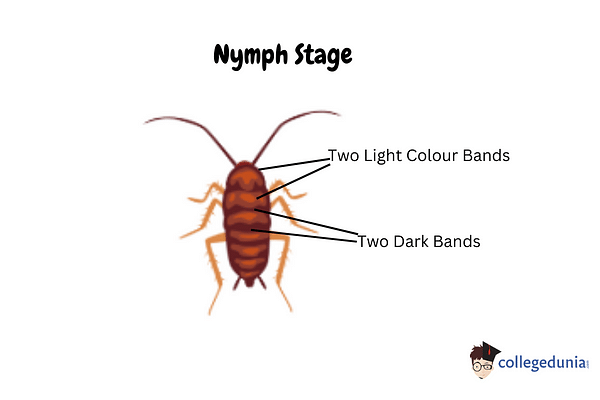
The time period for this stage varies from one species to another and also hugely depends upon the environmental factors and presence of predators. This stage usually lasts for about 11 to 14 months, depending on various circumstances.
They become fully developed in their last moult stage. After the completion of the nymph stage and the wings are partially developed, the cockroaches enter the adult stage of their life.
Stage 3: Adult
In this stage, the wings become fully developed and it becomes one of the distinct features to differentiate between an adult and a nymph cockroach. The lifespan of an adult cockroach hugely varies from species to species and depends on various environmental factors. They can have a typical lifespan from 2 months up to 2 years, depending upon the species.
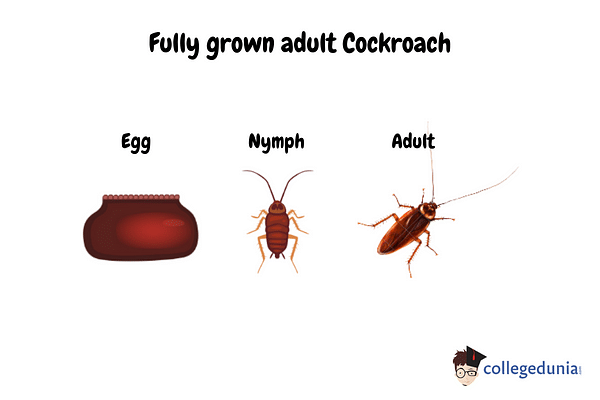
Cockroaches are omnivorous animals as they feed on almost anything. For survival purposes, they usually prefer a warm, dark-dingy, and humid climate to survive.
Things to Remember
- Cockroach (Periplaneta americana) is one of the large-sized insects found all over the world.
- They are mostly considered to be pests and usually inhabit kitchens, bakeries, godowns, storerooms, and sewage channels.
- Cockroaches have an average length of 4 cm and they are mainly reddish-brown in colour.
- The scientific name of the cockroach is Periplaneta americana.
- The body can be divided into three distinct parts – head, thorax, and abdomen.
- The lifespan of the cockroach depends on the factors such as breed, environment and diet.
- The lifecycle of cockroaches consists of three stages namely, Egg, Nymph and Adult.
- Cockroaches can have a typical lifespan from 2 months up to 2 years, depending upon the species.
Also Read:
| Related Topics To Structural Organisation in Animals | ||
|---|---|---|
| Types of Reproduction | Biogeochemical Cycles | Anatomy of the Earthworm |
| Agriculture Soil | Ant Life Cycle | Components of Ecosystem |
| Plasmodium Life Cycle | Lizard and Moth Life Cycle | Silkworm Life Cycle |
Previous Year Questions
- During an injury nasal septum gets damaged and for its recovery which cartilage is preferred?...(NEET 2001)
- Haversian canals occur in...(NEET 1989)
- Histamine secreting cells are found in...(NEET 1989)
- Which of the following features is not present in Periplaneta americana?...(NEET 2016)
- Protein present in cartilage is...(NEET 1997)
- If the head of cockroach is removed, It may live for few days because..(NEET 2020)
- An epithelial tissue which has thin flat cells, arranged edge to edge so as to appear like closely packed tiles, is found to be present at...(NEET 1994)
- Areolar connective tissue joins…(NEET 2006)
- Basement membrane is made up of...(NEET 1997)
- Characteristics of smooth muscle fibres are....(NEET 1992)
- Collagen is...(NEET 2002)
- Cuboidal epithelium with brush border of microvilli is found in...(NEET 2020)
- Earthworm possesses hearts...(NEET 1991)
- Earthworms are..(NEET 2006)
Sample Questions
Ques. What are Cockroaches? Where are they found? (2 marks)
Ans. Cockroach (Periplaneta americana) is one of the large-sized insects found in the world. The distribution of cockroaches is quite cosmopolitan in nature and it is primarily found in tropical and damp climates. They are mostly considered to be pests and usually inhabit kitchens, bakeries, godowns, storerooms, and sewage channels.
Ques. Where are cockroaches found in households? (2 marks)
Ans. The main places where this pest can be found are the nooks and cracked floors of the bathroom, kitchen, basements, and garages of any home.
Ques. Describe the characteristics of a regular house cockroach. (2 marks)
Ans. Cockroaches have an average length of 4 cm and they are mainly reddish-brown in colour. These animals have yellowish margins on the pronotum. The body of the cockroach is dorso-ventrally flattened, distinctly segmented, and covered by a shining brown exoskeleton.
Ques. What is the scientific name of the cockroach? (1 mark)
Ans. The scientific name of the cockroach is Periplaneta americana.
Ques. What are the factors that affect the eggs of the cockroaches? (2 marks)
Ans. It takes cockroaches about one to two months to hatch, but the egg stage lasts for 14 to 100 days depending on climatic changes in the environment. An increase in the rate of development is seen in higher temperatures. On average a female cockroach lays nearly 300 – 400 eggs in a year.
Ques. What is the nature of the sexuality of cockroaches? (1 mark)
Ans. The cockroaches are typically unisexual in nature.
Ques. What are the parts of a cockroach? (2 marks)
Ans. The body can be divided into three distinct parts – head, thorax, and abdomen. Wings that are darker than the body itself usually covers the dorsal body surface. Cockroaches are nocturnal and omnivorous animals.

Ques. Can a cockroach bite human beings? (2 marks)
Ans. Yes, since cockroaches are omnivorous insects and can devour almost everything, it also possesses the ability to bite humans and thus can easily spread disease.
Ques. Are cockroaches able to fly? (2 marks)
Ans. The ability of a cockroach to fly solely depends upon the species itself. Not all cockroaches can fly, while the American cockroach can glide short distances and the Australian cockroach can fly easily.
Ques. What are Malpighian Tubules? (2 marks)
Ans. Malpighian tubules: Malpighian tubules are excretory organs present in cockroaches. These are present at the junction of the midgut and hindgut. These are fine, long, unbranched, yellowish and blind tubules and are 100-150 in number. They help in the removal of excretory products from the haemolymph.
Ques. Describe the nymph stage of cockroaches. (3 marks)
Ans. It is the second stage where the cockroach is basically a tiny nymph. This process undergoes several stages of moulting, growing little day by day, and shedding of the skin. The nymph gradually becomes larger in size. In their earlier stage, they have soft, white bodies. Later this exoskeleton hardens to become more rigid and darker in colour.
The time period for this stage varies from one species to another and also hugely depends upon the environmental factors and presence of predators. This stage usually lasts for about 11 to 14 months, depending on the various circumstances.
They become fully developed in their last moult stage. After the completion of the nymph stage and the wings are partially developed, the cockroaches enter the adult stage of their life.
Ques. How does a cockroach look like in the adult stage? (2 marks)
Ans. In the adult stage, the wings become fully developed and it becomes one of the distinct features to differentiate between an adult and a nymph cockroach. The lifespan of an adult cockroach hugely varies from species to species and depends on various environmental factors. They can have a typical lifespan from 2 months up to 2 years, depending upon the species.
Ques. What are the factors on which the life span of cockroach depend? (2 marks)
Ans.
- Breed: Different species have different lifespans.
- Environment: Many factors such as humidity, temperature also plays a crucial role in their development.
- Diet: The availability of food and the type of food has a major impact on the overall development of these insects.
Ques. How many eggs do female cockroaches lay at a time? (2 marks)
Ans. The life cycle of cockroaches begins in eggs. The females lay around 10 to 50 eggs in one term in warm, humid conditions. The cockroaches carry the eggs in the eggshell covering located at the abdomen of female cockroaches in order to protect them, till it enters the nymph stage.
Do Check Out:



Comments