



Content Writer
A Concave polygon is a polygon with minimum one interior angle that measures greater than 180 degrees. It must possess at least four sides. The concave polygon generally has an irregular shape. A polygon that is not convex is concave. This polygon is the exact opposite of convex polygon.
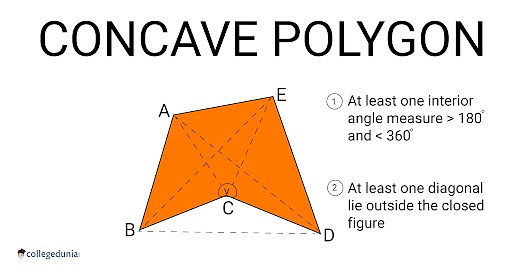
If and only if at least one internal angle is a reflex angle (between 180° and 360°), a simple polygon is said to be concave. Another name for it is a non-convex polygon. Its area and perimeter formula will be determined by the particular polygon's shape. The diagonals lie outside the boundary.
Read more: Polygon Curve Angle
KeyTerms: Concave polygon, Convex polygon, Quadrilateral, Angles of polygon, Exterior angles, Interior angles.
What is a Concave Polygon?
[Click Here for Sample Questions]
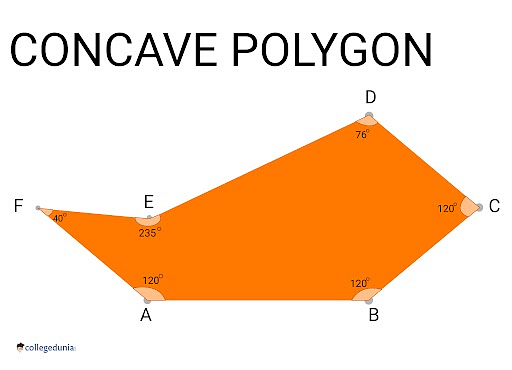
Concave Polygon is a type of polygon with at least one interior angle that measures larger than 180 degree. The vertices of a polygon are both inwards as well as outwards. The only polygons with more than four sides can be concave. The concave polygon is also referred to as non-convex polygon or reentrant polygon as they are opposite to the convex polygon. The diagonals of concave polygons lie entirely or partially outside the polygon.
Types of Concave Polygon
[Click Here for Sample Questions]
On the basis of their shape concave polygons are of two types. They are
- Regular Concave Polygon
- Irregular Concave Polygon
Regular Concave Polygon
Any polygon with equal interior angles and equal side lengths is said to be regular. A concave polygon is one that has at least one interior angle that is more than 180 degrees. Additionally, a polygon's interior angle total is equal to (n - 2) x 180, where n is the number of sides. Therefore, it is impossible to create a polygon with equal sides and an angle larger than 180 degrees. As a result, regular polygons are never concave.
Irregular Concave Polygon
The irregular polygon can have sides of varying lengths, and the lengths of each interior angle can likewise vary. It should be noted that because the internal angles of each concave polygon vary. Thus, it is established that all concave polygons are irregular
Read more:
Concave Polygon Formula
[Click Here for Sample Questions]
The formula of a concave polygon includes the area and perimeter of a concave polygon.
Area of a Concave Polygon
There is no simple formula to calculate the area of a concave polygon, unlike a regular polygon. There is a possibility that the length of each side and the inner angles will vary. The concave polygon must therefore be divided into triangles, parallelograms, or other shapes for which it is simple to calculate the area.
| Area of Concave Polygon = Area of the different shapes accessible in it |
Perimeter of a Concave Polygon
The total distance encircling the polygon's boundary is referred to as the polygon's perimeter. Similar to this, the circumference of a concave polygon is determined by the entire distance encircling its edge. The lengths of all the sides of a concave polygon can be added to determine its perimeter.
| Perimeter of Concave Polygon = Sum of all its sides |
Angles of Concave Polygon
[Click Here for Sample Questions]
Concave polygons also possess interior and exterior angles similar to other polygons.One or more interior angles that are reflex angles on a concave polygon serve as its primary distinguishing feature. The exterior and interior angles of concave polygons are as follows:
Sum of Exterior Angles of Concave Polygon
The total measure of the exterior angles of concave polygon is 360 degree. This indicates that all concave polygons have exterior angles that measure 360 degree, identical to other polygons.
Sum of Interior Angles of Concave Polygon
The same formula of convex polygon is used to find the sum of interior angles of concave polygon.
| The total sum of interior angles = (n-2) x 180 degrees |
where, n = number of sides in the polygon.
Concave Polygon
Some of the examples, to find sum of interior angles of concave polygons
- Quadrilateral [n = 4]
Sum of interior angles = 180 x (4 - 2) = 360 degrees
- Pentagon [n = 5]
Sum of interior angles = 180 x (5 - 2) = 540 degrees
- Hexagon [n = 6]
Sum of interior angles = 180 x (6 - 2) = 720 degrees
Properties of Concave Polygon
[Click Here for Sample Questions]
The following are a concave polygon's characteristics.
- At least one inwardly facing vertex characterizes a concave polygon, giving it its concave shape.It has at least one reflex angle. In other words, at least one interior angle must be both greater than 180° and smaller than 360°.
- The line segment drawn will intersect with the boundary more than two times.
- It can have more than one diagonal that lies outside the boundary.
- A concave polygon has at least one pair of sides that joins to the vertex outside.
- A concave polygon can be divided into set of convex polygons
- A triangle cannot be a concave polygon.
Difference Between Convex and Concave Polygons
[Click Here for Sample Questions]
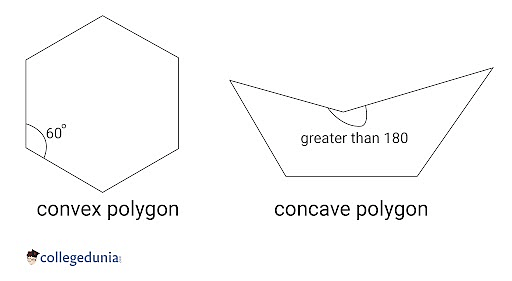
The difference between convex and concave polygons are mentioned below:
| Convex Polygons | Concave Polygons |
|---|---|
| It has no interior angle that measures 180 degrees | It has one reflex angles that measures more than 180 degrees |
| A convex polygon has 3 sides | A concave polygon has at least 4 sides |
| A line segment drawn inside convex shapes meets only 2 sides | A line segment drawn inside the concave shape meets more than 2 sides |
| No diagonals lie outside the polygon | Some of the diagonals may lie partly outside the polygon |
Difference between Convex and Concave Polygons
Things to remember
- A concave polygon has at least one reflex angle measuring more than 180 degrees
- A regular polygon can never exhibit the concave properties.
- A concave polygon is always irregular in shape
- The diagonals entirely or partially lie outside the boundary.
- A polygon's perimeter is the sum of all of its sides.
- A concave polygon's area is the space that can hold all of the possible shapes.
- An area of a concave polygon is the area of different shapes available in it.
- A star is the concave polygon as the interior angles is more than 180 degrees
- The triangle cannot be a concave polygon.
Sample Questions
Ques. If the side lengths of a concave polygon are 10 cm, 11 cm, 12 cm, 13 cm, 14 cm, 16 cm. What is its perimeter? (2 marks)
Ans. Given, sides of the polygon are 10 cm, 11 cm, 12 cm, 13 cm, 14 cm, 16 cm.
Perimeter = sum of all sides
Perimeter = 10+11+12+13+14+16 = 76 cm.
Ques. What are the other types of polygons? (3 marks)
Ans. The types of polygons are
- Regular polygons
- Irregular polygons
- Concave polygons
- Convex polygons
- Trigons
- Quadrilateral polygons
- Pentagon
- Hexagon
Ques. What is meant by a concave polygon? (1 mark)
Ans. A polygon is considered concave if at least one of its internal angles is greater than 180 degrees.
Ques. Mention a few properties of concave polygon. (5 marks)
Ans. The properties of concave polygon are as follows:
- A concave polygon has at least one inward-pointing vertex, which gives it its concave shape.
- It has at least one reflex angle. In other words, at least one interior angle must be both greater than 180° and smaller than 360°.
- The line segment drawn will intersect with the boundary more than two times.
- It can have more than one diagonal that lies outside the boundary.
- A concave polygon has at least one pair of sides that joins to the vertex outside.
Ques. State true or false for the following statements. (2 marks)
1. All the interior angles of a concave polygon are less than 180 degree.
2. Concave shapes are those shapes with at least one vertex pointing inwards.
Ans. For the given statements, the answers are -
1. False, the interior angles of a concave polygon are more than 180 degrees.
2. True, concave shapes possess at least one vertex pointing inwards. This gives the distance shape to a concave polygon.
Ques. How to find the area of a concave polygon? (2 marks)
Ans. By dividing the concave polygon into separate triangles through line segments drawn from one vertex point to the other vertices. The ultimate area will be determined by adding the areas of each triangle.
Using formula,
Area of concave polygon = Area of all the different shapes accessible
Ques. State the formula for calculating the perimeter of a concave polygon. (1 mark)
Ans. The perimeter of a concave polygon can be calculated by using the formula mentioned below:
Perimeter of a polygon = Sum of all its sides
Ques. What is the sum of the interior angles of a concave polygon? (2 marks)
Sum of interior angles = (n - 2) x 180 degrees.
Where, n = number of sides of the polygon
Ques. What is the sum of the exterior angles of a concave polygon? (1 mark)
Ans. The sum of exterior angles of a concave polygon is 360 degrees.
Ques. Is a star a concave polygon? (1 mark)
Ans. Yes, a star is a concave polygon since it possesses all of the characteristics of a concave polygon. The diagonals of a star lay outside the shape, it has more than four sides, and it has angles that are greater than 180 degrees.
Check out:



Comments