



Content Curator
Energy is defined as the capacity to do work. It is also defined as the power generated by the use of physical and chemical resources.
- Energy exists in many forms like Nuclear energy, Kinetic energy, Potential energy, Chemical energy, and so on.
- The main difference between kinetic energy and potential energy is that Kinetic energy in a body is due to its motion, whereas Potential Energy in a body is due to its state.
- Kinetic energy can be transferred from one body to another and is determined by the velocity, speed, and mass of the object.
- In contrast, potential energy is non-transferrable and is determined by the distance and mass of the object.
| Table of Content |
Key Terms: Energy, Kinetic Energy, Potential Energy, Difference between Kinetic and Potential Energy, Work, Gravitational potential energy, Types of kinetic energy, Types of potential energy
What is Kinetic Energy (KE)?
[Click Here for Sample Questions]
Kinetic Energy (KE) is the energy that an object possesses as a result of its motion.
- In other words, the work required to accelerate a body from rest to a required velocity is referred to as the object's kinetic energy.
- This holds true even for particles in motion.
- A person throwing a ball, a running train, or a falling drop of water are all examples of kinetic energy objects.
- KE is determined by two aspects of a body. One is the mass of the object, and the other is the velocity with which it moves.
- Velocity is the more important of the two and plays an important role in determining energy.
- Some examples of Kinetic energy are Radiant energy, thermal energy, sound energy, electrical energy, and mechanical energy.
- If an object is stationary, then its kinetic energy will be zero.
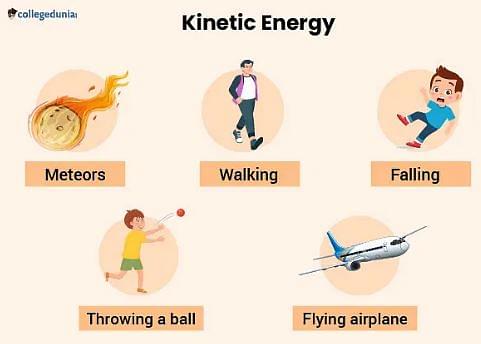
Kinetic Energy Formula
The formula of kinetic energy is given by
\(K.E. = \frac {1}{2}mv^2\)
Where
- m is the mass of the body
- v is the velocity of the body.
Types of Kinetic Energy
Depending on the type of object, kinetic energy can be divided into two types:
Translational Kinetic Energy
Translational kinetic energy is the kinetic energy possessed by a straight-moving object.
- An object's kinetic energy is proportional to its momentum.
- Because kinetic energy is related to momentum via the equation E = p2 / 2m, translational kinetic energy is calculated as E = 1/2 mv2.
Rotational Kinetic Energy
Rotational kinetic energy exists in rigid bodies that rotate along their center of mass.
- The total kinetic energy of the moving parts of a rotating body is used to calculate its rotational kinetic energy.
- Even at rest, bodies have kinetic energy. Its atoms and molecules are constantly moving.
- The temperature of such a body is measured by its kinetic energy.
Also Read:
What is Potential Energy (PE)?
[Click Here for Sample Questions]
William Rankine, a great physicist, coined the term potential energy in the 18th century. Potential energy is always determined by the position of the body rather than its trajectory of movement.
- The mass of the body, height relative to another object, and the strength of the gravitational field are all important factors of potential energy.
- It is the energy that is stored in an object and is not moving but has the potential to move.
- It can be defined as the energy that an object possesses as a result of its position in relation to another body.
- The PE could also be energy in a body as a result of internal stress or electrical charges in a body.
- Gravitational potential energy is one of the most common types of PE.
- Work is done against the gravitational force when an object is lifted from the ground.
- This work requires a lot of energy. When the object falls to the ground again, it gains energy from gravitational energy.
- The PE is converted to another form of energy as the object falls and moves from its resting position.

Potential Energy Formula
The formula of potential energy is given by
\(P.E. = mgh\)
Where
- m is the mass
- g is the acceleration due to gravity
- h is the height of the object from the surface
Types of Potential Energy
The different types of potential energy are
Gravitational potential energy
It is the potential energy of an object that is associated with gravitational force.
- When a book is placed on top of a table, the energy required to raise the book from the floor, as well as the energy possessed by the book as a result of its elevated position on the table, is referred to as gravitational potential energy.
- Gravity is the restoring force in this case.
Elastic potential energy
It is the energy possessed by an elastic body, such as a bow or a catapult, when stretched and deformed in one direction. Elasticity, which acts in the opposite direction, is the restoring force.
Chemical potential energy
It is energy related to the arrangement of atoms and molecules in a structure.
- Chemical potential energy is the energy possessed by a substance as a result of the potential it has to undergo a chemical change by participating in a chemical reaction.
- When fuel is burned, for example, the chemical energy stored in the fuel is converted to heat.
Electrical potential energy
It is the energy that an object possesses as a result of its electric charge. There are two kinds of potential energy: electrostatic potential energy and electrodynamic potential energy, also known as magnetic potential energy.
Nuclear potential energy
It is the potential energy held by particles (neutrons and protons) within an atomic nucleus. For example, in the sun, hydrogen fusion converts potential energy stored in solar matter into light energy.
Difference between Kinetic and Potential Energy
[Click Here for Sample Questions]
The differences between kinetic energy and potential energy are as follows:
| Parameters | Kinetic Energy | Potential Energy |
|---|---|---|
| Definition | The energy of a body or system due to the motion of the body or particles in the system is known as kinetic energy. | Potential energy is the energy that is stored in an object or system as a result of its position or configuration. |
| Relation to Environment | The kinetic energy of an object is measured relative to other moving and stationary objects in its immediate environment. | Potential energy is independent of the environment of an object. |
| Transferability | During collisions, kinetic energy can be transferred from one moving object to another. | It is not possible to transfer potential energy. |
| Examples | Stream of water, Stretched rubber, etc. | Water at the top of a fall, a ball thrown from the top of a building, etc. |
| SI Unit | Joule (J) | Joule (J) |
| Determining factors | Speed/velocity and mass | Height or distance and mass |
| Formula | K.E. = 1/2 mv2 | P.E. = mgh |
Things to Remember
- Energy is defined as the vitality and strength required to carry out an activity.
- Kinetic energy is the type of energy present in a body due to its motion.
- Potential Energy is the type of energy present in a body due to its state.
- Kinetic energy can be transferred from one body to another.
- Potential energy is non-transferable.
- The formula of kinetic energy is KE = 1/2 mv2.
- The formula of potential energy is PE = mgh.
Also Read:
Sample Questions
Ques. What is the unit of energy? (1 Mark)
Ans. The SI unit of energy is joule.
Ques. Give an example of kinetic energy. (1 Mark)
Ans. The energy possessed by a moving bus is an example of kinetic energy.
Ques. Determine the Gravitational Potential Energy at Height 'h'. (2 Marks)
Ans. rf = R + h and ri = R
ΔU = GMm 1/R–1/(R+h)
ΔU = GMmh/R(R + h)
When hR, R + h = R, and g = GM/R2, R + h = R.
Adding to the above equation,
Gravitational Potential Energy ΔU = mgh.
Ques. What is an object's kinetic energy? (2 Marks)
Ans. The energy possessed by an object as a result of its motion is referred to as the object's kinetic energy.
\(K.E. = \frac{1}{2} mv^2\)
Where m is the mass of the object and v is the velocity of the object.
Ques. Explain Potential Energy. (3 Marks)
Ans. Potential energy is the energy retained by an object as a result of its stationary position. Potential energy is the intrinsic energy of the body to its static position. The SI unit of potential energy is the joule, abbreviated J. In the nineteenth century, William Rankine, a Scottish engineer and physicist, coined the term "potential energy." Potential energy is classified into two types: elastic potential energy and gravitational potential energy.
Ques. What are the applications of Kinetic Energy? (3 Marks)
Ans. The following are some of the important applications that highlight the importance of KE:
- In automobiles, fuel is burned, and the heat energy is converted to motion, which is once again Kinetic energy in action.
- When water is stored in hydroelectric plants, it has potential energy. When the water flows down, the PE is converted to KE, and the KE is converted to electrical energy.
- The wind rotates the blades of windmills, and this rotational kinetic energy is converted to electrical energy.
Ques. Derive Kinetic Energy. (2 Marks)
Ans. The basic process of computing the work (W) done by a force yields the kinetic energy equation (F). If a body of mass m is pushed for a distance of d on a surface by a force that is parallel to it, the work done is:
W = F.d = m.a.d
⇒ W = m.d.(v2f−v2i/ 2d)
Simplifying the equation further, we get
W = 1/2mv2
Where v is the difference between initial and final velocities.
This work done is known as the kinetic energy of the body, hence
K.E = 1/2mv2
Ques. Determine the kinetic energy of a 200 kg object moving at a speed of 15 m/s. (2 Marks)
Ans: The KE can be found using the equation
KE= 1/2 mv2
KE=1/2(200kg)(15m/s)2
KE=45000J or 45KJ
Ques. What is meant by kinetic energy? (3 Marks)
Ans. The term Kinetic derives from the Greek language. Kinesis is a Greek word that means "to move." William Thomson was the first to use this name. Kinetic Energy (KE) is the energy that an object possesses as a result of its motion. In other words, the work required to accelerate a body from rest to a required velocity is referred to as the object's kinetic energy. This holds true even for particles in motion. A person throwing a ball, a running train, or a falling drop of water are all examples of kinetic energy objects.
Ques. What is the difference between kinetic and potential energy? (4 Marks)
Ans: The differences between kinetic and potential energy are as follows
| Kinetic Energy | Potential Energy |
|---|---|
| The energy of a body or system in relation to the motion of the body or particles in the system. | Potential energy is the energy that is stored in an object or system as a result of its position or configuration. |
| An object's kinetic energy is measured in relation to other moving and stationary objects in its immediate surroundings. | Potential energy is not affected by an object's surroundings. |
| In collisions, for example, kinetic energy can be transferred from one moving object to another. | It is not possible to transfer potential energy. |
For Latest Updates on Upcoming Board Exams, Click Here: https://t.me/class_10_12_board_updates
Also Check:



Comments