



Content Writer
Cross section is a mathematical representation of an object's intersection with a plane along its axis. A cross-section is a shape that results from the cutting of a solid (such as a cone, cylinder, or sphere) by a plane.
For example, if the base of a cylinder-shaped item is cut by a plane, the resulting cross-section will be a circle. The object has to come into contact with one another. This idea may be used for two-dimensional forms as well as three-dimensional ones, therefore the item need not be in three dimensions.
One can also view some actual cross-section examples, such as a tree after it has been cut, which displays a ring form. A square is created if a cubic box is cut along a plane parallel to its base.
Read more: Geometry Formula
KeyTerm: Cross-section, Cone, Cube, Sphere, Rectangle, Cylinder, Cross-sectional volume, Horizontal cross-section, Vertical cross-section
What is Cross-section?
[Click Here for Sample Questions]
The cross-section is the form created when a solid and a plane intersect in geometry. A two-dimensional geometric shape makes up the cross-section of a three-dimensional shape. In other words, a cross-section is the shape created by slicing a solid parallel to the base.
Cross-section Examples
[Click Here for Sample Questions]
Some of the examples of cross-section includes:
- Every circle is a cross-section of the sphere.
- A cone's horizontal cross-section is a circle, while its vertical cross-section is a triangle.
- A cylinder's horizontal cross-section is a circle, while its vertical cross-section is a rectangle.
Read more:
| Relevant Concepts | ||
|---|---|---|
| Cube | Cuboid | Volume of a Prism |
| Sphere Formula | Trigonometry | Triangular Pyramid |
Types of Cross Section
[Click Here for Sample Questions]
There are two types of cross-sections, namely:
- Horizontal cross-section
- Vertical cross-section
Horizontal Cross-Section
The horizontal cross-section plane cuts the solid shape in the horizontal direction such that it creates the parallel direction. It is also known as parallel cross-section.
Vertical Cross-Section
It is also known as perpendicular cross-section. In perpendicular cross-section, a plane cuts the solid shape in vertical direction such that it creates a perpendicular cross-section.
Read more: Equation of plane
Cross-Section Area and Volume
[Click Here for Sample Questions]
It is important to understand the important terminologies and functions relative to cross-section
Cross-Sectional Area
An area is projected onto the plane whenever a plane intersects a solid object. A cross-sectional area is a projection of this plane since it is further perpendicular to the axis of its symmetry.
The cross sectional area formula = l x w
Cross-Sectional Volume
The volume of the solid is determined by the integral of the area of cross-section.
Cross-Section in Geometry
[Click Here for Sample Questions]
Different three-dimensional shapes have different cross-sections. Here are few examples:
Cross-Sections of a Cone
A cone is a pyramid because it has a circular cross section. The cross-section, also known as a conic section (for a cone), may be a circle, a parabola, an ellipse, or a hyperbola depending on the connection between the plane and the slant surface.
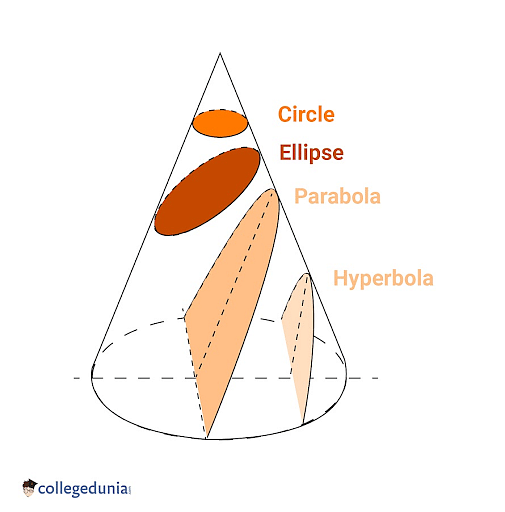
Different cross sections of cone
Cross-Sections of Cylinder
A cylinder's cross-section can be a circle, rectangle, or oval depending on the way it was cut. The result is a circle if the cylinder has a horizontal cross-section. The result is a rectangle if the plane slices the cylinder perpendicular to the base. The plane cuts the cylinder parallel to the base with a minor angle variation to create the oval shape.
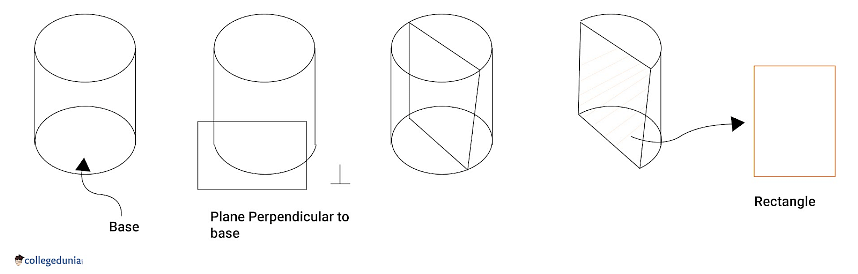
Cross sections of Cylinder
Cross-Sections of Sphere
The smallest surface area to volume ratio of any shape is known to be found in spheres. A circle is formed when a plane figure and a sphere intersect. A spherical circle has circular cross sections on all sides.
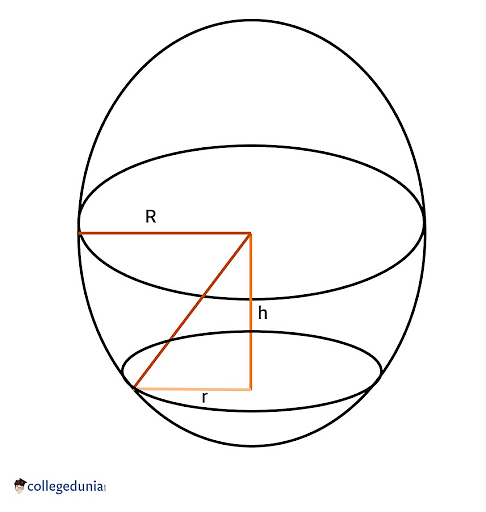
Cross Sections of Sphere
Things to remember
- A cross-sections is the intersection of a given object, by a plane along its axis.
- The cross-section of a three-dimensional shape is always a two-dimensional geometric shape.
- The two major types of cross-sections are horizontal cross-section and vertical cross-section.
- An object intersected by a plane which is perpendicular to the axis of its symmetry, this projection is called a cross-sectional area.
- The volume of the solid is defined by the integral of the area of cross-section.
Sample Questions
Ques. Determine the cross-section area of the given cylinder whose height is 25 cm and the radius is 4 cm. (5 marks)
Ans. Given:
Radius = 4 cm
Height = 25 cm
We know that when the plane cuts the cylinder parallel to the bottom, then the cross-section obtained may be a circle.
Therefore, the area of a circle, A = πr2 square units
Take π = 3.14
Substitute the values,
A = 3.14 (4)2 cm2
A = 3.14 (16) cm2
A = 50.24 cm2
The area of the cylinder is = 50.24 cm2
Ques. A solid, metallic, right circular cylindrical block of radius 7 cm and height 8 cm is melted, and small cubes of edge 2 cm are made from it. How many such cubes can be made from the block? (2 marks)
Ans. For the proper circular cylinder, we've radius (r) = 7 cm, height (h) = 8 cm.
Therefore, its volume = πr2h
= 3.14 × 72 × 8 cm3
= 1232 cm3
Ques. Find the cross-sectional area of a plane perpendicular to the base of a cube of volume equal to 27 cm3. (3 marks)
Ans. Since we know,
Volume of cube = Side3
Therefore,
Side3 = 27 [Given]
Side = 3 cm
Since, the cross-section of the cube will be a square therefore, the side of the square is 3 cm.
Hence, cross-sectional area = a2 = 32 = 9 sq.cm.
Ques. Define cross-section in geometry (1 mark)
Ans. A cross-section is the 2D shape obtained when a plane cuts a 3D solid.
Ques. What is the cross-section of a cube? (1 mark)
Ans. A cube has a square-shaped cross section. Since a cube's edges are all the same length and have square-shaped faces, it is a cube. As a result, the cube takes on the shape of a square when cut by a plane.
Ques. What is the cross-section of a cuboid? (1 mark)
Ans. A cuboid's cross-section is often a rectangle because all of its faces are square or rectangular. A rectangle results from cutting a cuboid by a plane.
Ques. What is the cross-section of a sphere? (1 mark)
Ans. A circle results from a plane cutting a sphere from any point on it. The place where the plane and the sphere intersect can affect the cross section's size. The sphere is divided into two equal portions if the plane cuts through the center of it (i.e. hemisphere).
Ques. What does the cross-section of the cone look like? (1 mark)
Ans. The round base of a cone narrows laterally to a point, known as the vertex. The cross section will be a circle if the cone is right circular. However, if it is an oblique cone, the cross section can resemble an oval.
Ques. Is the cross-section of the sphere and cylinder the same? (1 mark)
Ans. Cross section of both the sphere and cylinder is the same, that is a circle.
Ques. Mention two types of cross-section (2 marks)
Ans. The two types of cross-section are:
- Horizontal cross-section
- Vertical cross-section.
Check out:



Comments