



Education Content Expert
Cube Root 1 to 20 is the list of cube roots of the numbers 1 to 20. Cube root of a number refers to the value that when multiplied by itself thrice produces the original value. The cube root is the reverse of the cube of a number and is denoted by the symbol ∛. The cube root values from 1 to 20 range from 1 to 2.71441. In cube root from 1 to 20. 1 and 8 are perfect cubes while the remaining numbers are non-perfect cubes which means that their cube root will be irrational. The cube root 1 to 20 is expressed as ∛x in radical form and (x)⅓ in the exponential form. Cube root helps with faster calculations and reduces the need for tedious and long calculations.
Read More: NCERT Solutions for Class 8 Mathematics Cube and Cube Roots
| Table of Content |
Key Terms: Cube Root 1 to 20, Cube Root, Cube, Number, Prime Factorization, Long Division, Perfect Cube, Rational Number
What is Cube Root?
[Click Here for Sample Questions]
Cube Root of a number is defined as that number that results in the original number when it is multiplied three times by itself. The cube root of a number can be found easily with the help of prime factorization.
- In radical form, the cube root is expressed as ∛x.
- In exponential form, the cube root is expressed as (x)⅓
Example: In order to understand the concept of cube root, take an example of the number 27.
To find out the cube root of 27, we need a number that when multiplied thrice by itself shall give 27. We can write,
27 = 3 × 3× 3 = 33
Taking cubic root on both sides
∛27 = ∛33
Thus, the cube root of 27 is 3.
Read More:
| Chapter-Related Topics | ||
|---|---|---|
| Cube and Cube Roots | Cube Root 1 to 30 | Difference of Cubes Formula |
| Finding Square Roots through Prime Factorization | Square Root Formula | Estimating Square Root |
Cube Root 1 to 20 Value
[Click Here for Sample Questions]
The values of the cube root for the numbers from 1 to 20 are as follows:
| Number | Cube Root (3√) |
|---|---|
| 1 | 1.000 |
| 2 | 1.260 |
| 3 | 1.442 |
| 4 | 1.587 |
| 5 | 1.710 |
| 6 | 1.817 |
| 7 | 1.913 |
| 8 | 2.000 |
| 9 | 2.080 |
| 10 | 2.154 |
| 11 | 2.224 |
| 12 | 2.289 |
| 13 | 2.351 |
| 14 | 2.410 |
| 15 | 2.466 |
| 16 | 2.520 |
| 17 | 2.571 |
| 18 | 2.621 |
| 19 | 2.668 |
| 20 | 2.714 |
Cube Root 1 to 20 for Perfect Cubes
[Click Here for Sample Questions]
There are only two perfect cubes in cube roots from 1 to 20. 1 and 8 are the only two perfect cubes, which means their cube root is rational. The rest of the numbers are non-perfect cubes, whose cube root is irrational in nature.
The perfect cubes in cube root 1 to 20 are:
- ∛1 = 1
- ∛8 = 2
Cube Root 1 to 20 for Non-Perfect Cubes
[Click Here for Sample Questions]
The values of 1 to 20 cube roots for non-perfect cubes are as follows:
| Cube Root 1 to 20 for Non-Perfect Cubes | |
|---|---|
| ∛3 | 1.442 |
| ∛4 | 1.587 |
| ∛5 | 1.710 |
| ∛6 | 1.817 |
| ∛7 | 1.913 |
| ∛9 | 2.080 |
| ∛10 | 2.154 |
| ∛11 | 2.224 |
| ∛12 | 2.289 |
| ∛13 | 2.351 |
| ∛14 | 2.410 |
| ∛15 | 2.466 |
| ∛16 | 2.520 |
| ∛17 | 2.571 |
| ∛18 | 2.621 |
| ∛19 | 2.668 |
| ∛20 | 2.714 |
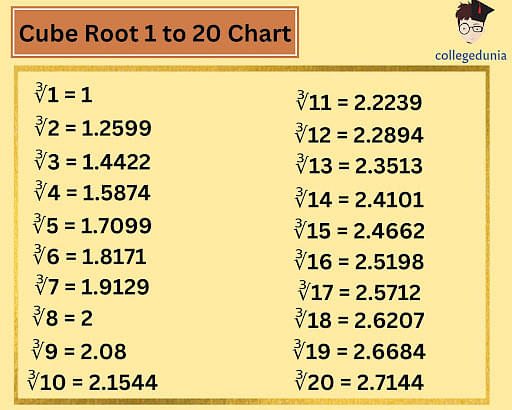
Cube Root 1 to 20 Chart
Read More: Cubes and Cube Roots MCQs
How to Calculate Cube Root 1 to 20?
[Click Here for Sample Questions]
We can calculate the cube root for numbers 1 to 20 with the help of prime factorization. For instance, to find the cube root of 8, we will follow the given steps:
Example: Find the Value of ∛8.
- Prime factorization of 8 = 2 × 2 × 2
- Pairing up the prime factors: 2
Thus, the value of ∛8 is 2.
However, for non-perfect cubes, we have to use the long division method of calculating cube roots.
Cubes of 1 to 20
[Click Here for Sample Questions]
Cube of a number refers to the value obtained when a number is multiplied thrice by itself. The cubes of numbers from 1 to 20 are listed below:
| Number | Cube |
|---|---|
| 1 | 1 |
| 2 | 8 |
| 3 | 27 |
| 4 | 64 |
| 5 | 125 |
| 6 | 216 |
| 7 | 343 |
| 8 | 512 |
| 9 | 729 |
| 10 | 1000 |
| 11 | 1331 |
| 12 | 1728 |
| 13 | 2197 |
| 14 | 2744 |
| 15 | 3375 |
| 16 | 4096 |
| 17 | 4913 |
| 18 | 5832 |
| 19 | 6859 |
| 20 | 8000 |
Solved Examples on Cube Root 1 to 20
[Click Here for Sample Questions]
Example 1: Simplify ∛3 + 33.
Solution: Given value is ∛3 + 33
We know that the value of ∛3 and 33 is
∛3 = 1.442
33 = 27
Thus, substituting the values,
∛3+33 = 1.442 + 27
∛3+33 = 28.442
Example 2: What is the value of ∛20 – 2 + (53)?
Solution: Given that, ∛20-2+(53)
The value of ∛20 and 53 is:
- ∛20 = 2.714
- 53 = 125
Putting the value in the given equation,
∛20 – 2 + (53) = 2.714 – 2 + 125
∛20 – 2 + (53) = 125.714
Also Read:
| Related Topics | ||
|---|---|---|
| Square Root Formula | Square Roots | Root Mean Square |
| Cube Formula | Some Interesting Patterns | Factoring Formula |
Things to Remember
- Cube Root is the number that produces a given number when cubed.
- It is the inverse process of calculating the cube of a number.
- Cube root of a number is represented using the symbol ∛.
- Cube Root 1 to 20 refers to the list of cube roots from 1 to 20.
- The value of cube root 1 to 20 ranges from 1 to 2.71441.
- 1 and 8 are the only two perfect cubes in cube roots of numbers from 1 to 20.
- All the numbers apart from 1 and 8 are non-perfect cubes that have irrational cube roots.
Sample Questions
Ques. A cube has a volume of 9 cubic centimeters. What will be the length of the side of the cube? (3 Marks)
Ans. Let us consider ‘a’ as the length of the side of the cube.
Volume of the Cube = a3 = 9 cm3
a3 = 9
a = ∛9 = 2.080 cm
Thus, the length of the side of the cube is 2.080 inches.
Ques. What do you mean by Cube Root 1 to 20? (3 Marks)
Ans. The value of cube root 1 to 20 refers to the number when multiplied three times to give the original number. The cube root can have both negative and positive values. Between the numbers 1 to 20, the cube roots of 1 and 8 are whole numbers which mean that they are rational, while the cube roots of 2, 3, 4, 5, 6, 7, 9, 10, 11, 12, 13, 14, 15, 16, 17, 18, 19, 20 are decimal numbers that are neither terminating nor recurring (irrational).
Ques. What is the value of ∛8/4? (3 Marks)
Ans. The value of ∛8 is
∛8 = 2
Substituting the value in the given number,
∛8/4 = 2/4 = ½ = 0.5
Thus, the value of ∛8/4 is 0.5.
Ques. Calculate the value of 10-∛6. (3 Marks)
Ans. The value of ∛6 is
∛6 = 1.817
Putting its value in the given number, we get
10-∛6 = 10 – 1.817
10-∛6 = 8.183
So, the value of 10-∛6 is 8.183.
Ques. Find out the real root of the equation x3 = 8. (1 Mark)
Ans. Given that,
x3 = 8
x = ∛8
We know that the real root for the equation x3 = 8 is for x = 2.
Ques. Name the methods used to calculate the cube roots from 1 to 20. (2 Marks)
Ans. There are two methods that are used to calculate the value of cube roots from 1 to 20. In order to calculate the cube root for perfect cubes (1, and 8), we use the prime factorization method and for non-perfect cubes (2, 3, 4, 5, 6, 7, 9, 10, 11, 12, 13, 14, 15, 16, 17, 18, 19, 20), the long division method can be used.
Ques. What is the value of ∛12 + ∛14? (3 Marks)
Ans. The values of ∛12 and ∛14 are:
∛12 = 2.289
∛14 = 2.410
Substituting the values,
∛12 + ∛14 = 2.289 + 2.410
∛12 + ∛14 = 4.699
Thus, the value of ∛12 + ∛14 is 4.699.
Ques. What values of cube roots from 1 to 20 fall between 2.5 and 3 inclusive? (1 Mark)
Ans. The values of cube roots 1 to 20 that fall between 2.5 and 3 are ∛16 (2.520), ∛17 (2.571), ∛18 (2.621), ∛19 (2.668), and ∛20 (2.714).
Ques. How many numbers in Cube Roots 1 to 20 are rational and irrational? (3 Marks)
Ans. 1, and 8 are the two perfect cubes so their cube roots will be rational numbers which means that they can be expressed in the form of p/q where q ≠ 0.
The numbers 2, 3, 4, 5, 6, 7, 9, 10, 11, 12, 13, 14, 15, 16, 17, 18, 19, and 20 are non-perfect cubes which means that their cube root will be an irrational number and they cannot be expressed in the form of p/q where q ≠ 0.
Ques. What is the cube root of 64? (3 Marks)
Ans. In order to find the cube root of 64, we will use the prime factorization method.
64 = 2×2×2×2×2×2 64 = 4 × 4 × 4
64 = 43
Taking the cube root on both the sides, we get
∛64 = ∛(43)
∛64 = 4
Check-Out:



Comments