



Content Curator
Real gas can be termed as the gas that does not act as an ideal gas whereas ideal gas is defined by three gas laws, namely, Boyle’s Law, Charles’ Law, and Avogadro Law, when combined together form the ideal gas equation.
| Table of Contents |
Key Terms: Ideal Gas Equation, Ideal Gas, Real Gas, Pressure, Volume, Gas Law, Ideal Gas Equation, Boyle’s Law, Charles’ Law
What Is Real Gas?
[Click Here for Sample Questions]
A real gas is a gas that obeys Boyle’s Law, Charles’ Law, and Avogadro Law or the Gas Law under certain circumstances when forces of interaction are negligible is known as real gas.
Some properties of real gas are discussed below:
- Real gas has an intermolecular force of attraction. When expansion takes place, the molecules spend more kinetic energy in order to overcome intermolecular attraction. Hence, the temperature drops down.
- Real gas can be liquefied because its molecules have the property of intermolecular attraction that helps to combine the molecule.
Also Check: Real Gas
What Is An Ideal Gas?
[Click Here for Sample Questions]
A gas that obeys Boyle’s Law, Charles’ Law, and Avogadro Law or the Gas Law is known as an ideal gas. In reality, ideal gas does not exist and such a condition is hypothetical. An ideal gas is also called theoretical gas. The concept of ideal gases helped in simplifying the equation of state as they obey the ideal gas law.
Ideal gases follow these rules:
- The molecules of an ideal gas do not attract or repel each other.
- The molecules of an ideal gas do not take up volume.
In reality, no such condition exists in gases, hence, an ideal gas is a hypothetical concept.
Equation of ideal gas is:
| pV = nRT |
Where p = Pressure of the gas,
V = Volume of the gas,
n = Avogadro Number and its value is 6.022 1023
T = Temperature
R = Gas Constant or Universal Gas Constant
Difference Between Ideal And Real Gas
[Click Here for Sample Questions]
Based on the properties of an ideal gas and real gas, let us look at the differences between them. The table below shows four points of difference between ideal and real gas.
| Ideal Gas | Real Gas |
|---|---|
| Ideal gas obeys the gas law in all conditions. | Real gas obeys the gas law under specific circumstances, such as low pressure and high temperature. |
| The molecules of ideal gas occupy a negligible amount of volume. | The volume occupied by the molecules of a real gas is not negligible in comparison to the total volume of gas. |
| There is a negligible force of attraction between the molecules of an ideal gas. | The force of attraction between the molecules of a real gas is not negligible. |
| An ideal gas is a hypothetical concept. | Real gas exists in reality. |
Real Gas Behavior: Deviation From Ideal Gas
[Click Here for Sample Questions]
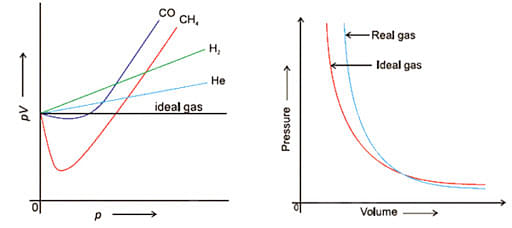
Real Gas Behavior
Key observations on above graphs:
- The first graph shows pV v/s p of a real and ideal gas. It shows how gases behave differently from an ideal gas.
- Two types of curves are plotted in the graph. In the curves for di-hydrogen and helium, as the pressure increases the value of pV also increases. The second type of plot is seen in the case of other gases like carbon monoxide and methane.
- In these plots, first, there is a negative deviation from ideal behavior, the pV value decreases with an increase in pressure and reaches a minimum value characteristic of a gas. After that pV value starts increasing to the top right.
- The curve then crosses the line for ideal gas and after that shows a positive deviation continuously. It is thus found that real gases do not follow the ideal gas equation perfectly under all conditions.
- The second graph shows the pressure v/s volume of a real and ideal gas.
- In this graph, the experimental data of real gas coincides with theoretically calculated data of ideal gas (using Boyle’s Law).
- It is apparent from the graph that at very high pressure the measured volume is more than the calculated volume. At low pressures, measured and calculated volumes approach each other.
Why Do Real Gases Deviate From Ideal Behavior?
[Click Here for Sample Questions]
All the gaseous molecules attract each other by a combination of forces. At high temperatures, they have enough energy, and they overcome their attractive force and predominate by the effects of the molecular volume. On the other hand, with the decrease in the temperature, the energy of these gaseous molecules also decreases.
Eventually, there comes a point where it becomes impossible for these molecules to overcome the force of attraction, and it results in the liquefaction of gas and turning into a liquid state. That is the reason that the ideal gas behavior is a hypothetical concept and does not apply in real situations.
Things to Remember
- Three gas laws, namely, Boyle’s Law, Charles’ Law, and Avogadro Law, when combined together form the ideal gas equation.
- Ideal gas is a hypothetical concept.
- Real gas obeys the gas law under specific circumstances, such as low pressure and high temperature.
- The gaseous molecules attract each other by a combination of forces.
- The volume occupied by the molecules of a real gas is not negligible in comparison to the total volume of gas.
- The concept of ideal gases helps in simplifying the equation of state.
Sample Questions
Ques: What is the ideal gas equation? (2 Marks)
Ans: Three gas laws, namely, Boyle’s Law, Charles’ Law, and Avogadro Law, when combined together form the ideal gas equation. The ideal gas equation is:
| pV = nRT |
Ques: What is an ideal gas? (3 Marks)
Ans: A gas that obeys Boyle’s Law, Charles’ Law, and Avogadro Law or the Gas Law is known as ideal gas. In reality, ideal gas does not exist and such a condition is hypothetical. The concept of ideal gases helped in simplifying the equation of state as they obey the ideal gas law.
Ideal gases follow these rules:
- The molecules of an ideal gas do not attract or repel each other.
- The molecules of an ideal gas do not take up volume.
In reality, no such condition exists in gases, hence, an ideal gas is a hypothetical concept.
Ques: What is real gas? (2 Marks)
Ans: A real gas is a gas that obeys Boyle’s Law, Charles’ Law, and Avogadro Law or the Gas Law under certain circumstances when forces of interaction are negligible is known as real gas. Properties of real gas are as follows:
- Real gas has an intermolecular force of attraction. When expansion takes place, the molecules spend more kinetic energy in order to overcome intermolecular attraction. Hence, the temperature drops down.
- Real gas can be liquefied because its molecules have the property of intermolecular attraction that helps to combine the molecule.
Ques: Define Boyle’s Law? (2 Marks)
Ans: According to Boyle’s Law, at a constant temperature and mass, the volume of the given amount of gas is inversely proportional to its pressure. In simple words, if the temperature and the mass of a given gas are kept constant, the volume of the gas will decrease with the increase in pressure.
P ∝ 1/V
This proportionality can be equated by adding a constant k. Now,
P= k*(1/V)
PV= k
Ques: Define Charles’ Law? (2 Marks)
Ans: Charles Law states that when the pressure on a dry gas is held constant, then the Kelvin temperature and therefore the volume will be directly proportional to each other.
As per the Charles Law equation,
V ∝ T,
The mathematical expression for the same is given as:
V =kT,
Therefore, V/T = K
Ques: What is Avogadro Law? (2 Marks)
Ans: Avogadro’s law is a gas law. It states that the total number of molecules/atoms of a gas is directly proportional to the volume occupied by the gas at constant temperature and pressure.
At any constant pressure and temperature, Avogadro’s Law can be expressed as:
V ∝ n
So, the formula of Avagadro’s Law can be given as-
V/n = k (where V is volume)
Ques: Explain why real gases deviate from ideal behavior? (3 Marks)
Ans: All the gaseous molecules attract each other by a combination of forces. At high temperatures, they have enough energy, and they overcome their attractive force and predominate by the effects of the molecular volume.
On the other hand, with the decrease in the temperature, the energy of these gaseous molecules also decreases. Eventually, there comes a point where it becomes impossible for these molecules to overcome the force of attraction, and it results in the liquefaction of gas and turning into a liquid state. Hence, this is the reason that real gases deviate from ideal behavior.
Ques: What are the two properties of real gas? (2 Marks)
Ans: Two properties of real gas are:
- Real gas has an intermolecular force of attraction. When expansion takes place, the molecules spend more kinetic energy to overcome intermolecular attraction. Hence, the temperature drops down.
- Real gas can be liquefied because its molecules have the property of intermolecular attraction that helps to combine the molecule.
Ques: Write 3 points of difference between ideal and real gas. (3 Marks)
Ans: The difference between ideal gas and real gas is specified below:
| Ideal Gas | Real Gas |
|---|---|
| Ideal gas obeys the gas law in all conditions. | Real gas obeys the gas law under specific circumstances, such as low pressure and high temperature. |
| The molecules of ideal gas occupy a negligible amount of volume. | The volume occupied by the molecules of a real gas is not negligible in comparison to the total volume of gas. |
| There is a negligible force of attraction between the molecules of an ideal gas. | The force of attraction between the molecules of a real gas is not negligible. |
Ques: What is the R in the ideal gas equation? (1 Mark)
Ans: The ideal gas equation is:
pV = nRT
Here R is the Universal Gas Constant. The value of R is approximately 8.3144598.
Ques: What is the value of the Avogadro number? (1 Mark)
Ans: The value of the Avogadro number is approximately 6.023 x 10²³.
Check-Out:



Comments