



Education Journalist | Study Abroad Lead
Evaporation and condensation are the two processes of nature that deal with fluids or liquids in general. Water is made up of particles that are held together by some kind of force. Though, the particles are loosely bound and thus are free to move. The molecules of water also possess a certain amount of thermal energy that is created due to the fast vibrations of the molecules of water. Hence, as the particles vibrate and therefore move with a stronger force, they escape into the air in the form of vapors. This process is known as evaporation. This process of evaporation is also reversible in nature and the molecules of water can transform back into liquids. This process is known as condensation. In this article, we will have a look at the process of evaporation and condensation, and the differences between the two.
| Table of Content |
Key Takeaways: Evaporation, Condensation, Solids, Liquids, Gases, Intermolecular forces, water cycle
What is Evaporation?
[Click Here for Sample Questions]
Evaporation basically refers to a process wherein the water changes its state from liquid to gaseous state. The rate of evaporation increases with a rise in temperature. The process of evaporation begins when the liquid molecules are heated up. The molecules receive energy in the form of the heat that is supplied. Evaporation takes place when the temperature is high and the pressure is low.
Evaporation naturally leads to cooling. In order to transform and change their shape, the molecules should ideally either gain or lose energy. When the state transition is from a liquid state to gas, the molecules need energy to overcome the potential energy present in them. Therefore, the liquid takes the required kinetic energy from its surroundings.
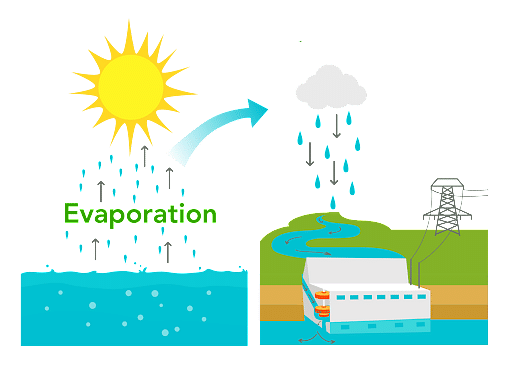
The process of evaporation
The process takes place at any temperature that is below the boiling point. The molecules absorb the energy from the surroundings and are released into the atmosphere in the form of vapors. Evaporation plays an important role in the water cycle as through this process the molecules of water are carried up with the help of the wind. These molecules eventually get condensed to form clouds which pour down in the form of rain.
For example, when we place a cold glass of water outside, the sweat on its external surface evaporates when the glass turns warm.
Also, clothes are dried in the presence of the sun as the water present in them is evaporated in form of water vapors in the atmosphere.
Read More: Vapour Pressure
What is Condensation?
[Click Here for Sample Questions]
Condensation is the process in which a substance undergoes a phase change and transforms from its gaseous state to its liquid state. When the molecules of the substance lose their energy, they start combining with each other to form a solution or tiny droplets of water. The process takes place under conditions of high pressure and a decreased temperature.
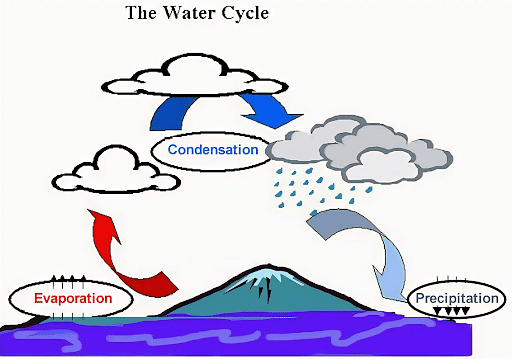
Condensation and the water cycle
Energy is released into the surroundings, hence we can say condensation is an exothermic process. It mainly occurs at places with high altitudes. It is an important process of the water cycle as the water molecules are carried by the wind and are condensed to yield the formation of clouds in the atmosphere.
For example, water vapor in the air condenses to tiny droplets of water that we can see when we place a cold can outside.
Also, we observe dew on the leaves in the mornings as the warmer air from the atmosphere is condensed in the form of water droplets on leaves
Also, Read: Difference between Evaporation and Transpiration
Difference between Evaporation and Condensation
[Click Here for Sample Questions]
The differences between evaporation and condensation are as tabulated below:
| Evaporation | Condensation |
|---|---|
| Evaporation can be defined as a process in which water changes in the form of a vapor. | Condensation refers to the process wherein the water vapor is transformed back into tiny droplets of water. |
| Energy is consumed during the process of evaporation. It is an endothermic reaction. | During the process of condensation, energy is released. It is an exothermic reaction. |
| Evaporation can take place at any time, at all places and surfaces. Evaporation becomes more frequent when the air is hot, dry, and windy. | Condensation takes place at the surface of the salt, carbon particles, nuclei-pollen grains, hygroscopic, etc. Condensation occurs frequently when the temperature of the air is decreased even beyond the saturation level. |
| Evaporation takes place just before a liquid reaches its boiling point. | Condensation refers to a change of phases and is independent of the temperature. |
| When pressure is decreased or a liquid is heated, the forces of attraction that exist between the molecules are lowered. This leads to the transformation of the liquids into gas. | When the pressure is increased or the temperature is increased, the forces of attraction that exist between molecules become significantly stronger. The gas then gets condensed to form a liquid or even a solid. |
| The state of matter, in evaporation, changes from liquid to gaseous state (vapor). | The state of matter, in condensation, changes from a gaseous to a liquid state. |
| It generally takes place at places with low altitudes. | Condensation generally takes place at high altitudes. |
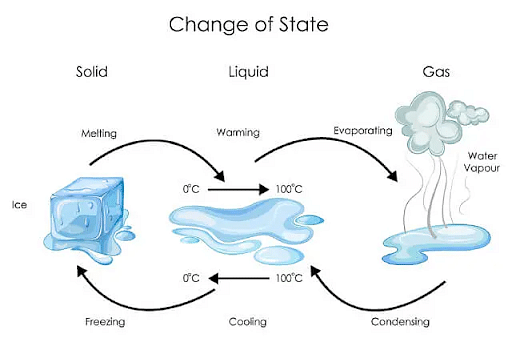
Change of State
Also, Read: Change of State: Melting Point, Boiling Point
Things to Remember
[Click Here for Sample Questions]
- Evaporation basically refers to a process wherein the water changes its state from liquid to gaseous state.
- Condensation is the process in which a substance undergoes a phase change and transforms from its gaseous state to its liquid state.
- Evaporation is endothermic in nature while condensation is an exothermic process.
- Evaporation takes place at low altitudes while condensation occurs at places with high altitudes.
- Evaporation and condensation are both important processes of the water cycle that involve phase change.
Read More:
| Supersaturated Solution | Standard Enthalpy of Formation | Fluid Pressure |
| Difference Between Density And Specific Gravity | Relation between viscosity and density | Hydrostatic Pressure |
Sample Questions
Ques. Explain the process of evaporation. (3 marks)
Ans. Evaporation is the process where a liquid is changed into a vapor form. At the beginning of this process, the molecules of water receive energy supplied to them in the form of heat. After the molecules gain energy, they escape their intermolecular forces to be released into the atmosphere as vapors.
The process only takes place at the surface of a liquid and not throughout the entire volume of a given body. During the process of evaporation, the pressure that exists in the surrounding atmosphere is higher than the pressure of vapor. This process is reversible in nature and the opposite process is known as condensation.
Ques. State the main difference between evaporation and condensation. (5 marks)
Ans. The main points of difference between evaporation and condensation are as follows:
- In evaporation, water is changed into a gaseous form while in condensation, the gaseous state of water is transformed back into a liquid state in form of tiny droplets of water.
- Evaporation is dependent on temperature while temperature plays no role in the process of condensation.
- Evaporation can take place at all surfaces and at any time while condensation takes place at the surface of the salt, carbon particles, nuclei-pollen grains, hygroscopic, etc.
- In evaporation, the temperature is increased and the pressure is decreased while in condensation, the pressure increases with a decrease in temperature.
- The forces of attraction between the molecules are weakened in evaporation due to the applied heat while in condensation, the intermolecular forces become stronger.
Ques. What is condensation? Explain its role in the water cycle. (5 marks)
Ans. Condensation refers to the process in which the water vapors present in the air are transformed into the liquid state of water. It can also be understood as the removal of the heat from the system in a way that the vapors present are converted into liquid or fluids.
Condensation and Water Cycle:
The process of condensation plays an important role in the water cycle as it is responsible for the formation of clouds. The water vapors that are present in the air through the process of evaporation eventually condense to form clouds. In vapor form, the molecules of water are randomly arranged when compared to their liquid state. As the molecules undergo condensation, they become more organized in structure. Therefore, heat is released into the atmosphere that transforms the water vapor into a liquid state. The process generally takes place when the warm air rises up and is cooled down significantly.
It is very important for the atmosphere to be fully saturated i.e. for the atmosphere to reach maximum vapor pressure in order for condensation to take place. The water cycle plays a very important role in the environment to maintain a water balance.
Ques. What are the factors that affect evaporation? (5 marks)
Ans. The factors affecting evaporation are as follows:
- Temperature: With the increase in temperature of the liquid, the rate of evaporation also increases. This is because as the heat is supplied to the molecules of a particle, the forces of attraction present between the molecules are weakened, and hence they are easily able to escape into the atmosphere.
- Surface Area: On increasing the surface area of a liquid, the rate of evaporation is also increased. That is why we spread out the clothes that are washed while drying them so that the rapid evaporation evaporates the water out of the clothes.
- Humidity in Air: Humidity refers to the water vapors that are already present in the air. When the atmosphere has high humidity, it has a lower rate of evaporation and therefore the water gets evaporated at a slower pace.
- Speed of Wind: As the speed of the wind increases, the rate of evaporation also gets increased. This is why, on a windy day, clothes dry at a faster rate.
Ques. Explain the steps of the water cycle in brief. (5 marks)
Ans. The water cycle mainly comprises 4 steps which are as follows:
- Evaporation: This process includes the transfer of water present on the surface of the earth to the atmosphere in the form of water vapors. In plants, this process is also referred to as transpiration as the water is transferred from the minute pores that are present on the plant’s leaves to the atmosphere in the form of water vapor.
- Condensation: After the conversion of water into vapor, the vapor condenses to again convert into the liquid form due to an increase in temperature. Therefore, the water vapors get condensed to form clouds.
- Precipitation: After the condensation process, the water vapors are turned into droplets of water that are stored inside the cloud. When the clouds get heavier or collide with each other, the water droplets fall down in the form of rain or precipitation.
- Runoff and Infiltration: The rain that falls down either runs off the rivers, oceans and the ground surface or is either absorbed in the ground, also known as infiltration.
Ques. Why do the doctors advise us to put strips of wet cloth on the forehead of a person with a high fever? (3 marks)
Ans. When a person is having a high fever, their temperature rises far above the normal body temperature. If we apply the strips of cool wet cloth on the forehead of the person, the eater goes through evaporation, and in the process of converting into vapors, the water uses the heat from the body and takes it away. Therefore, moist strips can help in lowering the body temperature of a person.
Ques. Explain the basic process of condensation in detail. (3 marks)
Ans. When water changes its state from gaseous to liquid, the process is known as condensation. Any gas can condense at high pressure and low-temperature condition. As long as the pressure of the liquid phase of the gas being condensed is less than the pressure associated with the condensing gas, condensation can take place. As the heat is taken away from the system, the molecules of the gas considerably slow down. In a condensation reaction, basically, two molecules combine with each other to yield a larger molecule.
Ques. State some applications of cooling through evaporation. (5 marks)
Ans. Evaporation naturally leads to cooling as the molecules of the liquid absorb energy from their atmosphere in order to change their state and transform into vapor. Some of the daily life applications of evaporative cooling are as follows:
- During summers, we generally wear cotton clothes. This is because cotton acts as a good absorber of water. It allows more of the sweat produced to be in direct contact with the atmosphere, which helps in the process of evaporation. Hence, we feel a lot cooler in cotton clothes.
- When the temperature around us rises, our body starts sweating in order to stay cool. Sweating mainly happens to be evaporation as the water present in our body absorbs energy and then eventually lowers the temperature of the body.
- On hot and dry days, an air cooler is usually more effective. This is because air coolers work on the basic principle of evaporative cooling. As the temperature of the atmosphere is high, the rate of humidity is low, so the rate of evaporation is high. The water, therefore, absorbs energy from the air and is transformed into vapor which cools the air.
- We store water in earthen pots in order to keep it cool. This is because the pores in the earthen pot provide a larger surface area for evaporation to take place and therefore lead to evaporative cooling of the water.
Ques. State the differences between the three states of matter. (5 marks)
Ans. The three states of matter are solids, liquids, and gases. The differences between these states are as tabulated below:
| Solids | Liquids | Gases |
|---|---|---|
| Solids have a definite shape and a definite volume. | Liquids do not have any definite shape. They attain the shape of the vessel they are stored in. | Gases neither have a definite shape nor a definite volume. |
| Solids are incompressible. | Liquids can be compressed up to some extent. | Gases are highly compressible. |
| The forces of attraction between the molecules of soilds are stronger. | The forces of attraction between the molecules of liquids are weaker than solids but stronger than gases. | The forces of attraction between the molecules of gases are the weakest. |
| There is very little space in between the particles of solids as they are tightly packed. | Liquid particles have more space in between them. | The space existing between the particles of gas is the greatest as they are loosely packed. |
| The solid particles are not able to move around freely. | The particles of liquids have somewhat free movement. | Gaseous particles are extremely free and are continuously moving around in a random motion. |
Ques. Why does our palm feels cold when we apply acetone or perfume on it? (2 marks)
Ans. When acetone or perfume is applied to our palm, the process of evaporation takes place and it gets evaporated. The particles of acetone or perfume absorb the energy from the surface of our palm or from the surroundings in order to compensate for the loss of energy during the process. Hence, the palms feel cold when acetone or perfume is applied to them.
Read More:



Comments