



Education Content Expert
Force of Attraction is the universal force of attraction acting between any two objects or bodies resulting in attracting or pulling each other. Force of Attraction between any two objects is directly proportional to their masses and is inversely proportional to the distance between them. There are numerous forces of attraction that exist in nature such as:
- Gravitational Force
- Electric Force
- Electrostatic Force
- Magnetic Force
Force of Attraction Formula is given as:
| \(F_g = \frac{Gm_1m_2}{r^2}\) |
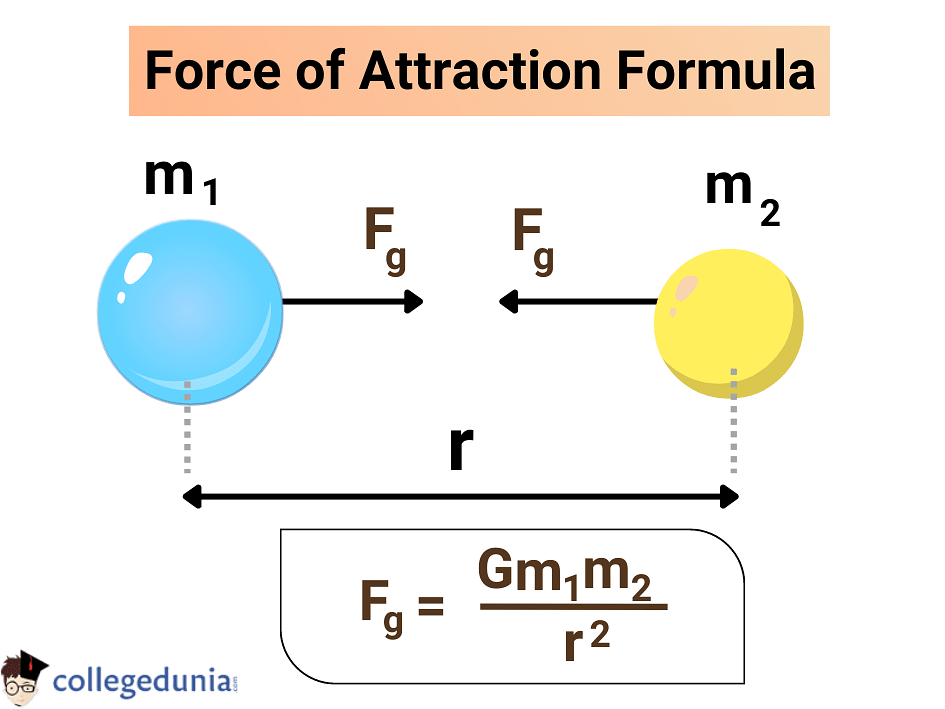
Where Fg refers to the force of attraction, m1, and m2 are the masses of the two objects, G is the gravitational constant and r is the distance between the two objects.
Read More: NCERT Solutions for Class 11 Physics Gravitation
Key Terms: Force of Attraction, Force of Attraction Formula, Gravitational Force, Universal Law of Gravitation, Gravitation Formula
What is Force of Attraction?
[Click Here for Sample Questions]
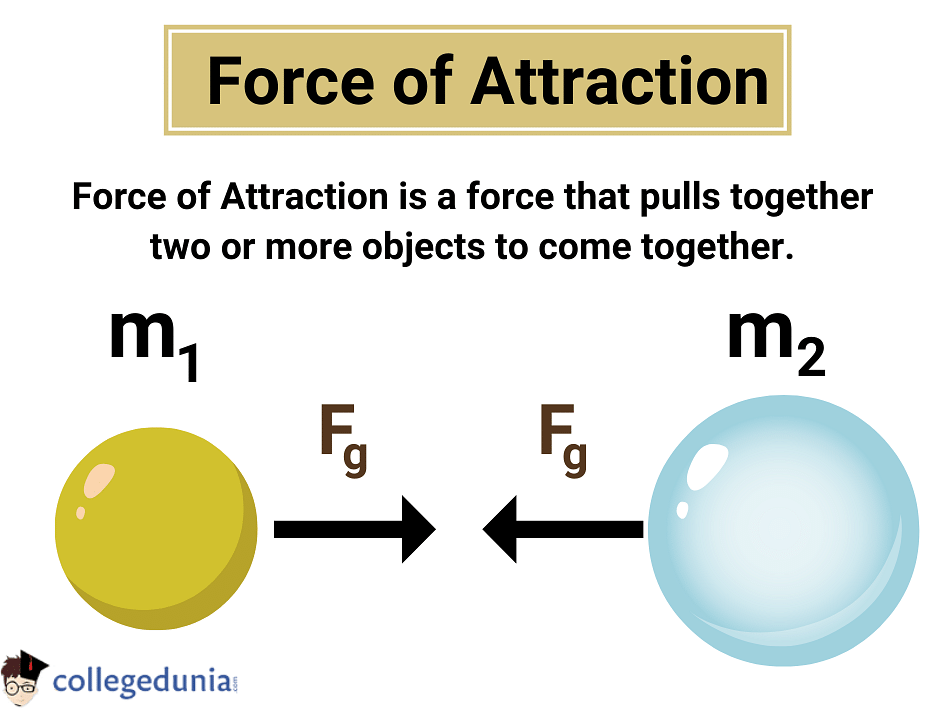
Force of Attraction is a force that pulls together two or more objects to come together. It is a force that attracts the bodies closer together even if they are not near or touching each other. There are majorly four types of Force of Attraction:
- Gravitational Force: It is the force of attraction exerted by different objects on one another due to their masses.
- Magnetic Force: It is related to the movement of charged objects through spaces generating electromagnetic fields.
- Electric Force: It is a repulsive or attractive interaction between any two charged bodies.
- Electrostatic Force: It influences the behavior of charged objects and particles.
Force of Attraction
Universal Law of Gravitation
[Click Here for Previous Years' Questions]
Sir Issac Newton, an English Physicist, proposed the Universal Law of Gravitation in the year 1680. According to Newton’s Universal Law of Gravitation,
| "Force of attraction between any two particles in the universe is directly proportional to the product of their masses and inversely proportional to the square of their distance." |
Therefore, it can be stated that,
- Gravity is inversely proportional to the square of the distance between the center of mass of the given objects.
- Gravity is directly proportional to the product of the masses of the given objects.
Read More:
Force of Attraction Formula
[Click Here for Sample Questions]
Force of Attraction between any two objects is directly proportional to their masses and inversely proportional to the distance between them.
- Force of Attraction is denoted by the symbol Fg.
- Its is measured in the units of Newton (N).
- The dimensional formula of Force of Attraction is given as [M1L1T-2].
Force of Attraction is equal to the product of the gravitational constant and the ratio of the product of the masses of the bodies to the square of the distance between them. Thus, the Force of Attraction Formula is given as:
| \(F_g = \frac{Gm_1m_2}{r^2}\) |
Where
- Fg: Force of Attraction acting between m1 and m2.
- G: Gravitational Constant (6.67 × 10 -11 Nm2/kg2)
- m1: Mass of First Object.
- m2: Masses of Second Object.
- r: Distance between Two Objects.
Gravity Detailed Video Explanation
Force of Attraction Formula Derivation
[Click Here for Sample Questions]
Consider two objects of masses m1 and m2 such that they are separated by a distance r. It is known that the force of attraction between two bodies is directly proportional to the product of the masses of the bodies. Thus,
F ∝ m1m2 …. (1)
Similarly, force is indirectly proportional to the square of the distance between the two bodies, thus,
F ∝ 1/r2 ⇢ (2)
From (1) and (2), we get
F ∝ m1m2/r2
Replace the proportionality sign with a constant to get
| Fg = Gm1m2/r2 |
Here, G refers to the gravitational constant. Thus, the force of attraction formula has been derived.
Force of Attraction Formula
Force of Attraction Formula Solved Examples
[Click Here for Previous Years' Questions]
Here are a few solved examples on Force of Attraction Formula for better understanding:
Example 1: Calculate the force of attraction if the mass of two bodies is 80 kg and 100 kg respectively and they are separated by a distance of 6 m.
Ans. Given that,
- m1 = 80 kg
- m2 = 100 kg
- r = 6 m
- G = 6.67259 x 10⁻¹¹ N m2/kg2
Using the Force of Attraction Formula, we get
F = [Gm1m2]/ r2
F = [6.673×10–11× 80 × 100] / 36
F = 148.28×10⁻¹¹ N
Thus, the force of attraction acting on the two bodies is 148.28 × 10⁻¹¹ N.
Example 2: What is the force of attraction between two masses of 30 kg and 50 kg separated by a distance of 4 m?
Solution: Given that,
- m1 = 30 kg
- m2 = 50 kg
- r = 4m
- G = 6.67259 x 10⁻¹¹ N m2/kg2
Using the Force of Attraction Formula, we get
F = [Gm1m2]/ r2
Fg = [6.673 ×10–11 × 30 × 50] / 16
F = 62.55 x 10⁻¹¹N
Thus, the force of attraction is 62.55 x 10⁻¹¹N.
Read More: Gravitation Important Questions
What is Gravitational Force?
[Click Here for Sample Questions]
Gravitational Force is defined as the force of attraction between any two objects in the universe. It affects two bodies and is always attractive in nature
- It is the most fundamental natural force present on earth.
- It pulls objects towards the center of the Earth.
- Gravitational force is also responsible for controlling the motion of the planets and the Moon.
- It is classified as a force of attraction as it constantly attracts masses to one another while never separating them.
- It is the product of the masses of the object and the gravitational constant divided by the square of the distance between the two objects.

Gravitational Force
Check More:
Things to Remember
- Force of Attraction is a natural force present in the universe that draws one mass towards another.
- Gravitational Force, Electric Force, Electrostatic Force, and Magnetic Force are the four main forces of attraction.
- Force of Attraction is denoted by the symbol Fg and is measured in Newton (N).
- The dimensional formula of Force of Attraction is [M1L1T-2].
- Force of Attraction Formula is given as \(F_g = \frac{Gm_1m_2}{r^2}\).
- Gravitational Force is defined as the fundamental force of attraction between two masses in the universe.
For Latest Updates on Upcoming Board Exams, Click Here: https://t.me/class_10_12_board_updates
Previous Years’ Questions
- The value of acceleration due to gravity at a height of... (KCET – 2020)
- A body weighs 72 N on the surface of the earth. What is the gravitational force... (NEET – 2020)
- Planet A has mass M and radius R. Planet B has half the mass... (JEE Main – 2020)
- Consider two solid spheres of radii R1 = 1m, R2 = 2m and... (JEE Main – 2020)
- A mass falls from a height 'h' and its time of fall ′l′ is recorded... (NEET – 2019)
- The time period of a satellite of earth is 5 hours. If the separation... (BITSAT – 2019)
- A body weighs 200N on the surface of the earth How much will it... (NEET – 2019)
- If the angular momentum of a planet of mass m, moving… (JEE Main – 2019)
- Assuming that the gravitational potential energy of an object… (NEET 2019)
- A solid sphere of mass ′M′ and radius ′a′ is surrounded by... (JEE Main – 2019)
Sample Questions
Ques. What is Gravity? (3 Marks)
Ans. Gravity is defined as the force of attraction between the surface of the Earth and any object. It is one of the four major forces that govern the universe along with Electromagnetic Force, Strong, and Weak Nuclear Forces.
- It is a force that attracts any two bodies in the universe whether they have equal masses or not.
- Gravity is the product of the mass of an object and the acceleration due to gravity.
- It is one of the weakest forces due to the large separation distance.
Ques. Compute the force of attraction acting between two bodies of masses 20,000 kg and 50,000 kg parted by a distance of 50 m. (3 Marks)
Ans. Given that,
- m1 = 20,000 kg
- m2 = 50,000 kg
- r = 50 m
- G = 6.67 × 10⁻¹¹ Nm2/kg2
Using the Force of Attraction Formula,
Fg = [Gm1m2]/ r2
Fg = [6.673 ×10–11 × 20000 × 50000] / 502
F = 2.67 x 10⁻⁵ N
Thus, the force of attraction acting between the two bodies is 2.67 x 10⁻⁵ N.
Ques. The mass of the planet Mars is 6 x 10²³ kg and its radius is 4.3 x 10⁶ m. Calculate the weight of a man on Mars whose weight on earth is 600 N. (g on Earth = 10 m/s2) (3 Marks)
Ans. Given that,
- Mass of Mars = 6 x 10²³ kg
- Radius of Mars = 4.3 x 10⁶ m
Weight of Man on Earth, W = mg
600 = m × 10
m = 60 kg (Mass of Man)
Acceleration due to gravity on Mars will be calculated as:
g = GM/r2
Substituting the values of M and r, we get
g = 6.67 × 10-11× 6 × 1023/4.3 × 106
g = 2.17 m/s2
Thus, the weight of the man on Mars will be
w = m × g
w = 60 × 2.17 = 130.2 N
Ques. What is the gravitational force between two bodies of masses 100 kg and 150 kg separated by a distance of 80 m? (3 Marks)
Ans. Given that,
- m1 = 100
- m2 = 150
- r = 80
Using the Gravitational Force Formula,
F = Gm1m2/r2
= (6.67 ×10−11 × 100 × 150)/(80)2
= 1.5643 × 10⁻¹⁰ N
Thus, the gravitational force between two bodies of masses 100 kg and 150 kg separated by a distance of 80 m is 1.5643 × 10⁻¹⁰ N.
Ques. What is the force of attraction acting on an object of mass 2000 kg at the Earth’s surface? (3 Marks)
Ans. Given that,
- m1 = Mass of Earth= 5.98 x 1024 kg
- m2 = Mass of Object = 2000 kg
- r = 6.38 x10⁶ m
Using the Force of Attraction Formula,
Fg = [Gm1m2]/ r2
F = (6.67259 x 10–11 x 5.98 x 1024 x 2000) / (6.38 x10⁶)2
F = 1.959 x 10⁴ N
Thus, the force of attraction is 1.959 x 10⁴ N.
Ques. What will be the gravitational force of attraction between a man of mass of 50 kg and a bus of mass of 1500 kg, if the distance between them is given as 10 m? (3 Marks)
Ans. Given that
- Mass of First Man, m1 = 50 kg
- Mass of Second Man, m2 = 1500 kg
- Distance between Them, r = 10 m
- Gravitational Constant, G = 6.67259 x 10⁻¹¹ N m2/kg2
Using the Force of Attraction Formula,
\(F_g = \frac{Gm_1m_2}{r^2}\)
Substituting the given values in the Force of Attraction Formula, we get
Fg = [6.673 ×10–11 × 50 × 1500] / 102
Fg = 5.0025 x 10⁻⁸ N
Thus, the Force of Attraction Formula between both men is 5.0025 x 10⁻⁸ N.
Ques. The mass of the Earth is 6 × 1024 kg and the mean radius of the earth is 6.4 × 10⁶ m. Calculate the value of acceleration due to gravity (g) on the surface of the earth. (3 Marks)
Ans. Given that,
- G = 6.67 × 10⁻¹¹ Nm2/kg2
- M = 6 × 1024 kg
- r = 6.4 × 10⁶
Using the acceleration due to gravity formula,
g = GM/r2
g = (6.67 × 10-11 ×6 × 1024) / (6.4 × 10⁶)2
g = 9.8 m/s2
Ques. Where is the Acceleration due to Gravity the highest and the lowest? (2 Marks)
Ans. Acceleration due to Gravity is the highest at the poles and lowest at the center of the Earth. This is because the acceleration due to gravity depends upon the radius of the Earth and the radius of the Earth is the highest at the poles due to its ellipsoid shape and lowest at the center of the Earth since acceleration due to gravity depends upon the distance between the object to its center and at the center, the distance is 0.
Ques. What is the gravitational force between two bodies of masses 200 kg and 170 kg if they are separated by a distance of 1000 m? (3 Marks)
Ans. Given that,
- m1 = 200
- m2 = 170
- r = 1000
Using the Gravitational Force Formula,
F = Gm1m2/r2
= (6.67 ×10−11 × 200 × 170)/(1000)2
= 2.26 × 10⁻¹² N
Thus, the gravitational force between two bodies is 2.26 × 10⁻¹² N.
Ques. The mass of the Earth is 6 × 1024 kg and the distance between the Earth and the Sun is 1.5 × 10¹¹ m. Find the mass of the sun if the gravitational force between the two is 3.5 × 10²² N. (3 Marks)
Ans. Given that,
- Mass of Earth, me = 6 × 1024 kg
- Distance between Earth and Sun, r = 1.5 × 10¹¹ m
- Gravitational Force Between Earth and Sun, F = 3.5 × 10²² N
- Gravitational Constant, G = 6.67259 x 10⁻¹¹ N m2/kg2
- Mass of Sun, ms =?
Substituting the given values in the Gravitational Formula,
\(F_g = \frac{Gm_1m_2}{r^2}\)
3.5 ×1022 = [6.673 ×10–11 × 6 × 1024 × ms] / (1.5 × 10¹¹)2
ms = 1.967 × 1030 kg
Therefore, the mass of the sun is 1.967 × 1030 kg.
Check-Out:



Comments