



Education Journalist | Study Abroad Lead
Heat is energy transferred from one body to another due to a temperature difference. When two bodies of different temperatures come in contact with each other, heat flows from the hotter to the colder. Heat Gain occurs when radiant heat from the sun shines through the glass and warms the space. Cool air escapes through seals, causing heat gain. Watts are used to measure the rate at which heat energy is used, also known as power loss. Solar energy is absorbed in the outer surface, represented by the air temperature, which affects heat gain through walls and roofs. Because it exists with the actual air temperature, the outdoor temperature would generate the same heat gain through the element without solar energy.
| Table of Content |
Key Terms: Heat Gain, Heat Capacity, Heat Energy, Temperature, Sunlight, Air, Specific Heat Capacity, Space
What is Heat Gain?
[Click Here for Sample Questions]
Heat Gain can be defined as the increase in temperature in a space caused by incoming sunlight (sunlight), heat from the outer surface (long-wave infrared radiation), and heat from other channels within the space (such as individuals, mechanical systems, lights, heaters, hobs, and computers), among various other things.
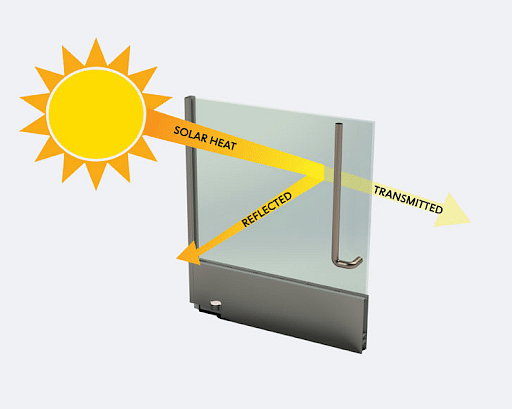
Heat Gain
Check-Out:
| Related Links | ||
|---|---|---|
| Heat Load Formula | Sensible Heat Formula | Calorimeters |
Heat Gain Formula
[Click Here for Previous Year's Questions]
The formula for heat gain is given as follows:
q = 1.10 x cfm x (t0 – ti)
Where,
- q = sensible heat gain from the outside air (measured in BTU/h)
- cfm = flow rate of the outside air entering the building
- to = the temperature outside (oF)
- ti = the temperature inside (oF)

Heat Gain and Heat Loss
Read More:
Things to Remember
- Heat gain in space is caused by incoming sunlight (sunlight), heat from the outer surface (long-wave infrared radiation), and heat from other channels within the area (such as heaters, hobs, individuals, mechanical systems, lights, and computers, among other things).
- Solar energy is absorbed in the outer surface, represented by the air temperature, which affects heat gain through walls and roofs.
- Because it exists with the actual air temperature, the outdoor temperature would generate the same heat gain through the element without solar energy.
- Watts are a unit of measurement for the rate at which heat energy is consumed, also known as power loss.
- Calorimeters are devices that measure heat or thermal energy transfer from one object to another. In a nutshell, a calorimeter is an instrument that can measure calorimetry.
PYQS
- A certain amount of heat energy is supplied to a monoatomic ideal gas… [KCET 2020]
- A deep rectangular pond of surface are A, containing water… [NEET 2019]
- A carnot engine takes 300 calories of heat at 500 K and rejects 150 calories… [UPSEE 2019]
- If the radius of a star is R and it acts as a black body, what would be… [BITSAT 2013]
- A black body has maximum wavelength 1 m at 2000 K… [NEET 1989]
- If λm denotes the wavelength at which the radiative emission… [KEAM 2004]
- A black body at 227∘ C radiates heat at the rate of… [NEET 2001]
- Two spherical black bodies have radii r1 and r2… [MHT CET 2017]
- The SI unit and dimensions of Stefan’s constant… [MHT CET 2019]
- The two ends of a rod of length L and a uniform cross-sectional area… [NEET 2009]
Sample Questions
Ques. Calculate the heat gain rate for the flow rate of 9000 cfm, t0 = 77°F and ti = 70°F. (3 Marks)
Ans. It is given that,
cfm = 9000, t0 = 77oF, ti = 70oF
We know that,
q = 1.10 × cfm × (t0 – ti)
q = 1.10 × 9000 × (77 – 70)
q = 69300 KW
Thus, the heat gain is 69300 KW.
Ques. Calculate the heat gain at an 8,000 cfm ventilation flow rate if the outside air temperature is 85 degrees Fahrenheit and the inside air temperature is 77 degrees Fahrenheit. (3 Marks)
Ans. Given that,
cfm = 8000
t0 = 85
ti = 77
Substitute in the given formula, we get
q = 1.10 × cfm × (t0 – ti)
q = 1.10 × 8000 × (85-77)
q = 70400
Therefore, the heat gain is 70400 KW.
Ques. Calculate the heat gain rate for a 6000 cfm flow rate with t0 = 73°F and ti = 63°F. (3 Marks)
Ans. Given that,
cfm = 6000
t0 = 73 oF
ti = 63 oF
Since, q = 1.10 × cfm × (t0 – ti)
q = 1.10 × 6000 × (73 – 63)
q = 66000 KW
Thus, the heat gain is 66000 KW.
Ques. Calculate the heat gain rate for the flow rate of 2000 cfm, t0 = 45°F and ti = 40°F. (3 Marks)
Ans. Given that,
cfm = 2000
t0 = 45 oF
ti = 40 oF
Since, q = 1.10 × cfm × (t0 – ti)
q = 1.10 × 2000 × (45 – 40)
q = 11000 KW
Thus, the heat gain is 11000 KW.
Ques. Calculate the heat gain rate for the flow rate of 2330 cfm, t0 = 45°F and ti = 40°F. (3 Marks)
Ans. Given that,
cfm = 2330, t0 = 45F, ti = 40F
We know that, q = 1.10 × cfm × (t0 – ti)
q = 1.10 × 2330 × (45 – 40)
q = 12815 KW
Thus, the heat gain is 12815 KW.
Ques. Give a reason: 'On a chilly day, a brass tumbler feels much cooler than a wooden tray.' (3 Marks)
Ans. Brass has a thermal conductivity of 109 W/mK. Wood has a thermal conductivity of 0.1 W/mK.
Brass has 1000 times the thermal conductivity of wood. Hence, in comparison to a wood tray, heat loss from a brass tumbler to the environment is 1000 times greater. The brass tumbler feels much cooler on a hot day than the wooden tray.
Ques. What factors influence the amount of heat that passes through a body? (3 Marks)
Ans. The amount of heat gained by a body is determined by the following factors:
- Mass of the body
- Nature of substance
- The rise in temperature of the body
Ques. How does a substance's temperature remain unaffected during its transition from one state to another? (2 Marks)
Ans. The heat that is applied to matter is used to change its state. This is referred to as latent heat. As a result, a substance's temperature is unaffected during its transition.
Ques. What is the capacity for heat? (2 Marks)
Ans. The amount of heat required to raise the temperature of a given amount of matter by 1°C is known as heat capacity. A substance's specific heat capacity (or specific heat) is 1 gram, whereas the molar heat capacity is 1 mole.
Ques. Explain heat capacity and specific heat capacity. (3 Marks)
Ans. Heat Capacity and Specific Heat Capacity are explained as follows:
- Heat Capacity: Heat capacity is a property of the material defined as the amount of heat required to cause a unit change in temperature in an object. Thermal capacity is another name for heat capacity.
- Specific Heat Capacity: A substance's specific heat capacity (c) is equal to the heat capacity of a substance's model divided by the model's mass. Specific heat is sometimes referred to as massic heat capacity.
Also Read:



Comments