



Content Curator
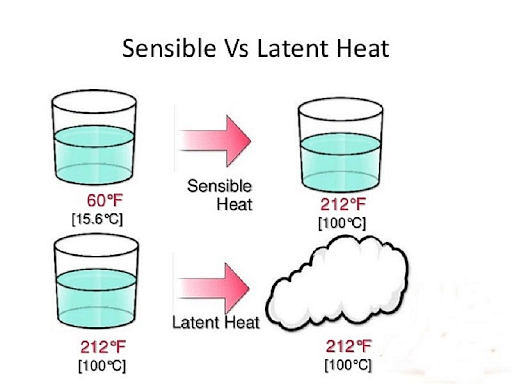
Sensible heat refers to heat that can be felt. Rather than changing phase, energy traveling from one system to another changes the temperature. For example sensible heat warms water rather than melting ice. In other words, Sensible heat refers to the change in temperature of the gas or material, but not to the phase shift.
- Sensible heat is used to contrast with the latent heat. The latent heat is related to the phase shift of solids, liquids, and gases.
- Latent heat is the heat required to shift phase from one form of matter to another without changing temperature.
- In a cooling system, condensation happens when latent heat is removed, and the refrigerant (cooling liquid) changes temperature due to sensible heat.
- The sensible heat capacity is used to explain the ability to lower the temperature, whereas the latent heat capacity is used to describe the ability to remove moisture from the air.
| Table of Content |
Key Terms: Latent heat, Sensible heat, Specific heat capacity, Temperature, Heat Energy, Phase shift, Energy, Heat, Thermometer
Also read: Wheatstone Bridge
What is Sensible Heat?
[Click Here for Sample Questions]
Sensible heat is referred to as a form of energy that is emitted into the atmosphere or absorbed. These are the heat energy that the human senses can detect. A thermometer can measure this type of heat because its increase or decrease causes a variable temperature change.
- Sensible heat can also be defined as the amount of energy required to cause a change in a substance's temperature.
- The only change in the temperature of gas or material is the concern of sensible heat but not the phase shift.
- The phase shift between the solid, liquid, and gas is relevant to the latent heat.
- In order to calculate the flow of air in the electric furnace the sensible heat formula is used.
Also read: Difference Between Equinox and Solstice
Sensible Heat Formula
[Click Here for Sample Questions]
In a thermodynamic process, sensible heat can be calculated as
\(Q_{sensible}=mc\Delta T\)
Where,
- m = mass of the body
- c = specific heat capacity of the body
- ΔT = change in temperature
Another formula to calculate sensible heat is given by
\(Q_{sensible}=1.10\times C_{fm}\times (t_o-t_i)\)
Where,
- Qsensible is the external heat gain in Btu/h
- 1.10 is the product of the air’s heat capacity (0.018 Btu/oF)
- Cfm is airflow rate moving in from outside
- to is outside temperature
- ti is inside temperature

Sensible Heat Examples
[Click Here for Sample Questions]
Some examples of sensible heat are:
- When it comes to boiling water, the water starts out at room temperature.
The water temperature begins to rise as the stove continues to deliver heat to the water pot. The shift in temperature of the water (from room temperature to boiling point) is caused by sensible heat.
- The warmth you get from the sun on a hot day or from a bonfire is an example of sensible heat. It is caused by a change in an object's or gas's temperature, rather than a change in phase, as is the case with latent heat. Although these two types of heat are very different, they are both responsible for the correct cooling and heating of your home.
Also read: Combination of Cells in Series and Parallel
Difference between Sensible Heat and Latent Heat
[Click Here for Sample Questions]
Definition
Latent Heat: The amount of energy absorbed or released during a phase transition at a constant temperature is referred to as latent heat.
Sensible Heat: The energy necessary to adjust the temperature of a substance without causing phase change is known as sensible heat.
Phase Transition
Latent Heat: For a system having a phase transition, latent heat is defined.
Sensible Heat: For a system with no phase transition, sensible heat is defined.
Energy Exchange
Latent Heat: Changes in the internal energy of matter.
Sensible Heat: The energy exchange between matter and its surroundings is referred to as sensible heat.
Change in macroscopic properties
Latent Heat: When a system is kept at a constant temperature, it is said to have latent heat.
Sensible Heat: Sensible heat refers to a system that experiences temperature fluctuations.
The terms "latent heat" and "sensible heat" refer to two different types of energy. The term "latent heat" refers to changes in a system's internal energy, whereas "sensible energy" refers to the energy exchange between a system and its surroundings. The major distinction between latent and sensible heat is that latent heat is defined for a system in which the phase of matter changes, whereas sensible heat is defined for a system in which the phase of matter does not change.
Also read: Combination of Resistors
Solved Examples
Ques. Calculate the sensible heat gain of the ventilation flow rate of 10,000 Cfm when the temperature (to) of the outside air is given as 88oF and the inside air temperature (ti) is given as 78oF.
Ans. We have
- Cfm = 10000
- to = 88oF
- ti = 78oF
Using the formula of sensible heat,
\(Q_{sensible}=1.10\times C_{fm}\times (t_o-t_i)\)
\(\Rightarrow Q_{sensible}=1.10\times 10000 \times (88-78)\)
\(\Rightarrow Q_{sensible}=110,000\,\, Btu/h\)
Ques. Calculate the sensible heat gain of the ventilation flow rate of 20,000 Cfm when the temperature (to) of the outside air is given as 88oF and the inside air temperature (ti) is given as 68oF.
Ans. We have
- Cfm = 20000
- to = 88oF
- ti = 68oF
Using the formula of sensible heat,
\(Q_{sensible}=1.10\times C_{fm}\times (t_o-t_i)\)
\(\Rightarrow Q_{sensible}=1.10\times 20000 \times (88-68)\)
\(\Rightarrow Q_{sensible}=440,000\,\, Btu/h\)
Also Read:
| Related Articles | ||
|---|---|---|
| Thermal Properties of Matter | P-n Junction | Heat Transfer |
| Thermal Expansion | Potential Energy | Thermal Stress |
| Coefficient of Linear Expansion | Thermal Conductivity | Current Electricity |
Things to Remember
- The term "sensible heat" refers to heat that can be felt. Rather than changing its phase, energy traveling from one system to another changes the temperature.
- The term "latent heat" refers to changes in a system's internal energy, whereas "sensible energy" refers to the energy exchange between a system and its surroundings.
- The warmth you get from the sun on a hot day or from a bonfire is an example of sensible heat. It is caused by a change in an object's or gas's temperature, rather than a change in phase, as is the case with latent heat.
- The water temperature begins to rise as the stove continues to deliver heat to the water pot. The shift in temperature of the water (from room temperature to boiling point) is caused by sensible heat.
Sample Questions
Ques. What is the latent heat of a fusion? (3 marks)
Ans. Substance from the solid to the liquid phase while maintaining the system's temperature. It's also the same as the difference in enthalpy between the solid and liquid phases, HSL. As a result, the latent heat of fusion is determined by the solid phase's crystal structure, which must be properly specified. Modern differential scanning calorimeters make direct measurements of the latent heat of fusion with moderate precision over a moderate range of temperature and pressure settings. The Clausius-Clapeyron Equation is a theoretical equation.

The subscript m stands for "along the melting line." This presupposes that data on the fluctuation of melting temperature with pressure is available; however, this is rarely the case, hence it is not a viable method of evaluating ΔHSL. For a variety of materials, compilations of DHSL experimental findings are available, but there is no good way to estimate them.
Ques. Why is specific heat capacity important? (3 marks)
Ans. The specific heat capacity (symbol cp) of a substance is the heat capacity of a sample divided by the mass of the sample in thermodynamics. Massic heat capacity is another name for specific heat capacity. It is the amount of heat that must be added to one unit of mass of a substance in order to produce a one-unit temperature increase. The joule per kelvin per kilogram, or J.Kg-1K-1, is the SI unit for specific heat capacity.
The amount of heat per unit mass required to raise the temperature by 1°C is known as heat capacity or specific heat. Specific heat can be used to determine processing temperatures and the quantity of heat required for processing, as well as to distinguish between two polymeric composites.
Ques. Calculate the sensible heat gain of the ventilation flow rate of 8000 Cfm when the temperature (to) of the outside air is given as 78oF and the inside air temperature (ti) is given as 68oF.(3 marks)
Ans. We have
- Cfm = 8000
- to = 78oF
- ti = 68oF
Using the formula of sensible heat,
\(Q_{sensible}=1.10\times C_{fm}\times (t_o-t_i)\)
\(\Rightarrow Q_{sensible}=1.10\times 8000 \times (78-68)\)
\(\Rightarrow Q_{sensible}=88000\,\, Btu/h\)
Ques. Why specific heat of water is high? (2 marks)
Ans. Because it contains hydrogen bonding between molecules, water has a high specific heat capacity. Hydrogen bonds are disrupted when heat is absorbed, allowing water molecules to move at random. When the temperature of water drops, hydrogen bonds form, and a finite amount of energy is released.
Ques. What is the specific heat to enthalpy? (2 marks)
Ans. The sum of a substance's internal energy and the product of its pressure and volume is known as enthalpy. The change in specific internal energy with regard to temperature while the volume is held constant is known as specific heat at constant volume (Isochoric process).
Ques. How specific heat differs from heat capacity? (2 marks)
Ans. The quantity of heat energy required by a unit of mass of a substance to raise its temperature by 1°C or 1 k is known as specific heat. Heat capacity, on the other hand, is the quantity of heat energy required by a substance to raise its temperature by one degree Celsius or one degree Kelvin.
Ques. Can specific heat be used to identify substances? (2 marks)
Ans. A substance's specific heat capacity can be used to identify it. The specific heat capacity of a substance is a physical property of the material it is made of, and it can be used to identify it in the same way that density can identify an incompressible substance like a solid or liquid.
Ques. Specific heat is scalar or vector? (1 mark)
Ans. A scalar quantity is a specific heat or specific heat capacity. A vector quantity has both magnitude and direction, whereas a scalar quantity just has magnitude. Specific heat is a scalar quantity because it has no direction.
For Latest Updates on Upcoming Board Exams, Click Here: https://t.me/class_10_12_board_updates
Check-Out:



Comments