



Education Journalist | Study Abroad Lead
Heat Conduction can be defined as the heat transfer from one solid/body to another that has a different temperature on coming into contact with each other. For instance, when we touch a hot kettle or when we rub our hands to warm up our hands. Fourier’s law of heat conduction and the principle of conservation of energy is used to derive various forms of the differential equation that govern the temperature distribution in a stationary medium.
| Table of Content |
Key Terms: Heat Conduction, Heat Energy, Heat Capacity, Specific Heat Capacity, Molar Heat Capacity, Fourier’s Law
Heat Conduction
[Click Here for Sample Questions]
Heat Conduction is the transmission of heat without observable particle movement from one area of a body to another or from one body to another that is in physical touch with it. The flow of heat is hindered due to the equilibrium of heat energy between two objects.
Some examples of heat conduction as we see it in our day-to-day life are as follows-
- A bar of chocolate melts in your hand due to the transfer of heat from your hand to the bar of chocolate.
- When placed directly against your back, a heating pad will transfer heat to that area.
- When a small kid returns from playing in the snow and huddles up to his mother, who has been waiting for him in a warm room, the mother will transfer heat to the youngster.
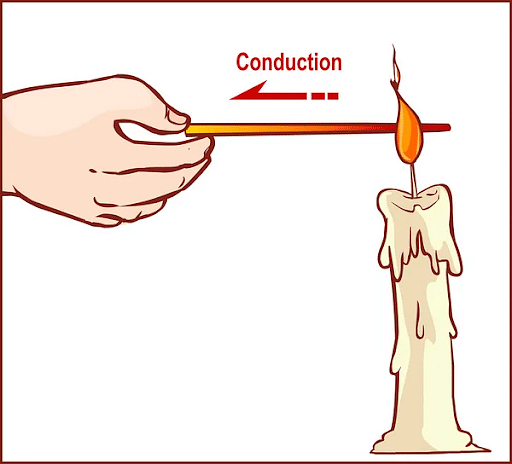
Heat Conduction
Also check:
Fourier’s Law
[Click Here for Sample Questions]
The fundamental principle that governs heat conduction is known as Fourier's law. Not surprisingly, Fourier’s law is also called heat conduction law. Fourier's law states:
“The rate of heat transfer through a material is proportional to the negative gradient in the temperature and the area (perpendicular to the gradient) of the surface through which the heat flows.”
In simpler terms, The law states the rate of heat transfer through a material is considered to be proportional to the negative temperature gradient present, as well as to the region through which the heat flows at right angles to the gradient. Integral form and differential form are the two equivalent representations of this rule. This law is regarded to be in an observation-based empirical equation.
Read More: Heat Transfer and Thermal Radiation
Mathematical Representation of Fourier’s Law
Fourier’s law of heat conduction is expressed as
Q ∝ A × (dt / dx)
Where,
- Q is the rate of heat transfer through a body per unit of time (in watts W)
- A is the heat flow surface area (m2)
- dt is the temperature difference in oC or K
- dx is the thickness of the body in the direction of flow
Hence we can express the Heat Conduction formula as
Q = – k × A (dt / dx)
Where
k is the Constant of proportionality and equals the thermal conduction of the body.
Diagrammatic Illustration of Fourier’s Law
Here is a diagrammatic illustration of Fourier’s Law:

Diagrammatic illustration of Fourier’s Law
Example: What will be the rate of heat transfer per square meter of the surface of a cork board having 5 cm thickness, and a temperature difference of 75oC is applied across the board? The value of thermal conductivity (k) is given as -0.4 W/mc.
Solution: Given that,
k = – 0.4
A = 5 cm
(dt / dx) = 75oC
Substituting the values in the heat conduction formula
Q = – k . A (dt / dx)
= – (- 0.4) (5) (75)
Q = 150 W
Read More: Thermal Energy Formula
Important Terminologies Related to Heat
[Click Here for Sample Questions]
- Heat Capacity: Heat capacity is defined as the ratio of the quantity of heat absorbed or rejected by it to the change in temperature.
- Specific Heat Capacity: Specific heat capacity for any substance or matter can be defined as the amount of heat energy required to raise the temperature of a unit mass of that substance by 1°C.
- Molar Heat Capacity: Molar heat capacity is the amount of heat energy needed to raise the temperature of one mole of a substance. The SI unit of molar heat capacity is J/(K⋅mol).
Read More: Thermal Conductivity
Things to Remember
- Heat Conduction is defined as the transfer of heat from one body to another at different temperatures when they come into contact with each other.
- The movement of electrons and the collisions of tiny particles within a body are what cause heat conduction, which is the transmission of internal thermal energy.
- Fourier's Law is the fundamental principle that governs heat conduction.
- Heat Conduction/ Fourier’s formula is Q ∝ A × (dt / dx)
- Heat capacity is the ratio of the quantity of heat absorbed or rejected by it to the change in temperature.
- Specific heat capacity for any substance or matter can be defined as the amount of heat energy required to raise the temperature of a unit mass of that substance by 1°C.
Sample Questions
Ques. Define specific heat capacity and what does it depend on and why? (3 Marks)
Ans. The specific heat capacity is defined as the quantity of heat (J) absorbed per unit mass (kg) of the material when its temperature increases by 1 K (or 1 °C), and its units are J/(kg K) or J/(kg°C). Specific heat capacity depends on the material of the substance because to get 1 °C per unit mass, the heat energy will vary from material to material.
Ques. 400g of vegetable oil with a specific heat capacity of 1.98 J/g °C is cooled from 100 °C. Calculate what will be the final temperature, if the heat energy given out by oil is 47376 J. (3 Marks)
Ans. From the given,
mass of the vegetable oil (m) = 400g
heat energy is given out by the oil (Q) = 47376 J
specific heat capacity of the vegetable oil (c) = 1.98 J/g °C
the initial temperature of the oil (T1)= 100 °C
Using the formula of specific heat capacity-
Q = mcΔT
Where Q stands for heat energy, m is the mass of the substance, c is the specific heat capacity and ΔT is the change in temperature.
By substituting the values, we get-
47376 = = 400 × 1.98 ×(100 − T2)
=> 100-T2 = 47376/792
=> T2= 100 - 47376/792
=> T2= 40.2 °C
Final temperature is = 40.2 °C.
Ques. What is Fourier’s law and how will it be mathematically represented? Name another name for Fourier’s law. (3 Marks)
Ans. Fourier’s law states that “the rate of heat transfer through a material is proportional to the negative gradient in the temperature and the area (perpendicular to the gradient) of the surface through which the heat flows.”
It is mathematically represented as:
Q ∝ A × (dt / dx)
Where
- Q is the rate of heat transfer through a body per unit of time (in watts W)
- A is the heat flow surface area (m2)
- dt is the temperature difference in °C or K
- dx is the thickness of the body in the direction of flow
Ques. Answer the following questions.
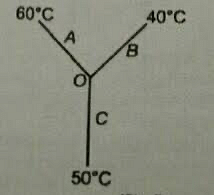
(a) Three identical heat conductors are fixed at O in the given figure below. Which is the conductor through which no flow of heat is taking place.
(b) Two hollow spheres of the same material, one with double the radius of the other and double the thickness of the other filled with ice, what is the ratio of times ice gets melted in the two spheres?
(c) One end of a conducting rod is maintained at a temperature of 50°C and at the other end, ice is melting at 0°C. Why will the rate of melting be doubled? (3 Marks)
Ans. (a) By calculating the thermal resistance of a cylindrical conductor where heat flows radially, A is the conductor through which no flow of heat is taking place.
(b) 2:1 is the ratio of times ice gets melted in two spheres.
(c) The rate of melting ice will be doubled if the temperature is raised to 200C and the area of the cross-section of the rod is doubled.
Ques. What is molar heat capacity, how is it mathematically represented and state its SI unit? (3 Marks)
Ans. Molar heat capacity is the amount of heat energy needed to raise the temperature of one mole of a substance. The SI unit of molar heat capacity is J/(K.mol).
Mathematically, it is represented as cm = C/n
Where cm is the molar heat capacity, n is the number of moles and C stands for heat capacity.
Ques. Fourier’s law is named after which scientist? According to the law, what is the rate of heat transfer dependent on and what does the negative sign in the heat conduction formula indicate? (3 Marks)
Ans. Joseph Fourier is the scientist after whom Fourier’s Law is named after. According to the law, the rate of heat transfer is dependent on temperature gradient and area of cross-section. The negative sign in the heat conduction formula indicates that heat is flowing in the negative direction of the temperature gradient.
Ques. What is the effect of temperature on the thermal conductivity of a material and what is heat transfer by molecular collision called and how is heat transferred in solids? What is the possible factor responsible for a decrease in heat transfer? (3 Marks)
Ans. Temperature increases with the increase in the thermal conductivity of a material. The heat transferred by molecular collision is called convection. Heat is transferred in solids via conduction. Material of the substance or if the substance’s thickness is increased then it may cause a decrease in the rate of heat transfer.
Ques. In thermal conductivity, heat is transferred from a hotter object to what kind of object? List a metal which is a good conductor of heat. In case of heat conduction through a plane wall, what assumptions do we make? (3 Marks)
Ans. In thermal conductivity, heat is transferred from a hotter object to a colder object. Gold, a metal, is a good conductor of heat. In the case of heat conduction through a plane wall, the assumptions we make for it are steady state, volumetric heat generation must be constant and K must be constant.
Ques. Name a bad conductor of heat and when we sit near a bonfire, we receive heat, name the process responsible for it and define it. (3 Marks)
Ans. Plastic is a bad conductor of heat because they have no free electrons available for conduction mechanisms like metals such as gold. When we sit near a bonfire, we get heat through radiation. Radiation is a process where heat waves are emitted that may be absorbed, reflected or transmitted through a colder body.
Also check:



Comments