



Education Journalist | Study Abroad Lead
Heat transfer refers to the exchange of heat from a high-temperature to a low-temperature body. Heat is the measure of the kinetic energy of the particles in a given system. The heat transfer formula can be expressed as Q = m × c × ΔT, where Q refers to the heat transferred, m is mass, c is the specific heat and ΔT is the temperature difference.
- Heat is a kinetic energy parameter, included by the particles in the given system.
- The kinetic energy of the particles will also increase if the temperature of a system increases.
- The energy of the particle from one system to another is transferred when the systems are brought into contact with one another.
- Heat transfer and its formula is essential for managing and optimizing energy exchanges in various systems.
Related Links
- Appearing for JEE Main, Download JEE Mains PYQ for all sabjects
- Appearing for NEET, Download NEET PYQ for all subjects
| Table of Content |
Key Terms: Heat, heat transfer, kinetic energy, heat transfer formula, conduction, convection, radiation.
Heat Transfer Formula
[Click Here for Sample Questions]
Formula for Heat Transfer: Let us consider two objects A and B which differ in their temperature. If we apply heat to A, that object will absorb heat from the environment and increase its internal energy against this, if we apply heat to B, then B will increase its internal energy by transferring a number of its thermal energy to its surroundings.
The Heat Transfer Formula is given by the equation:
Q = m × c × ΔT
Where;
- Q = heat supplied to the system;
- m = mass flow rate;
- c = specific heat capacity of the system (heat-transfer coefficient); and
- ΔT = is the temperature difference between the system.
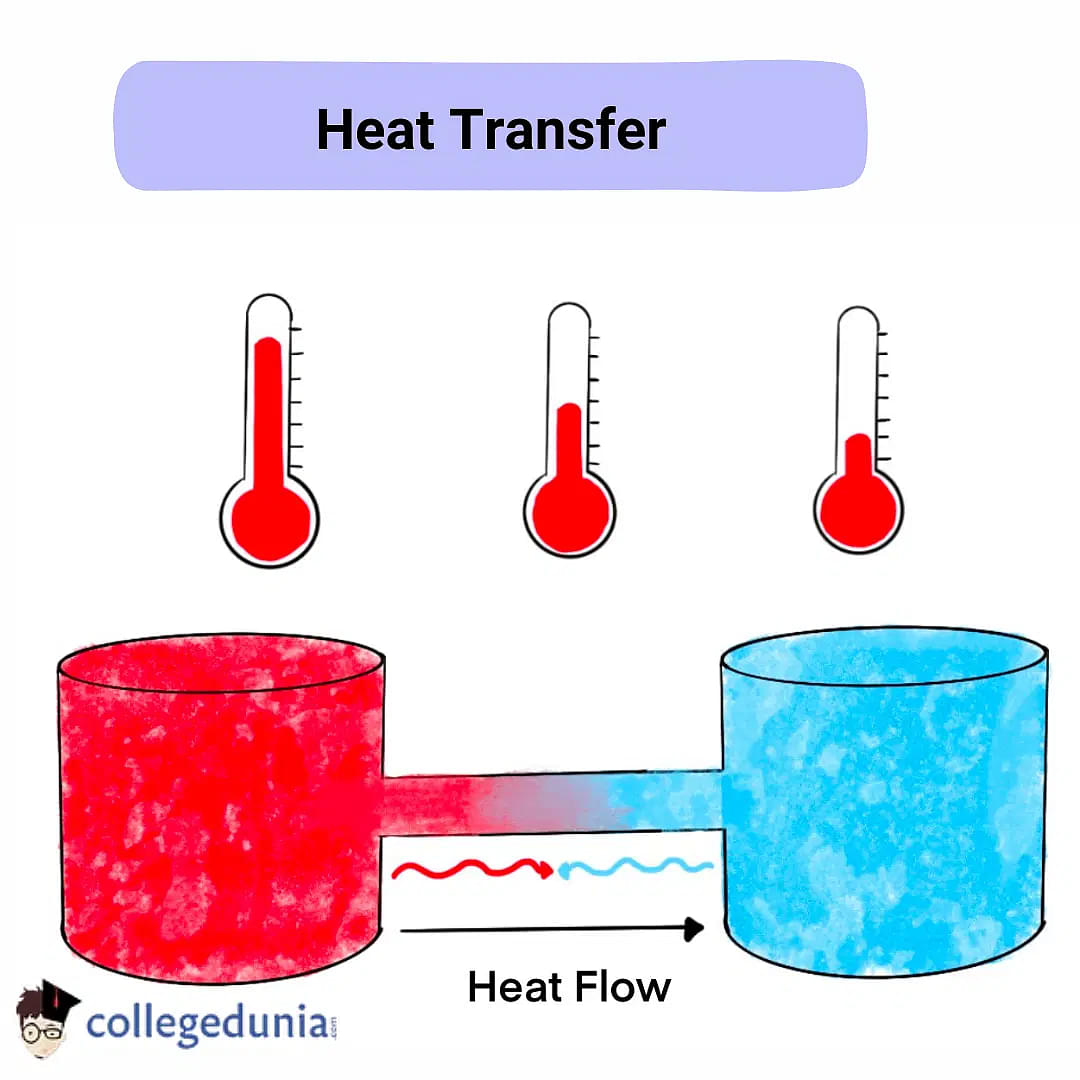
Heat Transfer
The practical application of this concept is apparent in our daily lives when we feel a hot object by placing our hand on it. The hot object receives some heat from our hand and cools down. On the other hand, the cooler object heats up by transferring some thermal energy to our hand and warms up.
The video below explains this:
Heat Transfer Formula Detailed Video Explanation:
Solved ExampleWhat is the amount of heat transfer between two water columns of different temperatures (40°C and 20°C) separated by a glass wall with an area of 1m by 2m and a thickness of 0.003m, given that the thermal conductivity of the glass is 1.4 W/mK? Solution: The amount of heat transfer can be calculated using the heat transfer formula: Q = kAΔT/d where Q is the amount of heat transfer, k is the thermal conductivity of the glass, A is the area of the glass wall, ΔT is the temperature difference between the two water columns, and d is the thickness of the glass wall. Plugging in the values given in the question, we get: Q = 1.4 * 1 * 2 * (40-20) / 0.003 Therefore, the amount of heat transfer between the two water columns is 186,666.67 Joules. |
Also read: Heat flux formula
What is Heat?
[Click Here for Sample Questions]
Heat is the number of joules per second (J/s) transferred by conduction, convection, or radiation from one point to another in a substance.
- The SI unit for heat is the joule (J).
- There are 3 types of heat transfer which include conduction, convection, and radiation.
Concept of Heat Transfer
[Click Here for Sample Questions]
Heat transfer is when heat moves from one object to another because they're not at identical temperatures and people's temperatures are different. In general, if object A is hotter than object B, then some heat is transferred from A to B until they reach equilibrium - until their temperatures are equal.
Methods of Heat Transfer
[Click Here for Sample Questions]
Transfer of heat also occurs with another three different processes. These are Conduction, Convection and Radiation.

Conduction
In this type of heat transfer, objects placed in contact with each other will exchange both kinetic and potential energy through the process called conduction.
- When a hot body is placed in contact with a cold body, after some time the temperature of the hot object becomes equal to that of a cold object.
- This is due to the conduction or transmission of heat from a hot to a cold object.
- If different metals are in direct contact with each other then they will not exchange any heat because metals are good conductors.
- They will transfer an equal amount of heat through their surfaces which have equal temperatures.
- Gas and liquids are also good thermal conductors, but they tend to have lower thermal conductivities than solids because they have free movement along their length (along their length they do not allow movement).
The heat transfer formula through conduction is given as:
Q = \({kA(T_{Hot} − T_{Cold}})_t \over d\)
Where;
- Q is the rate of heat transfer;
- k = the thermal conductivity of the material;
- A = the area of contact;
- T(Hot) = the temperature at one point on the hot object.
- T(Cold) = the temperature at one point on the cold object.
- t = time taken for conduction to occur.
- d = The thickness of the material
- A = Area of surface
The practical application of this concept is apparent when we feel hot by standing near a hot stove. The heat is transferred to our body by the conduction process.
Also Read:
| Related Articles | ||
|---|---|---|
| Thermal Conductivity | Unit of Conductivity | Difference between heat and temperature |
| Isothermal Process | Decomposition Reaction | Thermal Conductivity of Copper |
Convection
In this type of heat transfer, objects placed in contact with each other will exchange both kinetic and potential energy through the process called convection.
- Heat transfer by convection occurs from a hotter area to a colder area and it can be explained with the help of an experiment.
- In this experiment, a Bunsen burner is used as the hot object and a block of ice is used as the cold object.
- The hot air given off by the Bunsen burner will heat the ice block and will melt it.
- The ice water at room temperature can transfer its heat energy to our body, due to the convection process.
The formula for heat transfer through convection:
Q= HCA{T(Hot) − T(Cold)}
Where;
- Q = rate of heat transfer;
- HC = Heat Transfer Coefficient
- T(Hot) = Hot temperature
- T(Cold) = Cold Temperature
- A = Area of surface
Radiation
Thermal radiation is a process by which heat is transferred from one body to another through electromagnetic waves.
- It occurs when a hot body emits thermal radiation which can be absorbed by another object simultaneously and can make that object hot.
- Heat transfer by radiation occurs in all directions, unlike conduction or convection where heat will only flow in a direction of movement.
The heat transfer formula through radiation:
Q= σ {T4(Hot) – T4(Cold)} A
Where,
- Q = Heat transferred
- σ = Stefan Boltzmann Constant
- T(Hot)= Hot temperature
- T(Cold) = Cold Temperature
- A = Area of surface
Download the PDF: Methods of heat transfer
The heat transfer formula is an important concept in the field of thermodynamics and engineering. Heat transfer is the process of exchanging thermal energy between two or more physical systems. It plays a crucial role in various industrial applications such as power generation, refrigeration, and HVAC systems.
Applications of Heat Transfer
[Click Here for Sample Questions]
The concepts of heat transfer find applications in:
Home Heating and Cooling Systems
Heat transfer principles are integral to home HVAC (Heating, Ventilation, and Air Conditioning) systems. During winter, convection and radiation ensure efficient heating, while in summer, heat is transferred out of the house to keep it cool.
Automobile Radiators
Heat transfer is crucial in the cooling system of automobiles. Radiators use conduction and convection to dissipate heat generated by the engine, preventing overheating.
Cooking Processes
Heat transfer plays a vital role in cooking. Conduction is evident when a pot on a stove gets hot, while convection is observed when baking in an oven. Radiation from a grill or open flame is another aspect.
Thermal Comfort in Clothing
It helps in designing clothing for thermal comfort. Fabrics with good insulating properties (reduced heat transfer) are essential in cold climates, while breathable fabrics aid in cooling through convection and evaporation in warm weather.
Electronic Devices
Thermal management is also used in electronic gadgets. Heat sinks and fans utilize conduction and forced convection to dissipate heat from processors, preventing overheating.
Practical Applications
The practical applications of heat transfer formula is as follows –
- Newton's Law of Cooling:
- Formula: \(( Q = hA\Delta T )\)
- It is used for predicting cooling rates in various systems.
- This is used in industries to understand and control the cooling rates of materials or fluids.
- Stefan-Boltzmann Law:
- Formula: \(( Q = \sigma A (T_1^4 - T_2^4) )\)
- It is used for calculating heat transfer in radiative processes.
- Used in astronomy to study heat transfer in stars and other celestial bodies.
- Fourier's Law of Heat Conduction:
- Formula: \(( Q = -kA\frac{dT}{dx})\)
- This is used for understanding heat conduction in materials.
- Applied in material science to design efficient insulating materials or optimize heat conduction in electronic components. - Thermal Conductivity Formula:
- Formula: \(( Q = \frac{kA\Delta T}{d})\)
- It is used to calculate heat transfer through materials.
- Used in engineering for designing building materials, electronic components, and energy-efficient structures.
These practical applications and heat transfer formula demonstrate the diverse and critical roles that heat transfer concepts play in everyday life and various industries.
Things to Remember
- Heat will always flow from a hot object to a cold object.
- Energy is never created or destroyed, but only changes form.
- Heat transfer is the process of exchanging thermal energy between two or more physical systems due to temperature differences.
- There are three primary modes: conduction (through direct contact), convection (through fluid motion), and radiation (through electromagnetic waves).
- The general heat transfer formula is Q=m⋅c⋅ΔT, where Q – heat transferred, m – mass, c – specific heat, and ΔT – temperature difference.
- The rate of heat transfer by conduction is proportional to the difference in temperature and the area of contact between the two objects.
- The rate of heat transfer by convection is proportional to the temperature difference between the colder body and its surroundings as well as the area of contact between them.
- The rate of heat transfer by radiation is proportional to the Stefan Boltzmann Constant, the temperature difference and the area of contact.
Sample Questions
Ques: A system of weight 4.5 Kg is heated from its initial temperature of 32oC to its final temperature of 65oC. Find out the total heat obtained by the system. Note that the specific heat of the system is 0.45 kJ per Kg K. (3 marks)
Ans: Initial temperature of the system, Ti = 32oC,
The final temperature of the system, Tf = 65oC,
Mass of the system, m = 4.5 kg,
The total heat gained by the system can be computed by using the formula for heat transfer as given:
Q= m × c × ΔT
Q= m × c × (Tf – Ti)
So,
Q= 4.5 * 0.45 (65 – 32)
Q = 4.5 * 0.45 * 33
Therefore, Q = 66.8 Joule.
Ques: A 10 cm thick block of ice with a temperature of 0 °C lies on the upper surface of a 2400 cm2 slab of stone. The slab is steam-exposed on the lower surface at a temperature of 100 °C. Find the heat conductivity of stone if 4000 g of ice is melted in one hour given that the latent heat of fusion of ice is 80 cal ⁄ gm. (4 marks)
Ans: Given:
Area of slab, A = 2400 cm2
Thickness of ice, d = 10 cm
Temperature difference, Th – Tc = 100 °C – 0 °C = 100 °C
Time of heat transfer, t = 1 hr = 3600 s
Amount of heat transfer, Q = m L = 4000 × 80 = 320000 cal
Heat transfer rate, q = Q ⁄ t = 320000 cal ⁄ 3600 s = 89 cal ⁄ s
The formula for heat transfer rate is given as:
q = K A (Th – Tc) ⁄ d
Rearrange the above formula in terms of K.
K = q d ⁄ A (Th – Tc)
= (89 × 10) ⁄ (2400 × 100) cal ⁄ cm s °C
= 3.7 × 10⁻³ cal/cm s °C
Hence, the thermal conductivity of stone is 3.7 × 10⁻³ cal/cm s °C.
Ques: A metal rod 0.4 m long & 0.04 m in diameter has one end at 373 K & another end at 273 K. Calculate the total amount of heat conducted in 1 minute. (Given K = 385 J ⁄ m s °C) (4 marks)
Ans: Given:
Thermal conductivity, K = 385 J ⁄ m s °C
Length of the rod, d = 0.4 m
Diameter of the rod, D = 0.04 m
Area of slab, A = π D2 ⁄ 4 = 0.001256 m2
Temperature difference, Th – Tc = 373 K – 273 K = 100 K
Time of heat transfer, t = 1 min = 60 s
The formula for heat transfer rate is given as:
Q ⁄ t = K A (Th – Tc) ⁄ d
Q = K A t (Th – Tc) ⁄ d
= (385 × 0.001256 × 60 × 100) ⁄ 0.4 J
= 7.25 × 10³ J
Hence, the total amount of heat transfer is 7.25 × 10³ J.
Ques: An Aluminium rod and a copper rod of equal length 2.0 m and cross-sectional area 2 cm2 are welded together in parallel. One end is kept at a temperature of 10 °C and the other at 30 °C. Calculate the amount of heat taken out per second from the hot end. (The thermal conductivity of Aluminium is 200 W ⁄ m °C and that of copper is 390 W ⁄ m °C). (3 marks)
Ans: Given:
Thermal conductivity of aluminium, KAl = 200 W ⁄ m °C
Thermal conductivity of aluminium, KCu = 390 W ⁄ m °C
Combined thermal conductivity for parallel combination, K = 200 W ⁄ m °C + 390 W ⁄ m °C = 590 W ⁄ m °C
Length of rod, d = 2 m
Area of rod, A = 2 cm2 = 2 × 10⁻⁴ m2
Temperature difference, Th – Tc = 30 °C – 10 °C = 20 °C
The formula for heat transfer rate is given as:
q = K A (Th – Tc) ⁄ d
= (590 × 2 × 10-4 × 20) ⁄ 2 W
= 1.18 W
Hence, the total amount of heat transfer is 1.18 W.
Ques: An Aluminium rod and a copper rod of equal length 2.0 m and cross-sectional area 2 cm2 are welded together in series. One end is kept at 10 °C and the other at 30 °C. Calculate the amount of heat taken out per second from the hot end. (Thermal conductivity of aluminium is 200 W ⁄ m °C and of copper is 390 W ⁄ m °C). (4 Marks)
Ans: Given:
Thermal conductivity of aluminium, KAl = 200 W ⁄ m °C
Thermal conductivity of aluminium, KCu = 390 W ⁄ m °C
Combined thermal conductivity for parallel combination, 1 ⁄ K = 1 ⁄ 200 W ⁄ m °C + 1 ⁄ 390 W ⁄ m °C
K = (200 × 390) ⁄ (200 + 390) W ⁄ m °C
= 132.2 W ⁄ m °C
Length of the rod, d = 2 m
Area of rod, A = 2 cm2 = 2 × 10⁻⁴ m2
Temperature difference, Th – Tc = 30 °C – 10 °C = 20 °C
The formula for the heat transfer rate is given as:
q = K A (Th – Tc) ⁄ d
= (132.2 × 2 × 10-4 × 20) ⁄ 2 W
= 0.2644 W
Hence, the total amount of heat transfer is 0.2644 W.
Ques: Describe a scenario where the heat transfer formula is applied in an industrial setting. (3 marks)
Ans. Consider a chemical plant using a heat exchanger to cool a hot fluid.
- The heat transfer formula is applied to determine the heat exchange needed (Q).
- Here, m is the mass flow rate of the fluid, c is its specific heat, and ΔT is the temperature difference before and after cooling.
- Efficient design relies on accurate calculations to ensure optimal cooling without excessive energy usage.
- The formula guides engineers in selecting appropriate materials and dimensions for the heat exchanger, balancing effectiveness and cost.
Ques: A steel rod of mass 500 g and specific heat 0.45J/g°C is heated from 25°C to 150°C. Calculate the heat transferred. (2 marks)
Ans. Given: m = 500 gm
c = 0.45J/g°C,
ΔT=150°C−25°C=125°C.
Using the heat transfer formula Q=m⋅c⋅ΔT
= 500 g × 0.45 J/g°C × 125°C = 28125J
Ques: A copper block with a mass of 800 grams is initially at 80°C. If it absorbs 4000 Joules of heat, calculate its final temperature. (2 marks)
Ans: Given: m=800g, c=0.39J/g°C, Q=4000J, Ti=80°C.
Using the heat transfer formula Q=m⋅c⋅ΔT:
ΔT= Q/m.c = 4000/800⋅0.39 ≈12.82°C
Final temperature Tf=Ti+ΔT
= 80 + 12.82
≈ 92.82°C.
Ques: How does the heat transfer formula relate to the first law of thermodynamics? Explain. (3 marks)
Ans: The heat transfer formula, Q=m⋅c⋅ΔT, is consistent with the first law of thermodynamics, which states that energy cannot be created or destroyed, only transferred or converted from one form to another.
- In this formula, Q represents the transfer of thermal energy, m is the mass of the substance, c is the specific heat, and ΔT is the temperature change.
- The formula quantifies the heat transfer associated with a change in temperature, aligning with the principle of energy conservation.
- It demonstrates how heat energy is exchanged during a temperature change while considering the material's specific heat capacity.
Ques: Describe an experiment that illustrates the concept of heat transfer through conduction. Include materials needed and the steps involved. (4 marks)
Ans: Experiment: Conduction of Heat in Metal Rods
Materials:
- Metal rods of different materials (copper, aluminum, steel)
- Bunsen burner
- Thermocouples or temperature probes
- Stopwatch
- Insulating material (e.g., cloth)
- Heat-resistant gloves
Procedure:
- Place the metal rods side by side on a heat-resistant surface.
- Wrap one end of each rod with insulating material, leaving the other end exposed.
- Connect thermocouples or temperature probes to the exposed ends of the rods.
- Start the stopwatch and heat the exposed ends of the rods using a Bunsen burner.
- Record the temperature of each rod at regular intervals.
- Observe and compare the rate of temperature increase for different materials.
Explanation: As heat is applied to the exposed ends, it conducts through the metal rods. The insulated ends prevent heat loss in that direction. The experiment demonstrates the varying rates of temperature change in different metals, emphasizing their different thermal conductivities. This illustrates the principle of conduction, where heat is transferred through a material without any apparent motion of the material itself.
For Latest Updates on Upcoming Board Exams, Click Here: https://t.me/class_10_12_board_updates
Check-Out:



Comments