



Education Journalist | Study Abroad Lead
Heterotrophs and Autotrophs are two classifications of living organisms that depend on how they obtain energy and nutrients. We do plenty of actions in our day-to-day lives and to accomplish these actions we require some energy, and that energy is obtained from the meals which we consume. Thus, nutrients are the prime energy source and are required by our bodies. All living organisms need the energy to survive which they acquire in distinct forms. Autotrophs are referred to as producers because they can make their food from raw materials and natural sources like sunlight. Examples are plants and algae. Heterotrophs are the organisms that cannot make their food by carbon fixation and consume producers and other consumers hence are known as consumers. Dogs, fish, and humans are some examples of heterotrophs. In this article, we will learn more about heterotrophs and their types.
| Table of Contents |
Key takeaways: Heterotrophs, nutrition, consumers, carbon fixation, algae, producers, nourishment, food chain, organism, ecosystem, herbivores, carnivores, omnivores
What are Heterotrophs?
[Click Here for Sample Questions]
A heterotroph is an organism that consumes other plants or animals for power and nutrients. The term originates from the Greek word hetero for other and trophy for nourishment. Heterotrophs occupy the second and third classes in a food chain, a series of organisms that supply energy and nutrients for further organisms. Each food chain consists of three trophic groups, representing an organism’s function in the ecosystem. The first trophic class is occupied by the autotrophs, such as plants and algae while the herbivores are in the second group. Carnivores and omnivores occupy the third level. Herbivores, carnivores, and omnivores are heterotrophs, while primary producers are autotrophs.
By consuming reduced carbon compounds, heterotrophs can utilize all the energy they consume for their growth, reproduction, and other biological functions.The image below displays the simplified explanation of how the food chain functions in the real world and how living and non-living beings are dependent on each other.
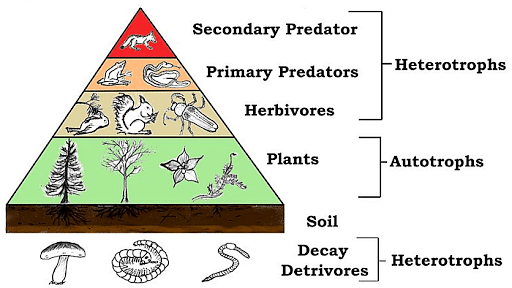
Food Chain
Types of Heterotrophs
[Click Here for Sample Questions]
There are two subdivisions of heterotrophs: photoheterotrophs and chemoheterotrophs. Photoheterotrophs are the organisms that acquire their energy from light, but must always consume carbon from different organisms, as they cannot utilize carbon dioxide from the air. Chemoheterotrophs, in contrast, obtain both their energy and carbon from other organisms.
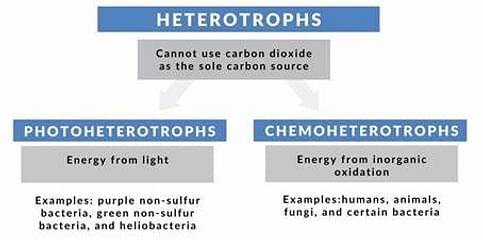
Types of Heterotrophs
The two major types of heterotrophs are as described below:
-
Photoheterotrophs
Photoheterotrophs are heterotrophic organisms that use sunlight as their energy source. They use organic compounds from the environment and may also be assumed as one of the two main sub-groups of phototrophs. Photoheterotrophs, in this respect, are organisms that rely only on light energy as they generate ATP by photophosphorylation. These organisms do not depend on carbon dioxide as their only carbon source. They use organic compounds such as carbohydrates, fatty acids, and alcohols obtained from the habitat for their carbon essentials.
-
Chemoheterotrophs:
Chemotrophs are organisms that obtain energy through a chemical procedure called chemosynthesis instead of photosynthesis. Chemoheterotrophs are chemotrophs that are heterotrophic organisms. They can further be classified as chemolithoheterotrophs or chemoorganoheterotrophs.
Most chemoheterotrophs acquire energy by consuming organic molecules like glucose. Chemoautotrophs on the other hand are autotrophs that utilize chemical energy to synthesize carbohydrates. They use inorganic compounds like hydrogen sulfide, sulfur, ammonium, and ferrous iron as reducing agents and synthesize organic compounds from carbon dioxide.
Examples of heterotrophs
[Click Here for Sample Questions]
Heterotrophs cannot manufacture their food by carbon fixation and therefore derives their nutrition intake from different sources of organic carbon, specifically plant or animal matter. Some of the examples of heterotrophs are:
-
Herbivores
Heterotrophs consuming plants for obtaining nutrition are called herbivores or primary consumers. Examples of herbivores are cows, deer, sheep, and other plant-eating animals. Animals that eat only fruits, such as birds, and monkeys, are also herbivores although they are called frugivores.
-
Carnivores
Carnivores are usually predators, such as secondary consumers: heterotrophs that eat herbivores, such as snakes, birds, and frogs, and marine organisms who consume zooplankton as small fish, crabs, and jellyfish. Carnivores could also be animals such as vultures or cockroaches, which eat animals that are already dead. They could also be tertiary consumers, predators such as lions, hawks, sharks, and wolves, eat other carnivores.
-
Fungi
Fungi are heterotrophic organisms although they do not consume their food as other creatures do rather they feed by absorption. Fungi feed on a variety of different things, such as wood, cheese, or flesh, although most of them specialize in a restricted range of food sources; some fungi are highly characterized and are only able to obtain nutrition from a single species.
Many fungi are parasitic and feed on a host without killing it. Although most fungi are saprobic, they feed on already lifeless or decaying things, such as leaf waste, animal remains, and other remains.
Read More: Difference between Autotrophs and Heterotrophs
Plants and Animal Heterotrophs
[Click Here for Sample Questions]
Some of the plants cannot produce their food thus have to obtain food from others and such plants are called heterotrophs. It takes place in parasitic plants or saprophytic plants. In this case, the parasitic plant depends on the host for survival whereas the saprophytic one depends on the dead and decayed matter for food.
The animals are heterotrophs as they cannot prepare their food like plants by the process of photosynthesis.
The other types of heterotrophs are detrivores that obtain nutrients from decaying plants and animals. Saprophytes are the organisms that consume dead organic matter. Another way of dividing the heterotrophs is, they can be organography or lithotrophs. Organotrophs are those organisms that use concentrated carbon compounds as the source of electrons from plants and animals. On the other hand, lithotrophs use an inorganic compound like sulfur, nitrate, or ammonium.
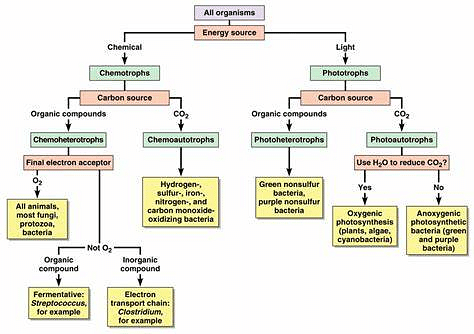
The flowchart below determines if the species is autotroph, heterotroph, or a subtype.

Flowchart to determine type of organism
Difference between heterotrophs and autotrophs
[Click Here for Sample Questions]
The differences between autotrophs and heterotrophs are as mentioned in the table below:
| Autotrophs | Heterotrophs |
|---|---|
| Generally the members of the plant kingdom and certain unicellular organisms like cyanobacteria | All members of the animal kingdom |
| Autotrophs are producers who prepare their food. | Heterotrophs are consumers who depend on other sources for their food. |
| These may be classified as photoautotrophs and chemoautotrophs. | These may be classified as photoheterotrophs and chemoheterotrophs. |
| The chloroplast helps in preparing food. | They do not contain chloroplast, so they can't prepare food. |
| They obtain energy from inorganic origins by converting light fuel into chemical fuel. | They obtain energy directly or indirectly from other organisms. |
| Autotrophs can reserve light energy and chemical energy. | Heterotrophs cannot store energy. |
| They are at the primary level in the food chain. | These are in the secondary or tertiary level in the food chain. |
| They cannot move from their place. | Can move here and there in search of food and protection. |
| Green algae, plants, and a few photosynthetic bacteria are examples of autotrophs. | Tigers, Cows, horses, buffaloes, and humans are examples of heterotrophs. |
Things to Remember
- Heterotrophs are organisms that either directly or indirectly rely on autotrophs for nutrition & food energy.
- For example, raccoons might consume corn planted in a field, or they might catch and eat rodents that rely on corn as a food source.
- There exist various types of heterotrophs including herbivores, carnivores, omnivores, decomposers, scavengers, and detritivores.
- The process of transforming inorganic CO2 into organic compounds such as carbohydrates, usually by photosynthesis is referred to as Carbon fixation.
- Organisms, which can utilize carbon fixation to manufacture their nutrition, are named autotrophs.
- A food chain describes the association between predator and prey. It is an approach to classify various animals, plants, and fungi that consume other organisms for their survival.
- The four levels in the food chain are primary consumers, secondary consumers, tertiary consumers, and finally decomposers or phytoremediators.
Sample Questions
Ques: Explain how a food chain works? (5 marks)
Ans: A food chain explains how energy and power consumption transfers from one body to another in our ecosystem. The four levels in the food chain are primary consumers, secondary consumers, tertiary consumers, and decomposers.
- The plants make their food so they are the primary source in the food chain that produces energy further it goes to primary consumer organisms like herbivores.
- Then comes carnivores who eat primary organisms for energy and this way energy travels from primary to tertiary consumers.
- In any environment, numerous orders of things cross over. Different food orders might eat similar living beings.
- A few consumers might eat a similar sort of plant or creature for energy. At the point when this occurs, the order of things shapes a food web.
Ques: What are the modes of nutrition? (3 marks)
Ans: The modes of nutrition are divided as:
- Autotrophic Nutrition:
These organisms are the power source of energy to the ecosystem as they create their food themselves. Photoautotrophs are another type under autotrophic nutrition. These organisms make their food by using natural resources like sunlight, air & water. Chemoautotrophs in the other category synthesize their food with the oxidation of chemicals.
- Heterotrophic Nutrition:
Unlike autotrophic organisms, these organisms are not able to prepare or synthesize their food on their own so they rely for energy on autotrophic organisms.
Ques: What do you understand by the term heterotrophic mode of nutrition? (3 marks)
Ans: Heterotrophic nutrition is a mode of nutrition in which organisms depend upon other organisms for food to survive. They can't prepare their food like Green plants. Heterotrophic organisms have to consume organic substances to survive.
All eukaryotes except for green plants are unable to manufacture their food: They obtain food from other organisms. This way of nutrition is also called heterotrophic nutrition. All heterotrophs have to transform solid food into soluble compounds capable of being absorbed. Then the soluble things of digestion for the organism are broken down for the release of energy (respiration). Heterotrophs depend on autotrophs for their food. Heterotrophic organisms have only 4 types of nutrition.
Ques: State some reasons how heterotrophs benefit from photosynthesis? (3 marks)
Ans: Heterotrophs rely on autotrophs to provide a continuous supply of new organic molecules. Heterotrophs are considered consumers in the food web and are placed at a secondary or tertiary level.
The heterotrophs benefit from photosynthesis in many ways.
- Directly by consuming plants as herbivores
- Indirectly by attacking, consuming, and killing, other herbivores animals carnivores, or omnivores
- By using oxygen for the cellular breathing process
Ques: Are humans considered heterotrophs? Why? (3 marks)
Ans: Humans, of course, are heterotrophs and are classified under chemoheterotrophs. This means that humans cannot synthesize their food but depend on other organisms for their food and can only sustain themselves by eating plants, or by eating animals that have themselves grown by eating plants. All of these foods are specifically grown for human consumption in agricultural ecosystems or gathered from natural ecosystems.
Ques: State some functions of heterotrophs. (3 marks)
Ans: Heterotrophs generally are the consumers who rely on food producers. They use organic carbon as their way of carbon. Furthermore, organic chemicals as their energy and source for electrons.
- Heterotrophs catabolize natural mixtures by respiration, fermentation, or both. Fermenting heterotrophs can be facultative. Moreover, Fermenting heterotrophs carry out fermentation in environments of low oxygen.
- Heterotrophs in the food chain can never come under primary, secondary, and tertiary consumers. As heterotrophs in the food chain can certainly be primary, secondary, and tertiary consumers.
Ques: Can autotrophs survive without Heterotrophs? (3 marks)
Ans: No, autotrophs and heterotrophs rely on each other for the smooth flow of energy in the environment. Heterotrophs are the consumers unlike autotrophs cannot make their food so they depend on autotrophs. Autotrophs create chemical energy and oxygen through photosynthesis for the stability of life on the planet.
Considered as heterotrophs, without decomposers to recycle nutrients, autotrophs will lack the nutrient to undergo photosynthesis - it would just be an organic waste. It will ultimately lead to the death of autotrophs. So autotrophs aren't only producers because they make food for themselves, but they also make the energy that all other living things rely on.
Ques: Where does the heterotrophic cell get ATP and how? (3 marks)
Ans: Heterotrophic bacteria, which include all pathogens, obtain energy from the oxidation of organic compounds. Carbohydrates (particularly glucose), lipids, and protein are generally oxidized compounds. The natural oxidation of these organic compounds by bacteria results in the synthesis of ATP as the chemical energy source. This process allows the generation of simpler organic compounds (precursor molecules) needed by the bacteria cell for biosynthetic or assimilatory reactions.
The Krebs cycle compounds serve as precursor molecules (building blocks) for the energy-requiring biosynthesis of complicated organic compounds in bacteria. Degradation reactions that continuously produce energy and generate prototype molecules for the biosynthesis of new cellular constituents are called amphibolic.
Check-Out:



Comments