

How do you convert km/h to m/s?

Jasmine Grover logo

Jasmine Grover

Education Journalist | Study Abroad Lead

The SI unit of distance is meter and time is measured in seconds according to the International System of Units.

  • 1 hour = 60 min
  • 1 min = 60 sec
  • Therefore, 1 hour = 60 x 60 = 3600 seconds

Also, 1 km = 1000 m

Therefore, 1 km/hr = 1000/3600 m/s
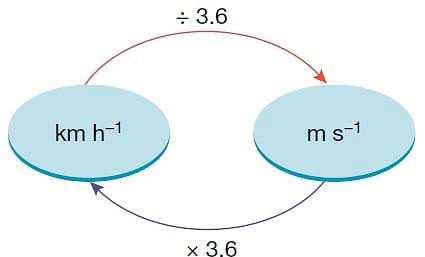
km/h to m/s conversion

To convert km/h to m/s, divide the speed in km/h by 3.6. The formula is:

1 m/s = 3.6 km/h

Or, to convert km/h to m/s, we multiply the given quantity by 5/18 m/s.

For example, if you want to convert 60 km/h to m/s:

60 km/h = 60 x 5/18 m/s

So, 60 km/h is equivalent to 16.67 m/s.

Also Read:

CBSE CLASS XII Related Questions

  • 1.

    An NGO organises a charity event in which they decide to distribute woollen caps to protect children from winter. The caps to be distributed are in three separate boxes, Box I has 30 red caps, Box II has 20 red and 10 green caps, and Box III has 30 green caps. The probability that a Box i is selected and a cap picked out is i/6, where i = 1, 2, 3.  
    Based on the above information, answer the following questions :


      • 2.

        A carpenter needs to design a wooden box in the shape of a cuboid such that the sum of its length and breadth is 3 cm more than its height. Twice of its length, thrice of its breadth and its height add up to 10 cm. Its breadth added to 7 times its height is 1 cm less than 3 times its length. 


          • 3.

            Evaluate:
            \[ \int_{0}^{1} \frac{x \tan^{-1}x}{(1+x^2)^{3/2}}\,dx \]


              • 4.
                Find:

                The principal value of \[ \sec^{-1}(\sqrt{2})+2\csc^{-1}(-2) \] is:

                  • \(-\frac{\pi}{2}\)
                  • \(-\frac{\pi}{4}\)
                  • \(\frac{\pi}{4}\)
                  • \(\frac{\pi}{2}\)

                • 5.
                  Find: \[ \int \frac{x^2}{(x^2-1)(x^2+4)}\,dx \]


                    • 6.

                      At a birthday party, children are being served orange juice in conical cups, as shown in the figure. 


                      Each cup is 15 cm deep and has a radius 5 cm. The juice is being poured into this cup at a rate of 0·1 cm3/s.
                      On the basis of the above information, answer the following questions :

                        CBSE CLASS XII Previous Year Papers

                        Comments


                        No Comments To Show


