



Education Journalist | Study Abroad Lead
Ionic bond is a bond between a metal and a non-metal that is responsible for holding oppositely charged ions together by a strong electrostatic attraction. The bond created when electrons are transferred from the outermost shell of a metal to the outermost shell of a non-metal is known as an electrovalent bond.
The metals involved in an ionic bond formation should have a low Ionization Potential, and the non-metals involved in an ionic bond formation should have a high Electron Affinity. The energy required to remove an electron from the outermost shell of an isolated gaseous atom is known as the ionization potential. Finally, electron affinity is defined as the energy released when an electron is added to an isolated gaseous atom's outermost shell.
| Table of Content |
Keyterms: Ionic Bond, Electron, Atom, Metal, Non-metal, Ions, Electrovalent bond, Energy, Orbit, Gas, Liquid, Solid
What is Ionic or Electrovalent Bond?
[Click Here for Sample Questions]
The complete transfer of one or more electrons from one atom to the other forms a chemical connection between two atoms, causing the atoms to achieve their closest inert gas configuration.
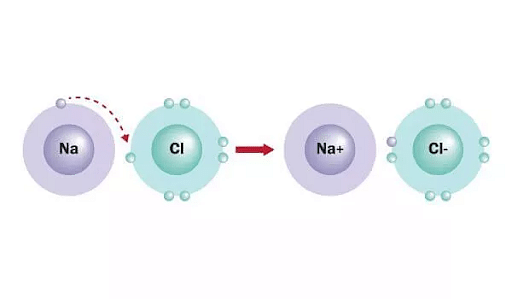
Two atoms can lose energy and become stable in one of the three ways. To complete their octet configuration, they can donate or accept electrons. An ionic bond, also known as an electrovalent bond, is the result of such a combination. When one atom obtains electrons from its outermost level or orbit, the other atom loses electrons.
Ionic Bond
When electrons are moved from one atom to another, positive and negative ions are formed. The electrovalent link, also known as an ionic bond, is produced when electrons are transferred between two atoms. Metals and non-metals are the only materials that create electrovalent bonding. Between two nonmetals, electrovalent bonds do not form.
In layman's terms, an electrovalent connection is formed when one atom transfers a particular number of electrons to another atom that has a predisposition to gain electrons, resulting in both atoms forming stable inert gas configurations. The potential energy of an electrostatic attraction is always reduced. As a result, the system's potential energy is significantly lower than before an ionic bond was formed.
Ionic Bond between Metals and Nonmetals
Read More:
| Related Articles | ||
|---|---|---|
| Packing Efficiency | Imperfections in Solids | Magnetic Properties |
| Schottky Defect | Covalent bonds | Frenkel Defect |
Characteristics of Ionic Bonding
[Click Here for Sample Questions]
- The complete transfer of valence electrons to achieve stability forms an ionic bond.
- The production of two oppositely charged ions, positive cations and negative anions, occurs as a result of this type of bonding.
- A strong attractive force exists between two oppositely charged ions. An ionic or electrovalent bond is what this force is called.

Structure of Ionic Bond
- Ionic bonds arise when electronegativity differences are big, whereas covalent bonds develop when electronegativity differences are minor.
- An ionic compound is made up of positive and negative ions that are attracted to each other electrostatically.
Properties of Ionic Bond
[Click Here for Sample Questions]
The following are the properties of an Ionic bond.
- The strongest of all bonds is the ionic bond.
- Ionic bonds are the most reactive of all the bonds in the correct medium since they have charge separation.
- The melting and boiling points of ionic bond compounds are high.
- Ionic-bound molecules are strong conductors of electricity in their aqueous solutions or in their molten state. The existence of ions, which operate as charge carriers, is responsible for this.
Duplet and Octet Rule
[Click Here for Sample Questions]
According to the Duplet or Octet rule, an ionic compound is generated when atoms of metals from Groups 1 to 3 in the periodic chart lose electrons to atoms of nonmetals from Groups 5 to 7 in the periodic table to complete their stable electronic configuration. During these electron exchanges, the protons of these atoms remain unchanged.
To reach the same electron structure as the next rare gas with two electrons in the outer level, element atoms usually lose, gain, or share electrons with other atoms. This is known as the Duplet Rule.

Duplet and Octet Rule
To reach the same electron structure as the nearest rare gas with eight electrons in the outer level, element atoms usually lose, gain, or share electrons with other atoms. This is known as the Octet Rule.
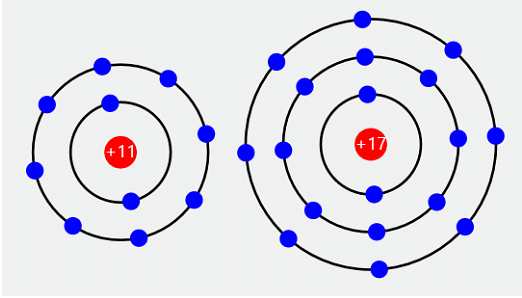
The outermost shell of the Sodium (Na) atom has just one electron, and if it loses that electron from its outermost shell, the M shell, the L shell becomes the outermost shell, and the octet becomes stable. The nucleus of this atom possesses eleven protons, but the number of electrons has decreased to 10, giving the sodium atom a positive charge and forming the sodium cation Na+.

Sodium Chloride Ionic Bond
The Chlorine (Cl) atom, on the other hand, has seven atoms in its outermost shell and requires one more electron to complete its octet. If Sodium and Chlorine react, Chlorine will take the electron that sodium loses. Because it would have seventeen protons in its nucleus and eighteen electrons in its K, L, and M shells after this operation, the chlorine atom would have a negative charge. As a result, the negatively charged Chlorine and positively charged Sodium form an Ionic bond, or Electrovalent compound, known as Sodium Chloride, or Common Salt.
Things to Remember
- Ionic bond is a bond between a metal and a non-metal that is responsible for holding oppositely charged ions together by a strong electrostatic attraction. The bond created when electrons are transferred from the outermost shell of a metal to the outermost shell of a non-metal is known as an electrovalent bond.
- When electrons are moved from one atom to another, positive and negative ions are formed. The electrovalent link, also known as an ionic bond, is produced when electrons are transferred between two atoms. Metals and non-metals are the only materials that create electrovalent bonding.
- To reach the same electron structure as the next rare gas with two electrons in the outer level, element atoms usually lose, gain, or share electrons with other atoms. This is known as the Duplet Rule.
- To reach the same electron structure as the nearest rare gas with eight electrons in the outer level, element atoms usually lose, gain, or share electrons with other atoms. This is known as the Octet Rule.
- According to the Duplet or Octet rule, an ionic compound is generated when atoms of metals from Groups 1 to 3 in the periodic chart lose electrons to atoms of nonmetals from Groups 5 to 7 in the periodic table to complete their stable electronic configuration. During these electron exchanges, the protons of these atoms remain unchanged.
Read More:
Sample Questions
Ques. Why are ionic compounds' melting and boiling points so high? (2 marks)
Ans. Strong electrostatic forces of attraction hold the constituents of ionic compounds, i.e., oppositely charged particles, together. To separate the constituents from their lattice, a substantial quantity of heat is applied. As a result, a considerable amount of lattice energy is required to melt or boil ionic materials. Electrovalent and ionic compounds have high melting and boiling points because of this.
Ques. What are the differences between reducing and oxidizing agents? (2 marks)
Ans. Metals that donate electrons to achieve a stable electronic state are known as reducing agents. As a result, metals are referred to as electron donors. Non-metals that accept electrons to achieve a stable electronic state are referred to as oxidizing agents. As a result, non-metals are referred to as electron acceptors.
Ques. What is the definition of a covalent compound? Make a list of its two properties. (2 marks)
Ans. The term "covalent bond" refers to a link produced by the mutual sharing of electrons. Covalent bonding, for example, is responsible for the creation of the chlorine molecule.
- The melting and boiling points of covalent compounds are low.
- Organic solvents such as Benzene and Phenol are soluble in covalent compounds.
Ques. Ionic bonds have what sort of force in them? (2 marks)
Ans. Ionic bonding is a type of chemical link in which one atom loses valence electrons while another gets them. This exchange makes the noble gas electrical state more stable for both atoms involved. An ionic bond is formed by the electrostatic interactions of two ions with opposite charges.
Ques. Is it possible to form ionic bonds between two nonmetals? How can Ionic bonds be broken? (2 marks)
Ans. To predict the type of bond that will develop between them, consider whether each element is a metal or a nonmetal. Nonmetals form covalent bonds, metals and nonmetals form ionic bonds and metals and metals from metallic bonds in general.
Since ionic compounds are polar, they break down in polar solvents like water. Polar solvents break down ionic bonds by disrupting them. The ionic bonds can be dissolved by dissolving the ionic substance in water.
Ques. What really is the charge on the manganese ion in this molecule, given the salt MnF3? (3 marks)
Ans. We must first establish the net charge of the molecules to which the transition metal manganese is linked to determine the charge of the transition metal manganese in the molecule MnF3. Three fluoride ions are linked to the manganese. The charge of the fluoride ion is a negative one. Since it's a halogen, we have three fluoride ions in the molecule because of the subscript in front of the fluoride. Each fluoride ion has a single charge, and because there are three of them, the total charge from these fluoride ions is three. Molecules want to reside in their most stable state, which has a charge of zero overall. As a result, the manganese atom will have a charge of +3 to balance out the three fluoride ions' charge of 3.
Ques. What is the charge of the barium ion in the molecule BaF2? (2 marks)
Ans. We must first establish the net charge of the molecules to which the barium ion is linked before we can compute the charge of the barium ion in the molecule BaF2. Two fluoride ions are bound to the barium ion.
The -1 charge of the fluoride ion. We have two fluoride ions, as shown by the subscript in front of the fluoride in the molecule. Because there are two fluoride ions, they have a total charge of -2. Molecules want to be in their most stable state, which has a charge of zero overall. As a result, the barium atom will have a charge of +2 to balance out the two fluoride ions' -2 charge.
Ques. Which among covalent or ionic bonds is stronger? (2 marks)
Ans. In general, a covalent bond is stronger than an ionic bond. Extremely high melting and boiling temperatures of covalently connected network solids such as diamond, silica and others, where all bonds are covalent, demonstrate this.
Ionic solids, such as NaCl, CaCl2, and others, have lower melting and boiling points.
Ques. Why are Mo and Cl unable to form an ionic bond? (3 marks)
Ans. In reality, molybdenum has six valence electrons: five in the 4d orbital and one in the 5s orbital. Chlorine comprises two 3s and five 3p in its atomic structure.
Regardless, you're adhering to the Octet Rule, a simplification that only applies to the core group parts (essentially the first two rows of the periodic table). The Octet Rule cannot be used for molybdenum and its d-orbitals because they are just too complicated.

Ques. Why do so many bonds have ionic and covalent properties? (3 marks)
Ans. To some extent, all chemical bonds have both ionic and covalent properties.
Because all chemical bonds have some directed character, as a result of the sharing of valence electrons, and some ionic character, as a result of the production of ions as electrons are lost or gained. Polar covalent bonds, which are generated due to differences in electronegativities, have an ionic aspect. In addition, the covalent nature of ionic bonds can be seen in some molecules that are thought to be ionic but are covalent.
Fagan’s rules can anticipate the ionic nature of a covalent bond to a large extent.
The difference in electronegativities of the constituent atoms of the bond can be used to calculate the percentage of ionic character in covalent bonds.
The bond is characterized as ionic when it contains more than 50% ionic character.
Ques. Is PCl3 an ionic or a covalent compound? (2 marks)
Ans. Because the number of paired electrons around the P atom is 4 (3 shared and one unshared pair), the geometric structure of the PCl3 molecule is a pyramid, which means the electric dipoles of the three P-Cl bonds do not cancel each other, resulting in polarity.
For Latest Updates on Upcoming Board Exams, Click Here: https://t.me/class_10_12_board_updates
Check-Out:



Comments