



Content Curator
Lignite is defined as a kind of coal whose appearance is usually a brownish-black one. For that reason, it is also known as brown coal. However, lignite may also be found in other coloured forms like yellow and even black, which are said to be extremely rare though. Lignite also has numerous uses, out of which it is found to be most commonly used in the fossil fuel power plant.
| Table of Contents |
Key Terms: Lignite, Coal, Brown Coal, Peat, Wood, Xyloid Lignite
What is Lignite?
[Click Here for Sample Questions]
Lignite is a kind of coal which is soft brownish in appearance and is formed from naturally compressed peat at shallow areas where temperatures are even lower than 1000C. Lignite or brown coal, is generally said to be combustible in nature and is often formed as sedimentary rock. Lignite is known to have low heat content due to which, it is considered as the lowest in the rank of coal and also has the lowest carbon content amongst all types of coal.
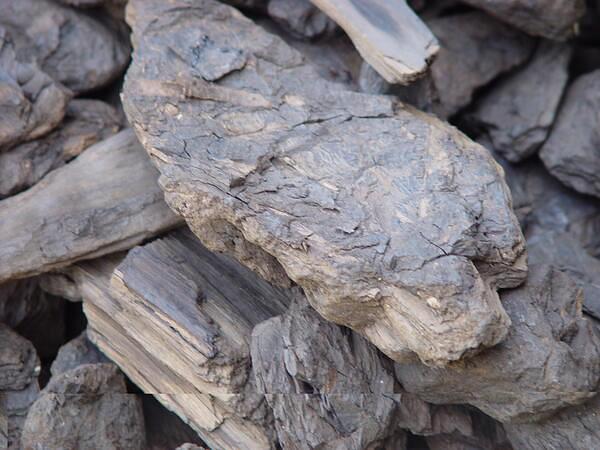
Lignite or brown coal
Formation of Lignite
[Click Here for Sample Questions]
Coal is determined as the most important fossil fuel that comes from the dead remains of prehistoric plants or animals. The formation of coal generally takes over millions of years, which is why it is an exhaustible and non-renewable natural resource. It was almost formed about 300 million years ago when the earth was covered with swampy forests. When plants in those forests died, they fell into the swamps. Thus, they formed a thick layer of dead vegetation in the swamp.
Such thick layers were formed for several years as more and more plants died. The topmost layers compressed the layers below. High temperature and pressure caused some physical and chemical changes and eventually, coal was formed. There are different stages for the formation of brown coal and they are as follows:
-
First Stage: Peat
In the first stage, when the plant matter becomes buried and is no longer exposed to air, anaerobic bacteria then start to decompose the material and after several thousands of years, partially decayed plant matter known as peat is formed. Peat is known to be the softest form of coal.
-
Second Stage: Lignite
In the second stage, when the peat is deeply buried, water and other compounds are squeezed out due to increasing pressure and this is how the lowest quality of coal, lignite that is dark brown in color is formed. Though lignite is comparatively harder than peat but is still very soft. Also, it consists of little traces of plants.
Then after the second stage, continued burial results in increasing temperature and pressures which causes this low-quality lignite coal to be transformed into higher quality “black coals”.
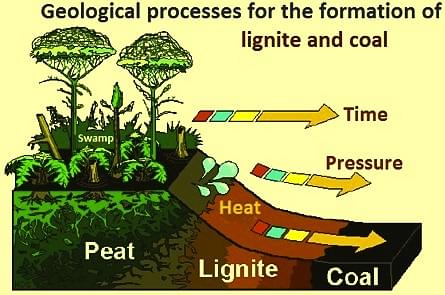
Formation of Lignite or Coal
Characteristics of Lignite
[Click Here for Sample Questions]
Lignite are brownish in color and are said to have the fibrous structure of wood. The term lignite is generally derived from the Latin word `lignum’, which means `wood’. As they occur from plants with a lot of resin, they have a lot of volatile substances. Lignite’s which are freshly mined are rough, but not that hard.
Lignite has a carbon content of around 20-30%, which may only rise up to 65-75% in an ash-free and dry form. It also has a high moisture content of up to 75% and 5-20% of ash content. The calorific value of lignite is almost less than 19.306 KJ/Kg for which lignite is ranked as the lowest.
Uses of Lignite
[Click Here for Sample Questions]
Lignite is mainly utilized to produce energy for which it is most commonly seen in the fossil fuel power plant. Since lignite contains a high amount of volatile substances, therefore it can be easily converted into liquid and even gaseous form. It is also used as a fuel for generating steam-electric power.
- Lignite is used for heating in the house – Lignite was and is used today to heat homes as a substitute for firewood. For that heating purpose, it is frequently crushed into briquettes.
- Lignite is used as a fuel – Lignite is mined all over the world and is solely employed in the manufacture of steam-electric power plants as lignite combustion provides less heat than other coals.
- Lignite is used in the field of agriculture – Agriculture is known to be an environmentally friendly application of lignite. When lignite is burned in power stations, the ash produced can be used as a soil supplement and fertilizer. Biological control microorganisms that help in reducing plant pests can also be grown using lignite. Also, Leonardite, which is a human acid-rich soil conditioner, can be generated by lignite.
- Lignite is used as mud for drilling purpose – Amine-treated lignite (ATL) which is a result of an amine reaction is used in drilling mud to prevent fluid loss during drilling.
- Lignite is also used in terms of jewelry – Jet which is a type of lignite has been used as a gemstone for thousands of years. It was widely employed in necklaces and other decorations in Britain until the end of the Roman period.
Types of Lignite
[Click Here for Sample Questions]
Lignite can be bifurcated into three types:
- Xyloid Lignite
- Compact Lignite
- Jet lignite
1. Xyloid Lignite
Xyloid lignite generally comes with the fibrous structure of wood for which it is often said to have the same appearance and the tenacity of ordinary wood. However, we can easily differentiate between xyloid lignite and ordinary wood as the woody tissue of xyloid lignite has undergone significant changes. It is also known as Fossil Wood.
2. Compact Lignite
Compact lignite is also known as Perfect Lignite.
3. Jet Lignite
Jet is another type of lignite, and is a gemstone. Unlike other gemstones, the jet is not a mineral but it is rather said to be a mineraloid that is generally used to make different kinds of jewelry.
Things to Remember
- Lignite is a kind of coal that is brownish-black in color and comes with the fibrous structure of wood.
- They are said to be the lowest in rank because of the low calorific value of lignite.
- Lignite is said to be formed from naturally compressed peat at shallow areas where the temperature is low and pressure is high.
- They may be of dry form but have a high moisture content of up to 75%.
- Lignite is mainly utilized in fossil fuel power plants. They are also utilized in the field of agriculture, in manufacturing jewelry, etc.
- Lignite are basically of three types, Xyloid Lignite, Compact Lignite and Jet lignite.
Sample Questions
Ques. What is Lignite? [3 marks]
Ans. Lignite is a kind of coal that is brownish-black in color and comes with a fibrous structure of wood. Because of its appearance, it is also known as brown coal. They are also said to be found in other coloured forms like black or even yellow but are extremely rare. The term lignite is generally derived from the Latin word `lignum’, which means `wood’. They are considered as the lowest in the rank of coal and also have the lowest carbon content amongst all types of coal.
Ques. Why is lignite considered the lowest in the ranks of coal? [1 mark]
Ans. Lignite is considered as the lowest in the rank of coal because of its low heat content which is said to be almost less than 19.306 KJ/Kg
Ques. How is Lignite formed? [3 marks]
Ans. Lignite is a kind of coal and is generally formed by the decomposition of plant materials over millions of years. Similarly, lignite is a combustible material that is built through the process of partial decomposition of plant remains over millions of years. Brown coal is typically said to be formed in an airless atmosphere at shallow depths under extreme climatic conditions like increased pressure and temperature lower than 1000C.
Accordingly, there are two main steps that are followed during the formation of lignite coal. First is peatification, where bacterial activity is the main process that creates the peat. Second is coalification, where increasing temperature and pressure from the burial grounds are the main factors, which helps in forming the lowest quality of coal, lignite.
Ques. State the issues that are caused due to high moisture content of Lignite. [2 marks]
Ans. The moisture content of Lignite is high, which is almost about 75% and therefore it creates a number of issues for it to use. It may reduce the electrical efficiency of thermal power plants and can cause problems during handling, such as repeated combustion. Furthermore, it also affects the fuel’s energy density by making long-distance transportation uneconomic.
Ques. Which type of rock is lignite? [1 mark]
Ans. Lignite is an organic sedimentary rock that forms from dead plant materials decomposition, typically in a swamp. It is combustible in nature and is known to be one of the most important fossil fuels.
Ques. What are the main applications of Lignite? [2 marks]
Ans. The main applications of Lignite include:
- Electricity Generation, where 79% of Lignite is utilized.
- Synthetic Natural Gas Production, where 13% of Lignite is utilized.
- Production of Fertilizers, where 7% of Lignite is utilized.
- Home Heating and Oil Well Drilling Mud, where 1% of Lignite is utilized.
Ques. How is lignite or coal obtained? [2 marks]
Ans. Lignite or coal is obtained by the process of mining. But obtaining coal from mines is not an easy task. There are few steps to do so, first is by removing the dirt from above the coal deposit. Then when the coal is exposed, explosives are utilized to break it into smaller pieces. After that, the coal is collected and loaded into wagons to get lifted to the surface. The miners enter and leave the mines through an elevator known as shaft.
Ques. How does lignite or coal mining destroy the environment? [2 marks]
Ans. Lignite or coal mining increases the risk of loosening top soils into streams and waterways, and the sediments are known to be contaminating our water which can result in killing downstream plant life and even fish. As coal contains sulphur and nitrogen traces, while burning they are released into the atmosphere which can harm the environment.
Ques. Is Lignite safe? If not, why? [3 marks]
Ans. No, Lignite is not safe. It is known to be one of the most harmful forms of coal and may have serious health hazards.
Lignite is said to be harmful because of the harmful emissions released into the environment due to combustion. If we are exposed to the air pollution caused by lignite, then there can be increased risks of lung cancer and heart disease. Also, the high moisture content present in Lignite can also result in dangerous emissions of CO2.
Read Also:



Comments