



Content Curator
London Dispersion Force is the weakest of all intermolecular forces. This force occurs between two different molecules that come close to each other. London dispersion force is also called a dipole-induced dipole attractive force wherein the atoms make temporary dipoles.
Combination of atoms forms molecules bound together by chemical bonds. The article discusses the London dispersion force, and types of bonds between atoms and illustrates the dispersion force with the help of examples.
Read More: Chemical Bonding & Molecular Structure
| Table of Contents |
Keyterms: Force, Intermolecular force, molecules, dipole-induced dipole, atoms, chemical bond, dispersion force, dipoles, electrons
London Dispersion Forces
[Click Here for Sample Questions]
London dispersion forces were first discovered by the German Physicist Fritz London. London dispersion forces are found to occur between all molecules when two electrons in two different parts of an atom make instantaneous temporary dipoles. The then-produced force is known as London Dispersion Force. The force is also called dipole-induced dipole attraction force. Some of the characteristics of London Dispersion Forces are:
- London Dispersion Force is produced when two atoms are in close proximity to each other.
- They are the weakest types of intermolecular force which can lead the nonpolar matters to condense.
- This property of London dispersion forces is employed in freezing liquids into the solids.
- Freezing occurs when the temperature gradually lowers.
- The molecules are said to be polar when London Dispersion forces cause a dipole-induced dipole attraction between the atoms of the molecule.
- Some of the other intermolecular forces existing between molecules are ionic forces, dipole-dipole forces, and hydrogen bonds.

London Dispersion Force
Read More: Hydrogen Bonding
London Dispersion Force Formula
[Click Here for Sample Questions]
The formula for London Dispersion Force is given below. The ability of the molecules to produce separation of charge or the induced dipole is known as polarizability. Hence, when the two dipoles interact with each other, the main parameter involved in binding the molecules is strength. The strength is denoted by ’μ’.
The strength of the dispersion force is directly proportional to the strength of the electric field. The electric field is denoted by E.
Therefore,
\(\mu = \alpha \times E\)
where, μ = Induced Dipole Moment
\(\alpha\) = polarizability
E = Electric Field
The interaction energy can be calculated by using the London Dispersion Force formula.

Here, V11 is the potential energy between two molecules or atoms that are identical. This formula was later modified as follows for two un-identical atoms or molecules:

Here,
I= Ionization Energy
A = polarizability
r= distance between the atoms
Read More: Potential Energy
London Dispersion Forces Examples
[Click Here for Sample Questions]
The electrons which are distributed unequally in the nucleus of the atom can produce dipole moments. When the other atoms or molecules get closer to the dipole it results in the formation of electrostatic attractive force between the atoms or molecules.
Let's understand this with an example.
- The covalent bonds are formed by the equal distribution of valence electrons.
- Both the atoms of Chlorine are bonded by a covalent bond.
- The force between the two chlorine atoms is the London dispersion force.
- This type of force of attraction is formed because of the unequal distribution of the electrons within the molecule.
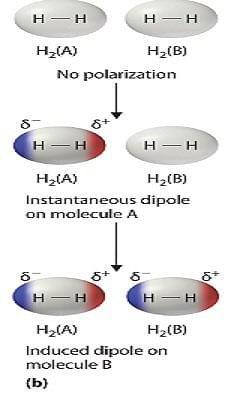
Temporary Dipoles in Two Non-Polar Diatomic Molecules
Read More: Diatomic Molecules
Types of Bonds
[Click Here for Sample Questions]
The different types of bonds existing between molecules can be classified as follows:
- Ionic Bond
- Covalent Bond
- Coordination Bond
Let us understand each of these in a little detail.
Ionic Bond
These are formed by cations and anions by the mechanism of either losing or gaining electrons thereby giving the molecule a positive or negative charge. Some interesting characteristics of ionic bonds are listed below:
- When an atom accepts an electron, it forms an anion with a negative charge
- When an atom donated an electron, it forms a cation with a positive charge
- Ionic bond is formed by the electrostatic force of attraction between the cation and the anion
- A classic example of an ionic bond is NaCl which is formed by the ionic bond between the ions Na+ and Cl-.

Ionic Bond in NaCl
Read More: Polyatomic Ion
Covalent Bond
The octet formation gets completed during the process of sharing of electrons between two atoms. Covalent bonds are typically formed between two polar or non-polar non-metals. Some of the characteristics of covalent bonds are:
- The polarity of the covalent bonds is based on the electronegativities of the bonded atoms.
- Metals lose electrons to form metal cations.
- The free electrons in the lattice structure of the metal remain there.
- This electrostatic force of attraction between metal ions and the freely available mobile electrons forms a metallic bond.
- This metallic bond is responsible for the specialized properties of metals like ductility, malleability, etc.
Read More: Physical Properties of Metals & Non-Metals
Coordination Bond
These bonds are formed by the unequal sharing of electrons between two atoms. Some of the interesting features are as follows:
- One of the atoms acts as an acceptor and the other acts as a donor.
- Coordination bonds are formed between atoms that form molecules.
- The coordinate bond is denoted with an arrow ‘ →’ that points towards the acceptor to the donor of the atom.
- The atom forming the coordinate bond becomes stable once the electron pair is shared.
- The fundamental principle involved in coordinate bond formation is dependent on the Lewis Theory.
Read More: Coordination Number
Things to Remember
- London dispersion force is the temporary attractive force that is produced due to the formation of temporary dipoles by atoms.
- This is the weakest intermolecular force of atoms.
- There are different types of Chemical bonds such as Covalent bonds, ionic bonds, metallic bonds, coordination bonds, etc.
- There are different types of intermolecular forces: London dispersion force, dipole-induced force, ion-ion force, and hydrogen bonding.
- These bonds are mainly formed by the sharing of electrons between atoms.
Also Read:
Sample Questions
Ques. What are London dispersion forces? Explain with an example. (2 marks)
Ans. The unequal distributions of an electron through the nucleus of an atom can induce a dipole moment in the atom. When any other atom or a molecule comes in contact with this induced dipole, this can be distorted which can lead to an electrostatic force of attraction between either atom or the molecules. Noble gases like Ne and Ar are examples.
Ques. What type of force is London dispersion? (2 marks)
Ans. London dispersion forces are weak intermolecular forces. These are formed when the electrons from two adjacent atoms occupy positions making the atom behave like a temporary dipole. The motion can cause the dipole to be formed temporarily when electrons are unsymmetrically distributed.
Ques. Where do London Dispersion forces occur? (2 marks)
Ans. When an atom or molecule is present in extremely close proximity to one another, London dispersion forces occur. These are typically the attractive forces between non-organic and non-ionic molecules. A temporary dissymmetry occurs resulting in a characteristic dipole property.
Ques. What are London dispersion forces between dipoles? (2 marks)
Ans. The London dispersion forces of an atom are the results of the coulombic interactions of an atom between the instantaneous dipoles. The dispersion forces are present between all the molecules or atoms and they are typically greater for heavier, more polarizable molecules and molecules of some larger surface atoms.
Ques. What is the basic difference between London dispersion forces and van der Waals? (2 marks)
Ans. The Van der Waals forces of attraction are a type of intermolecular force which occurs because of the dipole-dipole interactions of atoms. The London dispersion force is a subtype of the Vander Waals Forces which is predominant in non-polar molecules.
Ques. How are London forces formed? (2 marks)
Ans. London dispersion forces are brought about by an uneven distribution of electrons inside an atom. This results in a slightly negative (-) and somewhat certain charge on one or the other side of the particle. A temporary dipole has been laid out. This temporary dipole can prompt a temporary dipole on an adjoining atom.
Ques. Why is London dispersion weak? (2 marks)
Ans. It is the weak intermolecular power resulting from the movement of electrons that makes temporary dipoles in molecules. This force is weaker in more modest molecules and more grounded in bigger ones as they have more electrons that are farther from the nucleus and can move around easier.
Ques. Do all molecules have London dispersion forces? (2 marks)
Ans. London dispersion forces happen between all atoms. These very weak attractions happen in light of the random movements of electrons on atoms inside particles. London dispersion forces are the main kind of intermolecular attractions that exist in nonpolar atoms, like O.
Ques. Which molecule has the largest London dispersion forces? (1 marks)
Ans. The London dispersion forces can be found more stronger in Iodine molecules as they have the greatest number of electrons around the nucleus.
Ques. Which molecules experience London forces? (2 marks)
Ans. All the molecules have their electrons moving out of the atom making the molecule slightly positive or negative on either side. Hence every molecule experiences dispersion forces at some point in time.
Previous Year Questions
- Determine the dominant intermolecular force? [NEET 2009]
- Which is independent of bonding pair attraction? [UPSEE 2018]
- If X & Y are electronegative elements then? [NEET 2001]
- In which of these is the central atom sp2 hybridized? [NEET 2009]
- Which of these has the maximum bond angle? [NEET 2001]
- Determine the number of lone pairs? [NEET 2018]
- Determine the charge on the oxygen atom? [NEET 1998]
- Find the number of bond and lone pairs? [NEET 2002]
- Compound with bond angle 109.280 is? [NEET 1991]
- Why do lone pairs occupy equatorial positions? [NEET 2004]
- Why does BeF2 have zero dipole moment? [NEET 1989]
- Which has the highest bond order? [NEET 2018]
- 1.5 bond order is shown by? [NEET 2012]
- Which is a wrong statement on molecular structure? [NEET 2016]
- Which has the highest lattice energy? [NEET 1993]
- Arrange in order of increasing bond character. [NEET 1990]
- Which has maximum hydrogen bonding? [NEET 1990]
- Linear combination leads to? [NEET 1990]
- Predict the correct order of bond and lone pair. [NEET 2016]
- Which of the elements is not paramagnetic. [NEET 1998]
- The behavior change from paramagnetic to diamagnetic in? [NEET 2013]
- The hydrogen bond is strongest in? [NEET 1992]
- Trigonal planar geometry is found in? [NEET 2005]
For Latest Updates on Upcoming Board Exams, Click Here: https://t.me/class_10_12_board_updates
Check-Out:



Comments