



Content Curator
Maleic Acid (HO2CCH=CHCO2H) is an organic dicarboxylic acid which implies that it contains two functional groups of carboxyl. It is the cis-isomer of butenedioic acid. It has a faint odour and is a less stable white crystalline solid compound.
| Table of Content |
Key Takeaways: Organic Compounds, Ozonolysis, Esters, Cis-Trans Isomerism, Dicarboxylic Acid
Read More: Concepts in Chemistry
Structure of Maleic Acid
[Click Here for Sample Questions]
Maleic acid belongs to the group of organic compounds which are called dicarboxylic acids and derivatives. It contains two acid groups and has a covalent bond between the central carbon atoms and 4 carbons placed linearly with carboxylate groups at either end. The anhydride of acid which we got from oxidizing benzene/butane incorporates a cyclic molecule which contains five atoms.
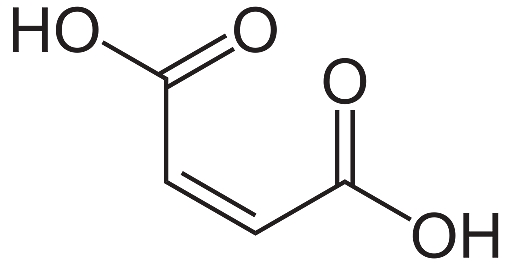
Chemical Structure of Maleic Acid
Properties of Maleic Acid
[Click Here for Sample Questions]
The important properties of maleic acid are given below:
| C4H4O4 or HOOCCH=CHCOOH | |
| Chemical names | Butenedioic acid, Cis-Butenedioic acid, Malenic acid, Maleinic acid, Toxilic acid |
| IUPAC name | (2Z)-But-2-enedioic acid |
| 135 °C (275 °F; 408 K) | |
| 1.59 g/cm3 | |
| Solubility in water | 478.8 g/L at 200 C |
| -1,355 kJ/mol | |
| 116.072 g·mol−1 |
Read Also:
Uses of Maleic Acid
[Click Here for Sample Questions]
Maleic acid is combustible and used in the assembly of glyoxylic acid via ozonolysis. The maleate ion which is useful in biochemistry is the ionized form of maleic acid and acts as an inhibitor of transaminase reactions which forms proteins. The esters of maleic acid are called maleates. It is utilized in making polyesters for fibre-supported covered mouldings, painted vehicles and numerous other synthetic items.
Fumaric acid alias trans-butenedioic acid is the geometrical isomer of maleic acid that occurs in various fungi and in Iceland moss which is a lichen with an upright thallus usually attached in one place.

Fungi and Landmoss
Similar to maleic acid, it is utilized in polyesters and since it is nontoxic, dissimilar to acid, it is utilized as an acidulant which is responsible for giving sour taste to foods or upgrading the apparent pleasantness of food varieties. It is created by isomerization of maleic corrosive or by ageing of molasses. Its responses are for the most part like those of maleic acid, despite the fact that it can not frame an intramolecular anhydride. It is a lot less dissolvable in water and most different solvents than its isomer.
Read Also:
Conversion of Maleic Acid into Fumaric Acid
[Click Here for Sample Questions]
The industrial use of maleic acid is in the creation of fumaric acid. The isomerization cycle is carried out to change into fumaric acid from maleic acid. In the isomerization cycle, various reagents like mineral acids and thiourea act as a catalyst. Probably, the simplest method for isolating maleic acid from fumaric acid is the distinction in the dissolvability in water. Maleic is exceptionally dissolvable in water though fumaric acid is extremely less and accordingly, it becomes more straightforward to filter fumaric acid.

Conversion of Maleic Acid to Fumaric Acid
An eminent point is that maleic acid cannot be promptly changed over into fumaric acid all alone. The primary limitations of the presence of double bonds of maleic acid keep it from suddenly changing over into fumaric acid. This is on the grounds that the rotation around the focal carbon-carbon double bond is not vigorously ideal. Subsequently, various techniques, for example, photolysis is expected to change the cis isomer over to trans isomer. The photolysis reaction, for example, breaking of the bonds utilizing light, for change of maleic acid to formic acid requires modest quantities of bromine also.
In the reaction process, the bromine atoms get converted into bromine radicals by light. The radical reaction is carried out between the alkene and the bromine radicals to form bromo-alkene radical. Hence, this leads to the breakdown of the carbon-carbon double bond to a single bond which can be further rotated. The cis-isomer of the product formed from the rotation changes to trans isomer and then the combination of bromine radicals leads to the restoration of double bond between the two carbon atoms.
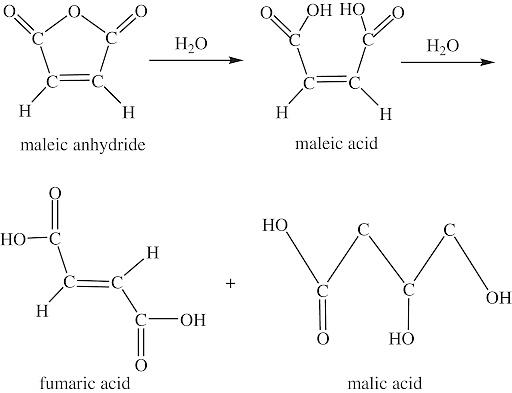
Isomerization Cycle
Another easy and safe method by which maleic acid gets converted to fumaric acid takes place by warming it in a concentrated hydrochloric acid. Due to this, the H+ ions that are dissociated act as free radicals thereby performing the same function as the bromine radicals and hence, are added reversibly to the double-bonded carbons. After the conversion of a double bond into a single bond, it is then rotated and as the H+ ions depart the single bond turns into a double bond again. Much later, due to the fact that fumaric acid is less soluble in water, the reaction yields purified fumaric acid.
There are living organisms who are able to take part in the conversion of maleic acid into fumaric acid as well. Some bacteria produce certain enzymes, known as the maleate isomerase, which are produced and used by the bacteria.

During the process of nicotinate metabolism, the maleate isomerase (maleate and fumarate) are responsible for the isomerization of maleic acid to fumaric acid.
Read Also:
Preparation and Industrial Applications of Maleic Acid
[Click Here for Sample Questions]
When we oxidize benzene or butane we get maleic anhydride and when we hydrolyze it for industry, we obtain the acid. The acid and its anhydride is prepared by the catalytic oxidation of benzene.

Industrial Production of Maleic Acid
It is employed in the formation of acid addition salts. It includes nylon and zinc-coated metals and is treated with drugs to make them more stable.
Read Also:
Other Reactions
[Click Here for Sample Questions]
Although not done financially, maleic acid can be changed over into maleic anhydride by the process of dehydration, to malic acid by hydration, and to succinic acid by hydrogenation (ethanol/palladium on carbon). It gives maleic acid chloride whenever we treat maleic acid with thionyl chloride or phosphorus pentachloride. Since maleic acid is electrophilic, it is used as a dienophile in various Diels-Alder reactions.

Dehydration of Maleic Acid
Read Also:
Things to Remember
- When maleic acid loses hydrogen ion, it forms a very strong intra-hydrogen bond so the acid is more stable and strong also.
- It contains two carboxyl groups on both sides so it is more stable.
- Maleic acid has a cis-configuration.
- With a strong hydrogen bond, the molecule usually exists in this quasi-cycle form. When it deprotonates, it forms a stable anion due to conjugation.
- The structure of maleic acid has restricted bond rotation and optimum substitution so it is a geometrical isomer.
- Maleic anhydride with water gives maleic acid.
Read Also:
Sample Questions
Ques. What is the difference between malic acid and maleic acid? (4 Marks)
Ans. The differences between malic acid and maleic acid are as follows:
| Malic Acid | Maleic Acid |
|---|---|
| Structural formula of malic acid is HOOC-CH2-CH(OH)-COOH | Structural formula of maleic acid is HOOC-CH=CH-COOH (cis-isomer of butenedioic acid) |
| Malic acid is a saturated dicarboxylic acid | Maleic acid is an unsaturated acid having a carbon-carbon double bond. |
| Malic acid is a hydroxy acid | Maleic Acid is not a hydroxy acid |
| Malic acid is optically active due to the presence of one asymmetric carbon in its molecule. | Maleic acid exhibits geometric isomerism with fumaric acid (trans-isomer). |
Ques. Why is maleic acid more acidic than fumaric acid? 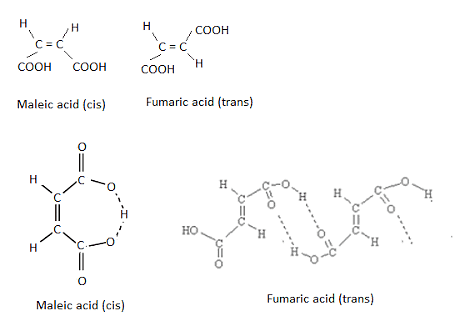 (3 marks)
Ans. In the figure, Maleic Acid is forming Intra-hydrogen bond while Fumaric Acid is forming Inter-hydrogen bond.
Maleic acid or cis- butenedioic acid, being a cis- isomer is capable of forming intra-hydrogen bond after losing H+ ion, making the conjugate Base (negative ion) much stable than the trans form (Fumaric acid) because both the oxygen atoms have strong interaction with the remaining H atom.
Consider the reaction,
Ha + H2O ⇔ H3O+ + A-
If the conjugate Base is being more stable, equilibrium shifts mainly to the right to provide more H+ ions, and thus increases the rate of reaction.
However, fumaric acid would not have this stabilization and thus less H+ ion is produced.
Ques. If maleic acid is polar, how does fumaric acid have a higher melting point than maleic acid? (3 marks)
Ans. Melting point is a property of organic compounds which depends on molecular packing in the lattice. In maleic acid two -COOH groups are placed at cis position whereas in fumaric acid , two -COOH are in trans fashion.
So intermolecular H - bonding present in fumaric acid but intramolecular H-bonding present in maleic acid(it is present as a discrete molecule) as a result fumaric acid has higher melting point than maleic acid.
If you consider the crystal packing, fumaric acid is trans acid and maleic acid is cis acid & packing efficiency is higher in trans form and hence higher melting point.
Ques. How can you explain why maleic acid can form intramolecular hydrogen bonds and an anhydride, whereas fumaric acid cannot? (2 marks)
Ans. Have a look at the molecular structure. Fumaric acid has a central trans oriented double bond, which is unable to rotate without breaking the molecule. Thus, the carboxyl groups never come close enough to form a hydrogen bond or to split off water and form an anhydride.
In maleic acid in contrast the carboxyl groups are fixed in proximity, which favors chemical interactions.
Ques. Why is the second dissociation constant greater for fumaric acid than maleic acid? (2 marks)
Ans. The difference is because of the structures of the singly dissociated ions. Fumaric acid is simply two different carboxylate groups that dissociate somewhat independently. Maleic acid on the other hand dissociates once to form a more stable resonant ring structure. It is a 1,4 dicarbonyl with an alkene between 2 and 3 this means the remaining hydrogen can alternate between the oxygen to form an alternating 3 centre bond, since this is adjoined by an alkene it forms a seven constituent aromatic ring. Aromatic rings provide stability and reduce acidity.

Ques. What would happen when we treat maleic acid with sodium carbonate? (2 marks)
Ans. Maleic acid (cis-structure) gives gas bubbles and is quicker than when they respond with fumaric acid (trans-structure). The reactions are acid-base reactions. The base acid is treated with sodium carbonate and magnesium strips separately.
Read Also:



Comments