



Content Curator
Albumin is a protein substitute produced by the liver. It is an important constituent of blood that the kidney filters. It acts as a carrier protein hormones,fatty acids and steroids in the blood. It maintains the intravascular oncotic
| Table of Content |
Key Takeaways: Nitric acid, Albumin, Protein, Albuminuria, Liver, Kidneys, Hormones.
What is Albuminuria?
[Click Here for Sample Questions]
A normal working kidney of a person has little to no traces of albumin in their urine, counting about 250 mg in normal urine per day. A certain level of anomaly can occur in the albumin content if any damage to the kidney occurs which is way above the normal level to enter into the urine. This condition is called albuminuria. However, if the albumin level is abnormally low and keeps on staying abnormal, then the condition is known as micro-albuminuria.

Difference in the Albumin Levels of a Healthy and Damaged Kidney
Diabetes patients are most prone to get affected from the condition due to worsen kidney. Damage caused in the kidney due to high blood pressure, heart failure, cirrhosis, and lupus can also be a cause.
Read Also:
| Related Articles | ||
|---|---|---|
| Test for Fats | Test for Protein | Lipids |
Tests to Detect Albumin in Urine
[Click Here for Sample Questions]
Albumin levels in urine is a major indicator of the diseased state of the kidney. Thus, different tests for detecting the presence of albumin in urine are used commonly. This helps in;
- Diagnosing diseases associated with the kidney
- Monitoring the improvements in the kidney during the treatment
Tests mainly used to detect the presence of albumin in urine are as follows:
- Heller’s test - a white ring is formed due to albumin expedition.
- Sulphosalicylic acid test - thickening of the solution and the colour changing into whitish cloud.
Heller’s Test
[Click Here for Sample Questions]
Heller’s test is based on the principle of denaturation and precipitation of proteins in the presence of strong acid. Materials required to carry out the experiment are concentrated nitric acid, test tube, measuring cylinder, dropper, test tube holder and urine sample.
Procedure
- Add 5ml concentrated nitric acid precisely from the reagent jar, with the help of a measuring cylinder, and put it into a test tube.
- Add a few drops of the urine sample from the sample urine jar, using a dropper.
- Pour some sample of urine touching the inner side of the test tube with a dropper and slightly inclining the tube so as to form a covering on the nitric acid.
- See the changes that occur in the test tube.
Observation and Conclusion
The changes taking place in the test tube are observed. At the meeting of the two layers, a white ring occurs which indicates the presence of albumin in the given sample of urine.
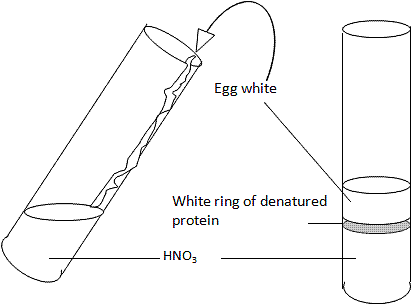
White Ring formation in Heller’s Test
Read Also:
| Related Topics | ||
|---|---|---|
| Blood | Amino Acids | Pituitary Gland |
Sulphosalicylic Acid Test
[Click Here for Sample Questions]
This test is based on the principle that salicylic acid causes precipitation of proteins that results in the sample becoming thick and turbid. The extent of turbidity in the sample can be used to estimate the amount of protein it contains. Materials required to carry out the experiment are urine sample, measuring cylinder, burner, 30% sulphosalicylic acid, test tube, dropper, test tube holder.
Procedure
- Add 2ml sample of the urine precisely from the sample urine jar, with the help of a measuring cylinder and pour it into a test tube.
- Add a few drops of the sulphosalicylic acid with the help of a dropper into the tube holder carrying the urine sample.
- The colour of the solution in the tube turns to white.
- While holding the tube with the help of a holder, heat the solution on the burner slowly.
- Keep noticing the change that takes place thereafter.
Observation and Conclusion
The provided sample of urine turns into a thick cloudy turbid solution which is slightly whitish in colour indicating the presence of albumin in the sample.

Sulphosalicylic Acid Test
Read Also: Life Processes Important Questions
Things to Remember
- Albumin is a key protein constituent produced by the human liver.
- It acts as a carrier protein for thyroid hormones, fatty acids and steroids in the blood and maintains the intravascular oncotic pressure.
- Albuminuria is a condition where a normal working kidney of a person has more traces of albumin than its normal count in their urine causing damage to the kidneys.
- The presence of albumin can be determined with Heller’s Test and Sulphosalicylic Acid Test.
- Heller’s test is characterized by the occurrence of a white ring and in sulphosalicylic acid test, the sample turns turbid.
Sample Questions
Ques. Mention any two metabolic disorders, which can be diagnosed by analysis of urine. (1 mark)
Ans. The two metabolic disorders, which can be diagnosed by analysis of urine are- glycosuria and ketonuria.
Ques. What is Albuminuria? (2 marks)
Ans. Albuminuria is a condition where a normal working kidney of a person has excess traces of albumin in the albumin count of their urine causing damage to the kidneys.
Ques. What are the two ways to detect the presence of albumin in urine? (2 marks)
Ans. The two ways to detect the presence of albumin in urine are - Heller’s Test and Sulphosalicylic Acid Test.
Ques. What is albumin? (1 mark)
Ans. Albumin is a protein found in the blood which acts as a carrier protein for thyroid hormones, fatty acids and steroids in the blood.
Ques. Which organ is responsible for producing albumin? (1 mark)
Ans. Liver is responsible for producing albumin in the blood.
Ques. In a condition of high blood pressure, what is the status of albumin level in urine? (1 mark)
Ans. In kidney disturbance and in high blood pressure, albumin level in urine is significantly high.
Ques. After heating equal amounts of 30 % sulphosalicylic acid and urine containing albumin, which of the changes can be seen? (2 marks)
Ans. Heating of equal amounts of 30 % sulphosalicylic acid and urine containing albumin, a whitish or cloudy turbid solution is noticed.
Ques. What is the reagent used in Heller's test? (1 mark)
Ans. Nitric acid is the reagent used in Heller's test.
Ques. What is the result that we can see in Heller's test? (1 mark)
Ans. As a result of Heller’s test, at the meeting of the two layers, a white ring occurs which also indicates the presence of albumin in the given sample of urine.
Ques. __________ filters albumin in the blood. (1 mark)
(1)Liver
(2)Heart
(3)Brain
(4)Kidneys
Ans. 4. Kidneys
Check-Out:



Comments