



Education Journalist | Study Abroad Lead
The mouth and buccal cavity are integral parts of the human anatomy and are responsible for the initial stages of digestion, communication, and oral health. The mouth, consisting of the lips and cheeks, serves as the external opening for food intake and speech production.
- Within the mouth lies the buccal cavity, enclosed by the lips and cheeks. This cavity contains teeth, tongue, salivary glands, palate, uvula, and tonsils.
- It plays a vital role in mechanical digestion through chewing and mixing food with saliva.
- Taste perception, speech production, and immune defense against pathogens entering the mouth are also functions associated with the buccal cavity.
Read More: Saliva
| Table of Content |
Key Terms: Buccal cavity, Oral cavity, Mechanical digestion, Salivation, Oral ulcers, Salivary gland disorders
Buccal Cavity
[Click Here for Sample Questions]
The buccal cavity, also known as the oral cavity, is an essential part of the digestive system in the head and neck region.
- It is the initial section of the digestive tract where food enters the body.
- The buccal cavity plays a crucial role in various functions, including ingestion, mechanical digestion, and the initial stages of chemical digestion.
Read More: Parts of Mouth
Difference Between the Mouth and Buccal Cavity
[Click Here for Sample Questions]
"Mouth" and "buccal cavity" are often used interchangeably to refer to the same anatomical structure. However, in a strict anatomical sense, there is a subtle difference between the two:
- Mouth: The term "mouth" generally refers to the entire external opening through which food enters the body and includes both the buccal cavity and the oral vestibule.
It encompasses the lips, cheeks, teeth, and the space between the lips and cheeks (oral vestibule), as well as the buccal cavity itself.
- Buccal Cavity: The buccal cavity, also known as the oral cavity, is the specific portion within the mouth that lies behind the lips and cheeks.
It is the space enclosed by the lips externally and the cheeks internally.
The buccal cavity contains the teeth, tongue, salivary glands, palate, uvula, and tonsils, as described in the previous response.
So, while the buccal cavity is a component of the mouth, the term "mouth" encompasses a broader area, including the buccal cavity and the oral vestibule. In general usage, however, the terms "mouth" and "buccal cavity" are often used interchangeably to refer to the entire structure involved in oral functions and digestion.
Read More: Human Digestive Part
Main parts of the Buccal Cavity
[Click Here for Sample Questions]
The buccal cavity, or the oral cavity, is an integral part of the human anatomy involved in various functions such as ingestion, mechanical digestion, and the initial stages of chemical digestion. Here are the main parts of the buccal cavity:
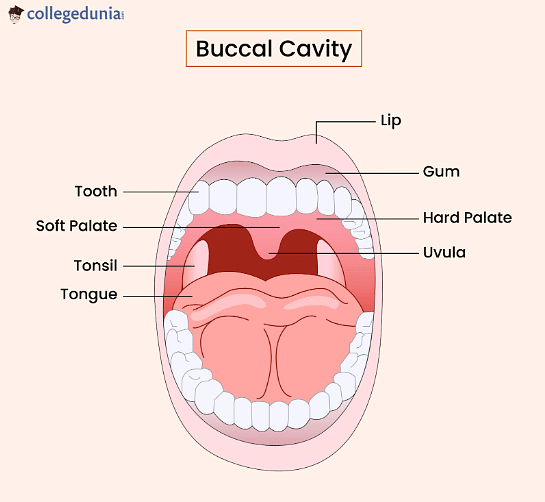
Main parts of the buccal cavity
- Lips: The lips are the fleshy structures that form the external boundary of the buccal cavity. They help in grasping and manipulating food during ingestion and play a role in speech and facial expressions.
- Cheeks: The cheeks are the soft tissues that line the sides of the face and form the internal boundary of the buccal cavity. They assist in keeping food within the oral cavity during chewing and help in the production of sounds during speech.
- Teeth: The teeth are rigid structures in the buccal cavity, primarily involved in mechanical digestion. There are different types of teeth, including incisors, canines, premolars, and molars, each with specific functions in cutting, tearing, and grinding food.
- Tongue: The tongue, an organ of muscles, is located on the buccal cavity's bottom. It controls several processes, including voice production, food manipulation during chewing, and taste perception. Taste receptors that distinguish between flavors are located on the tongue's top surface.
- Salivary Glands: The buccal cavity contains three pairs of salivary glands that produce saliva. These glands are the parotid glands, located near the ears; the submandibular glands, located beneath the lower jaw; and the sublingual glands, located beneath the tongue. Saliva helps moisten the food, facilitating chewing and swallowing, and contains enzymes like amylase that initiate the breakdown of carbohydrates.
- Palate: The palate, which is made up of the tough palate and the soft palate, serves as the roof of the buccal cavity. The front hard palate acts as a firm surface on which the tongue and food can travel while being chewed. When swallowing, the soft palate at the rear aids in sealing up the nasal passages to stop food from entering the nasal cavity.
- Uvula: The uvula is a small, cone-shaped structure hanging down from the posterior end of the soft palate. It helps prevent food or liquid from entering the nasal cavity during swallowing.
- Tonsils: The tonsils are clusters of lymphoid tissue located on the sides of the throat within the buccal cavity. They are part of the immune system and help prevent infections by trapping pathogens that enter the mouth.
These parts of the buccal cavity work together to facilitate the initial stages of digestion and ensure proper oral functions for chewing, swallowing, and speech.
Read More: Alimentary Canal
Process of a Buccal Cavity
[Click Here for Sample Questions]
The buccal cavity, also known as the oral cavity, is involved in several processes related to digestion and speech. The process that occurs in the buccal cavity:
- Ingestion: The process begins with the intake of food through the mouth. The lips and cheeks help in guiding the food into the buccal cavity.
- Mechanical Digestion: Once food enters the buccal cavity, the teeth play a crucial role in mechanical digestion. The incisors are used for cutting, the canines for tearing, and the premolars and molars for grinding and crushing the food into smaller pieces.
- Salivation: The salivary glands, located in and around the buccal cavity, produce saliva. Saliva contains enzymes, such as amylase, which initiate the breakdown of carbohydrates. Saliva also helps moisten the food, making it easier to form a bolus for swallowing.
- Mixing and Chewing: The tongue assists in mixing saliva with the food, forming a soft mass called a bolus. The tongue also aids in moving the food around the buccal cavity during chewing, ensuring thorough mixing with saliva and promoting mechanical digestion.
- Taste Perception: The taste buds on the upper surface of the tongue detect different flavors, contributing to the perception of taste.
- Formation of Swallowing Reflex: The buccal cavity detects a correctly prepared bolus when it is eaten and combined with saliva. The food moves from the buccal cavity into the pharynx and esophagus as a result of the swallowing reflex being triggered.
- Speech Production: The buccal cavity is also involved in speech production. The movement of the tongue, lips, and other oral structures helps shape airflow and produce sounds, enabling speech and language expression.
Read More: Mouth Anatomy
Disease Of Buccal Cavity And Mouth
[Click Here for Sample Questions]
The buccal cavity and mouth can be affected by various diseases and conditions. Here are some common diseases and conditions that can occur in the buccal cavity and mouth:
- Tooth Decay (Dental Caries): Tooth decay is a common condition characterized by the destruction of tooth enamel due to bacterial activity. It can lead to cavities, tooth sensitivity, and toothache.
- Gum Disease (Gingivitis and Periodontitis): Gum inflammation brought on by bacterial infection is known as gum disease. Gum disease's early stage, gingivitis, is marked by red, puffy, and bleeding gums. If ignored, it can develop into periodontitis, which causes the bone and connective tissue supporting the teeth to deteriorate.
- Oral Thrush (Candidiasis): Oral thrush is a fungal infection caused by Candida yeast. It appears as white patches on the tongue, inner cheeks, and other areas of the buccal cavity. It is more common in individuals with weakened immune systems or those taking certain medications.
- Oral Ulcers: Oral ulcers, also known as canker sores, are painful, shallow sores that can develop on the tongue, inner cheeks, or lips. They are often caused by minor injuries, stress, hormonal changes, or certain underlying conditions.
- Oral Cancer: Oral cancer can affect various parts of the buccal cavity, including the tongue, lips, gums, and the lining of the mouth. It is often associated with tobacco and alcohol use, as well as infection with human papillomavirus (HPV).
- Temporomandibular Joint Disorders (TMJ Disorders TMJ disorders affect both the muscles that move the jaw and the jaw joint. They may result in migraines, headache-like symptoms, clicking or popping sounds while opening or shutting the mouth, and jaw discomfort.
- Disorder of Salivary Gland: Problems with the salivary glands can cause symptoms including dry mouth, swelling, discomfort, and trouble eating or speaking. These problems include salivary stones, infections, or inflammation (sialadenitis).
Things To Remember
- The buccal cavity, or oral cavity, is involved in ingestion, mechanical digestion, and the initial stages of chemical digestion.
- The term "mouth" refers to the entire external opening, including the buccal cavity and the oral vestibule.
- The buccal cavity contains important structures such as the lips, cheeks, teeth, tongue, salivary glands, palate, uvula, and tonsils.
- The lips and cheeks help in guiding food into the buccal cavity, while the teeth are involved in mechanical digestion by cutting, tearing, and grinding food.
- Salivary glands produce saliva, which helps moisten the food, initiate carbohydrate digestion, and facilitate swallowing.
- The tongue plays a role in mixing saliva with food, forming a bolus, and assisting in taste perception and speech production.
- The palate, including the hard and soft palate, acts as the roof of the buccal cavity and aids in food travel, swallowing, and preventing food from entering the nasal cavity.
- Diseases and conditions that can affect the buccal cavity and mouth include tooth decay, gum disease, oral thrush, oral ulcers, oral cancer, temporomandibular joint disorders, and disorders of the salivary glands.
Also Read:
Sample Question
Ques. What are the main parts of the buccal cavity involved in digestion and oral health? (1 Mark)
Ans: The buccal cavity consists of the lips, cheeks, teeth, tongue, salivary glands, palate, uvula, and tonsils.
Ques. How does the buccal cavity contribute to mechanical digestion? (1 Mark)
Ans: The teeth in the buccal cavity are responsible for cutting, tearing, grinding, and crushing food into smaller pieces, aiding in mechanical digestion.
Ques. What is the role of saliva in the buccal cavity? (2 Marks)
Ans: Saliva, produced by the salivary glands in the buccal cavity, helps moisten the food, facilitating chewing and swallowing. It contains enzymes, such as amylase, which initiate the breakdown of carbohydrates.
Ques. How does the tongue contribute to the functions of the buccal cavity? (2 Marks)
Ans: The tongue assists in mixing saliva with food, forming a bolus for swallowing. It also helps move food around the buccal cavity during chewing, and its upper surface contains taste buds for taste perception.
Ques. What is the difference between "mouth" and "buccal cavity"? (2 Marks)
Ans: The mouth refers to the complete external entrance, including the buccal cavity and the oral vestibule, despite the fact that the phrases are sometimes used interchangeably. The area surrounded by the lips and cheeks, where the primary oral functions take place, is referred to as the buccal cavity.
Ques. How does the buccal cavity contribute to speech production? (1 Mark)
Ans: The movements of the tongue, lips, and other oral structures in the buccal cavity shape airflow and produce sounds, enabling speech and language expression.
Ques. What are some common diseases that can affect the buccal cavity and mouth? (2 Marks)
Ans: Tooth decay (dental caries), gum disease (gingivitis and periodontitis), oral thrush (candidiasis), oral ulcers, oral cancer, temporomandibular joint disorders (TMJ disorders), and salivary gland disorders are some common diseases that can affect the buccal cavity and mouth.
Ques. How can proper oral hygiene practices help maintain oral health? (2 Marks)
Ans: Tooth decay, gum disease, and other oral health issues may be avoided with regular brushing, flossing, and dental checkups. The maintenance of proper dental hygiene habits also benefits general health and well-being.
For Latest Updates on Upcoming Board Exams, Click Here: https://t.me/class_10_12_board_updates
Check-Out:



Comments