



Content Curator
Multivariable calculus or multivariate calculus is the branch of mathematics that is useful to find the relationship between the input and output variables. In mathematics, multivariable calculus is the extension of calculus that deals with multiple variables. Multivariable calculus includes two or more variables instead of a single variable.
Moreover, multivariable calculus consists of limits and derivatives, partial differentiation, multiple integrations, fundamental theorems with multivariable dimensions, vector fields, etc. Apart from this, multivariable calculus plays an essential role in many fields such as engineering, natural and social science, weather forecasting, astronomy, etc. Also, the two- dimensional(2D) and three-dimensional(3D) models are studied with the help of multivariable calculus.
Read Also: Methods of Integration
| Table of Content |
Key Takeaways: Calculus, Multivariable Calculus, Partial Differentiation, Integration, Vector Space, Limits and Derivatives
Multivariable Calculus
[Click Here for Sample Questions]
Multivariable calculus is the function of two or more variables while single calculus deals with the function of a single variable. The relationship between the input and output variable can be found using multivariable calculus. Also, the integration and differentiation are solved in the same way as in single calculus. Multivariable functions are the functions of two or more variables. Mathematically,
f(z) = f(x,y)
Where, f(z) is an output function, x and y are the input variables. Also, z is dependent on x and y.
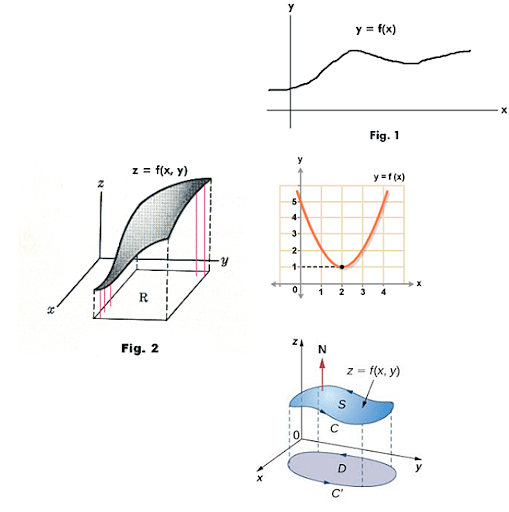
Diagrams describe multivariable calculus
The important operations are involved in the multivariable calculus are mentioned below:
- Multiple integrations
- Partial differentiation
- Limits and continuity
- Curves and surfaces etc.
Check Important Notes for Conditional Probability
Steps to Solve Multivariable Calculus
[Click Here for Sample Questions]
There are some basic steps to be followed to solve the multivariable calculus. Such as:
- When the function is dependent on two or more variables then a partial derivative is used to determine multivariable calculus. To find the derivative of the function concerning one of those variables, keep all the variables constant.
Mathematically,
If z = f(x,y) then the derivative is given as,
dz = fxdx + fydy
Or, If there is a function ‘w’ which is dependent on three variables like x,y,z then,
w = f(x,y,z)
dw = fxdx + fydy + fxdz
- When we change all the variables and find the derivative then it is referred to as the total derivative. When there are two functions like f(x) and g(x) then the derivative of both the functions is the sum of these two functions. Mathematically,
(f + g)’ = f ’ + g’
Also Check: Three Dimensional Geometry
Topics of Multivariable Calculus
[Click Here for Sample Questions]
There are many topics in multivariable calculus such as:
| S.No. | Multivariable Topics | Advanced Calculus Topics |
|---|---|---|
| 1. | Differential Calculus |
|
| 2. | Integral Calculus |
|
| 3. | Vector Field | |
| 4. | Curves and Surfaces |
|
| 5. | Fundamental Theorem |
|
| 6. | Integration over Curves and Surfaces |
|
Read More: Calculus Formula
Applications of Multivariable Calculus
[Click Here for Sample Questions]
Multivariable calculus is widely accepted in many fields such as science, engineering, finance, research etc. some of the major applications of multivariable are mentioned below:
- In a dynamic system, multivariable calculus is the core tool used which is used for optimal control.
- Multivariable calculus is helpful in evaluating empirical data in regression analysis.
- In the field of finance, quantitative analysts use multivariable calculus which is helpful in predicting the future trends in the stock market.
- Multivariable calculus is also used to determine the 2D and 3D motion of fluid particles and streams in mechanical engineering.
- Multivariable calculus is used to study the high dimensional model system which has deterministic nature in engineering as well as social science.
Check More: Increasing and Decreasing Functions in Calculus
Things to Remember
[Click Here for Sample Questions]
- Multivariable calculus deals with the multivariable functions and variables.
- Multivariable calculus functions are also known as multivariate functions.
- In mathematics, Multivariable calculus is the extension of calculus.
- Multivariable calculus is also useful in the study and modelling of two-dimensional and three-dimensional systems in engineering.
- Multivariable calculus is also useful in determining the motion of rotating bodies in astronomies.
Read More: Fundamental Theorem of Calculus
Sample Questions
Ques. Evaluate the following limit: [2 marks]
\(\lim\limits_{x \to 1} |x^3 - x^2 +1|\)
Ans. Given,
\(\lim\limits_{x \to 1} |x^3 - x^2 +1|\)
Now, \(\lim\limits_{x \to 1} |x^3 - x^2 +1| = (1)3 - (1)2 + 1\)
\(= 1 - 1 + 1 = 1\)
Ques. Find the derivative of the function f(x) = 3x at x= 2. [2 marks]
Ans. Given, \(f(x) = 3x\)
Derivative of f(x) is given as,
f’(x) = 3
When x = 2 then,
f(2) = 3.
Therefore, f(x) at x = 2 is 3.
Ques. When the function z = f(x,y) = x4 + y3 + sin xy. Then find out the first partial derivative. [2 marks]
Ans. GIven, z = f(x,y) = x4 + y3 + sin xy.
Here, function z is dependent on two variables x and y. So, a partial derivative is found with respect to x as well as y separately.
Now, first partial derivative w.r.t to x is given as,
∂ z/ ∂ x = ∂ f/ ∂ x = 4x3 +0 + cos(xy) . y
Similarly, first partial derivative w.r.t to y is given as,
∂ z/ ∂ y = ∂ f/ ∂ y = 0+3y2 + cos(xy) . x
Ques. If two vectors and b→ are such that |a→ | = 2 and |b→ | = 3 and a→ . b→ = 4. then Determine | a→ - b→| . [3 marks]
Ans.


Ques. When w = xy2 + yz - 3 , x = r2s - t , y = r + 2st , z = rs - 2t. Find ∂ w/ ∂ t by using chain rule. [5 marks]
Ans. Given , w = xy2 + yz - 3, x = r2s - t, y = r + 2st, z = rs - 2t.
Here, f(x,y,z) and x= g(r,s,t) , y=h(r,s,t), z=j(r,s,t) and also f,g,h,j are differentiable. Then find the partial derivative using chain rule such as:
∂ w/ ∂ t = (∂ w/ ∂ x)(∂ x/∂ t) + (∂ w/ ∂ y)(∂ y/∂ t) + (∂ w/ ∂ z)(∂ z/∂ t)
Now,
∂ w/ ∂ x = y2
∂ w/ ∂ y = 2xy+z
∂ w/ ∂ z = y
∂ x/∂ t = -1
∂ y/∂ t) = 2s
∂ z/∂ t) = -2
According to Chain rule,
∂ w/ ∂ t = (∂ w/ ∂ x)(∂ x/∂ t) + (∂ w/ ∂ y)(∂ y/∂ t) + (∂ w/ ∂ z)(∂ z/∂ t)
∂ w/ ∂ t = y2 (-1) + (2xy+z)(2s) + y(-2)
∂ w/ ∂ t = -y2 + 4 sxy + 2sz – 2y
∂ w/ ∂ t = -( r+2st )2+ 4s(r2s - t)(r+2st) + 2s(rs - 2t) - 2(r+2st)
∂ w/ ∂ t = -r2 - 4s2t2 - 4rst + (4r2s2 - 4st)(r + 2st) + 2s2r - 4st - 2r - 4st
∂ w/ ∂ t = -r2 - 4s2t2 - 4rst + 4r3s2 + 8 r2.s3t - 4srt - 8s2t2 + 2s2.r - 8st - 2r
∂ w/ ∂ t = -r2 -12s2t2 - 8rst + 4r3s2 + 8 r2.s3t + 2s2.r - 8st - 2r
Hence, ∂ w/ ∂ t = -r2 -12s2t2 - 8rst + 4r3s2 + 8 r2.s3t + 2s2.r - 8st - 2r
Ques. Solve: ∫( x3 - 1 /x2) dx. [2 marks]
Ans. Given, ∫( x3 - 1 /x2) dx
∫( x3 - 1 /x2) dx = ∫( x3 / x2 - 1/x2) dx
= ∫(x - x-2) dx
= ∫(x - x-2) dx
= ( x1+1/1+1 - x-2+1/-2+1) + c
= (x2/2 -x-1/-1) +c
= x2/2 -1/x + c
Hence, ∫( x3 - 1 /x2) dx = x2/2 -1/x + c.
Ques. Determine the total derivative if the function z = 5x2y2 + 4x sin y. [2 marks]
Ans. GIven,
z = 5x2y2 + 4x sin y
The total differentiation of the given function is,
dz = (∂ z/ ∂ x) dx + (∂ z/ ∂ y) dy
dz = (10xy2 + 4 siny)dx + (10x2y+4x cosy) dy
Therefore, dz =(10xy2 + 4 siny)dx + (10x2y+4x cosy) dy
Ques. Determine the area of a parallelogram whose adjacent sides are given by the vectors such as: [2 marks]
\(\overrightarrow{a} = 3\hat{i} + \hat{j} + 4\hat{k} \text{ and } \overrightarrow{b} = \hat{i} - \hat{j} + \hat{k}\)
Ans. Given, \(\overrightarrow{a} \times \overrightarrow{b} = \begin{vmatrix} \hat{i} & \hat{j} & \hat{k} \\[0.3em] 3 & 1 & 4 \\[0.3em] 1 & -1 & 1 \end{vmatrix} = 5\hat{i} + \hat{j} - 4\hat{k}\)
Now, \(|\overrightarrow{a} \times \overrightarrow{b}| = \sqrt{25+1+16} = \sqrt{42}\)
Hence the required area is √42.
Ques. Using the section formula, prove that the three points (-4,6,10),(2,4,6) and (14,0,-2) are collinear. [5 marks]
Ans. Let us assume that A (-4,6,10),B(2,4,6) and C(14,0,-2) are the given points.Also, consider that C divides the point |AB| in the ratio of k:1.
By using section formula(internally), the coordinates of C are given by,
C(14,0,-2) = (2k-4/k+1 ,4k+6/k+1 ,6k+10/k+1)....(i)
Now, equate the x coordinates, we get,
2k-4/k+1 = 14
⇒ 2k-4 = 14(k+1)
⇒ 2k-4 = 14k+14
⇒2k -14k = 14+4
⇒ -12k = 18
⇒k = - 18/12
⇒ k= -3/2 .
Put the value of k in equation (i) , we get,
⇒ 2(-3/2) -4/(-3/2)+1, 4(-3/2)+6/(-3/2)+1 ,6(-3/2)+10/(-3/2)+1 )
⇒-3-4/-½ , -6+6/-½ , -9+10/-½
⇒-7*2/-1 , 0*2/-1, 1*2/-1
⇒14, 0 , -2 which is equal to point C.
Therefore, C is the point which divides the points |AB| in the ratio of 3:2.
Hence, A, B and C are collinear.
⇒ x= 15 , y= -10 , z= 16
Therefore, C(15,-10,16) is the third vertex.



Comments