


Name the universal acceptor and universal donor blood groups.

Collegedunia Team logo

Collegedunia Team

Content Curator

The universal acceptor blood group is type O negative (O-) and the universal donor blood group is type AB positive (AB+).

Type O negative (O-) blood is considered the universal acceptor because it lacks any antigens on the surface of the red blood cells. This means that it can be received by anyone, regardless of blood type, making it a crucial resource in emergency situations where a quick blood transfusion is necessary.

On the other hand, type AB positive (AB+) blood is considered the universal donor because it has both A and B antigens on the surface of the red blood cells, as well as the Rh factor. This means that it can be given to anyone, regardless of their blood type, as their immune system is unlikely to reject the AB+ blood due to the presence of both A and B antigens.
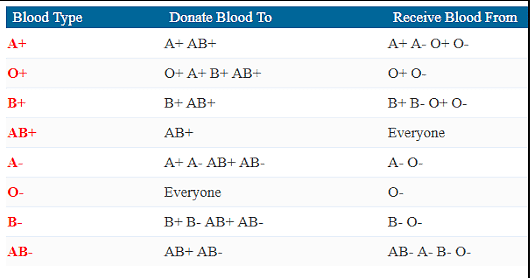
Universal acceptor and universal donor blood groups

Universal Acceptor and Universal Donor Blood Groups

Also check:

CBSE CLASS XII Related Questions

  • 1.
    Assertion (A): The embryo with 8 to 16 blastomeres is called a morula.
    Reason (R): The morula continues to divide and transform into trophoblast.

      • Both Assertion (A) and Reason (R) are true and Reason (R) is the correct explanation of the Assertion (A).
      • Both Assertion (A) and Reason (R) are true, but Reason (R) is not the correct explanation of the Assertion (A).
      • Assertion (A) is true, but Reason (R) is false.
      • Assertion (A) is false, but Reason (R) is true.

    • 2.
      In Pisum sativum, the flower colour may be violet (V) or white (v). What proportion of the offspring in a cross of "VV × vv" would be expected to be violet?

        • 25%
        • 50%
        • 75%
        • 100%

      • 3.
        Choose a correct option that shows an interaction in which one species benefits while the other is neither harmed nor benefitted.

          • Mycorrhizal associations between fungi and roots of higher plants
          • Sea anemone and clownfish
          • Abingdon tortoises and goats in the Galapagos Island
          • Cuscuta on hedge plants

        • 4.

          Assertion (A) : The pyramid of biomass in a pond aquatic ecosystem is always inverted.

          Reason (R) : The biomass of consumers like fishes far exceeds that of the producers like phytoplanktons.

            • Both Assertion (A) and Reason (R) are true and Reason (R) is the correct explanation of the Assertion (A).
            • Both Assertion (A) and Reason (R) are true, but Reason (R) is not the correct explanation of the Assertion (A).
            • Assertion (A) is true, but Reason (R) is false.
            • Assertion (A) is false, but Reason (R) is true.

          • 5.

            "Indo-Burma" is considered as a hotspot. What is meant by the term "hotspots" in biodiversity ? List two criteria used for determining a "hotspot". Name any two hotspots of India.


              • 6.
                Identify the parts P, Q, R, S in the figure given below and select the option in the correct order.

                  • P - Seed, Q - Thalamus, R - Mesocarp, S - Endocarp
                  • P - Thalamus, Q - Seed, R - Endocarp, S - Mesocarp
                  • P - Seed, Q - Thalamus, R - Endocarp, S - Mesocarp
                  • P - Thalamus, Q - Seed, R - Mesocarp, S - Endocarp
                CBSE CLASS XII Previous Year Papers

                Comments


                No Comments To Show
