


NCERT Solution For Chapter 4 Telephone Conversation

Collegedunia Team logo

Collegedunia Team

Content Curator

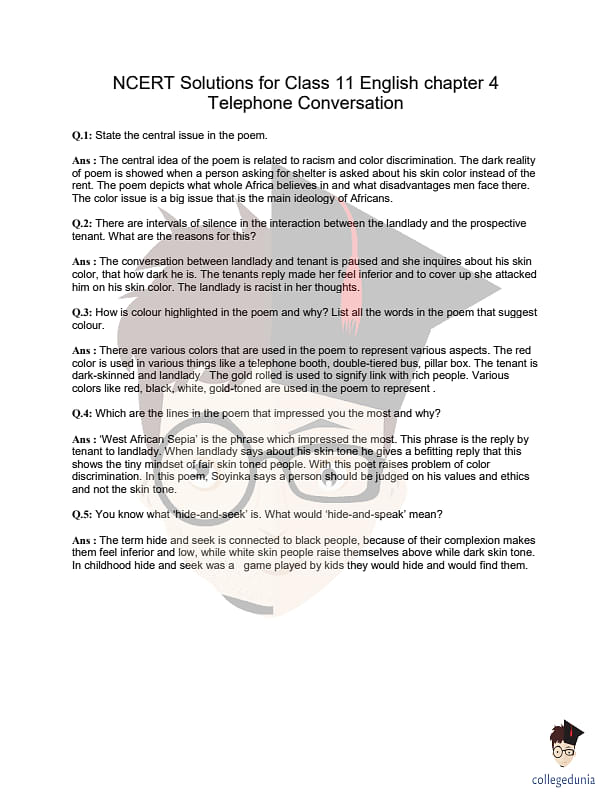
NCERT Solutions for Class 11 English Woven Words Poetry Chapter 4 Telephone Conversation is provided in this article. Telephone Conversation is written by a renowned African writer Wole Soyinka. The poem shows light on current racial discrimination even after the passing of a law against it.

Also Read: NCERT Solutions for Class 11 English

NCERT Solutions For Class 11 English Poetry Chapter 4

Download Free PDF: NCERT Solution For Class 11 English Chapter 4
Telephone Conversation Summary

  • An African man is looking for a rental room. He finds an advertisement in a newspaper. In the ad, it is written that there is no problem with race. 
  • Man previously had bitter experiences with such ads, so he decides to make a telephone call to the landlady from a public telephone booth.
  • He tells the lady that he is a black man and asks her if it is acceptable. The lady hesitates in asking if he is completely black or half black.
  • When the man responded to her by saying that he is not completely black because his palms and soles are white, the lady goes silent. 
  • She hangs the phone even though the man pleads for her to at least meet him once in person and check if he is totally black.

Also Check:

Other Poetry
Class 11 English Chapter 1 – The Peacock Class 11 English Chapter 2 – Let Me Not to the Marriage of True Minds Class 11 English Chapter 3 – Coming
Class 11 English Chapter 5 – The World is too Much With Us Class 11 English Chapter 6 – Mother Tongue Class 11 English Chapter 7– Hawk Roosting

CBSE CLASS XII Related Questions

  • 1.

    Why does Charley say, “He (Sam) certainly can’t go back to his old business”? (The Third Level)


      • 2.

        How do the stories ‘The Last Lesson’ by Alphonse Daudet and ‘Lost Spring’ by Anees Jung illustrate the impact of socio-political factors on education?


          • 3.
            How does the author prove in paragraph 1 that a sense of humour is a double-edged sword?


              • 4.
                You are Shreya/Sanjay Rao. Your child is participating in a play to be enacted on the school annual day. You have received an invitation to attend the same. Draft a reply in not more than 50 words accepting the invitation.


                  • 5.
                    You are Mrs. Savita Manjrekhar, a professor in English. You are invited to be one of the judges for the inter-school debate competition by the Principal of J.M. Public School, Cochin. Write a formal letter expressing your inability to accept the invitation.


                      • 6.
                        Read the following extract and answer the following questions:
                        The make-up room had the look of a hair-cutting salon with lights at
                        all angles around half a dozen large mirrors. They were all
                        incandescent lights, so you can imagine the fiery misery of those
                        subjected to make-up. The make-up department was first headed by
                        a Bengali who became too big for a studio and left. He was succeeded
                        by a Maharashtrian who was assisted by a Dharwar Kannadiga, an
                        Andhra, a Madras Indian Christian, an Anglo-Burmese and the
                        usual local Tamils. All this shows that there was a great deal of
                        national integration long before A.I.R. and Doordarshan began
                        broadcasting programmes on national integration. This gang of
                        nationally integrated make-up men could turn any decent-looking
                        person into a hideous crimson hued monster with the help of truck-
                        loads of pancake and a number of other locally made potions and
                        lotions.
                        (Poets and Pancakes)
                        (i) Why does the author compare the make-up room to a salon?
                        (ii) Select the correct option from those given in brackets to fill in the blank.
                        The term ‘crimson hued monster’ refers to the make-up applied to actors to make them look ugly so that they look \underline{\hspace{1.5cm}} (beautiful/terrified) on screen.
                        (iii) Complete the following sentence appropriately.
                        The make-up team’s ability to transform actors reveals two things about their skills:
                        First, their ___ and second, their use of ___.
                        (iv) Give textual evidence to prove that the make-up team reflected national integration.
                        (v) Explain the phrase ‘fiery misery’ with reference to the given extract.
                        (vi) What does the following line from the extract showcase?
                        “With the help of truck-loads of pancake and a number of other locally made potions and lotions.”
                        (A) creativity
                        (B) normalcy
                        (C) exaggeration
                        (D) simplicity

                          Comments


                          No Comments To Show
