



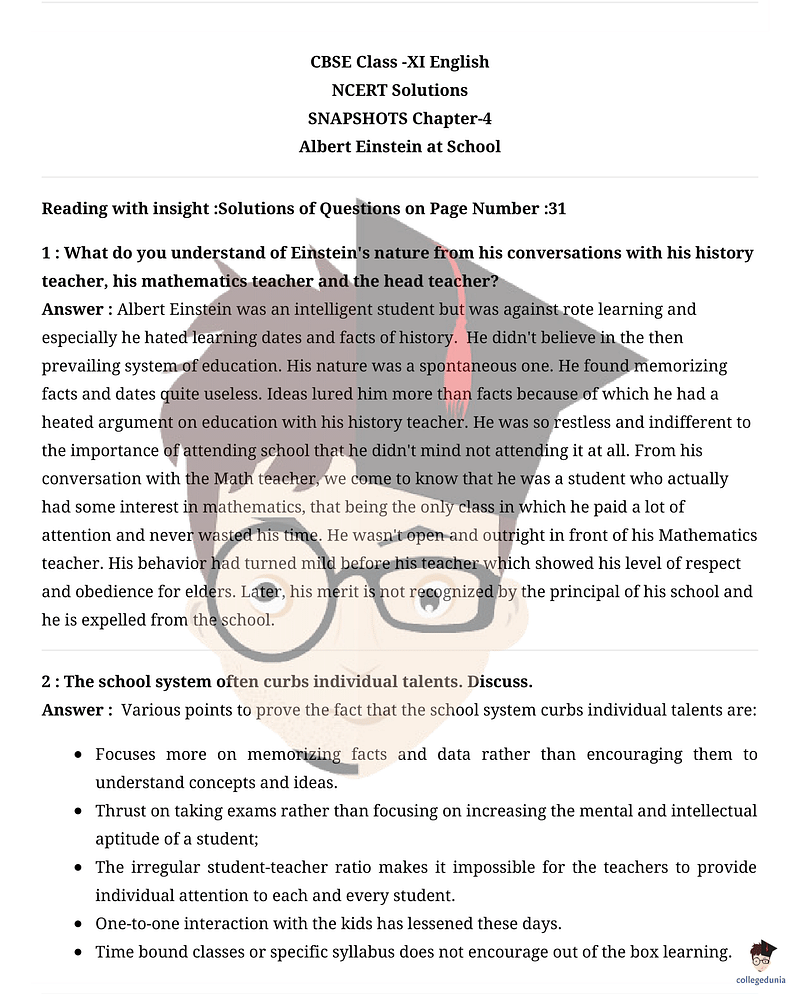
NCERT Solutions for class 11 English Snapshot Chapter 4 Albert Einstein at School is given below for students to use it as study material for their exams. The lesson is an excerpt from the biography ’The Young Einstein” by Patrick Pringle. The students are told about the childhood troubles faced by young Einstein who was disliked equally by his teachers and headmaster. Albert Einstein is described as a rebel who refused to learn conventional subjects and hated mugging up. The story tells the students how young Albert devised a plan to get rid of the traditional schooling system and follow his dream of pursuing mathematics.
Download: NCERT Solutions for Class 11 English Snapshot Chapter 4 pdf
NCERT Solutions for Class 11 English Snapshot Chapter 4
NCERT Solutions for Class 11 English Snapshot Chapter 4 Albert Einstein at School is given below:

Albert Einstein at School Summary
Albert Einstein, the theoretical physicist and one of the brightest minds known to humankind did not have a great school life. The lesson Albert Einstein at School gives insight into the early years of Einstein’s life. There are incidents mentioned in the lesson where Albert is found making his viewpoint to the teachers who follow the traditional methods of learning. The students understand from the events in the story that Albert disliked school and saw a reliable friend in Yuri. He often vented his heart out to his cousin Elsa who tried her best to convince Albert that he was better than the rest of the students and just needed to pace up a little bit. Einstein later is found taking the help of Yuri to get a doctor to certify that he is not fit to attend the school. But, the story ends differently and we see that Albert leaves the school head held high. Let us look at the chronological series of events mentioned in the chapter:
- In a History class one day, Albert is asked a question on a particular date and Albert admits to the teacher that he never felt the necessity to mug up the dates as it was completely pointless to do so.
- Einstein is seen expressing his viewpoints on the then prevailing educational system and saying most of the subjects taught were irrelevant and students should be taught subjects of their interest.
- Einstein is portrayed to be in pain in saying children from the slum and voicing out his opinions against the educational norms set for the kids of the slum.
- Einstein is later encouraged by his cousin Elsa to put in more effort and do better in his studies at school.
- Einstein is hell-bent to leave the school and begins charting out a plan along with his close friend Yuri.
- Yuri sets up an appointment with a doctor who after a conversation with Einstein understands the extent to which he dislikes school and decides to certify him as unfit to attend the school.
- But, when Einstein reaches his school, he realizes that he is already expelled by the headmaster owing to the increasing number of complaints against him.
- His behavior with peers and teachers is heavily criticized and he is rusticated with immediate effect. The teachers also hold him responsible for not being able to teach in class.
- Einstein is elated at this decision and wants to argue with the headmaster regarding the educational system, but chooses to stay silent and leave.
- He bids goodbye to his only friend and walks out of the school happy only to pursue the subject of his choice.
Albert Einstein at School gives all of us a glimpse into the lives of many scholars like Einstein who seemed to have a laid-back school life. The famous physicist that we know Einstein to be, did not have a promising school life. His childhood was full of struggles only because he stood up for a different teaching methodology. However, students must understand that despite the struggles, Einstein continued pursuing physics and mathematics with utmost passion to become an expert in the field. His failures were indeed a stepping stone for his success in the later future.
Also Check NCERT Solutions for Class 11 English
| Chapter 1: The Summer of the Beautiful White Horse | Chapter 2: The Address | Chapter 3:Ranga’s Marriage |
| Chapter 8: Silk Road | Chapter 6: The Ghat of the Only World | Chapter 5: Mother’s Day |
Also See Class 11 Subject Guides



Comments