


NCERT Solutions for Class 10 Maths Chapter 8 Introduction to Trigonometry Exercise 8.1

Jasmine Grover logo

Jasmine Grover

Education Journalist | Study Abroad Lead

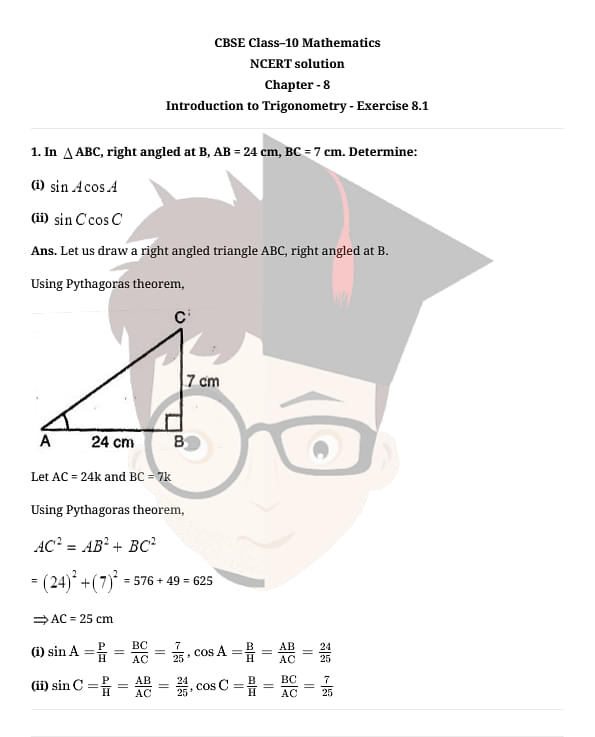
NCERT Solutions for Class 10 Maths Chapter 8 Introduction to Trigonometry Exercise 8.1 is provided in this article. Class 10 Maths Chapter 8 Introduction to Trigonometry covers important concepts like trigonometric ratios, trigonometry table, trigonometric identities and formulas. Chapter 8 exercise 8.1 includes questions based on trigonometric ratios.

Download PDF: NCERT Solutions for Class 10 Maths Chapter 8 Introduction to Trigonometry Exercise 8.1


Check below the pdf of NCERT Solutions for Class 10 Maths Chapter 8 Exercise 8.1
Read Also: NCERT Solutions for Class 10 Maths Chapter 8 Introduction to Trigonometry

Check out NCERT solutions of other exercises of class 10 maths chapter 8 Introduction to Trigonometry:


Class 10 Chapter 8 Introduction to Trigonometry Related Links:

CBSE Class 10 Maths Study Guides:

CBSE X Related Questions

  • 1.
    There are two sections A and B of Grade X. There are 28 students in Section A and 30 students in Section B. What is the minimum number of books you will acquire for the class library so that they can be distributed equally among students of Section A or Section B ?

      • 144
      • 2
      • 420
      • 272

    • 2.
      The HCF of 960 and 432 is :

        • 48
        • 54
        • 72
        • 36

      • 3.
        The natural number 1 is :

          • a prime number.
          • a composite number.
          • prime as well as composite.
          • neither prime nor composite.

        • 4.
          Find the greatest number less than 10,000 which is exactly divisible by 48, 60 and 65.


            • 5.
              In the figure given above, \(\triangle ABC \sim \triangle XYZ\), then find the values of \(x\) and \(y\).


                • 6.
                  Prove that : \( \frac{\sec^3 \theta}{\sec^2 \theta - 1} + \frac{\text{cosec}^3 \theta}{\text{cosec}^2 \theta - 1} = \sec \theta \cdot \text{cosec} \theta (\sec \theta + \text{cosec} \theta) \)

                    Comments


                    No Comments To Show
