



Education Journalist | Study Abroad Lead
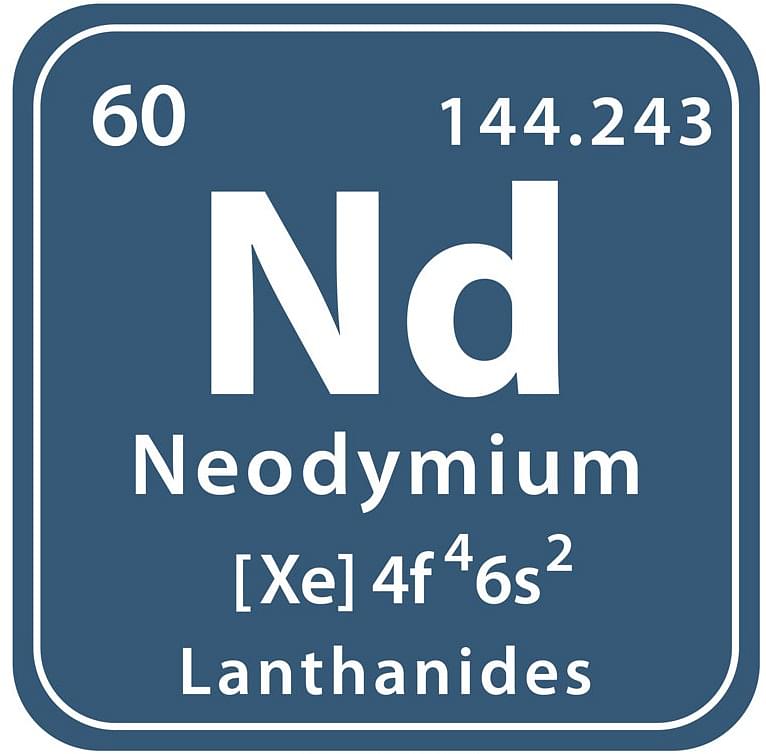
Neodymium is an inorganic element on the modern periodic table. It is symbolized as Nd and has an atomic number of 60. As per the modern periodic table, Neodymium can be considered as an inner transition element wherein the differentiating electron is seen to enter into the (n-2) f-subshell. Most essentially, it is considered to be a highly dense metal with an atomic mass of 144.242 u. It is generally found in the group of Lanthanides on the modern periodic table and is often referred to as a rare earth metal.
| Table of Contents |
Keyterms: Modern Periodic table, electron, D &f block elements, Inner transition element, Lanthanides
What is Neodymium?
[Click Here for Sample Questions]
Neodymium is known to be the second most abundant of the rare-earth elements, as per the modern periodic table. It is an inorganic element that belongs in the group of lanthanides. It is an inner transition metal where the differentiating electron enters the (n-2) f-subshell. It was first discovered by Austrian chemist Carl Auer von Welsbach in 1885.

Neodymium
Apparently, it is seen to compose a separate block referred to as the f-block in the modern periodic table. This element, in general, cannot be found in its metallic appearance as much as other lanthanides. It is usually refined for further usage. It is symbolized as Nd and has an atomic number of 60.
Neodymium
Usually, the group of lanthanides are referred to as rare earth metals. However, the distribution of it is quite naturally as common as other metals, such as, cobalt, copper, magnesium, etc., and is also broadly dispersed in the earth’s crust. The general electronic configuration of Neodymium is [Xe] 4f46s2.

Lanthanides
Also Read:
| Chapter Related Topics | ||
|---|---|---|
| Lanthanide Contraction | Ammonium Persulfate | Difference between Elements and Compounds |
| Ammonium Acetate | Hydrogen Chloride | Actinoids |
Chemical Properties of Neodymium
[Click Here for Sample Questions]
- Neodymium belongs in the group of Lanthanides and has an atomic number of 60. It can be considered as an inner transition element wherein the differentiating electron is seen to enter into the (n-2) f-subshell.
- The boiling points of Neodymium are: 3074°C, 5565°F, 3347 K. The melting points of it are 1016°C, 1861°F, 1289 K.
- Most importantly, the key isotope of the metal is 142Nd.
- The relative atomic mass that is generally found in Neodymium is 144.242 u.
- Neodymium is generally found in the state at about 20°C.
- The density of the metal is 7.01 g cm−3.
- The oxidation states of Neodymium are +0, +2, +3, +4 respectively, as per the configuration.
- The crystal structure of the element is usually a closely packed Double hexagonal structure.

Chemical Properties of Neodymium
Physical Properties of Neodymium
[Click Here for Sample Questions]
- Neodymium is usually highly reactive in air and is seen to tarnish as soon as it is exposed to it.
- It is the 60th element on the periodic table that is extremely lustrous and has a shiny yellow appearance if seen visually.
- The main sources that are found to originate from lanthanide elements are the minerals monazite and bastnaesite that are extracted by several techniques like ion exchange and solvent extraction.
- Neodymium is seen to naturally occur in its metallic form, but is yet rarely found in the earth’s crust with a concentration of almost 18%.
- This element has almost five naturally existing isotopes in the earth’s crust. However, the one that is found in abundance is the isotope 142 Nd that has a composition of about 27.2%. Every other isotope it has is mainly synthetic in nature.
| Name of the Element | Isotopes | Atomic mass | Natural abundance in percentage |
|---|---|---|---|
| Neodymium | 142Nd | 141.908 | 27.2 |
| 143Nd | 142.910 | 12.2 | |
| 144Nd | 143.910 | 23.8 | |
| 145Nd | 144.913 | 8.3 | |
| 146Nd | 145.913 | 17.2 | |
| 148Nd | 147.917 | 5.8 | |
| 150Nd | 149.921 | 5.6 |
- In general, it is seen to exist in the form of different compounds like halides, sulfides, hydroxides, and more.
Reactivity of Neodymium
[Click Here for Sample Questions]
- Neodymium is generally a highly electropositive element that is also highly reactive in nature.
- Since the element is highly reactive in air, it is found to tarnish as soon as exposed to air. It consequently contributes to the fading of the silver-white luster of the element.
- The element is known to react with hydrogen to form non-stoichiometric hydrides.
- For liberating hydrogen, it dissolves readily in warm water.
Complex Formation of Neodymium
[Click Here for Sample Questions]
Since Neodymium belongs from the Lanthanide group, it is generally seen to form complexes with chelating ligands. However, the element does not comprise the capability of forming complexes with pi-bonding ligands due to its high electropositive nature.

Complex Formation of Neodymium
In a nutshell, the chelating ligands, along with which lanthanides are found to form complexes, are usually beta-diketones. Acetylacetone, dibenzoyl methane, thenoyltrifluoroacetone are a few examples out of many others. For instance, [Nd(H2O)9] (BrO3)3.
Things to Remember
- Neodymium is an inorganic element on the modern periodic table that belongs in the group lanthanides, mainly showing properties of inner transition elements. It is symbolized as Nd and has an atomic number of 60.
- This metal has nearly five naturally existing isotopes in the earth’s crust. But, the one isotope that is found in abundance is 142 Nd which has a composition of almost 27.2%. Every other isotope it has is mainly synthetic in nature.
- The oxidation states of Neodymium are +0, +2, +3, +4 respectively.
- The chelating ligands with which lanthanides are found to form complexes are usually beta-diketones. Acetylacetone, dibenzoyl methane, thenoyltrifluoroacetone are a few examples out of many others.
Also Read:
| Chapter Related Topics | ||
|---|---|---|
| Group 18 Elements | Actinium | Atoms and Molecules |
| Curium | Dichromate | Chromate |
| d and f block elements MCQ | D and F Block Important Questions | d and f Block Elements Ncert Solutions |
Sample Questions
Ques. Elaborate what Neodymium is according to the modern periodic table. (3 marks)
Ans: First discovered by Austrian chemist Carl Auer von Welsbach in 1885, Neodymium is known to be the second most abundant of the rare-earth elements. This element belongs in the group of Lanthanides and comes with an atomic number of 60. Neodymium is generally considered in the group of inner transition elements wherein the differentiating electron is seen to enter into the (n-2) f-subshell. It is considered to be a highly dense metal with an atomic mass of about 144.242 u.
Ques. What are the general chemical characteristics of the element Neodymium? (4 marks)
Ans:
- Here are the general chemical properties of the element Neodymium on the modern periodic table,
- Neodymium, in the group of lanthanides, has an atomic number of 60.
- The key isotope of Neodymium that is rather found in abundance, unlike other isotopes of the element, is 142Nd.
- The oxidation states of Neodymium are +0, +2, +3, +4 respectively.
- The density of Neodymium is 7.01 g cm−3.
- The relative atomic mass found in Neodymium is about 144.242 u.
Ques. What is the reactivity involved in the element Neodymium? What is its atomic number? (4 marks)
Ans:
- Here is the reactivity involved in the element Neodymium,
- Neodymium generally reacts with several nonmetals that help form corresponding compounds.
- Neodymium is generally a highly electropositive element that is also highly reactive in nature.
- In general, it reacts with nitrogen to form nitrides.
- Since the element is highly reactive in air, it is generally seen to tarnish as soon as exposed to air. Thus, it results in the fading of the silver-white luster of the element.
Ques. Define in a table the isotopes, atomic mass and abundance of the element Neodymium. (5 marks)
Ans: Here is a table denoting the isotopes, atomic mass and abundance of Neodymium:
| Name of the Element | Isotopes | Atomic mass | Natural abundance in percentage |
|---|---|---|---|
| Neodymium | 142Nd | 141.908 | 27.2 |
| 143Nd | 142.910 | 12.2 | |
| 144Nd | 143.910 | 23.8 | |
| 145Nd | 144.913 | 8.3 | |
| 146Nd | 145.913 | 17.2 | |
| 148Nd | 147.917 | 5.8 | |
| 150Nd | 149.921 | 5.6 |
Ques. Elaborate in brief about the complex formations involved in Neodymium. (3 marks)
Ans: Neodymium generally belongs in the group of the lanthanide series. Usually, this element is seen to form complexes with chelating ligands. The element, however, does not possess the ability of forming complexes with pi-bonding ligands due to its high electropositive nature. Having said that, the chelating ligands with which lanthanides form complexes are usually beta-diketones. Acetylacetone, dibenzoyl methane, and thenoyltrifluoroacetone are a few instances of the same out of many others. For example, [Nd(H2O)9] (BrO3)3.
Ques. What are some health hazards associated with the element Neodymium? (3 marks)
Ans:
- Here are some known health hazards associated with the element Neodymium,
- If the element Neodymium, which belongs in the lanthanide series, gets gathered in the human body, it can result in damage to our liver.
- Neodymium is generally seen to cause eye irritation in humans.
- This element is highly responsible for causing damage to the cell membranes of marine animals and can influence negatively upon their reproduction.
- Neodymium glasses negatively contribute to creating health issues, like extreme lung infections.
Ques. What are Neodymium Magnets? (2 marks)
Ans: A neodymium magnet is known to be one of the most broadly used rare-earth magnets. Neodymium magnets are generally made from an alloy of neodymium, iron, and boron to help from the Nd2Fe14B tetragonal crystalline structure. Most essentially, neodymium is known to provide high performance at an economical cost. Quite apparently, they were first formulated to compete against the high prices of samarium cobalt magnets.
Ques. Define Neodymium Glass. (2 marks)
Ans: Neodymium glass, also known as Alexandrite Glass, is formulated by adding neodymium oxide in glass melt. Usually, this form of glass is seen to change colours in accordance with different lighting conditions. Generally, in daylight, the color condition alters to a lavender hue, while it appears pale blue under fluorescent lights. It is used in coloring glass. It also changes to a greenish hue under a trichromatic lighting condition. The phenomenon generally occurs due to the presence of Neodymium oxide (Nd²O³) in the glass.
For Latest Updates on Upcoming Board Exams, Click Here: https://t.me/class_10_12_board_updates
Check-Out:



Comments