



Education Journalist | Study Abroad Lead
Potassium Dichromate is a hexavalent chromium compound. Its oxidising qualities are less potent than potassium permanganate. The inorganic chemical compound is considered a primary standard (in volumetric analysis). It is red in colour and highly toxic. Its solutions have shown long term stability and resistance to acid, light, most organic matter and chloride ions. Potassium Dichromate is often used in laboratories and industries as an oxidising agent.
| Table of Content |
Keyterms: Potassium, Chromium, Compound, potassium permanganate, Solutions, Resistance, Oxidising agent, Solutions, Water, Alcohol
What is Potassium Dichromate?
[Click Here for Sample Questions]
Potassium Dichromate is an oxidising agent used for industrial applications. It is less potent than potassium permanganate. The chemical formula of this crystallised ionic solid is K2Cr2O7. Produced by adding acid to potassium chromate it is soluble in water and insoluble in alcohol. It is a hexavalent compound meaning the chromium in it has a +6 oxidisation state. This makes it toxic to humans. Its popularity in lab experiments comes from its inability to absorb air moisture and dissolve in it.
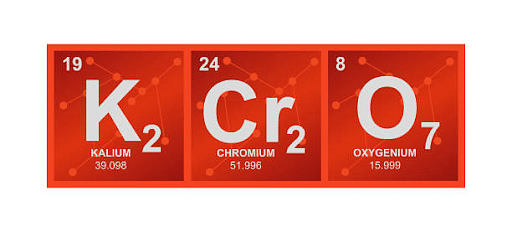
Potassium dichromate Structure
Also Read:
| Chapter Related Topics | ||
|---|---|---|
| Lanthanide Contraction | Ammonium Persulfate | Difference between Elements and Compounds |
| Ammonium Acetate | Hydrogen Chloride | Actinoids |
Important Formulae and Structure
[Click Here for Sample Questions]
Potassium Dichromate can be obtained two ways:
- Through a reaction of potassium chloride with sodium dichromate. A heated sodium dichromate solution is mixed with a specified amount of potassium chloride and allowed to cool until red-orange potassium dichromate crystals form.
Na2Cr2O7 + 2KCl → K2Cr2O7 + 2NaCl

Potassium Dichromate
- Alternatively, it can be obtained from potassium chromate through roasting chromite ore with potassium hydroxide.
K2Cr2O7 → 2K+ + Cr2O72−
Cr2O72− + H2O ⇔ 2CrO42− + 2H+
Potassium dichromate or K2Cr2O7 has 294.185 g/mol molar mass. It has a density of 2.68g/cm2. Its boiling and melting points are 500 °C and 398 °C respectively. The ionic compound is made up of two positively charged potassium ions (K+) and the negatively charged dichromate ion (Cr2O7-). The two hexavalent chromium atoms are found attached to three oxygen atoms and also to a bridging oxygen atom.
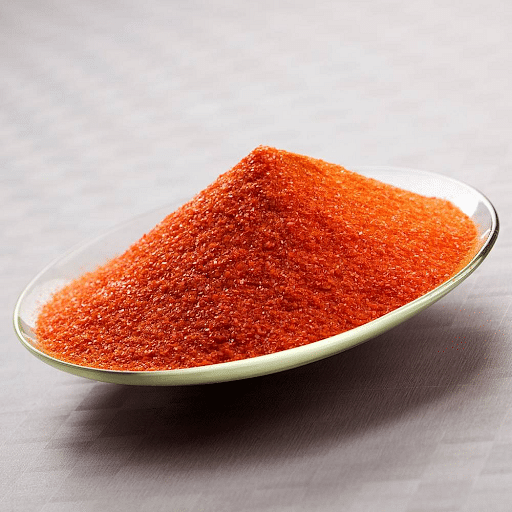
Crystalline Potassium Dichromate
Chemical Properties of Potassium Dichromate
[Click Here for Sample Questions]
Reaction with heat: Introducing heat to K2Cr2O7 decomposes it into potassium chromate (K2CrO4) and produces O2 gas.
4K2Cr2O7 → 4K2CrO4 + 2Cr2O3 + 3O2
Reaction with alkalis: When the solution of K2Cr2O7 reacts with an alkali (ionic salt), a yellow solution is obtained because of the potassium chromate formation.
K2Cr2O7 (Orange-red) + 2KOH → 2K2CrO4(Yellow) + H2O
The addition of acid changes the yellow colour of K2CrO4 back to orange-red due to the reformation of K2Cr2O7.
2K2CrO2(Yellow) + H2SO4 → K2Cr2O7(Orange-red) + K2SO4 + H2O
Reaction on oxidization: K2Cr2O7 is used as a powerful oxidizing agent. In the presence of dilute H2SO4, the following reaction occurs.
K2Cr2O7 + 4H2SO4 → K2SO4 + Cr2 (SO4)3 + 4H2O + 3(O)
Reaction on Sulphuric acid or Chromyl Chloride Test: Potassium dichromate on reaction with concentrated sulphuric acid gives reddish-brown vapours of chromyl chloride. This reaction is also called Chromyl Chloride Test. The reaction is as follows:
K2Cr2O7 + 4KCl + 6H2SO4 ⇔ 2CrO2Cl2 + 6KHSO4 + 3H2O
Physical Properties of Potassium Dichromate
[Click Here for Sample Questions]
The physical properties of Potassium dichromate can be described as follows:
- It is a red-orange ionic compound when at room temperature.
- It is odourless.
- It is soluble in water and not soluble in alcohol.
- It is highly toxic.
- It is highly corrosive.

Solution of Potassium Dichromate
- It has a refractive index of 1.738.
- It is non combustible in nature.
- Its crystalline structure is triclinic (7 crystal system) and coordination geometry for the central atom chromium is tetrahedral.
Uses of Potassium Dichromate
[Click Here for Sample Questions]
The uses of potassium dichromate are as follows:
- The chromic acid prepared from potassium dichromate is used for cleaning glassware and etching materials. But this practice is no longer used primarily because of health and safety concerns around hexavalent chromium.
- It is used in cement to slow the setting of the mixture and increase the density and texture of the finished product.
- It is used in the estimation of volumetric analysis.
- Potassium dichromate is a common reagent in traditional “wet tests”. It is used in chrome tanning in the leather industry.
- A black titration with acidified potassium dichromate is used to determine the concentration of ethanol in a sample.
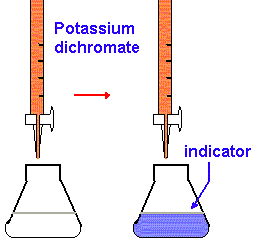
Potassium dichromate in the titration process
- It is used to prepare chrome alum and several other industrially important chromium compounds.
- The mixture of potassium dichromate with approximately 35% nitric acid solution is known as Schwerter’s Solution. This solution is used to test the purity of the silver.
- Potassium dichromate is used to stain certain types of wood by darkening the tannins in the wood.
Health Hazards of Potassium Dichromate
[Click Here for Sample Questions]
- Potassium dichromate has a high potential for causing cancer. Prolonged exposure can cause severe respiratory problems and in some cases even death.
- A dose of 40g or less can prove fatal and cause heavy side effects.
- It burns the inner lining of the stomach and intestines if consumed.
- Exposure and consumption can cause symptoms like excess urination and vomiting and loose motion.

Health hazards of Potassium dichromate
- The Potassium ion present in this compound has been known for the cause of heart diseases such as low blood pressure, heartbeat malfunction, heart attack, choking off blood veins.
- Skin also gets burnt by its corrosive nature.
- The compound is also corrosive and exposure may produce severe eye damage or blindness.
- Consequences of prolonged exposure include reproductive disease, loss of fertility in males, genetic disorders and harm to unborn children.
Things to Remember
- Potassium Dichromate is a hexavalent chromium compound.
- Its solutions have shown long term stability and resistance to acid, light, most organic matter and chloride ions.
- Potassium Dichromate is often used in laboratories and industries as an oxidising agent.
- The chemical formula of this crystallised ionic solid is K2Cr2O7.
- Potassium Dichromate is produced through a reaction of potassium chloride with sodium dichromate.
- The chromic acid prepared from potassium dichromate is used for cleaning glassware and etching materials. But this practice is no longer used primarily because of health and safety concerns around hexavalent chromium.
Also Read:
Sample Questions
Ques. Why do transition elements show variable oxidation states? (CBSE 2014) (2 marks)
Ans. The variability of the oxidation state of transition elements is due to incompletely filled d-orbitals and the presence of unpaired electrons, i.e. (ns) and (n -1) d electrons have approximately equal energies.
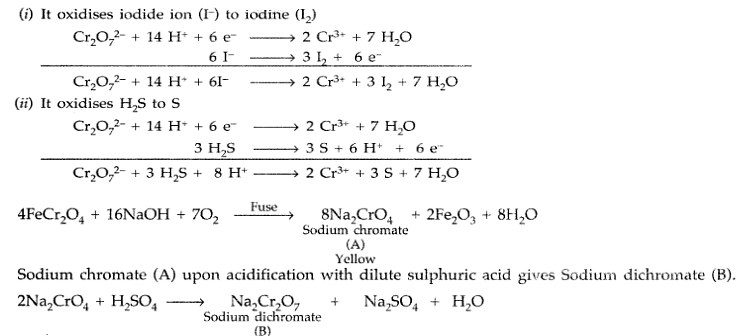
Ques. Describe the oxidising action of potassium dichromate and write the ionic equations for its reaction witH (i) iodine (ii) H2S (4 marks)
Ans. Potassium dichromate (K2Cr2O7) acts as a strong oxidising agent in an acidic medium using H2SO4.
K2Cr2O7 + 4H2SO4 → K2SO4 + Cr2(SO4)3 + 4H2O + 3[O]
Ionic reactions are as follows:
(i) It oxidises iodide ion (I-) to iodine (I2)

(ii) It oxidises H2S to S

Ques. Describe the preparation of potassium permanganate. How does the acidified permanganate solution react with oxalic acid? Write the ionic equations for the reactions. (CBSE 2015) (2 marks)
Ans. Potassium Permanganate (KMnO4) is prepared from pyrolusite ore (MnO2). The ore (MnO2) is fused with an alkali metal hydroxide like KOH in the presence of air or an oxidising agent like KNO3 to give dark green potassium manganate (K2MnO4). K2MnO4 disproportionates in a neutral or acidic solution to give potassium permanganate.

Ques. Describe the oxidising action of potassium dichromate and write the ionic equations for its reaction with (i) iodine (ii) H2S. (CBSE 2015) (5 marks)
Ans. Potassium dichromate (K2Cr2O7) acts as a strong oxidising agent in an acidic medium using H2SO4.
K2Cr2O7 + 4H2SO4 → K2SO4 + Cr2(SO4)3 + 4H2O + 3[O]
Ionic reactions:
Sodium dichromate (B) on reaction with KCl forms orange coloured compound Potassium dichromate (C).
Na2Cr2O7 + 2KCl → 2NaCl + K2Cr2O7 (C)
(i) Thus (A) → Sodium chromate Na2CrO4
(A) → Sodium dichromate Na2Cr2O7
(B) → Potassium dichromate K2Cr2O7
(ii) (C) is used as a strong oxidising agent in the acidic medium in volumetric analysis.
Ques. (a) Describe the preparation of potassium dichromate from chromite ore. What is the effect of change of pH on dichromate ion?
(b) How is the variability in oxidation states of transition elements different from that of non-transition elements? Illustrate with examples. (CBSE 2012) (5 marks)
Ans. (a) Potassium dichromate is prepared from chromate by reacting chromite ore with Na2CO3
4FeCr2O4 + 8Na2CO3 + 7O2 → 8Na2CrO4 + 2Fe2O3 + 8CO2
The yellow solution of sodium chromate is filtered off and acidified with H2SO4 to give orange sodium dichromate.
2Na2CrO4 + 2H+ → Na2Cr2O7 + H2O + 2Na
Sodium dichromate is then treated with KCl to give potassium dichromate as orange crystals.
Na2Cr2O7 + 2KCl → K2Cr2O7 + 2NaCl
The chromates and dichromates are interconvertible in an aqueous solution depending upon the pH of the solution.
2CrO4 + 2H+ → Cr2O7 + H2O
Cr2O7 + 2OH–→ 2CrO4 + H2O
Ques. (a) When chromite ore FeCr2O4 is fused with NaOH in presence of air, a yellow coloured compound (A) is obtained which on acidification with dilute sulphuric acid gives a compound (B). Compound (B) on reaction with KC1 forms an orange coloured crystalline compound (C). (5 marks)
(i) Write the formulae of the compounds (A), (B) and (C).
(ii) Write one use of the compound (C).
(b) In the 3d series (Sc = 21 to Zn = 30) :
(i) Which element shows the maximum number of oxidation states?
(ii) Which element shows only a +3 oxidation state?
(iii) Which element has the lowest enthalpy of atomization?
Ans. The chromite ore FeCr2O4 on the fusion of NaOH in presence of air forms a yellow coloured compound (A) that is Sodium Chromate.
Sodium dichromate (B) on reaction with KCl forms orange coloured compound Potassium dichromate (C).
Na2Cr2O7 + 2KCl → 2NaCl + K2Cr2O7 (C)
(i) Thus (A) → Sodium chromate Na2CrO4
(A) → Sodium dichromate Na2Cr2O7
(B) → Potassium dichromate K2Cr2O7
(ii) (C) is used as a strong oxidising agent in the acidic medium in volumetric analysis.
(b) (i) Mn
(ii) Sc
(iii) Zn
Ques. What does the potassium dichromate test for? (2 marks)
Ans. For organic chemistry, potassium dichromate is an oxidizing agent that is milder than potassium permanganate. It is used for the oxidation of alcohol. This converts primary alcohols into aldehydes and carboxylic acids under more pressing conditions.
Ques. Is potassium dichromate light-sensitive? (2 marks)
Ans. Clear, light-sensitive orange crystals. Potassium dichromate is used in cotton dyeing as chromium mordant. In black and white image processing, potassium dichromate is used as an intensifier.
Ques. What is the charge of potassium dichromate? (2 marks)
Ans. K2Cr2O7 is the molecular formula. A reddish-brown colour as a solid and a molecular weight of 294.18 grams per mole is the physical properties of potassium dichromate. Potassium dichromate is also referred to as a compound of hexavalent chromium, and chromium oxidation is 6+.
Ques. Describe the preparation of potassium dichromate from iron chromite ore. What is the effect of increasing pH on a solution of potassium dichromate? (5 marks)
Ans. Potassium dichromate is prepared from chromite ore (FeCr2O4) by the following steps:
Step 1: Preparation of sodium dichromate in the reaction of Chromite ore with sodium hydroxide and oxygen gas.
4FeCr2O4 + 16NaOH + 7O2 → 8Na2CrO4 + 2Fe2O3 + 8H2O
Step 2: Conversion of Sodium Chromate on reaction with concentrated Sulfuric acid gives Sodium dichromate as a product.
2Na2CrO4 + conc. H2SO4 → Na2Cr2O7 + Na2SO4 + H2O
Step 3: Sodium dichromate on reaction with potassium chloride converts to potassium dichromate as a product.
Na2Cr2O7 + 2KCl → K2Cr2O7 + 2NaCl
As potassium dichromate is less soluble than sodium chloride so, potassium dichromate is obtained in the form of orange crystals. Dichromate ion exists in equilibrium with chromate ion at around pH. However, by changing the pH they can be interconverted.
For Latest Updates on Upcoming Board Exams, Click Here: https://t.me/class_10_12_board_updates
Check-Out:



Comments